
The collective noun for seagulls helps describe how these familiar birds gather, move, and feed together around coastlines and beaches. You may see them near harbors, lakes, rivers, and busy cities, where they often stay in groups. A flock is the most natural term in everyday English, so flock of seagulls is a clear choice when several birds are flying or resting together.
Different situations can call for different collective expressions. A colony can describe seagulls living or nesting together, while gaggle and screech may appear in some descriptions. These terms give writers more ways of describing birds based on their movement, feeding, or behavior. For example, seagulls may be flying together, resting on rooftops, or gathering near fishing boats while searching for food along the shore.
Using these group names can make your writing more descriptive without repeatedly saying many seagulls. From an English-writing perspective, choosing a suitable collective noun gives the reader a clearer picture of what the birds are doing and where they are gathered. Words connected with food, fishing, cities, coastal areas, and water can add useful context when describing a group of seagulls.
Why Are Collective Nouns Used for Seagulls?
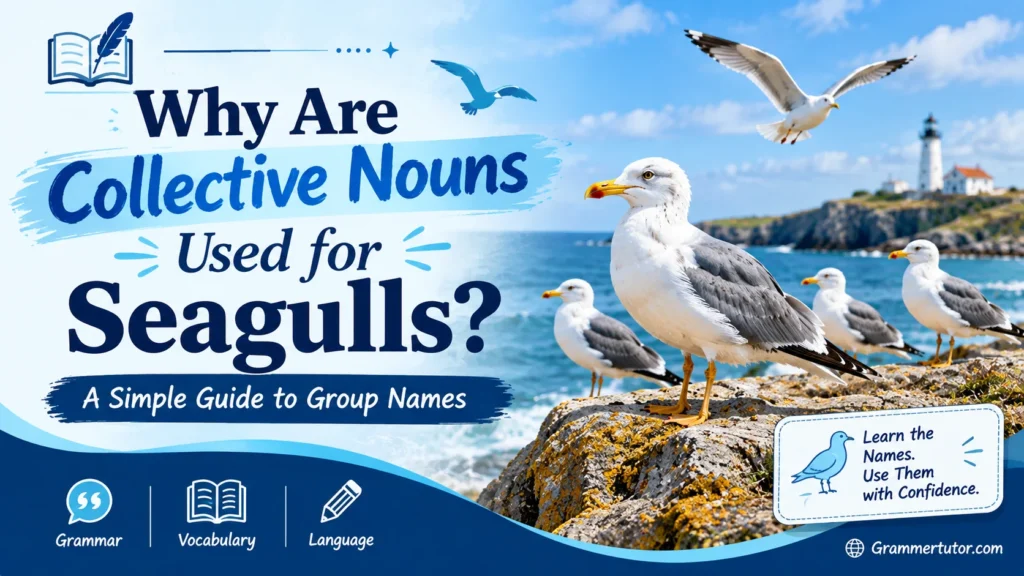
A collective noun gives a group of animals a single name. With seagulls, these expressions help describe birds that are flying together, feeding in the same place, nesting near one another, or gathering around a food source.
For example, “a flock of seagulls” immediately tells us that several birds are moving or staying together. In a sentence such as “A flock of seagulls circled above the beach,” the phrase creates a much clearer image than simply saying “many seagulls.”
Different terms can also highlight different situations. A group living and nesting together may be described as a colony, while flock works as a broad and familiar term for a group of birds.
Collective Nouns for Seagulls

Here are some collective nouns and group expressions associated with seagulls:
| Collective Noun | Used For | Simple Example |
| Flock | Seagulls flying, feeding, or gathering together | A flock of seagulls flew over the beach. |
| Colony | Seagulls nesting or living together | A colony of seagulls settled on the rocky island. |
| Gaggle | A loose or informal group, especially on land | A gaggle of seagulls gathered near the pier. |
| Screech | A descriptive expression connected with the birds’ loud calls | A screech of seagulls disturbed the quiet morning. |
| Swarm | A large, busy-looking gathering, used descriptively | A swarm of seagulls surrounded the fishing boat. |
Among these, a flock of seagulls is the safest and most natural choice for ordinary English. Some of the other expressions are more descriptive, informal, or context-dependent rather than universally established collective nouns.
Flock of Seagulls
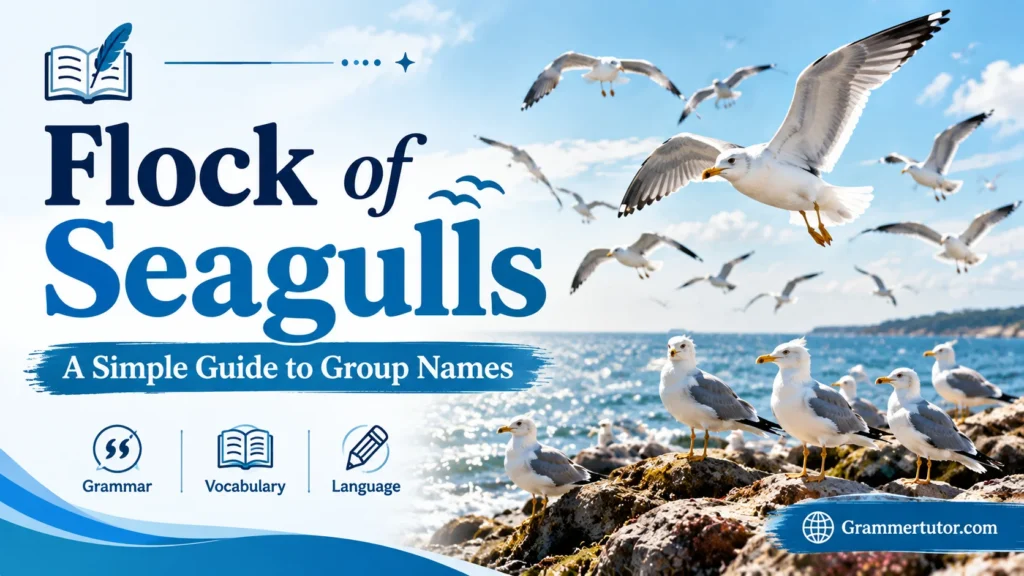
Flock of seagulls is the most straightforward expression for a group of seagulls. It can describe birds flying through the air, gathering around food, resting together, or moving along a beach.
Seagulls often travel in groups because shared movement can help them locate food and respond to changes in their surroundings. When several birds appear together above a coastline, “flock” is a simple and natural choice.
Examples of “Flock of Seagulls”
- A flock of seagulls flew across the blue sky.
- We watched a flock of seagulls near the shoreline.
- A flock of seagulls gathered beside the fishing boats.
- The children chased a flock of seagulls along the beach.
- A large flock of seagulls circled above the harbor.
- The fisherman noticed a flock of seagulls following his boat.
- A flock of seagulls landed near the pier.
- The wind pushed the flock of seagulls toward the cliffs.
- A flock of seagulls searched the sand for food.
- We saw a flock of seagulls flying over the ocean.
Colony of Seagulls
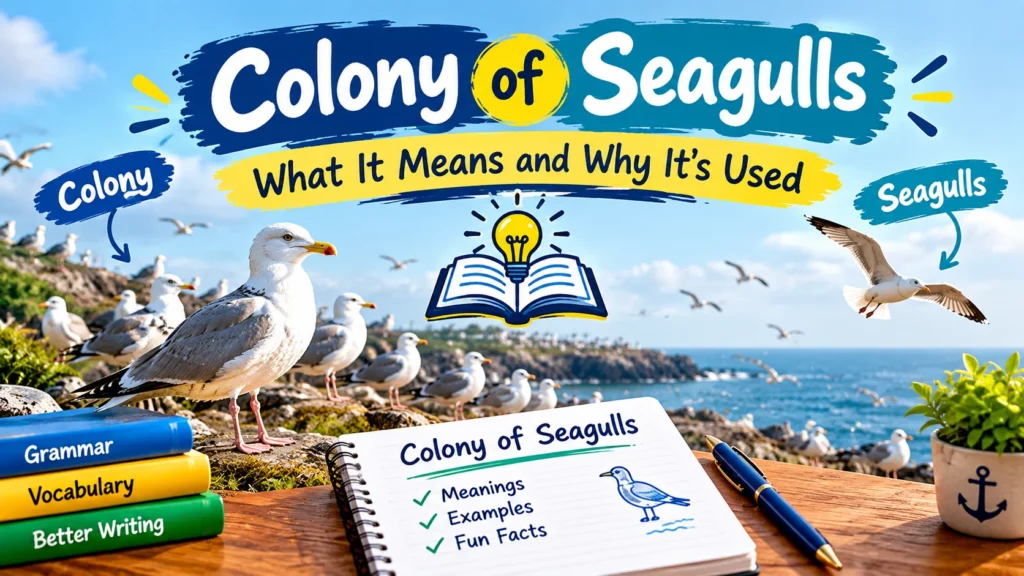
A colony of seagulls describes a group that lives and nests together in the same area. This term is especially useful when discussing breeding grounds or places where many birds establish nests.
Seagulls can form nesting colonies on islands, cliffs, beaches, rooftops, and other suitable locations. During the breeding season, many pairs may gather in one area and raise their young close to one another.
The word colony focuses more on the birds’ shared living or nesting location than simply on their movement.
Examples of “Colony of Seagulls”
- A colony of seagulls nested on the rocky island.
- Researchers observed a colony of seagulls near the coast.
- The colony of seagulls returned to the nesting site.
- Hundreds of birds lived in the colony of seagulls.
- A protected island provided shelter for a colony of seagulls.
- The cliffs were home to a large colony of seagulls.
- The colony of seagulls became active during the breeding season.
- Tourists watched the colony of seagulls from a distance.
- The birds built nests throughout the colony of seagulls.
- Conservationists monitored the colony of seagulls each year.
Gaggle of Seagulls

Gaggle is traditionally associated with geese, particularly when they are gathered on the ground. However, it can sometimes be used humorously or informally for a disorderly group of seagulls.
This expression works best when you want to emphasize the noisy or somewhat chaotic appearance of several birds gathered together. It isn’t as standard for seagulls as flock, so writers should use it with the right context.
For everyday or formal writing, flock of seagulls remains the clearer choice.
Examples of “Gaggle of Seagulls”
- A gaggle of seagulls gathered around the picnic area.
- We noticed a noisy gaggle of seagulls near the food stalls.
- A gaggle of seagulls crowded around the fishing nets.
- The children watched a gaggle of seagulls on the sand.
- A hungry gaggle of seagulls waited near the boats.
- The gaggle of seagulls scattered when the dog approached.
- A gaggle of seagulls surrounded the discarded fish.
- The pier was covered with a gaggle of seagulls.
- A noisy gaggle of seagulls competed for scraps.
- The gaggle of seagulls moved toward the shoreline.
Screech of Seagulls
The phrase screech of seagulls is more descriptive than grammatical. It draws attention to the loud, harsh calls that people often associate with seagulls.
Seagulls are highly vocal birds. Their calls can be heard around beaches, ports, fishing areas, and urban neighborhoods. Because of this distinctive sound, “screech” can create a vivid image when describing a noisy gathering.
It is better treated as a descriptive expression rather than a universally recognized formal collective noun.
Examples of “Screech of Seagulls”
- A screech of seagulls filled the morning air.
- We heard a screech of seagulls from the harbor.
- The sudden screech of seagulls woke the campers.
- A loud screech of seagulls came from the beach.
- The screech of seagulls echoed across the cliffs.
- Visitors could hear the screech of seagulls near the pier.
- A constant screech of seagulls came from the rooftops.
- The fisherman worked while listening to the screech of seagulls.
- The screech of seagulls added to the sounds of the busy harbor.
- At sunrise, the screech of seagulls could be heard along the coast.
Swarm of Seagulls
Swarm is normally used for insects and other animals that move in large numbers. When applied to seagulls, it is generally a vivid, informal description rather than the standard collective noun.
A writer might use it when a very large number of seagulls suddenly surround a food source, fishing boat, or crowded beach. The word emphasizes the birds’ rapid movement and large numbers.
For precise everyday English, however, flock is preferable.
Examples of “Swarm of Seagulls”
- A swarm of seagulls surrounded the fishing boat.
- A huge swarm of seagulls descended on the beach.
- The fishermen watched a swarm of seagulls following the boat.
- A swarm of seagulls gathered around the fresh catch.
- The sudden swarm of seagulls surprised the visitors.
- A swarm of seagulls moved across the harbor.
- The boat attracted a swarm of seagulls.
- A noisy swarm of seagulls covered the shoreline.
- The swarm of seagulls scattered when the boat moved away.
- From the cliff, we could see a swarm of seagulls near the water.
How Seagulls Behave in Groups
Seagulls are highly adaptable birds, and their group behavior often depends on food, breeding, weather, and habitat. You may see them gathering around fishing boats, beaches, garbage sites, wetlands, lakes, and coastal rocks.
Food is one of the biggest reasons seagulls come together. If one bird discovers a reliable food source, other birds may quickly notice and approach. This can produce a large gathering in a short period.
Seagulls also form nesting groups during breeding periods. Depending on the species and location, nesting sites can contain many birds living relatively close to one another. Their loud calls and territorial behavior help them communicate and defend nesting areas.
Their ability to adapt has also allowed many gull species to live close to humans. Beaches, ports, parking lots, rooftops, and city parks can all provide opportunities for feeding and resting.
Interesting Facts About Seagulls
Seagulls are actually gulls, a diverse group of seabirds in the family Laridae. The word “seagull” is common in everyday speech, but bird specialists generally use specific names such as Herring Gull, Lesser Black-backed Gull, or Black-headed Gull for individual species.
Gulls have strong wings that allow them to glide efficiently over water and land. They can take advantage of rising air currents, allowing them to remain airborne without constantly flapping their wings.
Their diet is extremely flexible. Depending on the species and habitat, gulls may eat fish, marine invertebrates, insects, eggs, small animals, carrion, and human food. This broad diet contributes to their success in both coastal and urban environments.
Many gull species are also intelligent and adaptable. They can learn from their surroundings and take advantage of new food opportunities. Some have even been observed dropping hard-shelled food onto solid surfaces to break it open.
Seagulls also have excellent eyesight and strong bills. Their webbed feet help them move across water, while their wings make them capable fliers. These physical features allow them to live in a wide range of environments.
Collective Noun for Seagulls in a Sentence
Choosing the right collective noun depends on the situation. If you’re simply talking about several seagulls together, flock is usually the clearest option.
If you’re describing birds that live and breed in the same location, a colony may be more appropriate. Descriptive expressions such as gaggle, screech, and swarm can add personality to informal or creative writing, but they aren’t equally established as standard collective nouns.
| Situation | Suitable Expression |
| Birds flying together | Flock of seagulls |
| Birds feeding together | Flock of seagulls |
| Birds nesting together | Colony of seagulls |
| Birds living in a breeding area | Colony of seagulls |
| Noisy birds gathered together | Gaggle of seagulls — informal/descriptive |
| Emphasis on their calls | Screech of seagulls — descriptive |
| Very large, rapidly moving group | Swarm of seagulls — figurative/descriptive |
Conclusion
The collective noun for seagulls is most commonly flock, especially when several birds are flying, resting, or moving together. Colony can describe seagulls that live or nest together, while other terms may appear in certain descriptions. Using the right group name makes your writing more descriptive and gives the reader a clearer picture of how seagulls gather, move, and feed.
READ MORE: Collective Noun for Porcupines: A Complete Guide with Examples
FAQs
Q1. What is the collective noun for seagulls?
The most common collective noun for seagulls is flock. You can say “a flock of seagulls” when several seagulls are together.
Q2. Is “flock of seagulls” correct?
Yes, “flock of seagulls” is a natural and widely understandable expression for a group of seagulls, particularly when they are flying or resting together.
Q3. What is a group of seagulls called?
A group of seagulls is commonly called a flock. This term is suitable for seagulls gathered together in many everyday situations.
Q4. Can “colony” be used for seagulls?
Yes. Colonies can describe seagulls that live or nest together in the same area, particularly around suitable coastal or nesting locations.
Q5. What does a flock of seagulls mean?
A flock of seagulls means several seagulls gathered or moving together. They may be flying, resting, feeding, or searching for food.
Q6. Can seagulls be found in groups near cities?
Yes. Seagulls can gather around busy cities, particularly near coastlines, harbors, rooftops, fishing areas, and places where food is available.
Q7. Where might you see a flock of seagulls?
You may see a flock near beaches, harbors, lakes, rivers, coastal areas, fishing boats, rooftops, and other places where seagulls gather.
Q8. What other collective expressions are used for seagulls?
Some descriptions may use terms such as colony, gaggle, or screech. However, their usage can vary, so flock remains a clear everyday choice.
Q9. Why use collective nouns for seagulls?
Collective nouns make writing more descriptive and help readers understand what several birds are doing without repeatedly using phrases such as many seagulls.
Q10. How can I use “flock of seagulls” in a sentence?
You can write, “A flock of seagulls was flying together above the shore.” This clearly describes several seagulls moving together.