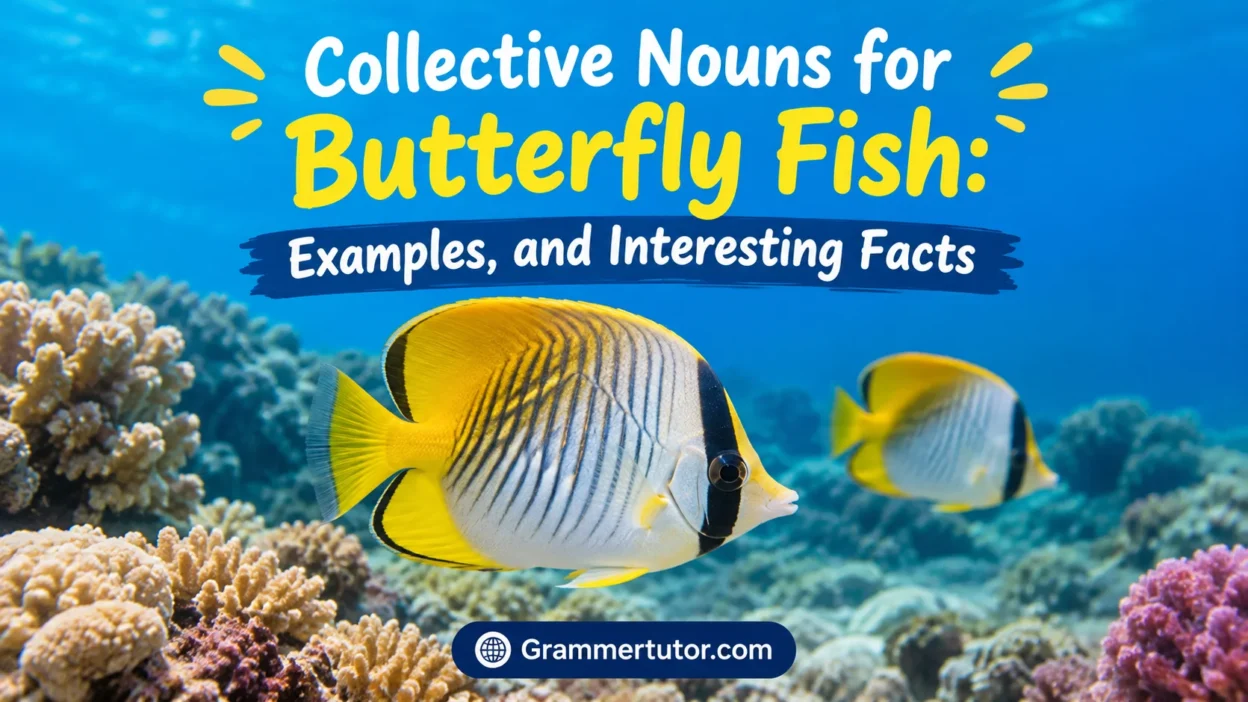
Collective Nouns for Butterfly Fish include a school of butterfly fish and a shoal of butterfly fish, two common expressions for fish swimming together in the sea. Butterfly fish are colorful creatures with bright patterns, flattened bodies, and graceful swimming movements that make them easy to recognize in tropical marine environments.
These marine fish belong to the family Chaetodontidae and live around coral reefs in tropical oceans and subtropical oceans. Many species feed on small invertebrates, coral polyps, algae, and other food sources. Their social behavior varies by species; some are seen in pairs, while others form larger groups. They may swim together while searching for food, moving through a coral reef, or remaining close to a mate. The phrase group of butterfly fish refers to two or more fish gathered in the same area.
Both school of butterfly fish and shoal of butterfly fish are general group terms that help readers describe gatherings clearly. Understanding these words improves knowledge of marine life and supports improving English vocabulary. When choosing a term, consider the context and the fish’s behavior. In my experience explaining collective nouns, familiar examples make these expressions easier to remember and use in everyday writing.
What Do You Call a Group of Butterfly Fish?
A group of butterfly fish is commonly described as a school of butterfly fish or a shoal of butterfly fish. Both expressions are appropriate, but they can emphasize slightly different behaviors.
A shoal is a general term for fish swimming or gathering together, whether or not they coordinate their movements. A school usually describes fish swimming in a coordinated way, often moving in a similar direction and maintaining a relatively organized formation.
The word group is also correct and works well when the fish are simply gathered in one location. There is no widely established, butterfly-fish-specific collective noun comparable to some traditional names used for other animals.
Quick Comparison of Group Terms
| Collective Term | Meaning | Simple Example |
| School | Fish swimming together in a coordinated manner | A school of butterfly fish swam over the reef. |
| Shoal | Fish gathering or swimming in the same area | A shoal of butterfly fish gathered near the coral. |
| Group | A general gathering of fish | A group of butterfly fish appeared near the rocks. |
| Pair | Two fish together | A pair of butterfly fish searched for food. |
| Gathering | Fish collected in one place | A gathering of butterfly fish surrounded the reef. |
Note: School and shoal are the most useful terms when describing groups of fish. Pair specifically means two fish, while group and gathering are general expressions rather than specialized collective nouns.
School of Butterfly Fish
A school of butterfly fish describes butterfly fish swimming together in a coordinated pattern. The term is especially suitable when several fish move in the same direction or appear to follow a shared swimming pattern.
Butterfly fish do not always form large schools. Many species are commonly observed in pairs, especially when feeding or maintaining a territory. However, some species may gather in larger groups, particularly where food is plentiful or environmental conditions bring them together.
Watching a school of butterfly fish can be fascinating because their bright colors stand out against the reef. Their movements also help illustrate the difference between a coordinated school and a loosely assembled group of fish.
Examples of “School of Butterfly Fish”
- A school of butterfly fish swam above the coral reef.
- We watched a school of butterfly fish move through the clear water.
- A school of butterfly fish passed between the coral formations.
- The diver photographed a school of butterfly fish near the reef.
- A school of butterfly fish moved toward a rocky outcrop.
- The children saw a school of butterfly fish in the aquarium.
- A school of butterfly fish swam past the underwater camera.
- The guide pointed out a school of butterfly fish near the coral.
- A school of butterfly fish moved gracefully through the lagoon.
- The marine biologist observed a school of butterfly fish during the survey.
Shoal of Butterfly Fish
A shoal of butterfly fish refers to several butterfly fish gathered or swimming in the same area. Unlike a school, a shoal does not necessarily imply that all the fish are moving in a coordinated pattern.
This expression is useful when describing fish feeding near coral, resting around reef structures, or occupying the same part of the water. Butterfly fish may gather where food is available, although the size and composition of these gatherings depend on the species and local conditions.
A shoal can contain fish that remain relatively close together without maintaining the synchronized movement associated with a typical fish school.
Examples of “Shoal of Butterfly Fish”
- A shoal of butterfly fish gathered near the coral.
- We noticed a shoal of butterfly fish beside the reef.
- A shoal of butterfly fish moved around the underwater rocks.
- The photographer captured a shoal of butterfly fish in the lagoon.
- A shoal of butterfly fish searched for food among the corals.
- The diver observed a shoal of butterfly fish near a reef ledge.
- A shoal of butterfly fish appeared in the shallow water.
- The guide identified a shoal of butterfly fish during the dive.
- A shoal of butterfly fish gathered around a coral formation.
- The marine researcher recorded a shoal of butterfly fish swimming near the seabed.
Pair of Butterfly Fish
A pair of butterfly fish refers to two individuals swimming or living near one another. This expression is particularly relevant because many butterfly fish species are often observed in pairs.
In some species, pairs consist of a male and female that maintain a close association. Depending on the species, they may feed together, defend a territory, or remain near one another while moving around the reef. However, not every pair of butterfly fish necessarily represents a breeding pair.
The word pair is a useful choice when you want to describe two fish without suggesting that they belong to a larger school or shoal.
Examples of “Pair of Butterfly Fish”
- A pair of butterfly fish swam beside a coral formation.
- We spotted a pair of butterfly fish near the reef.
- A pair of butterfly fish searched for food among the coral branches.
- The diver photographed a pair of butterfly fish in clear water.
- A pair of butterfly fish moved around a rocky ledge.
- The marine biologist observed a pair of butterfly fish feeding.
- A pair of butterfly fish passed through the shallow lagoon.
- The two fish remained close together near the reef.
- A pair of butterfly fish appeared beside a sea fan.
- The underwater camera recorded a pair of butterfly fish swimming together.
Group of Butterfly Fish Near a Coral Reef
A group of butterfly fish is a straightforward expression for several individuals seen together around a reef. It is especially helpful when their behavior does not clearly indicate whether they form a school or a shoal.
Coral reefs provide butterfly fish with food, shelter, and suitable places to forage. Their compressed bodies allow them to maneuver around coral branches and narrow spaces. Many species also have small, pointed mouths adapted to picking food from crevices and coral surfaces.
When describing an underwater scene, the word group lets you focus on the fish themselves rather than making assumptions about how closely coordinated their behavior is.
Examples of “Group of Butterfly Fish”
- A group of butterfly fish explored the coral reef.
- A group of butterfly fish appeared among the colorful corals.
- The diver watched a group of butterfly fish near the seabed.
- A group of butterfly fish moved around the reef’s rocky edges.
- The photographer captured a group of butterfly fish in the sunlight.
- A group of butterfly fish searched for tiny organisms on the coral.
- The guide showed visitors a group of butterfly fish near the lagoon.
- A group of butterfly fish swam between two coral formations.
- The researchers counted a group of butterfly fish during their survey.
- A group of butterfly fish added bright colors to the underwater scene.
How Butterfly Fish Behave in Groups
Butterfly fish display a range of social behaviors, and their relationships depend on their species, habitat, and stage of life. Some are frequently observed in pairs, while others may form larger gatherings. Their movements are influenced by food availability, competition, predators, and the layout of the reef.
When feeding, butterfly fish often inspect coral surfaces and crevices for small prey or other food. Some species feed heavily on coral polyps, while others eat a broader mixture of small invertebrates, algae, and other materials. These differences affect where individual fish spend their time and whether they are likely to be seen alone, in pairs, or in larger groups.
Butterfly fish may also use their body patterns and coloration in communication or species recognition. Some have dark bands across their eyes, which may make their eyes harder for predators to locate, while spots near their tails can distract attention from the head. These markings vary among species and should not be assumed to serve exactly the same purpose in every butterfly fish.
Understanding their behavior helps explain why school, shoal, and pair are useful terms in different circumstances. The best expression depends on what the fish are actually doing rather than simply how many are present.
Butterfly Fish Compared With Other Reef Fish
Butterfly fish share coral reef habitats with many other marine species. Although several reef fish can form schools or shoals, their feeding habits, body shapes, and social behavior differ.
| Fish Type | Typical Group Description | Notable Characteristic |
| Butterfly fish | School, shoal, or pair | Often brightly colored and associated with coral reefs |
| Clownfish | Group or breeding pair | Often associated with sea anemones |
| Surgeonfish | School or shoal | Many species feed on algae |
| Parrotfish | School, shoal, or group | Many have beak-like teeth used to graze on reef surfaces |
| Damselfish | Group, shoal, or territorial individuals | Many species defend small feeding territories |
These are general descriptions, not rigid rules. The behavior of each species varies, and fish within the same family may differ in how they gather and feed.
Fascinating Facts About Butterfly Fish
Butterfly fish have evolved several adaptations that help them thrive around coral reefs. Their bodies are usually thin and laterally compressed, which allows them to turn through narrow spaces between coral branches. Many species have bright yellow, white, black, or orange patterns, and some possess a dark band across the face or a contrasting spot near the tail.
Their small mouths help them pick tiny food items from reef surfaces, while their diets vary by species and may include coral polyps, small crustaceans, worms, other invertebrates, and algae. Most butterfly fish live in warm marine waters, particularly in the Indo-Pacific region, although their distribution differs among species. Their lifespan also varies with species and environmental conditions; many live for several years, but there is no single lifespan that applies to all butterfly fish. Coral reef health is important to many species because reefs provide feeding grounds, shelter, and breeding habitat. These traits make butterfly fish interesting subjects for marine biologists and underwater observers alike.
READ MORE: Collective Noun for Plovers: A Complete Guide with Examples
Conclusion
The most common collective nouns for butterfly fish are a school of butterfly fish and a shoal of butterfly fish. Both expressions describe these colorful marine fish when they gather and swim together. Found around tropical and subtropical coral reefs, butterfly fish display interesting social behaviors, with some living in pairs and others forming larger groups. Learning these collective nouns helps you describe marine life accurately and improve your English vocabulary.
FAQs
Q1. What is a group of butterfly fish called?
A group of butterfly fish may be called a school of butterfly fish or a shoal of butterfly fish. The general phrase group of butterfly fish is also correct.
Q2. What is the most suitable collective noun for butterfly fish?
School and shoal are both suitable terms. Use school when the fish swim in a coordinated way and shoal when they are gathered together without necessarily moving in unison.
Q3. Is “school of butterfly fish” correct?
Yes. A school of butterfly fish is a correct expression, particularly when the fish move together in a coordinated pattern.
Q4. What is the difference between a school and a shoal?
A shoal describes fish gathered in the same area, whether or not they coordinate their movements. A school usually refers to fish swimming together in a more synchronized manner.
Q5. Can butterfly fish live in pairs?
Yes. Many butterfly fish species are often seen in pairs. Some pairs maintain territories and feed together, although behavior varies by species.