Collective Noun for Insects helps us describe insects when they gather together, such as a swarm of insects flying in the air or a colony of ants living together. These expressions make English sentences clear, simple, and meaningful. Insects are fascinating creatures with different shapes and behaviors. Bees, butterflies, beetles, mosquitoes, grasshoppers, and ants are common examples.
A swarm often describes insects moving together, while a colony refers to insects living in an organized community. Some insects gather temporarily to find food, reproduce, or move from one place to another. These group behaviors play important roles in nature and make collective nouns useful in everyday English, wildlife writing, and educational content. Learning collective nouns improves English vocabulary, grammar, and communication skills.
Students, teachers, writers, and wildlife enthusiasts can use these expressions to describe insect groups accurately. Understanding terms such as swarm, colony, and group also supports language learning and descriptive writing. When we study insects in their natural habitats, we learn how they live together, gather food, and interact with their surroundings. Using the correct collective noun makes nature descriptions more accurate and helps readers understand animal behavior easily.
Why Do We Use Collective Nouns for Insects?
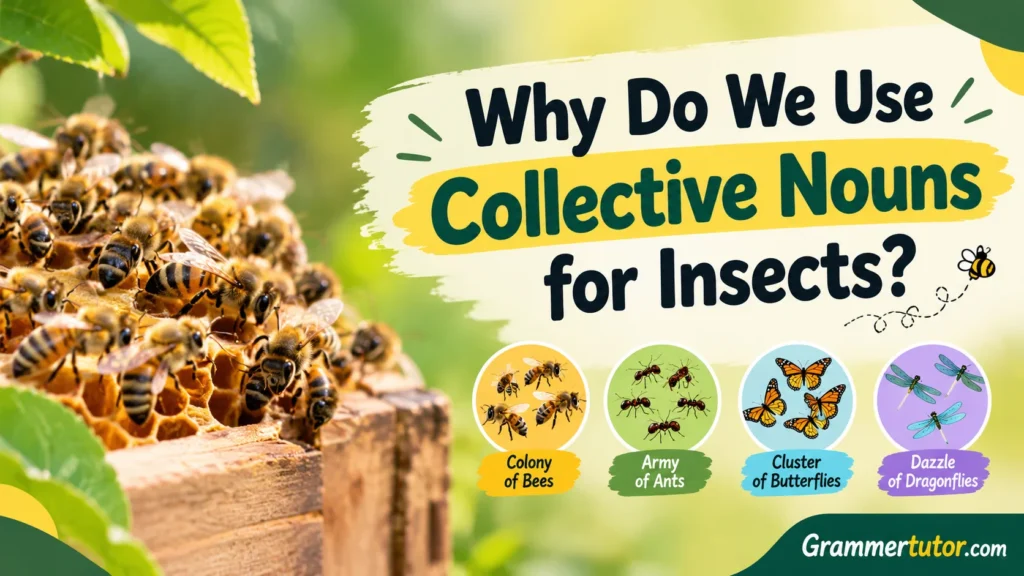
Insects often gather in groups for different reasons. Ants work together to find food, honeybees cooperate inside their colonies, and locusts can form enormous swarms that travel across landscapes. Collective nouns help us describe these gatherings without repeating the word insects several times.
The word swarm is commonly used for a large group of insects moving or gathering together. A colony describes a community of insects living together, often with different roles. Similarly, a cloud of insects describes a large number of flying insects that appear together in the air.
Choosing the right collective noun depends on the insect’s behavior and the situation. For example, you might describe ants living in an organized nest as a colony, while mosquitoes flying above a pond could be described as a cloud. These expressions make wildlife descriptions clearer and more interesting.
Collective Nouns for Insects
| Collective Noun | Used For | Simple Example |
| Swarm | A large gathering of insects | A swarm of bees flew past. |
| Colony | Insects living in an organized community | A colony of ants built a nest. |
| Cloud | Numerous flying insects | A cloud of mosquitoes hovered nearby. |
| Nest | Insects living or developing in a nest | A nest of wasps hung beneath the roof. |
| Cluster | Insects gathered closely together | A cluster of ladybugs rested on a leaf. |
| Horde | A very large gathering of insects | A horde of locusts covered the field. |
| Flight | Insects flying together | A flight of butterflies crossed the garden. |
Note: Swarm and colony are especially useful expressions, but they do not mean exactly the same thing. Some terms in the table, such as cloud, cluster, and horde, are descriptive expressions rather than specialized names for particular insect species.
Swarm of Insects
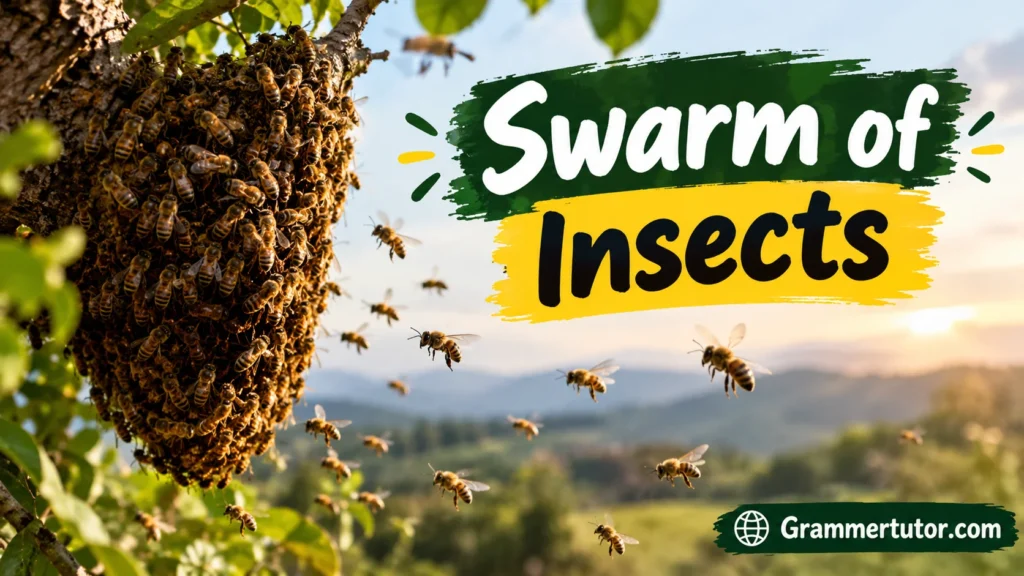
A swarm of insects is a large group of insects gathered or moving together. This is one of the best-known collective nouns for insects. It is often used for bees, locusts, flies, and other insects that appear in large numbers.
Swarming can happen for different reasons, including reproduction, migration, and searching for food. Honeybees, for example, may swarm when a queen and part of her colony leave a hive to establish a new home. Locusts can also gather in large swarms and travel across agricultural areas.
The word swarm is especially useful when you want to emphasize the size or movement of a group.
Examples of “Swarm of Insects”
- A swarm of bees flew around the flowering tree.
- We watched a swarm of locusts move across the field.
- A swarm of flies gathered near the fruit.
- The farmer noticed a swarm of insects above the crops.
- A swarm of flying insects appeared after sunset.
- The children watched a swarm of bees near the garden.
- A swarm of locusts moved toward the farmland.
- We saw a swarm of insects hovering above the pond.
- A swarm of bees settled near the tree.
- The large swarm of insects disappeared into the distance.
Colony of Insects
A colony of insects is a group of insects living together in a shared environment. This expression is particularly suitable for social insects such as ants, termites, and honeybees.
In a colony, insects may cooperate to gather food, care for their young, maintain their nest, and defend themselves. Some species have different roles for different members. For example, an ant colony may include a queen, workers, and reproductive males.
Colonies vary in size and organization. Some contain relatively few individuals, while others may include thousands or even millions of insects. Their cooperative behavior allows many social insects to survive and reproduce successfully.
Examples of “Colony of Insects”
- A colony of ants built a nest beneath the garden wall.
- The colony of termites damaged the wooden fence.
- A colony of bees lived inside the hive.
- Scientists observed a colony of insects in the laboratory.
- A colony of ants searched for food near the kitchen.
- The gardener discovered a colony of termites in an old stump.
- A colony of bees worked together to care for their young.
- The colony of insects remained active throughout the day.
- A large colony of ants occupied the space beneath a rock.
- Researchers studied how a colony of insects communicated.
Cloud of Insects
A cloud of insects describes a large number of insects flying together in a way that resembles a cloud. This expression focuses on their appearance and movement rather than their social organization.
Mosquitoes, gnats, and midges may gather in visible clouds, particularly near water or in humid environments. Some flying insects also gather around lights or open spaces where they find suitable conditions.
A cloud of insects can look like a single moving shape from a distance. However, it consists of many individual insects flying in the same general area. This expression is useful in nature descriptions and everyday conversations.
Examples of “Cloud of Insects”
- A cloud of mosquitoes hovered above the pond.
- We noticed a cloud of tiny insects near the streetlight.
- A cloud of gnats floated over the grassy field.
- The evening air was filled with a cloud of flying insects.
- A cloud of insects gathered around the garden lamp.
- The hikers walked through a cloud of mosquitoes.
- A cloud of midges appeared above the riverbank.
- A cloud of small insects moved across the meadow.
- The warm weather brought a cloud of flying insects.
- A cloud of insects drifted above the tall grass.
Nest of Insects
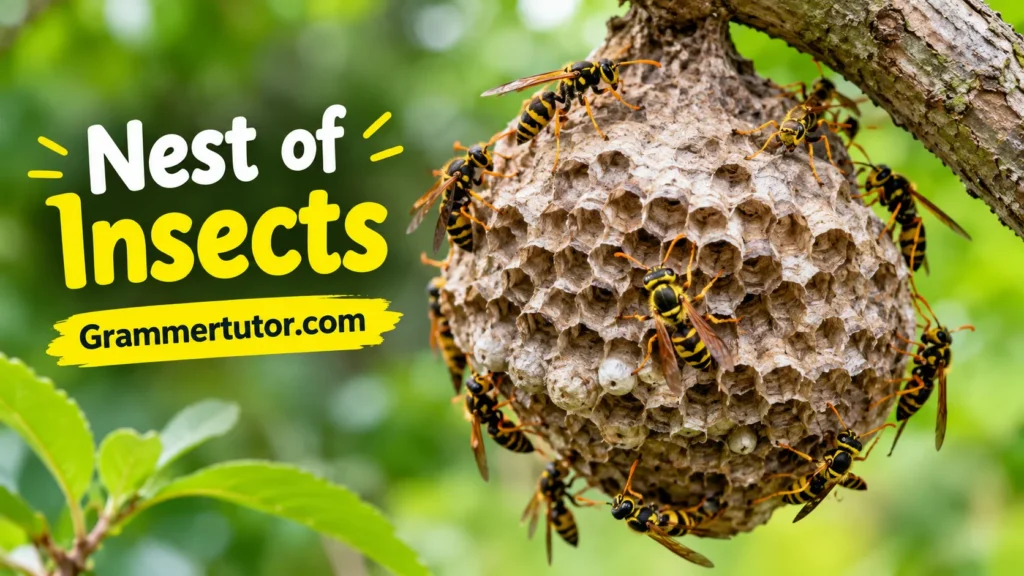
A nest of insects refers to insects living, reproducing, or developing in a shared nesting place. The word nest describes their home rather than a universal social group.
Wasps, hornets, and some ants build nests that protect their young and provide shelter. Depending on the species, these structures may be made from soil, plant fibers, mud, wax, or other materials.
Insect nests can differ greatly in size and appearance. Some are hidden underground, while others hang from trees, grow inside hollow wood, or attach to buildings. Observing a nest can reveal how insects protect themselves and care for their developing young.
Examples of “Nest of Insects”
- A nest of wasps hung beneath the roof.
- We discovered a nest of insects inside a hollow tree.
- A nest of ants appeared near the garden path.
- The wasps returned to their nest after searching for food.
- The gardener found a nest of insects beneath a wooden board.
- A nest of hornets was attached to the tree branch.
- The children observed a nest of insects from a safe distance.
- A nest of wasps provided shelter for the developing larvae.
- The old shed contained a nest of insects.
- The insects returned to their nest before nightfall.
Cluster of Insects
A cluster of insects is a group gathered closely together in one place. It is a flexible expression that can describe insects resting on plants, gathering around food, or seeking shelter.
Unlike a colony, a cluster does not necessarily represent a permanent community. The insects may simply gather temporarily because of the weather, available food, or suitable resting places.
Ladybugs, beetles, and other insects may sometimes be seen in clusters. Some species gather together during colder conditions, while others congregate around plants or other useful resources.
Examples of “Cluster of Insects”
- A cluster of ladybugs rested on the tree bark.
- We noticed a cluster of insects beneath a large leaf.
- A cluster of beetles gathered around fallen fruit.
- The children observed a cluster of small insects on the garden wall.
- A cluster of insects gathered around the outdoor light.
- Several insects formed a cluster on the plant stem.
- A cluster of ladybugs appeared near the window.
- The photographer captured a cluster of beetles on a branch.
- A cluster of insects rested in a sheltered corner.
- The gardener spotted a cluster of insects on the leaves.
Horde of Insects
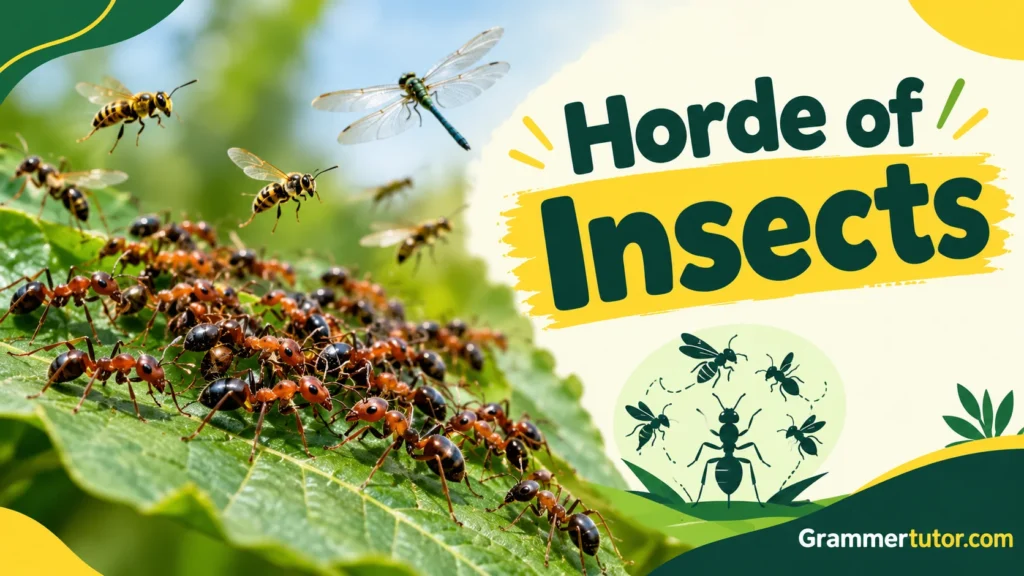
A horde of insects describes a very large group, often one that appears overwhelming because of its size. The word is particularly useful when writing about insect outbreaks or large gatherings that affect crops and other parts of the environment.
Locusts are a well-known example because some species can form enormous groups under suitable environmental conditions. When locust numbers increase dramatically, they may consume large quantities of vegetation and cause serious agricultural damage.
The word horde is a general descriptive term rather than a specialized collective noun for one insect species. It emphasizes abundance and can make a description more vivid.
Examples of “Horde of Insects”
- A horde of locusts descended on the farmland.
- A horde of insects covered the plants after the rain.
- The hikers passed through a horde of flying insects.
- A horde of beetles gathered around the fallen tree.
- A horde of locusts moved across the dry landscape.
- The garden was surrounded by a horde of insects.
- A horde of small insects appeared near the crops.
- The farmer watched a horde of locusts approach the field.
- A horde of insects gathered around the bright lights.
- The sudden appearance of a horde of insects surprised the visitors.
Flight of Insects
A flight of insects describes insects flying together or a group observed while in flight. It emphasizes their movement through the air rather than the structure of their community.
Butterflies, moths, and other winged insects may be described as a flight when they appear together. Some insect flights occur during migration or reproduction, while others happen when insects search for food or suitable habitats.
The expression can help readers imagine the movement of insects across a garden, meadow, or woodland. However, it is a descriptive phrase rather than a universally established collective noun for every insect species.
Examples of “Flight of Insects”
- A flight of butterflies passed over the wildflowers.
- We watched a flight of moths near the garden.
- A flight of insects rose from the tall grass.
- The photographer captured a flight of butterflies in the meadow.
- A flight of winged insects crossed the open field.
- The children observed a flight of butterflies above the flowers.
- A flight of insects moved toward the trees.
- We saw a flight of moths around the outdoor light.
- A flight of butterflies passed through the sunny garden.
- The flight of insects disappeared behind the bushes.
Types of Insects and Their Characteristics
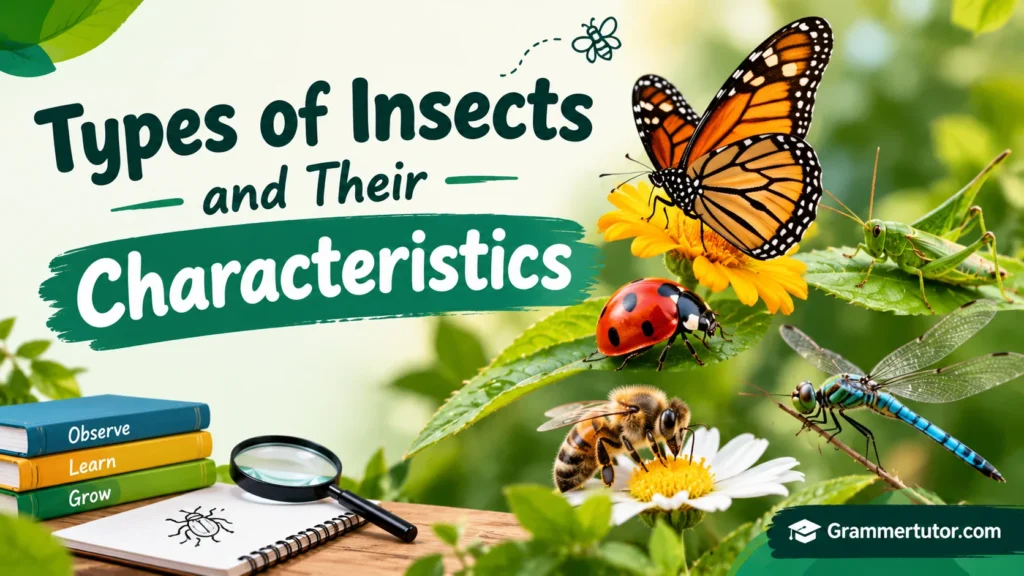
Insects belong to a highly diverse group of animals found in nearly every terrestrial environment. Ants, bees, butterflies, beetles, mosquitoes, grasshoppers, and dragonflies each have physical features and behaviors suited to their way of life.
Most adult insects have three main body sections: the head, thorax, and abdomen. They have six legs and one pair of antennae, and many species also have wings. Their mouthparts vary according to their diets. Butterflies have a long, coiled proboscis for sipping nectar, while beetles and grasshoppers have chewing mouthparts.
Social insects such as ants, termites, and honeybees often cooperate in colonies. Other insects may gather temporarily without forming permanent social groups. Butterflies, for instance, may congregate around flowers or moist ground, while mosquitoes may gather in the air near suitable habitats.
Examples of Insect Characteristics
- Ants use chemical signals to communicate with other members of their colonies.
- Honeybees collect nectar and pollen from flowers.
- Butterflies often feed on nectar using their specialized mouthparts.
- Beetles have hardened forewings that protect their flight wings in many species.
- Grasshoppers use powerful hind legs for jumping.
- Mosquitoes have specialized mouthparts for feeding.
- Dragonflies have large eyes that help them detect movement.
- Termites can digest cellulose with help from microorganisms in their digestive systems.
- Many insects undergo metamorphosis as they develop.
- Some insects provide important ecosystem services through pollination and decomposition.
Interesting Facts About Insects
Insects have remarkable lifespans, physical features, and feeding habits that make them essential parts of natural ecosystems. Their longevity varies widely by species: some adult mayflies live for only hours or days, while queen ants and termites of certain species can survive for many years. Most insects have an exoskeleton that protects their bodies and helps prevent water loss, and many grow by shedding this outer covering as they develop. Their diets are equally varied. Bees collect nectar and pollen, butterflies often drink nectar, grasshoppers feed mainly on plant material, and many beetles consume plants, fungi, decaying matter, or other small animals. Some mosquitoes feed on plant sugars, while females of many species also take blood meals to obtain nutrients for egg production. Social insects such as ants, termites, and honeybees can cooperate to find food, protect their nests, and care for their young. Other species gather in temporary swarms or clusters in response to food availability, reproduction, or environmental conditions. These biological differences help explain why several expressions are used to describe groups of insects.
READ MORE: Collective Noun for Jackdaws: A Complete Guide with Examples
Conclusion
Understanding the collective noun for insects makes English writing clearer and more descriptive. Words like swarm and colony help us explain how insects gather, live, and work together. By learning these expressions, students and writers can improve their vocabulary, use correct grammar, and describe the fascinating world of insects with confidence.
FAQs
Q1. What is the collective noun for insects?
Swarm of insects is one of the most familiar collective expressions. Other useful terms include colony, cloud, nest, cluster, horde, and flight, depending on the situation.
Q2. What is a group of insects called?
A group of insects can be called a swarm, colony, or cluster, depending on how the insects are gathered. The general word group is also correct.
Q3. Is “swarm of insects” correct?
Yes. Swarm of insects is a widely understood expression for a large group of insects gathered or moving together.
Q4. What is the difference between a swarm and a colony of insects?
A swarm usually emphasizes a large gathering or movement of insects, while a colony refers to a community living together, often with cooperative behavior and organized roles.
Q5. What is a cloud of insects?
A cloud of insects describes numerous insects flying together in a way that resembles a cloud. Mosquitoes, gnats, and midges may form these gatherings.