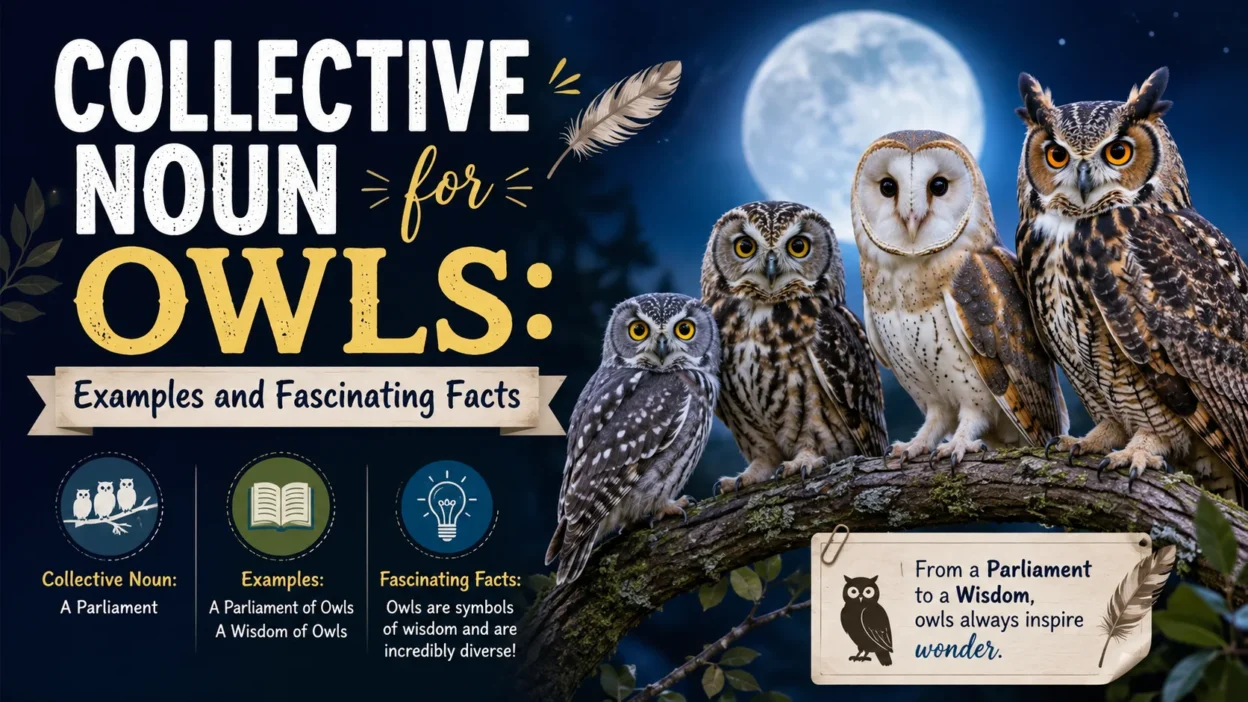
The Collective Noun for Owls is a parliament of owls, a traditional expression that makes this unusual collective noun memorable.A parliament of owls is a traditional term used for a group of owls.It stands out among collective nouns because it gives these remarkable birds of prey a distinctive name rather than using only general descriptions such as a flock of owls or group of owls.
In English, collective nouns provide special words for groups of animals, people, objects, and things viewed as one unit. Familiar examples include a herd of elephants, a pack of wolves, and a flock of birds. Such expressions make language more descriptive, interesting, and memorable to learn.The word parliament also has a strong connection with the owl’s traditional reputation for wisdom, intelligence, observation, and mystery.
Their large eyes, silent flight, powerful talons, and excellent hearing are unique biological features that help these birds hunt effectively in darkness. Their nocturnal lifestyles and other physical adaptations provide an opportunity to explore their behavior, diet, and habitat. Understanding these qualities makes the collective noun more fascinating, while showing why a parliament of owls remains such a distinctive and memorable expression.
What Is the Collective Noun for Owls?
The traditional collective noun for owls is parliament.
A Parliament of Owls
The expression “a parliament of owls” is a traditional collective noun used to describe a group of owls. The word parliament creates a memorable image of several wise-looking owls gathered together.
Example: A parliament of owls gathered in the forest.
| Type | Simple Example |
| Collective noun | Parliament |
| Animal | Owls |
| Complete phrase | A parliament of owls |
| Singular example | An owl sat on the branch. |
| Plural example | Several owls sat on the branches. |
| Collective example | A parliament of owls gathered in the forest. |
The basic structure is:
a parliament + of + owls
For example:
A parliament of owls gathered in the woodland.
Here, parliament identifies the group, while owls identify the birds belonging to that group.
Simple Example Sentences
- A parliament of owls gathered in the forest.
- We saw a parliament of owls near the old trees.
- A parliament of owls rested in the woodland.
- The photographer observed a parliament of owls.
- A parliament of owls appeared after sunset.
- A parliament of owls gathered near the cliffs.
- The researcher studied a parliament of owls.
- A parliament of owls moved through the woodland.
- A parliament of owls was seen near the nesting area.
- The visitors watched a parliament of owls from a distance.
How to Use “A Parliament of Owls” Correctly
Using a parliament of owls is straightforward.
The basic structure is:
a parliament + of + owls
For example:
A parliament of owls was resting in the trees.
The word parliament functions as the collective noun, while owls identify the members of the group.
When you treat the group as one unit, you can use a singular verb:
Example:
A parliament of owls is resting in the forest.
When you focus on the individual birds, use the plural noun owls with a plural verb:
Example:
The owls are resting in the forest.
The first sentence emphasizes the group, while the second focuses on individual owls.
Simple Example Sentences
- A parliament of owls is resting in the trees.
- The owls are hunting in the forest.
- A parliament of owls was seen at dusk.
- The owls were sitting on nearby branches.
- A parliament of owls is gathering in the woodland.
- The owls are searching for prey.
- A parliament of owls was observed near the nest.
- The owls were flying silently through the forest.
- A parliament of owls is resting during the daytime.
- The owls are becoming active after sunset.
Can You Say “A Flock of Owls”?
You can use a flock of owls as a general description of several owls, but a parliament of owls is the more distinctive traditional collective expression.
The word flock is widely used for groups of birds, so it isn’t difficult to understand. However, if you’re specifically looking for the traditional collective noun associated with owls, parliament is the better choice.
Example: A flock of owls flew across the woodland.
Simple Example Sentences
- A flock of owls flew across the forest.
- A flock of owls gathered near the trees.
- Several owls flew over the valley.
- A group of owls rested in the woodland.
- A parliament of owls appeared after sunset.
- The owls moved silently through the forest.
- A flock of owls crossed the open field.
- Several owls perched on nearby branches.
- A group of owls gathered near the cliffs.
- The birds disappeared into the darkness.
Parliament of Owls vs. Other Expressions
Different expressions can describe several owls, but they don’t all have the same status. Parliament is the traditional and distinctive collective noun, while flock and group are general descriptions.
| Expression | Meaning | Simple Example |
| A parliament of owls | Traditional collective expression | A parliament of owls gathered in the forest. |
| A flock of owls | General group of birds | A flock of owls flew across the valley. |
| A group of owls | Simple general description | A group of owls rested in the trees. |
| Several owls | Simple plural expression | Several owls were hunting nearby. |
| A family of owls | Parent owls and young | A family of owls lived in the woodland. |
For traditional collective-noun vocabulary, a parliament of owls is the most recognizable choice.
Simple Example Sentences
- A parliament of owls gathered in the woodland.
- A group of owls rested in the trees.
- Several owls hunted after dark.
- A family of owls lived near the forest.
- A flock of owls flew across the valley.
- The owls perched on high branches.
- A parliament of owls was observed at night.
- Several owls searched for prey.
- A group of owls moved through the forest.
- The family of owls remained near its nesting site.
Owl Behavior and Why “Parliament” Is Interesting
The expression a parliament of owls is especially interesting because it reflects the long-standing cultural association between owls and wisdom. However, the collective noun shouldn’t be taken as evidence that owls actually gather together to hold meetings or make decisions like a human parliament.
Many owl species are relatively solitary, particularly outside the breeding season. They often maintain territories and hunt alone. Some species can form pairs during breeding, while parents remain with their young until the young birds become more independent.
Owls are primarily nocturnal, meaning they’re active during the night. However, not every owl species follows a strictly nighttime schedule. Some species are active during the day or around dawn and dusk.
Their hunting abilities are remarkable. Owls have excellent hearing and vision, and many species have facial structures that help collect and direct sound toward their ears. Their soft, specialized feathers also allow them to fly with remarkably little noise.
This silent flight gives owls an advantage when approaching prey. Small animals may have difficulty detecting an owl until the bird is already very close.
Simple Example Sentences
- Many owls hunt alone.
- A parliament of owls gathered in the forest.
- Owls often become active after sunset.
- Some owl species hunt during the day.
- Owls use excellent hearing to locate prey.
- Their feathers help reduce flight noise.
- A pair of owls may raise young together.
- Owls can remain hidden in trees during daylight.
- A parliament of owls is a traditional expression.
- Different owl species have different hunting behaviors.
Interesting Facts About Owls
Owls are fascinating birds of prey belonging to the order Strigiformes. They occur on every continent except Antarctica and occupy a wide range of habitats, including forests, grasslands, deserts, wetlands, mountains, and urban areas. Their longevity varies considerably between species. Small owl species generally have shorter lifespans than larger species, while some owls can live for many years under favorable conditions. Captive individuals of certain species may live considerably longer than wild birds because they receive consistent food and protection from predators, disease, and environmental dangers.
Owls have several unique physiological features that make them exceptional hunters. Their large, forward-facing eyes provide excellent depth perception, while their ability to rotate their heads through a very large range helps them observe their surroundings. Despite the popular idea that owls can turn their heads completely around, they cannot rotate them 360 degrees. Their neck anatomy allows many species to rotate their heads by roughly 270 degrees.
Their hearing is equally impressive. Many owls have asymmetrically positioned ears, meaning the openings can occur at slightly different heights on the head. This arrangement helps them determine where a sound originates. Their facial disc also helps collect and direct sound toward the ears.
Owls have specially adapted feathers that contribute to silent flight. The edges of their primary wing feathers have structures that help break up airflow and reduce turbulence. A soft feather surface further absorbs sound. These adaptations allow many owls to approach prey with remarkably little audible wing noise.
Their dietary habits depend on the species and habitat. Most owls are carnivorous predators that eat animals such as mice, rats, voles, shrews, insects, frogs, lizards, fish, and other birds. Larger owl species may capture relatively large prey, while smaller species often specialize in insects and small vertebrates.
Owls also produce pellets, which are compact masses of indigestible material such as fur, bones, feathers, and other prey remains. Because owls often swallow prey whole or in large pieces, their digestive systems separate usable material from indigestible parts. The remaining material is later regurgitated as a pellet.
Another fascinating characteristic is their ability to blend into their surroundings. Owl plumage often provides excellent camouflage, allowing them to remain difficult to spot while resting during the day. Their coloration can resemble tree bark, leaves, rocks, or other features of their habitat.
Quick Owl Facts
- Owls are birds of prey.
- They belong to the order Strigiformes.
- Owls live on every continent except Antarctica.
- Many owl species are nocturnal.
- Owls have excellent hearing and vision.
- Some owls can rotate their heads by approximately 270 degrees.
- Many owl species have specialized feathers for silent flight.
- Owls commonly eat small mammals, birds, insects, reptiles, amphibians, and fish.
- Owls produce pellets containing indigestible prey remains.
- A parliament of owls is the traditional collective expression.
- Owl feathers often provide effective camouflage.
Conclusion
The collective noun for owls is parliament, as in “a parliament of owls.” This traditional term reflects the owl’s long-standing association with wisdom, intelligence, observation, and mystery. While a group of owls and flock of owls can describe owls generally, parliament remains the distinctive collective noun. Learning this term also gives you a chance to explore the fascinating behavior, hunting skills, habitat, and biological features of these remarkable birds.
FAQs
Q1. What is the collective noun for owls?
The most commonly recognized collective noun for owls is parliament. You can say “a parliament of owls.”
Q2. Why are owls called a parliament?
The term parliament is traditionally associated with owls because of their reputation for wisdom, intelligence, and thoughtful observation.
Q3. Can I say a flock of owls?
Yes. Flock of owls is a general expression for a group of owls, but parliament of owls is the distinctive traditional term.
Q4. Can I say a group of owls?
Yes. A group of owls is grammatically correct and works as a general description, although it isn’t the special collective noun.
Q5. What is a parliament of owls?
A parliament of owls refers to a group of owls and is the traditional collective noun used for them.
Q6. Is “parliament of owls” grammatically correct?
Yes. “A parliament of owls” is a well-established traditional expression for a group of owls.
Q7. What other animals have special collective nouns?
Many animals have traditional collective nouns. For example, a herd of elephants, a pack of wolves, and a flock of birds.
Q8. Are owls nocturnal birds?
Most owl species are nocturnal, meaning they are primarily active at night. Their adaptations help them hunt effectively in darkness.
Q9. What makes owls good hunters?
Owls have several hunting adaptations, including large eyes, excellent hearing, silent flight, and powerful talons. These features help them locate and capture prey.
Q10. What is the plural of owl?
The regular plural of owl is owls. For example, “Several owls were resting in the trees.”