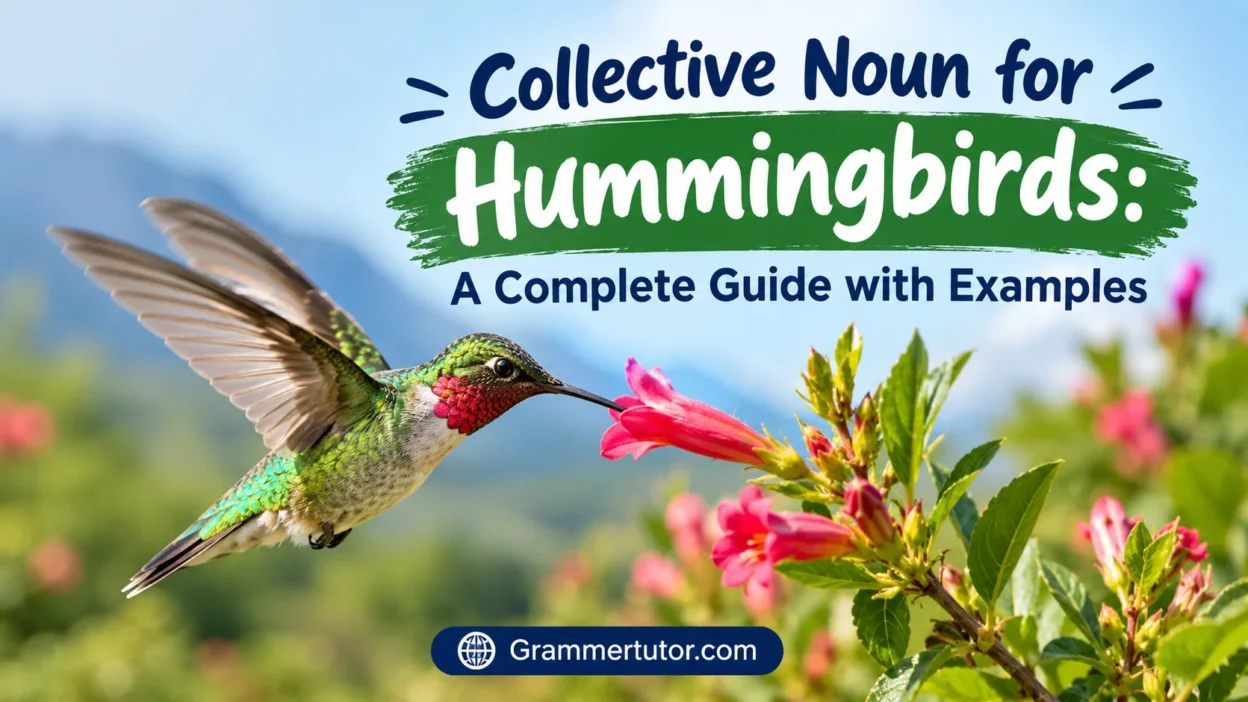
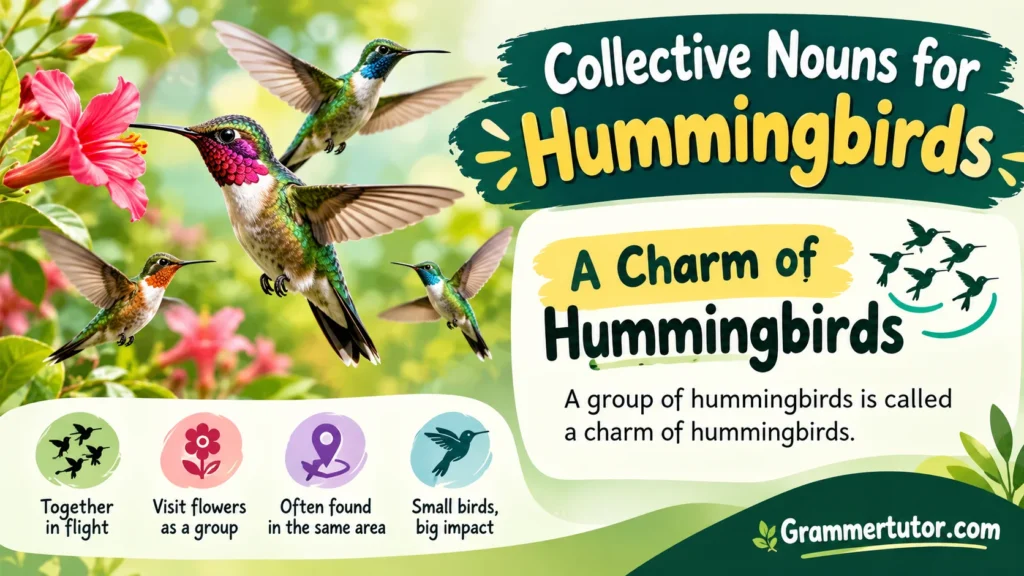
The collective noun for hummingbirds is a charm, a traditional phrase that describes these tiny birds when they gather or move together. Hummingbirds are interesting birds because they can fly quickly from flower to flower while looking for plenty of food. This lively movement makes the name a charm of hummingbirds a natural and memorable expression for English learners.
A collective noun is a word or phrase that describes several animals or objects as one group. Besides the charm of hummingbirds, the glittering of hummingbirds is another descriptive expression sometimes used for these colorful birds. Such expressions can describe hummingbirds flying, gathering, or gathering together in areas where food is available.
Learning these group names can make wildlife descriptions more colorful and help English learners expand vocabulary. Whether you are writing about birds, studying grammar, or simply interested in nature, using the right term can make your sentences more expressive. From my experience with English vocabulary, terms such as charm of hummingbirds make simple descriptions more vivid and enjoyable.
Why Collective Nouns Are Used for Hummingbirds
Hummingbirds are small, active birds known for their rapid wing movements and ability to hover in one place. They often visit flowers and feeders where food is available. Although many hummingbirds spend much of their time alone while feeding, several may appear in the same area when resources are plentiful.
Collective nouns give writers and speakers a convenient way to describe several hummingbirds together. The expression “a charm of hummingbirds is especially interesting because the word “charm” reflects the beautiful and captivating appearance of these tiny birds.
Other descriptive terms can emphasize the way hummingbirds appear while moving through the air. Their shimmering feathers and extremely fast movements make them visually distinctive.
Using collective nouns also adds variety to wildlife writing and helps readers picture the animals being described.
Collective Nouns for Hummingbirds
| Collective Noun | Used For | Simple Example |
| Charm | A group of hummingbirds | A charm of hummingbirds visited the garden. |
| Glittering | Hummingbirds moving or appearing together | A glittering of hummingbirds flew near the flowers. |
| Bouquet | A group of hummingbirds | A bouquet of hummingbirds gathered near the feeder. |
| Shimmer | Hummingbirds seen together | A shimmer of hummingbirds moved around the garden. |
| Group | A general group of hummingbirds | A group of hummingbirds flew over the flowers. |
Charm of Hummingbirds
A charm of hummingbirds is the traditional collective expression most closely associated with these tiny birds. The word “charm” creates a pleasant image because hummingbirds are admired for their bright colors, delicate appearance, and energetic movements.
This expression is particularly suitable for creative wildlife writing or descriptions of several hummingbirds appearing together.
Examples of “Charm of Hummingbirds”
- A charm of hummingbirds visited the garden.
- We watched the charm of hummingbirds near the flowers.
- A charm of hummingbirds flew around the feeder.
- The charm of hummingbirds appeared at sunrise.
- A charm of hummingbirds moved between the flowers.
- The children watched the charm of hummingbirds outside.
- A charm of hummingbirds gathered near the garden.
- We photographed a charm of hummingbirds in the yard.
- The charm of hummingbirds disappeared into the trees.
- The charm of hummingbirds returned to the flowers.
Glittering of Hummingbirds
A glittering of hummingbirds is a colorful descriptive expression connected with the way these birds can appear to sparkle as they move rapidly through the air. Their iridescent feathers can reflect light and create a shimmering visual effect.
This expression works especially well in descriptive or creative writing about hummingbirds flying near flowers or feeders.
Examples of “Glittering of Hummingbirds”
- A glittering of hummingbirds flew over the garden.
- We saw a glittering of hummingbirds near the flowers.
- A glittering of hummingbirds appeared in the morning.
- The glittering of hummingbirds moved around the feeder.
- A glittering of hummingbirds hovered beside the trees.
- The photographer captured the glittering of hummingbirds.
- A glittering of hummingbirds flew across the yard.
- We watched the glittering of hummingbirds near the blossoms.
- The glittering of hummingbirds disappeared into the forest.
- A glittering of hummingbirds returned to the garden.
Bouquet of Hummingbirds
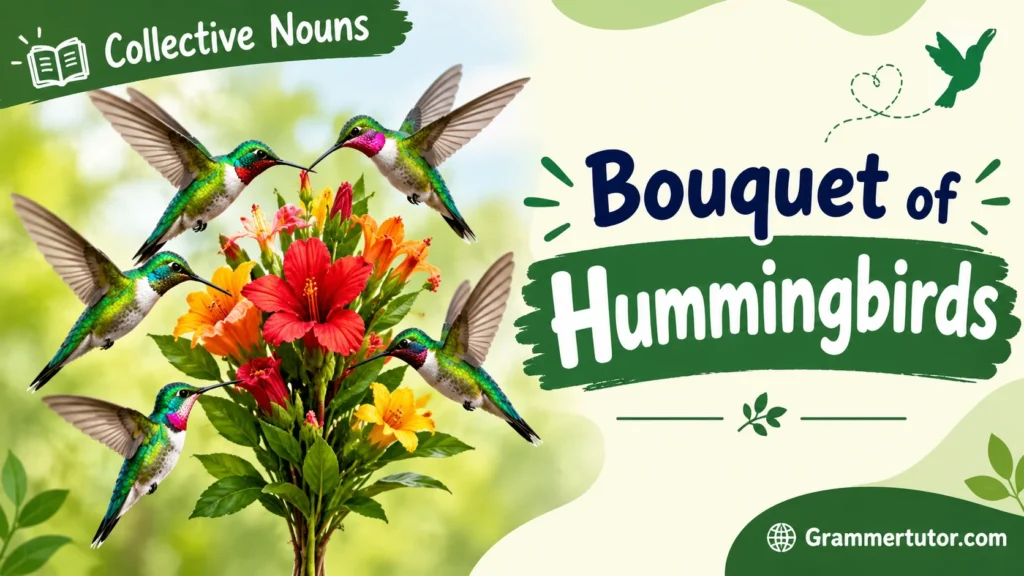
A bouquet of hummingbirds is a descriptive expression that compares a group of these colorful birds to a collection of flowers. It is not as common as charm, but it can be useful in creative descriptions.
The expression works well when several hummingbirds are gathered around flowering plants or a garden.
Examples of “Bouquet of Hummingbirds”
- A bouquet of hummingbirds gathered near the flowers.
- We noticed a bouquet of hummingbirds in the garden.
- A bouquet of hummingbirds flew around the blossoms.
- The bouquet of hummingbirds appeared near the feeder.
- A bouquet of hummingbirds visited the garden every morning.
- The photographer saw a bouquet of hummingbirds.
- A bouquet of hummingbirds moved from flower to flower.
- We watched a bouquet of hummingbirds near the trees.
- The bouquet of hummingbirds filled the garden with movement.
- A bouquet of hummingbirds disappeared behind the flowers.
Shimmer of Hummingbirds
A shimmer of hummingbirds is a creative expression that highlights the bright, reflective appearance of these birds. Many hummingbird species have iridescent feathers that can seem to change color when light strikes them from different angles.
This phrase can make nature writing more vivid, especially when describing hummingbirds moving quickly in sunlight.
Examples of “Shimmer of Hummingbirds”
- A shimmer of hummingbirds appeared near the flowers.
- We watched a shimmer of hummingbirds in the garden.
- A shimmer of hummingbirds flew around the feeder.
- The shimmer of hummingbirds moved through the sunlight.
- A shimmer of hummingbirds hovered beside the blossoms.
- The children enjoyed watching a shimmer of hummingbirds.
- A shimmer of hummingbirds visited the garden.
- We saw a shimmer of hummingbirds near the trees.
- The shimmer of hummingbirds disappeared into the distance.
- A shimmer of hummingbirds returned to the flowers.
Group of Hummingbirds
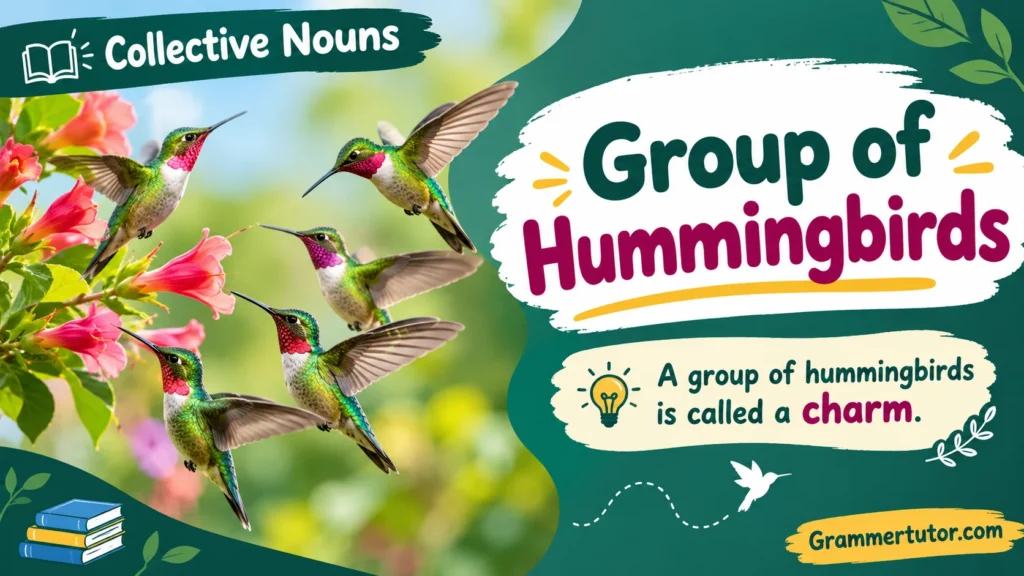
A group of hummingbirds is a straightforward expression for several hummingbirds. Unlike some traditional animal group names, group is a general term rather than a distinctive collective noun.
It is useful when you simply want to describe multiple hummingbirds without using a traditional or poetic expression.
Examples of “Group of Hummingbirds”
- A group of hummingbirds flew over the garden.
- We saw a group of hummingbirds near the feeder.
- A group of hummingbirds visited the flowers.
- The group of hummingbirds moved quickly between the plants.
- A group of hummingbirds appeared in the morning.
- We watched a group of hummingbirds from the window.
- A group of hummingbirds gathered around the flowers.
- The group of hummingbirds flew toward the trees.
- A group of hummingbirds hovered above the garden.
- The group of hummingbirds disappeared into the bushes.
Types of Hummingbirds and Their Characteristics
Hummingbirds belong to the Trochilidae family and include many different species. They are native to the Americas, with the greatest diversity occurring in Central and South America. Different species can vary considerably in size, color, habitat, and feeding behavior.
Hummingbirds are particularly recognizable because of their small bodies, narrow bills, rapid wingbeats, and ability to hover. Their wings can move extremely quickly, allowing them to remain almost stationary while feeding from flowers.
These birds have long bills and specialized tongues that help them obtain nectar. They also eat small insects and other tiny organisms, which provide important nutrients and protein.
Examples of Hummingbird Characteristics
- Hummingbirds are very small birds.
- They belong to the Trochilidae family.
- Hummingbirds can hover in one place.
- Their wings beat extremely rapidly.
- Many hummingbirds feed on flower nectar.
- Hummingbirds also eat small insects.
- Their feathers can have bright iridescent colors.
- They are native to the Americas.
- Hummingbirds have specialized tongues for feeding.
- Different hummingbird species vary in size and appearance.
Interesting Facts About Hummingbirds
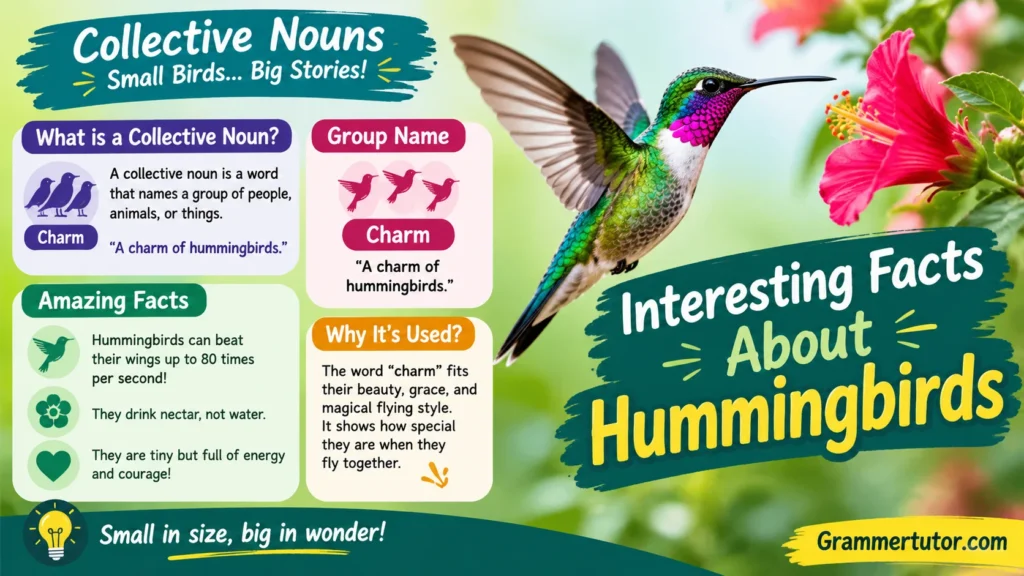
Hummingbirds are remarkable birds with unusual physical features and energetic lifestyles. Their longevity varies by species, and although they are extremely small, some hummingbirds can survive for several years under suitable conditions. Their survival depends on factors such as food availability, predators, weather, habitat, and other environmental pressures.
One of their most impressive physiological features is their rapid wing movement. Hummingbirds can beat their wings at extraordinary speeds, allowing them to hover while feeding. Their wing and shoulder structure gives them exceptional control in the air, and they can move forward, backward, sideways, and even briefly remain suspended in one position.
Their diet is strongly connected to their energetic lifestyle. Hummingbirds frequently drink nectar from flowers, which provides a quick source of energy. They also consume small insects and other tiny organisms to obtain nutrients that nectar alone does not provide. Because flying and hovering require substantial energy, hummingbirds need to feed frequently.
Their long, specialized bills and tongues are also important adaptations. These features allow hummingbirds to reach nectar deep inside flowers. As they visit flowers, they can transfer pollen from one plant to another, making them valuable pollinators in many ecosystems.
Hummingbirds are also famous for their colorful feathers. Many species have iridescent plumage that appears to change color depending on the angle of light. This combination of bright colors, rapid movement, and hovering ability makes a group of hummingbirds an especially fascinating sight.
READ MORE: Collective Noun for Puppies: A Complete Guide with Examples
Conclusion
The most traditional collective noun for hummingbirds is a charm of hummingbirds. This beautiful expression suits these tiny, colorful birds because they often move quickly between flowers and gather where food is available. A glittering of hummingbirds is another descriptive expression that can be used. Learning these collective nouns can make wildlife writing more expressive while also helping English learners improve their vocabulary and grammar.
FAQs
Q1. What is the collective noun for hummingbirds?
The most commonly recognized collective noun for hummingbirds is a charm of hummingbirds.
Q2. Why are hummingbirds called a charm?
The word charm is traditionally associated with a group of hummingbirds and reflects their beautiful appearance and lively movement.
Q3. Is “a charm of hummingbirds” grammatically correct?
Yes. A charm of hummingbirds is a grammatically correct collective-noun phrase.
Q4. What is another collective noun for hummingbirds?
A glittering of hummingbirds is another expression sometimes used to describe a group of hummingbirds.
Q5. Can I use “a flock of hummingbirds”?
Yes, a flock of hummingbirds can be understood because “flock” is a general collective noun for birds, although a charm of hummingbirds is the traditional specific expression.
Q6. What does “a charm of hummingbirds” mean?
It means a group of hummingbirds considered together as one group.
Q7. Are hummingbirds usually seen in groups?
Hummingbirds are often solitary, but several may gather in the same area when there is plenty of food, especially flowers with rich nectar.
Q8. What sentence uses “a charm of hummingbirds”?
A simple example is: “We watched a charm of hummingbirds flying from flower to flower in the garden.”
Q9. Why should English learners know collective nouns for birds?
Collective nouns help English learners describe animals more precisely and make their sentences more varied and expressive.
Q10. What is the difference between “a charm” and “a glittering” of hummingbirds?
Both can describe a group of hummingbirds, but a charm of hummingbirds is the more traditional and widely recognized expression, while a glittering of hummingbirds is a more descriptive alternative.