Collective noun for capons is usually a flock. Capons are castrated male chickens raised for their tender meat and flavor. When these domestic birds live or feed together on a farm, the word flock provides a simple and natural way to describe them.
In everyday English, flock of capons is the most common expression because flock refers to a group of birds, including domestic chickens. For example, “A flock of capons gathered near the farmyard to eat.” Using the right collective noun makes writing about poultry, farm life, and animal behavior clearer and easier to understand.
The English language also has many interesting collective nouns for animals, such as a pride of lions, a herd of buffalo, a murder of crows, and an exaltation of larks. Other terms include swarm, colony, and school for certain animal groups. Learning these expressions helps students, teachers, and English learners describe animals naturally and improve their vocabulary.
Why Are Collective Nouns Used for Capons?
A collective noun is a word used to describe several people, animals, or things as a group. Collective nouns make sentences shorter, reduce repetition, and help readers imagine a group in a particular setting.
For capons, collective expressions are useful when describing birds living on a farm, gathering around food, resting in an enclosure, or moving across a yard. For example, instead of writing, “A group of capons walked across the farmyard,” you can write, “A flock of capons walked across the farmyard.”
Both sentences are understandable, but flock provides a familiar term for a gathering of birds. Other expressions, such as group and pen, may be suitable depending on the situation. However, there is no universally established collective noun used exclusively for capons.
Collective nouns also make educational articles, farm descriptions, stories, and English assignments more engaging. By choosing the appropriate expression, writers can communicate their ideas clearly while improving their vocabulary.
Collective Nouns for Capons
Here are some useful expressions for describing capons. The table distinguishes familiar group terms from words that describe the birds’ surroundings.
| Collective Noun | Used For | Simple Example |
| Flock | Capons gathered together | A flock of capons walked across the yard. |
| Group | Several capons together | A group of capons gathered near the barn. |
| Pen | Capons kept in an enclosure | A pen of capons rested in the shade. |
| Cohort | Capons considered as a particular group | A cohort of capons was raised on the farm. |
| Collection | A general gathering of capons | A collection of capons was kept at the poultry farm. |
| Brood | Young birds raised together, depending on context | A brood of chicks stayed near the hen. |
| Flock of poultry | Domestic birds kept together | A flock of poultry moved around the farm. |
Note: Flock and group are the most straightforward choices for capons. Pen refers primarily to an enclosure, while cohort and collection are general descriptive terms rather than established capon-specific collective nouns. Brood is generally associated with young birds, so it is not the best choice for a group of adult capons.
Flock of Capons
Flock is the most useful general collective noun for capons. It describes several birds gathered together, whether they are walking around a farmyard, feeding, resting, or moving across an open field.
Capons are domestic chickens, so the word flock fits naturally when referring to them as a group. The flock may contain a few birds or many birds, depending on how they are raised. This expression is suitable for everyday conversation, educational writing, and descriptions of poultry.
Examples of “Flock of Capons”
- A flock of capons walked around the farmyard.
- The farmer fed a flock of capons every morning.
- A flock of capons rested beneath the trees.
- We saw a flock of capons near the chicken coop.
- A flock of capons gathered around the food.
- The children watched a flock of capons in the field.
- A flock of capons moved slowly across the yard.
- The farmer kept a flock of capons in a clean enclosure.
- A flock of capons searched the ground for food.
- The caretaker checked the flock of capons before sunset.
Group of Capons
Group is another correct and widely understood expression for several capons together. It is a general collective term that can be used in almost any situation, particularly when you want to describe the birds without suggesting a particular behavior or traditional naming convention.
Unlike specialized animal group names, group is familiar to English learners and readers of all ages. It works well in school assignments, farm reports, and everyday writing.
Examples of “Group of Capons”
- A group of capons stood beside the barn.
- The farmer observed a group of capons in the garden.
- A group of capons gathered near the feeding area.
- We counted a group of capons before closing the gate.
- A group of capons rested in the shade.
- The children learned about a group of capons at the farm.
- A group of capons walked toward the water trough.
- The farmer moved a group of capons into a larger enclosure.
- A group of capons pecked at the ground.
- The caretaker watched a group of capons during feeding time.
Pen of Capons
Pen is a useful expression when describing capons kept together in an enclosed space. Strictly speaking, the word refers to the enclosure rather than a special biological group, but phrases such as “a pen of capons” are natural in descriptions of poultry farming.
A pen helps farmers manage feeding, monitor the birds, and provide a designated place for shelter. The expression is especially suitable when writing about farm routines and animal care.
Examples of “Pen of Capons”
- A pen of capons stood near the farmhouse.
- The farmer cleaned the pen of capons every day.
- A pen of capons received fresh water in the morning.
- The caretaker inspected the pen of capons.
- A pen of capons rested after eating.
- The farmer provided enough space for the pen of capons.
- A pen of capons stayed inside during the rain.
- The children observed a pen of capons from outside.
- The pen of capons had access to fresh feed.
- The farmer checked the health of the capons in the pen.
How Capons Behave in Groups
Capons are domestic chickens, and their behavior in groups is influenced by their living conditions, individual temperaments, and social interactions. Like other chickens, they may peck at the ground, search for food, rest together, and establish social relationships within their flock. They can also display a social hierarchy that influences access to food and preferred resting places.
Capons are generally less aggressive than intact roosters because castration reduces the influence of male sex hormones. However, their behavior varies, and they still need appropriate space, suitable shelter, and careful management to avoid stress and conflict.
When several capons gather around a feeding area, a water source, or a shaded part of the farmyard, expressions such as flock of capons and group of capons help describe their activities naturally. Observing these birds also shows why collective nouns are useful: they allow writers to describe several animals together without repeatedly naming each individual.
Interesting Facts About Capons
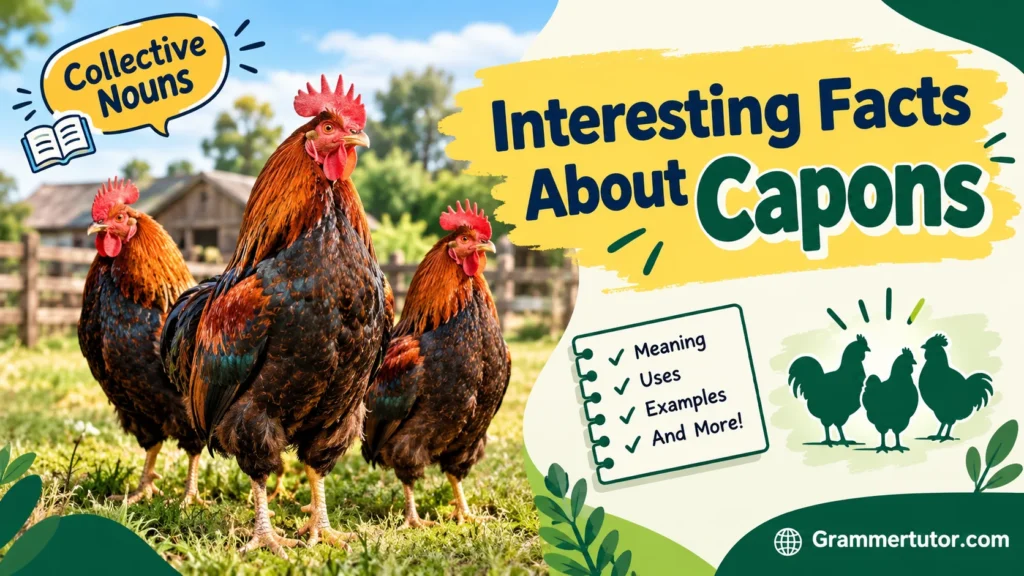
Capons have an interesting history in poultry farming and traditional cuisine. They are male chickens that have been castrated, usually when young, and this process changes their hormonal development. Compared with intact roosters, capons are generally less aggressive and may develop more body fat, contributing to the tenderness and flavor of their meat. Their physical development can differ from that of ordinary roosters, although the precise changes depend on breed, age, and management.
Regarding longevity, capons do not have one fixed lifespan. Their potential lifespan depends on genetics, nutrition, living conditions, veterinary care, and whether they are raised for meat or kept for other purposes. Commercially raised capons are often slaughtered relatively young, so their natural maximum lifespan is not usually observed in farming. With appropriate care, chickens can live for several years, but individual outcomes vary.
Their unique physiological features are closely associated with caponization. Reduced male sex hormone activity can influence the development of the comb and wattles, body composition, and behavior. Capons may be calmer than intact roosters, but they remain active domestic birds that need suitable space and opportunities to engage in natural behaviors.
Their dietary habits are similar to those of other chickens. Capons need a balanced poultry diet containing appropriate protein, energy, vitamins, and minerals. They may also forage for seeds, grains, insects, and other small food items when given access to suitable outdoor areas. Fresh water must always be available, and their feed should meet their nutritional requirements rather than relying entirely on grain or household scraps.
Another interesting fact is that capons have been valued in traditional festive meals in various culinary cultures. Their long history in poultry production shows how selective farming practices have influenced the characteristics and uses of domestic chickens.
Conclusion
Collective noun for capons is flock. You can also use group as a simple alternative or pen of capons when referring to birds kept in an enclosure. Learning these expressions improves your vocabulary, strengthens your English grammar, and makes your writing more clear, natural, and engaging.
FAQs
Q1. What is the collective noun for capons?
Flock is the most useful general collective noun for capons. For example, “A flock of capons walked across the farmyard.”
Q2. What are capons?
Capons are male chickens that have been castrated, usually when young. They are traditionally raised for meat that is valued for its tenderness and flavor.
Q3. Can I say “a group of capons”?
Yes. A group of capons is grammatically correct and easy to understand. It is a suitable alternative when you do not want to use flock.
Q4. Is “a flock of capons” correct English?
Yes. Flock is commonly used for groups of birds, including domestic chickens, making a flock of capons a natural expression.
Q5. Can “pen of capons” be used as a collective noun?
Yes, as a descriptive expression. However, pen primarily refers to the enclosure where the capons are kept rather than an exclusive collective noun for the birds.
Q6. Is there a special collective noun used only for capons?
There is no widely established, universally accepted collective noun exclusive to capons. Flock and group are the clearest general choices.
Q7. How do capons behave in groups?
Capons may feed, rest, and explore together. Like other chickens, they can establish social hierarchies, and their behavior depends on their environment and individual temperament.
Q8. What do capons eat?
Capons eat balanced poultry feed containing essential nutrients. They may also forage for seeds, grains, insects, and other suitable food when given access to appropriate outdoor areas.
Q9. Do capons live longer than ordinary chickens?
Not necessarily. Their lifespan depends on genetics, care, nutrition, and living conditions. Many commercially raised capons are slaughtered young, making direct lifespan comparisons difficult.
Q10. Why is it useful to learn collective nouns for capons?
Learning collective nouns improves vocabulary, strengthens grammar, and makes writing more descriptive. It also helps readers discuss groups of domestic birds clearly in educational and farming contexts.