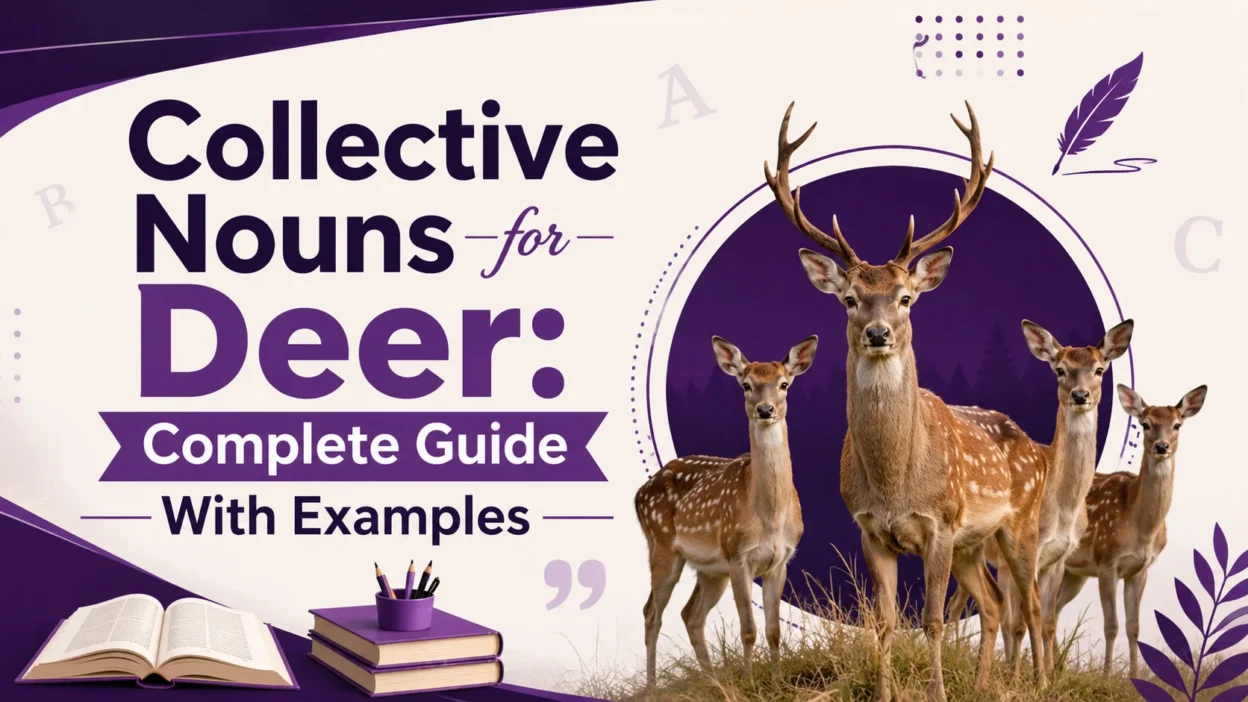
Learning Collective Noun For Deer helps you describe a group of deer correctly and naturally in everyday English writing. Many people think there is only one way to describe a deer, but the most widely accepted collective noun is a herd. This common term is used in everyday language, wildlife writing, and the English language because it is accurate, correct, natural, and precise. Older names like parcel and ran gale appear in historical records, literature, and regional tradition, yet modern usage still favours herd as the most apt choice. From my own experience reading wildlife books, learning these collective nouns helped improve my vocabulary, made my writing more informative, and allowed me to communicate more confidently as a student, writer, teacher, or wildlife enthusiast.
A deer belongs to the deer family, or Cervidae, and these graceful, gentle animals often live, travel, and stay together for protection and easier access to food. Whether you see a large group grazing in a field, meadow, or forest, walking along a forest path, or resting near bushes, you may notice an inquisitive buck with impressive antlers, a female deer called a doe, and a young deer known as a fawn, kid, or calf. These observations create a clearer picture of animal behaviour and help us describe wildlife more effectively.
Beyond deer, collective nouns are special, descriptive words and linguistic constructs used to describe a collection of similar entities, individuals, people, animals, things, or objects with a single term. Well-known examples include a pride of lions and a murder of crows. These names reflect collective behavior, characteristics, social dynamics, habits, and the unique presence of different species, including the diverse species of deer. As you discover, learn, and explore these captivating and fascinating facts, you will find answers to common questions, remember an array of interesting names, and improve your communication while appreciating the richness, precision, history, old hunting traditions, poetic style, and the amazing diversity of wildlife.
What Are Collective Nouns?
Collective nouns are words that refer to a collection of people, animals, or things as one unit. They make writing and speaking more interesting and precise.
For example:
- A flock of birds
- A school of fish
- A pride of lions
- A herd of deer
When talking about deer, several collective nouns can be used depending on the context, although some are much more common than others.
Collective Nouns for Deer
| Collective Noun | Simple Example |
| Herd | A herd of deer crossed the road. |
| Parcel | A parcel of deer rested near the trees. |
| Rangale | A rangale of deer wandered through the forest. |
| Mob | A mob of deer ran across the valley. |
| Bunch | A bunch of deer grazed quietly. |
| Leash | A leash of deer stood near the river. |
| Bevy | A bevy of deer explored the meadow. |
Herd of Deer
The most common and widely accepted collective noun for deer is herd. It refers to a group of deer living, feeding, or travelling together.
Examples of “Herd of Deer”
- A herd of deer grazed in the open field.
- We watched a herd of deer near the lake.
- The herd of deer disappeared into the forest.
- A herd of deer crossed the quiet road.
- Farmers noticed a herd of deer in their crops.
- The herd of deer searched for fresh grass.
- A herd of deer rested beneath the tall trees.
- Rangers tracked a herd of deer through the valley.
- The herd of deer moved together at sunrise.
- Children admired a herd of deer from a safe distance.
Parcel of Deer
The word parcel is a traditional but less common collective noun for deer.
Examples of “Parcel of Deer”
- A parcel of deer wandered through the forest.
- We spotted a parcel of deer near the river.
- The parcel of deer rested quietly.
- Hunters noticed a parcel of deer in the distance.
- A parcel of deer gathered under the trees.
- The parcel of deer drank fresh water.
- A parcel of deer walked across the meadow.
- Tourists photographed a parcel of deer.
- The parcel of deer disappeared after hearing noise.
- A parcel of deer searched for food together.
Rangale of Deer
Rangale is an old English collective noun that is rarely used today but remains interesting for language enthusiasts.
Examples of “Rangale of Deer”
- A rangale of deer crossed the forest trail.
- The rangale of deer grazed peacefully.
- We saw a rangale of deer near the mountain.
- A rangale of deer rested in the shade.
- The rangale of deer moved carefully.
- Rangers followed a rangale of deer.
- A rangale of deer drank from the stream.
- The rangale of deer scattered quickly.
- A rangale of deer appeared at dawn.
- Visitors admired the rangale of deer.
Mob of Deer
The collective noun mob is occasionally used for a large gathering of deer, especially when they move together quickly.
Examples of “Mob of Deer”
- A mob of deer rushed through the woods.
- We watched a mob of deer running together.
- The mob of deer crossed the valley.
- A mob of deer escaped the noise.
- The mob of deer entered the forest.
- A mob of deer grazed nearby.
- Rangers counted a mob of deer.
- The mob of deer disappeared into the hills.
- A mob of deer startled the campers.
- The mob of deer travelled across the meadow.
Bunch of Deer
Although informal, bunch is sometimes used in everyday conversation.
Examples of “Bunch of Deer”
- A bunch of deer stood near the trees.
- We found a bunch of deer in the meadow.
- The bunch of deer grazed quietly.
- A bunch of deer crossed the stream.
- The bunch of deer rested together.
- Children spotted a bunch of deer.
- A bunch of deer walked through the park.
- The bunch of deer disappeared into the woods.
- We photographed a bunch of deer.
- The bunch of deer searched for food.
Leash of Deer
Leash is an old-fashioned collective noun that appears in historical English.
Examples of “Leash of Deer”
- A leash of deer wandered through the forest.
- The leash of deer stopped near the lake.
- We watched a leash of deer at sunrise.
- A leash of deer grazed peacefully.
- The leash of deer crossed the field.
- A leash of deer rested beneath an oak tree.
- Rangers observed a leash of deer.
- The leash of deer drank from the stream.
- A leash of deer disappeared into the woods.
- Visitors admired the leash of deer.
Bevy of Deer
The word bevy is rarely used for deer but can occasionally describe a small gathering.
Examples of “Bevy of Deer”
- A bevy of deer grazed quietly.
- We noticed a bevy of deer near the forest.
- The bevy of deer crossed the road.
- A bevy of deer rested together.
- The bevy of deer drank from the river.
- Rangers photographed a bevy of deer.
- A bevy of deer moved across the meadow.
- The bevy of deer disappeared into the trees.
- We admired a bevy of deer at sunset.
- A bevy of deer searched for fresh leaves.
Interesting Facts About Deer
Deer are among the world’s most adaptable mammals and can be found across forests, mountains, grasslands, and wetlands. Depending on the species, most wild deer live between 6 and 14 years, while those in protected environments may survive for 20 years or more. One of their most remarkable features is the antlers of male deer, which are made of bone and are shed and regrown every year—a unique trait among mammals. Deer also have excellent hearing, a powerful sense of smell, and eyes positioned on the sides of their heads, giving them a wide field of vision to detect predators. They are herbivores, feeding mainly on grasses, leaves, twigs, bark, fruits, nuts, and mushrooms. Their four-chambered stomach allows them to digest tough plant material efficiently, making them highly successful in many different habitats around the world.
Why Learning Collective Nouns for Deer Matters
Knowing collective nouns for deer makes your English more descriptive and engaging. Whether you’re writing a wildlife article, teaching students, or simply improving your vocabulary, these terms add precision and interest. They also provide insight into how deer naturally live in groups for protection, feeding, and migration. Learning these expressions helps you appreciate both the richness of the English language and the fascinating social behaviour of deer.
Conclusion
Understanding the Collective Noun For Deer is a simple way to improve your English vocabulary and make your writing more accurate. Although herd is the most widely accepted term, learning older names such as parcel and rangale also gives you a better understanding of the history of the English language. Whether you are a student, writer, teacher, or wildlife enthusiast, using the correct collective noun helps you describe deer clearly and confidently in both speech and writing.
FAQs
Q1. What is the collective noun for deer?
The most common and accepted collective noun for deer is a herd.
Q2. Are there other collective nouns for deer?
Yes. Besides herd, older terms such as parcel and rangale can be found in historical and literary sources.
Q3. Why is “herd” the most common term?
Herd is widely used because it accurately describes a group of deer and is recognised in modern English.
Q4. What is a baby deer called?
A baby deer is commonly called a fawn, although kid and calf may also be used for certain species.
Q5. What is a female deer called?
A female deer is called a doe.