The collective noun for wombats can be a group, mob, or colony, depending on the context. The word group is the safest choice for clear, natural English.Wombats are sturdy Australian marsupials with powerful claws, rounded bodies, and remarkable underground shelters. These burrowing mammals spend much of their time digging, resting in cool tunnels, and searching for grasses, roots, and other plant material.
Their plant-based diet and feeding habits connect them closely to Australia’s distinctive wildlife. Although wombats are generally solitary animals, several may live in a suitable habitat with burrow systems located near one another. Their natural environment, underground burrows, and shelter help explain their daily behavior. Learning collective nouns improves vocabulary, grammar, and English usage. When describing animal gatherings, choosing the right word choice makes wildlife writing clearer and more engaging.
Expressions such as group of wombats, mob of wombats, and colony of wombats are useful collective expressions, but no single term is universally established for every situation. Understanding the animals’ habits, habitats, physical characteristics, and species characteristics helps writers use accurate terminology and descriptive language. This approach supports linguistic accuracy, better communication, and stronger writing skills while keeping the contextual meaning and ecological context clear.
Why Do We Use Collective Nouns for Wombats?
Collective nouns allow writers to refer to several wombats without repeatedly naming each animal. They are useful in wildlife observations, school projects, nature stories, and descriptions of Australian mammals.
For example, a wildlife observer might write, “A group of wombats emerged from their burrows after sunset.” This sentence communicates that several animals appeared together without suggesting that wombats always live in organized communities.
The expression mob of wombats can also be used as an informal descriptive phrase for several animals gathered in one place. However, it should not be presented as a universally established wombat-specific term. Similarly, colonies of wombats may describe animals inhabiting the same general area, although wombats are not typically highly social animals.
Choosing an appropriate expression depends on what you are describing. A group may consist of animals spotted together, while a gathering may simply refer to wombats seen in the same location.
Collective Nouns for Wombats

| Collective Noun | Used For | Simple Example |
| Group | Several wombats considered together | A group of wombats crossed the trail. |
| Mob | An informal description of several wombats | A mob of wombats appeared near the woodland. |
| Colony | Wombats occupying the same general area | A colony of wombats lived across the habitat. |
| Gathering | Wombats assembled in one place | A gathering of wombats appeared near the grassland. |
| Community | Wombats inhabiting the same broader environment | A community of wombats occupied the reserve. |
Note: Group is the clearest general expression. Mob, colony, gathering, and community are descriptive alternatives whose suitability depends on context; they are not all recognized as formal, species-specific collective nouns.
Group of Wombats
A group of wombats refers to multiple wombats observed together in the same place. This expression is particularly useful because it does not imply that these animals have a strong social structure.
Wombats often spend time alone, digging burrows and searching for vegetation. Nevertheless, individuals may occupy neighboring burrows or encounter one another where food and shelter are available. Their behavior can differ according to species, habitat, and environmental conditions.
Using a group makes it easy to describe these encounters without making assumptions about how closely the animals interact.
Examples of “Group of Wombats”
- A group of wombats wandered across the open pasture.
- A group of wombats appeared beside the eucalyptus trees.
- We spotted a group of wombats near the walking path.
- A group of wombats explored the grassy hillside.
- The ranger photographed a group of wombats at dusk.
- A group of wombats moved between patches of native vegetation.
- The children watched a group of wombats from a safe distance.
- A group of wombats rested near the entrance to their shelter.
- The wildlife camera recorded a group of wombats after sunset.
- A group of wombats searched the ground for tender shoots.
Mob of Wombats

A mob of wombats is an informal expression that can describe several wombats appearing together. The word mob is familiar in Australian English, where it can refer to a group of animals or people. However, it is not a universally established collective noun specifically for wombats.
This expression can work well in conversational wildlife writing, especially when several animals are spotted in a shared area. It should not suggest that wombats routinely travel in coordinated packs, because they generally lead relatively solitary lives.
Examples of “Mob of Wombats”
- A mob of wombats appeared near the rocky slope.
- The photographer noticed a mob of wombats beside the paddock.
- A mob of wombats emerged from the surrounding scrub.
- We saw a mob of wombats beneath the evening sky.
- A mob of wombats moved through the native grass.
- The ranger recorded a mob of wombats during the survey.
- A mob of wombats appeared near the edge of the reserve.
- A mob of wombats wandered across the sandy clearing.
- The documentary featured a mob of wombats in their natural habitat.
- A mob of wombats was spotted near the bushland track.
Colony of Wombats
A colony of wombats describes several wombats occupying the same general habitat. This phrase is useful when discussing a population living across a particular area, although it should not be confused with the tightly organized colonies formed by some social mammals.
Wombats dig extensive burrows that provide shelter from harsh weather and help regulate their body temperature. Depending on the habitat, different individuals may establish burrows relatively close to one another. Some burrow systems have multiple entrances, and wombats may use different shelters throughout their home ranges.
The word colony can therefore describe a local concentration of wombats in a broad sense, but it does not necessarily mean that they cooperate or share one communal den.
Examples of “Colony of Wombats”
- A colony of wombats inhabited the protected grassland.
- Researchers examined a colony of wombats living near the woodland.
- A colony of wombats occupied the reserve’s dry interior.
- The conservation team monitored a colony of wombats throughout the season.
- A colony of wombats was recorded in the wildlife survey.
- The habitat supported a colony of wombats among native plants.
- A colony of wombats lived across the sandy landscape.
- The report described a colony of wombats in the region.
- A colony of wombats was observed near several underground shelters.
- The reserve provided suitable habitat for a colony of wombats.
Gathering of Wombats

A gathering of wombats is a descriptive expression for several animals seen in the same place at the same time. It emphasizes the event of their appearing together rather than suggesting a permanent social relationship.
Wombats may be observed in the same area when their habitats overlap or when suitable vegetation attracts multiple individuals. They are primarily nocturnal, so wildlife observers are more likely to encounter them during the evening or at night.
This expression works especially well in nature stories because it describes what an observer sees without claiming that the animals have a formal group structure.
Examples of “Gathering of Wombats”
- A gathering of wombats appeared along the forest margin.
- The naturalist observed a gathering of wombats after twilight.
- A gathering of wombats was visible beside the grassy bank.
- We photographed a gathering of wombats near the nature reserve.
- A gathering of wombats attracted attention during the wildlife tour.
- The moonlight revealed a gathering of wombats in the clearing.
- A gathering of wombats appeared near the scattered shrubs.
- The researcher documented a gathering of wombats at night.
- A gathering of wombats moved across the open terrain.
- Visitors watched a gathering of wombats from the observation platform.
Community of Wombats
A community of wombats is a broad descriptive phrase for wombats living within the same general environment. It can be useful in conservation writing when discussing the animals that inhabit a particular reserve, woodland, or grassland.
However, the word community does not necessarily mean that wombats form close-knit social groups. Individual wombats usually maintain their own activity patterns and burrows, and their interactions may be limited compared with those of highly social animals.
This expression is most appropriate when the focus is on a local population, its habitat, and the environmental conditions that support it.
Examples of “Community of Wombats”
- A community of wombats inhabited the protected valley.
- The conservationists studied a community of wombats in the region.
- A community of wombats depended on the surrounding native vegetation.
- The reserve offered shelter to a community of wombats.
- A community of wombats was included in the habitat assessment.
- The wildlife team monitored a community of wombats during the dry season.
- A community of wombats occupied the surrounding bushland.
- The report highlighted the importance of protecting a community of wombats.
- A community of wombats benefited from the restoration project.
- The natural habitat supported a community of wombats throughout the year.
Burrow Dwellers: How Wombats Live
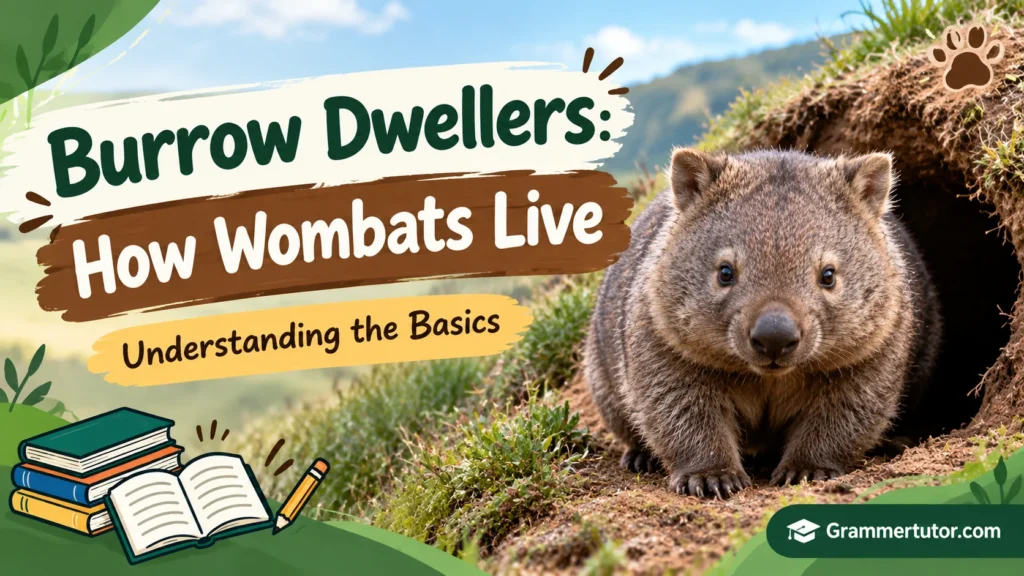
Wombats are famous for their underground homes, which provide shelter and help them avoid extreme temperatures. Their strong limbs and sturdy claws allow them to excavate soil, creating tunnels and chambers that can become extensive over time. Although neighboring wombats may have burrows in the same area, each animal’s use of shelter depends on its species and local conditions.
These marsupials are primarily active at night, when cooler temperatures make it easier to forage. Their plant-based diet includes grasses, roots, bark, and other vegetation, depending on what is available. They have specialized digestive systems that extract nutrients from fibrous food, and their digestive process is exceptionally slow compared with that of many other mammals.
Wombats also have several unusual physical characteristics. Their compact bodies and powerful shoulders support digging, while their tough rear ends help protect them when they retreat into burrows. Their front teeth continue growing, helping compensate for the wear caused by eating abrasive plant material. Wombats also produce distinctive cube-shaped droppings, which can help them mark their territories. These features make them particularly interesting subjects for wildlife studies.
Interesting Facts About Wombats
Wombats have surprisingly long lives for medium-sized burrowing mammals. In the wild, they may live for around 5–15 years, depending on the species and environmental conditions, while individuals in managed care can sometimes live longer. Their longevity is influenced by food availability, disease, habitat quality, predators, and other threats. Their slow-moving appearance can be misleading because wombats are strong diggers and can move quickly over short distances when necessary.
There are three living wombat species: the common wombat, the southern hairy-nosed wombat, and the northern hairy-nosed wombat. The northern hairy-nosed wombat is particularly rare and faces serious conservation challenges. Wombats possess strong claws, robust limbs, and specialized teeth suited to their herbivorous lifestyle. Their backward-facing pouch is another useful adaptation because it helps prevent soil from entering the pouch while the mother digs. These marsupials give birth to highly underdeveloped young, which continue growing inside the pouch.
Wombats mainly eat grasses and other tough plant materials. Their digestive systems process fibrous food slowly, helping them obtain nutrients from vegetation that many animals cannot use as efficiently. They may spend several hours feeding during their active periods, depending on the conditions. Their teeth, jaw muscles, and digestive systems are all adapted to this diet. Understanding these traits makes descriptions of wombats more informative and shows how language about animal groups can connect with a deeper appreciation of wildlife biology.
READ MORE: Collective Noun for Martens: A Complete Guide With Examples
Conclusion
Understanding the collective noun for wombats makes it easier to describe these fascinating Australian marsupials in clear, natural English. Group of wombats is a simple, widely understandable expression, while mob of wombats and colony of wombats may also be used depending on the context. Learning these collective nouns improves your vocabulary, strengthens your writing skills, and helps you describe animal gatherings more accurately.
FAQs
Q1. What is the collective noun for wombats?
Group of wombats is the clearest general expression. Words such as mob and colony can also describe multiple wombats, depending on the context, but they are not universally established wombat-specific collective nouns.
Q2. Can I say “a mob of wombats”?
Yes. A mob of wombats can be used as an informal descriptive expression for several wombats together. It should not be presented as the only official collective noun for the species.
Q3. Is “colony of wombats” correct?
The expression is understandable when referring to wombats living in the same general area. However, wombats are generally solitary, so colony does not necessarily imply that they live in a tightly organized community.
Q4. Do wombats live together in groups?
Wombats generally live solitary lives, although their burrows and home ranges may overlap. Several individuals can inhabit the same broad area without behaving like a closely coordinated social group.
Q5. What is a wombat’s home called?
A wombat’s underground shelter is called a burrow. Wombats excavate burrows using their powerful forelimbs and claws.