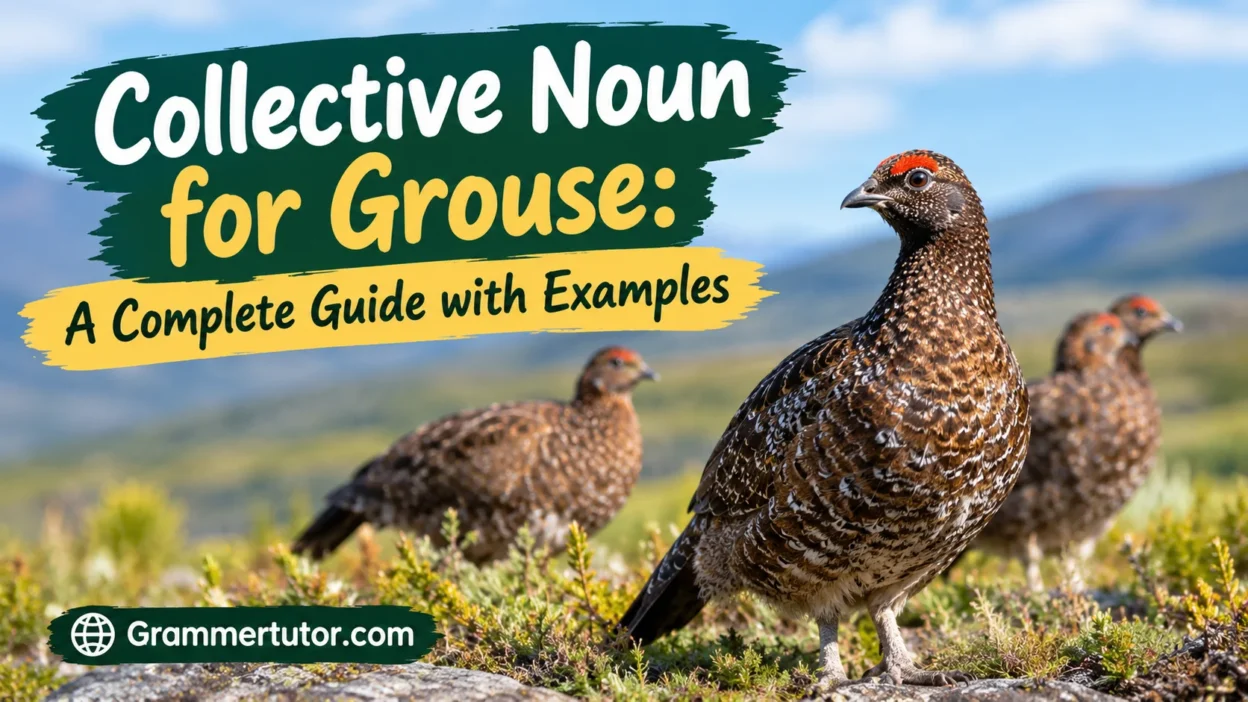
The collective noun for grouse helps English learners describe these ground-dwelling birds when they gather in groups and display natural behaviors. Covey is a recognized term for a small group of grouse. Grouse belong to the pheasant family, known scientifically as Phasianidae.
These feathered birds have ground-based habits and perform remarkable courtship displays. Different grouse species live in varied natural habitats, including open moorlands and coniferous forests. Understanding their courtship behavior and family groups adds useful detail to wildlife descriptions.
Learning these collective terms improves grammar learning, sentence writing, and bird vocabulary. Whether you are studying grammar, preparing educational content, or reading about wildlife, choosing precise descriptions makes your writing clearer and more interesting. These expressions also help language learners connect the English language with the natural world and describe bird gatherings accurately.
Why Collective Nouns Are Used for Grouse
Grouse often spend much of their time on the ground, searching for food, resting among vegetation, or moving through suitable habitat. Some species gather during particular seasons, especially when males display to attract females. A collective noun makes it easier to describe these gatherings without repeatedly referring to individual birds.
The expression a covey of grouse is especially associated with a small family group. A lek refers more specifically to a courtship gathering where males display to attract females. These terms do not all describe exactly the same behavior, so choosing the appropriate expression helps communicate the intended meaning.
Collective Nouns for Grouse
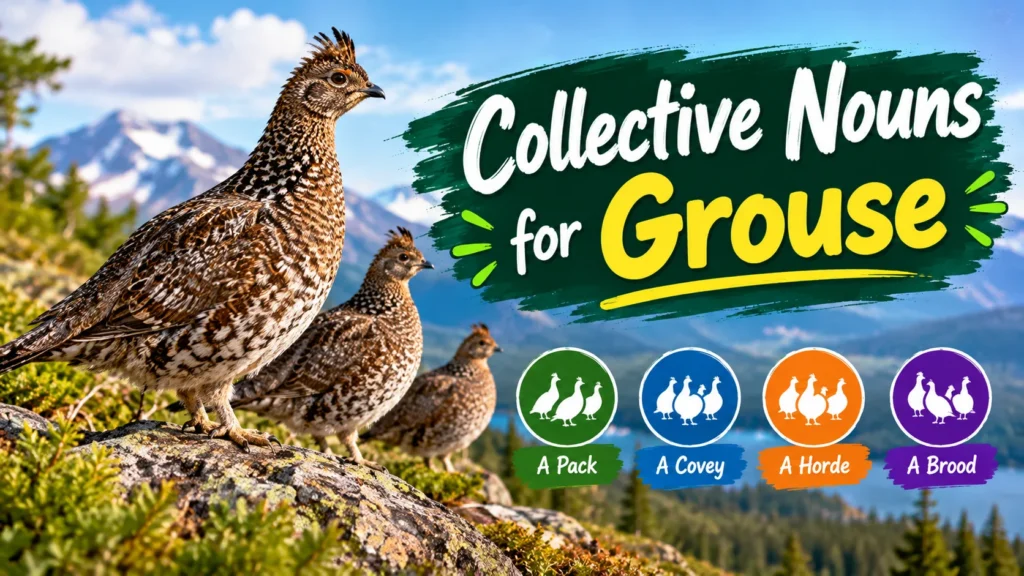
| Collective Noun | Used For | Simple Example |
| Covey | A small family group | A covey of grouse moved through the heather. |
| Pack | A group of grouse | A pack of grouse crossed the clearing. |
| Lek | A courtship gathering | A lek of grouse formed on the open ground. |
| Flock | A general gathering of birds | A flock of grouse searched for seeds. |
| Brood | A family of young birds | A brood of grouse chicks followed their mother. |
Note: These expressions are not equally common or interchangeable. Covey and lek have more specific traditional or behavioral associations, while flock is a straightforward general term.
Covey of Grouse
A covey of grouse is a traditional collective expression for a small group of these birds. It is particularly suitable when describing a family group or a few grouse staying close together in their natural surroundings.
Examples of “Covey of Grouse”
- A covey of grouse wandered across the heath.
- We spotted a covey of grouse beside the pine trees.
- The covey of grouse searched for seeds beneath the bushes.
- A covey of grouse slipped quietly into the tall grass.
- The naturalist observed a covey of grouse near the hillside.
- A covey of grouse rested among the low shrubs.
- The covey of grouse scattered when a fox approached.
- We photographed a covey of grouse during our countryside walk.
- A covey of grouse explored the edge of the woodland.
- The convoy of grouse disappeared into the thick vegetation.
Pack of Grouse
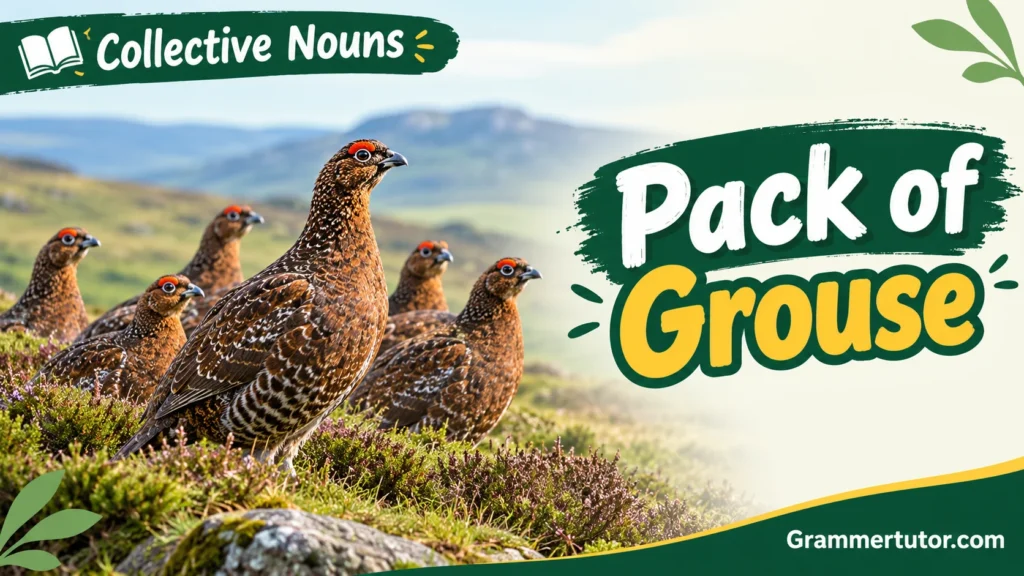
A pack of grouse appears in traditional lists of bird collective nouns and may describe a gathering of grouse. The word pack is more familiar for certain mammals, so this expression is less natural in everyday conversation than a general phrase such as a group of grouse or a covey of grouse.
Examples of “Pack of Grouse”
- A pack of grouse moved across the open moor.
- The pack of grouse searched for food near the shrubs.
- We noticed a pack of grouse beside the trail.
- A pack of grouse gathered beneath the evergreen branches.
- The pack of grouse hurried toward the grassy slope.
- A wildlife photographer watched a pack of grouse from afar.
- The pack of grouse explored a patch of wild vegetation.
- A pack of grouse emerged from the woodland.
- The pack of grouse remained close to the sheltered ground.
- We caught sight of a pack of grouse before sunset.
Lek of Grouse
A lek of grouse refers to a courtship gathering associated with certain grouse species. During the breeding season, males gather at display sites, where they perform movements, make sounds, or show off their plumage to attract females. This term describes a particular social and reproductive behavior rather than simply any gathering of birds.
Examples of “Lek of Grouse”
- A lek of grouse formed on the open moor.
- The leak of grouse became active during spring.
- Researchers observed a leak of grouse before sunrise.
- A leak of grouse attracted the attention of birdwatchers.
- The lek of grouse provided an opportunity to study courtship.
- Several male grouse displayed within the lek.
- A wildlife guide explained how a leek of grouse operates.
- The lake was located away from the busy trail.
- Scientists recorded the calls heard at the lek of grouse.
- The leak of grouse became quieter after the breeding season.
Flock of Grouse
A flock of grouse is a general, easily understood expression for several grouses together. Although more specialized terms occur in traditional collective-noun lists, flock works well when the precise type of gathering is unknown or unimportant.
Examples of “Flock of Grouse”
- A flock of grouse moved through the meadow.
- We watched a flock of grouse feeding near the woodland.
- The flock of grouse crossed a narrow footpath.
- A flock of grouse gathered near the berry bushes.
- The flock of grouse flew over the low ridge.
- A birdwatcher spotted a flock of grouse beside the stream.
- The flock of grouse searched among fallen leaves.
- A flock of grouse rested in a sheltered clearing.
- The flock of grouse moved away from the visitors.
- We saw a flock of grouse at the edge of the moor.
Brood of Grouse
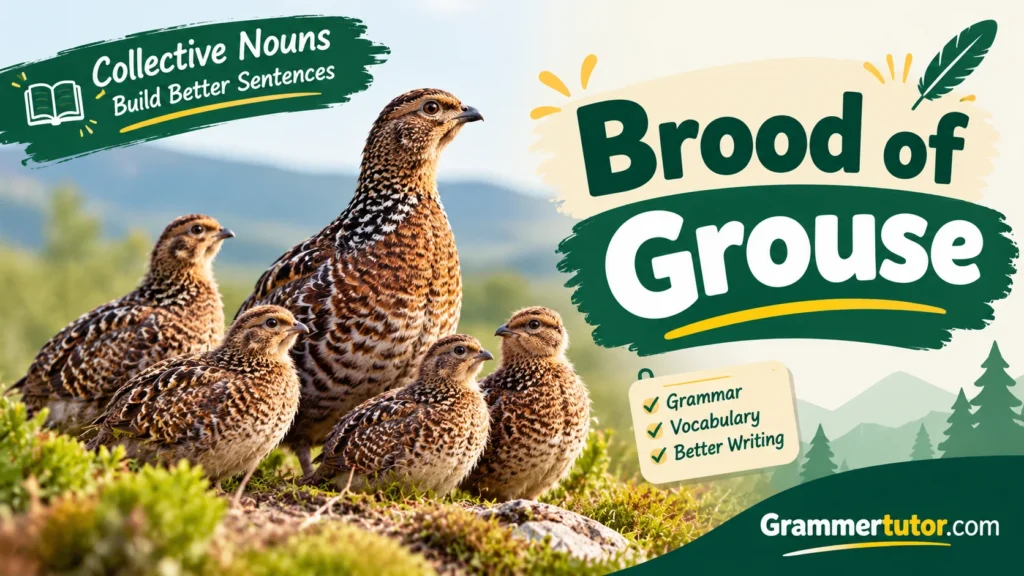
A brood of grouse describes a family of young birds, usually associated with their mother. Young grouse need protection and guidance while developing the skills required to find food and avoid danger. This term is most suitable when the group includes chicks rather than a gathering of adult birds. Traditional bird-name lists include brood among the terms associated with grouse.
Examples of “Brood of Grouse”
- A brood of grouse chicks followed their mother.
- The brood of grouse hid beneath the ferns.
- We spotted a brood of grouse near the meadow.
- A brood of grouse searched for tiny insects.
- The mother grouse protected her brood from danger.
- A brood of grouse moved through the young grass.
- The brood of grouse rested beside a fallen log.
- A wildlife photographer watched a brood of grouse from a distance.
- The brood of grouse scattered among the wildflowers.
- The mother led her brood of grouse toward safer ground.
Different Grouse Species and Their Habitats
Grouse include several species adapted to different landscapes. The red grouse is associated with British moorlands, while the ruffed grouse inhabits wooded areas in North America. The greater sage-grouse lives in sagebrush country, and the spruce grouse is associated with northern coniferous forests. These birds have different appearances and behaviors, but all depend on habitats that provide food, shelter, and places to reproduce.
Examples of Grouse Habitats
- Red grouse inhabit areas of heather moorland.
- Ruffed grouse are associated with forests and woodland edges.
- Greater sage-grouse depend on sagebrush ecosystems.
- Spruce grouse live in coniferous woodland.
- Some grouse forage among low-growing plants.
- Woodland grouse can shelter beneath dense vegetation.
- Moorland birds often use shrubs for cover.
- Seasonal conditions influence the availability of grouse food.
- Suitable nesting areas help grouse raise their young.
- Protecting natural habitats supports grouse populations.
Interesting Facts About Grouse
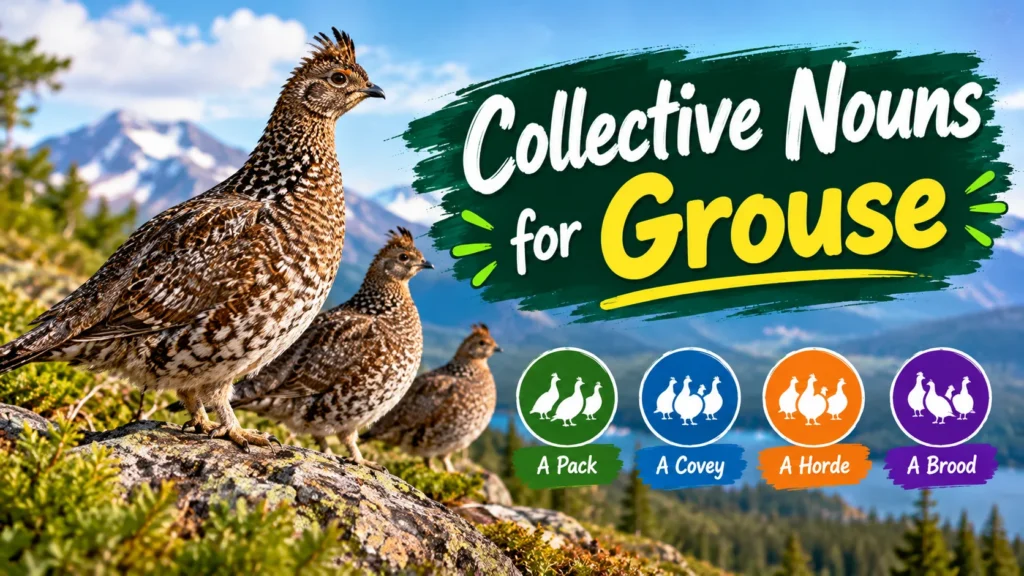
Grouse are fascinating birds with adaptations suited to life in challenging environments. Their lifespan varies by species and is influenced by predators, weather, disease, food supplies, and habitat quality. Some individuals survive for several years in the wild, although young birds face considerable risks during their early lives.
One striking physiological feature of grouse is their thick plumage, which helps provide insulation during cold weather. Many species also have feathered legs or feet that assist movement over snow or cold ground. Their body shapes, camouflage, and strong legs help them remain close to the ground, where they forage and take shelter. Male grouse in several species have distinctive courtship displays, including tail fanning, wing movements, vocalizations, and other visual signals.
Grouse diets vary by species and season. Many consume leaves, buds, seeds, berries, and other plant material; chicks often eat more insects and other small invertebrates because these foods provide important nutrients for growth. Some grouse depend heavily on particular plants, such as sagebrush or heather, making habitat conservation especially important. Their seasonal feeding habits, breeding displays, and family groups show how these birds are adapted to their surroundings.
Conclusion
Understanding the collective noun for grouse helps you describe these birds clearly and improve your English vocabulary. Covey is a recognized term for a small group of grouse, while flock may also be used in general descriptions of birds gathering together. Learning these terms makes your writing more accurate and interesting. Whether you are studying grammar or writing about wildlife, choosing suitable collective nouns helps you connect language with the natural world.
FAQs
Q1. What is the collective noun for grouse?
Covey is a recognized collective noun for grouse, particularly for a small family group. Flock is also a clear general expression.
Q2. Can I use “a flock of grouse” in a sentence?
Yes. For example: A flock of grouse moved across the meadow. It is an understandable general expression for several birds together.
Q3. What does “lek of grouse” mean?
A lek is a courtship gathering where males display to attract females. It refers to a particular breeding behavior rather than every group of grouse.
Q4. What is a brood of grouse?
A brood of grouse refers to young grouse from a family group, generally cared for by their mother.
Q5. What do grouse eat?
Depending on the species and season, grouse eat items such as seeds, buds, leaves, berries, and insects. Young chicks often consume more insects than adults.