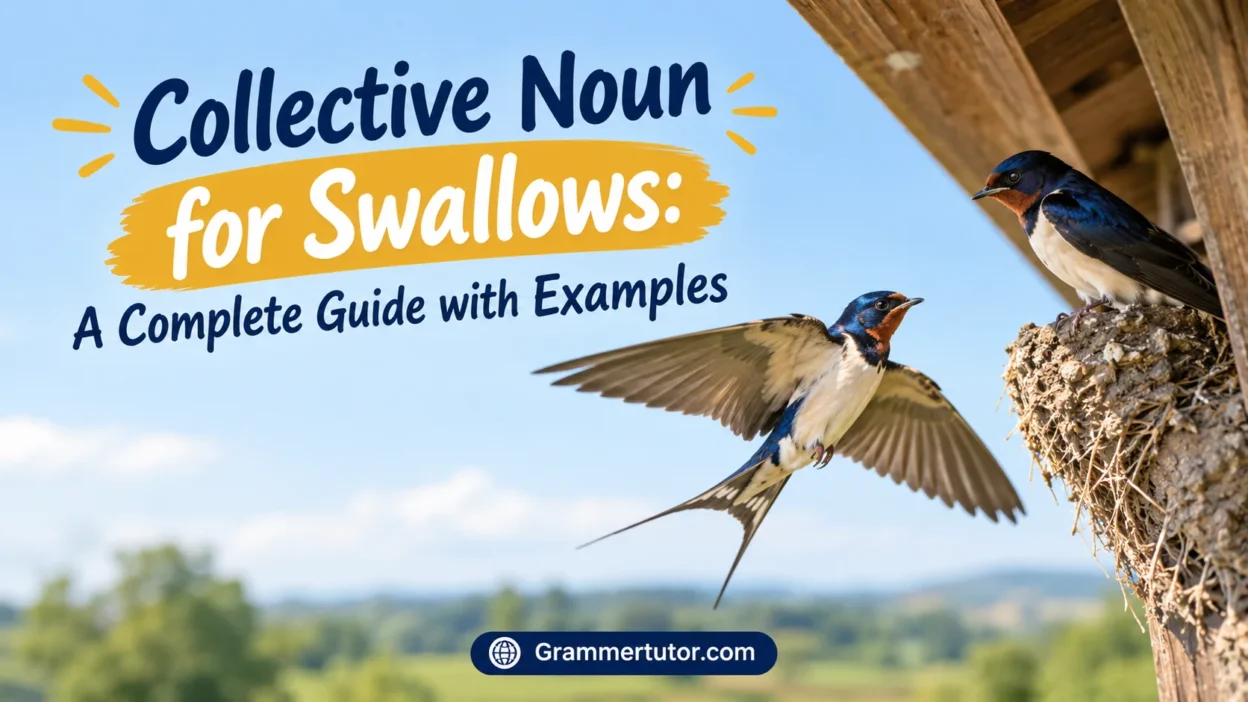
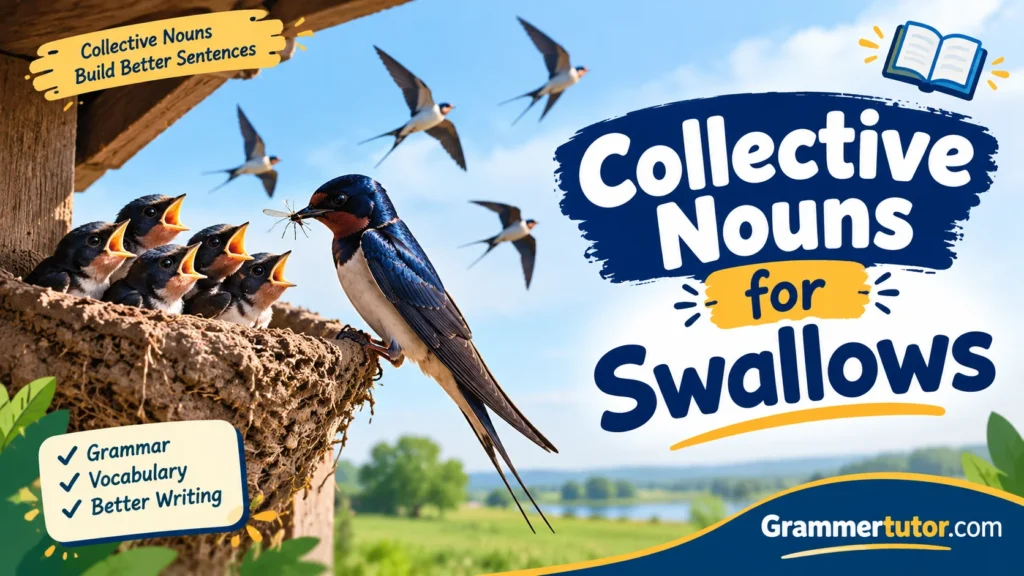
The collective noun for swallows is commonly a flight of swallows or a flock of swallows, describing these birds as they move together through the sky. These agile birds are admired for their graceful flight, swift movement, forked tails, and impressive aerial movements. When swallows gather above fields, glide across lakes, or settle on telephone wires, these group expressions help readers picture their natural behavior. Swallows belong to the Hirundinidae family and are fascinating bird species known for catching insects while flying.
Swallows often gather in considerable numbers before seasonal migration, around feeding grounds, and at communal roosting sites. Their feeding behavior involves catching insects in the air, making them skilled aerial insect hunters. A flight of swallows often describes birds moving together through the sky, while a flock can describe a group of birds gathered in one place. These bird gatherings provide useful examples of animal groups and shared activities. In English, a collective noun is a word used to describe several people, animals, or objects as one group. Learning these terms improves English vocabulary, bird vocabulary, and understanding of group terminology.
When writing about swallows, you can describe their movement, appearance, and swallow behavior in simple, clear language. For example, you might observe swallows gathering together above feeding areas or resting near their communal resting places. Such natural descriptions help readers understand the remarkable lives of these birds and develop stronger descriptive writing skills. Understanding collective expressions, collective naming, and word meanings also supports English grammar and language learning. Through bird observation, readers can learn more about roosting behavior, animal behavior, and the fascinating lives of swallows in their natural environment.
Why Do Swallows Gather in Groups?
Swallows come together for several practical reasons. During daylight hours, they may feed above meadows, wetlands, and open water where flying insects are plentiful. As evening approaches, some species assemble at communal roosting sites, including reed beds, where large numbers can settle together.
Migration is another important reason for these gatherings. Before traveling to warmer regions, swallows may form impressive flocks that move across landscapes in search of suitable resting and feeding locations. Their coordinated movements create beautiful scenes for birdwatchers.
Collective nouns help us describe these activities without lengthy explanations. A flight emphasizes movement through the air, while a flock is a familiar general term for several birds traveling or gathering together. The best expression depends on the scene you want to describe.
Collective Nouns for Swallows
| Collective Noun | Used For | Simple Example |
| Flight | Swallows moving through the air | A flight of swallows crossed the meadow. |
| Flock | Several swallows gathered or traveling together | A flock of swallows circled the lake. |
| Company | A gathering described in a general or literary way | A company of swallows rested nearby. |
| Host | A very large gathering of birds | A host of swallows filled the evening sky. |
| Gathering | Swallows assembled in one place | A gathering of swallows settled on the wires. |
| Cloud | Numerous swallows appearing together in the sky | A cloud of swallows swept above the fields. |
| Group | Any collection of swallows | A group of swallows perched on a fence. |
Note: Flock is the most familiar general expression, and flight is a useful descriptive term for birds in the air. Company, host, cloud, and gathering can describe groups in appropriate contexts, but they should not all be treated as equally established, swallow-specific collective nouns.
Flight of Swallows
A flight of swallows describes these birds as they travel through the air. Their narrow wings, streamlined bodies, and forked tails help them make quick turns while pursuing flying insects. Watching a flight of swallows can reveal how skillfully they change direction and maintain control during rapid aerial movements.
This expression works particularly well in nature writing because it highlights motion rather than simply counting birds. It can describe swallows passing over a river, darting around a barn, or moving across an open field at dusk.
Examples of “Flight of Swallows”
- A flight of swallows skimmed across the quiet pond.
- We watched a flight of swallows dart between the trees.
- A flight of swallows swept low over the wheat field.
- The photographer captured a flight of swallows against the sunset.
- A flight of swallows passed above the village rooftops.
- The children admired a flight of swallows chasing insects.
- A flight of swallows crossed the valley before evening.
- The sudden flight of swallows startled a nearby flock of sparrows.
- A flight of swallows moved gracefully above the riverbank.
- At sunrise, a flight of swallows appeared over the pasture.
Flock of Swallows
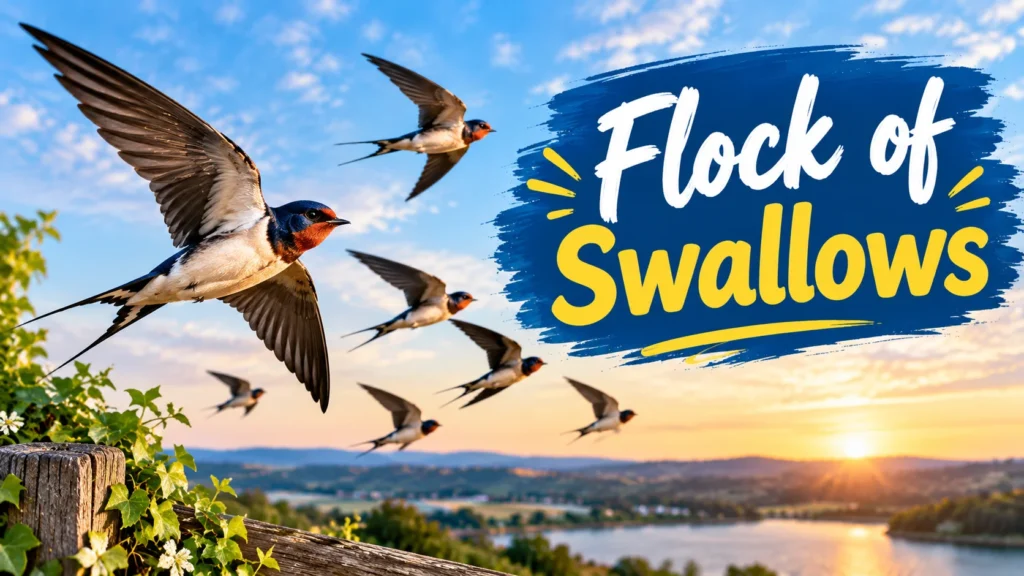
A flock of swallows is a natural, widely understood expression for several swallows gathered together or moving as a group. It is suitable for everyday conversation, schoolwork, birdwatching notes, and wildlife articles.
Swallows may form flocks while feeding, preparing for migration, or gathering near communal roosts. Their movements can look coordinated as they respond to the availability of insects and changing environmental conditions. However, not every flock follows a single leader or moves in a perfectly synchronized pattern.
The word flock is especially useful when you want a simple, clear phrase without suggesting a particular flight pattern.
Examples of “Flock of Swallows”
- A flock of swallows gathered beside the marsh.
- The flock of swallows searched for insects above the pasture.
- A flock of swallows rested along the wooden fence.
- We spotted a flock of swallows near the railway bridge.
- A flock of swallows rose above the grassland.
- The farmer noticed a flock of swallows around the barn.
- A flock of swallows gathered before their evening roost.
- The flock of swallows moved across the countryside.
- A flock of swallows circled above the orchard.
- Several children watched a flock of swallows near the stream.
Company of Swallows
A company of swallows is a descriptive expression for several birds considered together. The word company often refers to people spending time together, but English also uses it in literary and imaginative descriptions of animals.
This expression can add a gentle, poetic quality to nature writing. It is less common in everyday bird descriptions than flock, so it is best used when the style calls for variety rather than when scientific precision is the main goal.
A writer might choose this phrase when describing swallows resting near a cottage or gathering over a peaceful countryside landscape.
Examples of “Company of Swallows”
- A company of swallows rested beneath the cottage eaves.
- A company of swallows appeared above the flowering meadow.
- The company of swallows brought movement to the quiet landscape.
- A company of swallows settled near the old stone bridge.
- We admired a company of swallows circling the farmhouse.
- A company of swallows returned to the nesting area.
- The company of swallows fluttered above the garden.
- A company of swallows gathered near the river reeds.
- A company of swallows crossed the pale morning sky.
- The naturalist recorded a company of swallows near the wetland.
Host of Swallows
A host of swallows is a descriptive phrase that suggests a large number of birds. The word host is often used in English to emphasize abundance, making it useful for vivid descriptions of extensive gatherings.
This expression suits scenes in which many swallows fill the sky, particularly around feeding grounds or seasonal roosting locations. It emphasizes the impressive size of the gathering rather than a particular social structure.
Although host is not the standard everyday term specifically associated with swallows, it can be effective in literary writing and descriptive passages about wildlife.
Examples of “Host of Swallows”
- A host of swallows filled the sky above the wetlands.
- A host of swallows swept across the open countryside.
- The host of swallows gathered near the reed beds.
- A host of swallows appeared above the harvested fields.
- We watched a host of swallows descend toward the marsh.
- A host of swallows moved across the golden horizon.
- The evening sunlight illuminated a host of swallows.
- A host of swallows circled above the shallow lake.
- A host of swallows gathered near the migration route.
- The birdwatchers photographed a host of swallows at dusk.
Gathering of Swallows
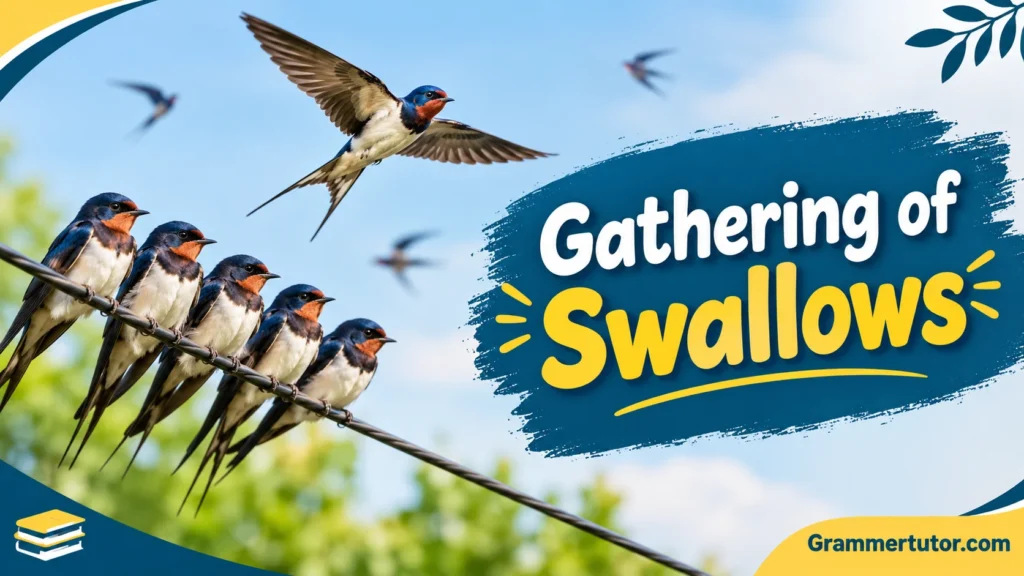
A gathering of swallows describes birds assembled in a particular place. Unlike a specialized collective noun, gathering is a general descriptive word, but it is useful when you want to emphasize the act of coming together.
Swallows may gather on overhead wires, around nesting locations, or above places where insects are abundant. Some species also congregate at traditional roosting sites, where large numbers settle together at night.
This phrase is easy to understand and works well in educational writing because it describes the situation directly without suggesting that the birds belong to a formal social unit.
Examples of “Gathering of Swallows”
- A gathering of swallows appeared along the telephone wires.
- The gathering of swallows increased as sunset approached.
- A gathering of swallows rested above the village square.
- We noticed a gathering of swallows near the reed beds.
- A gathering of swallows formed over the flooded meadow.
- The naturalist observed a gathering of swallows beside the river.
- A gathering of swallows returned to the same nesting area.
- The gathering of swallows became more noticeable before dusk.
- A gathering of swallows moved toward the shelter of the trees.
- Local birdwatchers photographed a gathering of swallows near the lake.
Cloud of Swallows
A cloud of swallows is a vivid descriptive expression for a large number of birds visible together in the sky. It compares their collective appearance to a cloud, helping readers imagine a broad, moving shape against the horizon.
This phrase is particularly effective when swallows are flying in large numbers over open fields or wetlands. Their rapid turns and changing positions can make the gathering appear to expand, contract, or ripple as the birds move.
Although cloud is not the most conventional general collective noun for swallows, it can make descriptive writing more engaging when the visual effect is important.
Examples of “Cloud of Swallows”
- A cloud of swallows swept above the sunflower fields.
- We saw a cloud of swallows moving across the distant hills.
- A cloud of swallows darkened a small section of the evening sky.
- The cloud of swallows drifted above the wetland.
- A cloud of swallows gathered over the open pasture.
- The sunset formed a beautiful background for a cloud of swallows.
- A cloud of swallows moved rapidly above the river.
- The observer watched a cloud of swallows change direction.
- A cloud of swallows appeared near the coastal grassland.
- The distant cloud of swallows gradually disappeared from view.
Group of Swallows
A group of swallows is a straightforward expression for several birds found together. It is useful whenever you want to avoid uncertainty about specialized collective nouns or simply describe what you observe.
The expression can refer to swallows resting on branches, feeding over a meadow, or gathering near buildings. It does not imply that the birds are following a particular migration pattern or using a communal roost.
Because group is a general term, it fits formal and informal writing alike. It is also an easy phrase for young learners to understand and use correctly.
Examples of “Group of Swallows”
- A group of swallows perched along the garden wall.
- We counted a group of swallows near the old farmhouse.
- A group of swallows fed above the grassy hillside.
- The group of swallows rested after a long period of flight.
- A group of swallows gathered around the nesting boxes.
- The students observed a group of swallows through binoculars.
- A group of swallows moved between the nearby buildings.
- The group of swallows searched for food above the pond.
- A group of swallows settled on the branches of a willow.
- The wildlife photographer followed a group of swallows across the field.
Types of Swallows and Their Characteristics
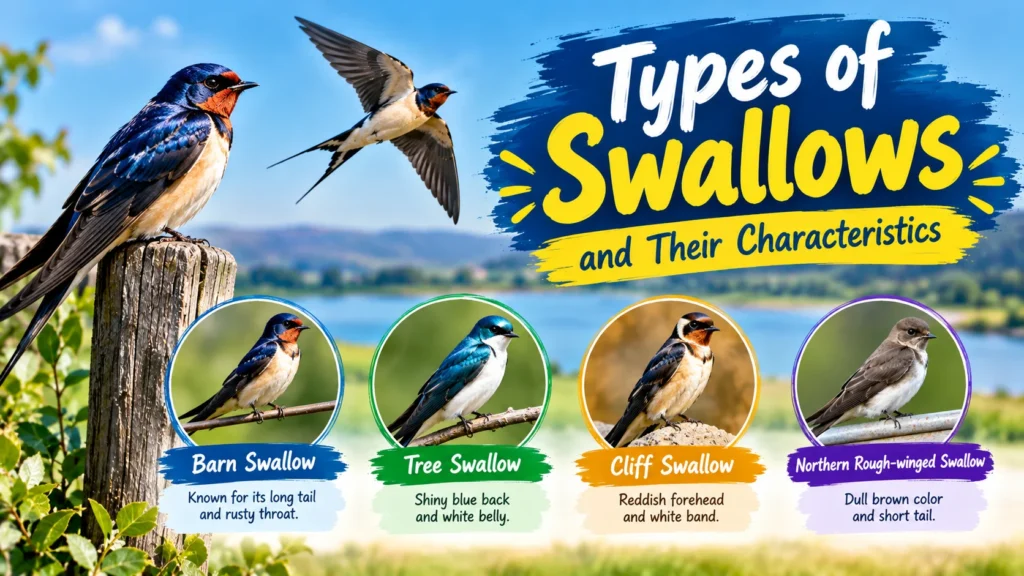
Swallows belong to the family Hirundinidae, which includes many species adapted to catching insects in flight. The barn swallow is famous for its deeply forked tail and glossy blue upperparts, while the tree swallow is known for its iridescent blue-green coloring and white underparts. Other species, such as the cliff swallow and bank swallow, have distinctive nesting habits and physical features.
Many swallows have long, pointed wings that support fast, agile flight. Their relatively wide mouths help them capture small flying insects while moving through the air. These birds often feed over water, fields, grasslands, and other locations where insects are plentiful.
Their nesting behavior varies by species. Barn swallows commonly build cup-shaped mud nests on sheltered structures, while bank swallows excavate nesting tunnels in sandy banks. Cliff swallows construct enclosed mud nests, often in colonies. These differences show that swallows share certain adaptations while displaying a wide range of behaviors.
Examples of Swallow Characteristics
- Barn swallows have long, forked tails.
- Tree swallows often display iridescent upperparts.
- Cliff swallows build distinctive mud nests.
- Bank swallows excavate tunnels in suitable sandy banks.
- Many swallows catch insects while flying.
- Their pointed wings help them maneuver through the air.
- Several swallow species migrate seasonally.
- Some swallows gather at communal roosting sites.
- Swallows often nest near open areas with plentiful food.
- Their aerial feeding habits make them fascinating birds to observe.
Interesting Facts About Swallows
Swallows have fascinating life histories, specialized body structures, and feeding habits that support their active lifestyles. Their lifespan varies by species and environmental conditions, and some individuals survive for several years in the wild. Survival depends on factors such as food availability, weather, predators, disease, and the demands of migration. Their streamlined bodies, pointed wings, and forked tails help many species perform rapid aerial maneuvers, while their relatively broad mouths make catching insects in flight more efficient.
Swallows are insectivorous birds, meaning that insects form the main part of their diet. They commonly feed on flies, mosquitoes, beetles, and other small invertebrates, depending on what is available in their habitat. By consuming flying insects, they play a useful role in many ecosystems. Their feeding activity often brings them over ponds, wetlands, farmland, and meadows where insects gather. Unlike mammals, swallows do not have teeth for chewing; they swallow much of their small prey whole.
Migration is another remarkable aspect of swallow behavior. Some species travel long distances between breeding grounds and wintering areas, relying on suitable feeding habitats along the way. Before or during these journeys, swallows may assemble in large flocks or gather at communal roosts. Their group behavior offers protection through numbers and allows many birds to use productive feeding or resting locations. These biological traits explain why expressions such as flight of swallows and flock of swallows are useful in describing different scenes involving these remarkable birds.
Conclusion
Understanding the collective noun for swallows makes it easier to describe these graceful birds and their behavior. A flight of swallows and a flock of swallows are common expressions used when discussing swallows moving through the sky or gathering together. Learning these terms improves your English vocabulary, strengthens your writing, and helps you describe bird behavior clearly.
FAQs
Q1. What is the collective noun for swallows?
Flight of swallows is a useful descriptive expression, while flock of swallows is a familiar general term for a group of these birds.
Q2. Is “flock of swallows” correct?
Yes. Flock of swallows is grammatically correct and widely understandable. It can describe swallows feeding, resting, or traveling together.
Q3. What does “flight of swallows” mean?
A flight of swallows describes swallows moving through the air. The expression emphasizes their movement and graceful aerial behavior.
Q4. Do swallows gather in large numbers?
Yes. Some swallow species form large gatherings at feeding locations and communal roosts, especially during particular seasons and before migration.
Q5. What is the difference between a flight and a flock of swallows?
A flight emphasizes birds in the air, while a flock is a more general term for birds gathered or traveling together.