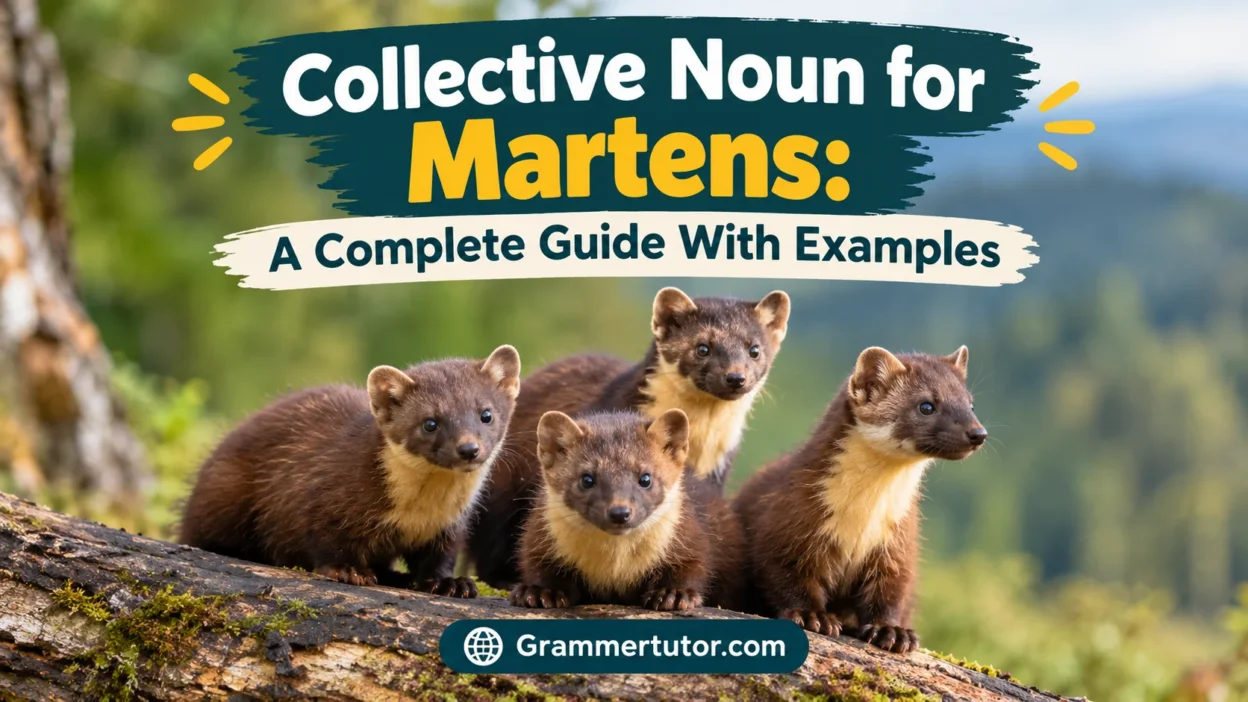
The collective noun for martens does not have one universally established, species-specific answer. The phrase group of martens is a clear and accurate general expression for these agile, furry mammals. Martens belong to the weasel family, scientifically known as Mustelidae, and have slender bodies, bushy tails, sharp claws, and excellent climbing abilities. When several martens appear in the same area, using a simple expression helps you describe them naturally and accurately.
Martens usually lead solitary lives, spending much of their time hunting, climbing trees, and exploring territories. They may encounter one another during the mating season, while mothers care for their young animals in sheltered dens. Understanding their animal behavior, habits, and surroundings helps explain why different expressions may fit particular situations. For example, pair can describe two martens, while family may refer to a mother and her young. Although colony is sometimes used to describe animal groups, it is not a universally recognized collective noun specifically for martens.
Learning collective nouns can strengthen English vocabulary and support vocabulary development. Whether you are studying animal behavior, preparing a school assignment, or exploring the English language, choosing natural expressions improves clear communication. For example, “A group of martens was exploring the forest” provides an engaging and accurate description. In my experience, simple wording often works best when writing about wildlife, mammals, and animal groups. By understanding their habits and depending on the context when choosing terms, you can describe martens clearly and accurately and make your wildlife writing, English learning, and language learning more effective.
Why Are Collective Nouns Used for Martens?
Collective nouns allow writers to describe multiple animals together without repeating the same words. They also help readers picture how animals gather, interact, or live in their natural habitats.
Martens are generally solitary and territorial, so they are not typically found in large, permanent social communities like some other mammals. A mother marten may live with her kits, while two adults might come together during the breeding season. In these situations, expressions such as a family of martens or a pair of martens can communicate the relationship between the animals.
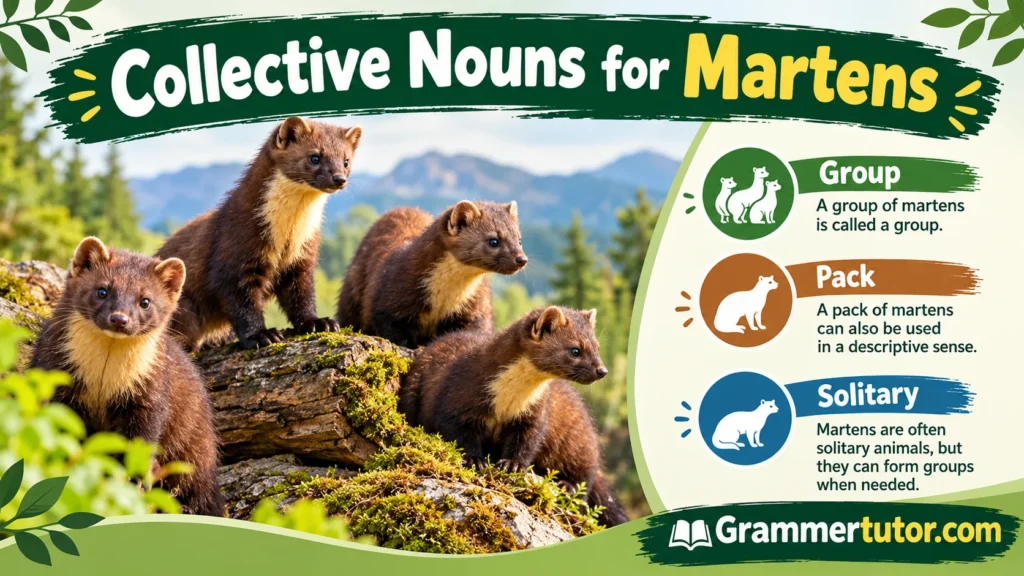
For general descriptions, a group of martens is the safest and most natural choice. The expression a richness of martens occasionally appears in informal lists of animal collective nouns, but it is not a commonly established term in everyday English.
Collective Nouns for Martens
| Collective Noun | Used For | Simple Example |
| Group | Martens considered together | A group of martens appeared near the woodland. |
| Family | A mother marten and her offspring | A family of martens rested inside a den. |
| Pair | Two martens together | A pair of martens crossed the forest trail. |
| Litter | Young martens born to the same mother | A litter of martens slept in the nest. |
| Colony | A group living in the same general area; not a standard marten-specific term | A colony of martens is discussed in the wildlife report. |
Note: Group is the most reliable general expression. Family, pair, and litter describe particular relationships or circumstances. Colony is a general term and should not be taken to mean that martens normally form organized colonies.
Group of Martens
A group of martens refers to several members of the marten family found together or discussed as a unit. This expression works in wildlife reports, educational materials, and everyday conversation without suggesting that the animals always live socially.
Martens may encounter one another around suitable habitats or during the breeding season. However, their interactions depend on the species, time of year, and availability of food and shelter. Since many martens maintain separate territories, a gathering may be temporary rather than a lasting social group.
Examples of “Group of Martens”
- A group of martens was spotted near the rocky hillside.
- We watched a group of martens moving through the woodland.
- A group of martens explored the forest floor after sunset.
- The wildlife photographer captured a group of martens near an old tree.
- A group of martens appeared on the trail camera footage.
- Researchers recorded a group of martens in the mountain habitat.
- A group of martens searched among fallen branches.
- The children learned about a group of martens during their nature lesson.
- A group of martens moved between the trees in the early morning.
- The documentary featured a group of martens in their natural surroundings.
Family of Martens
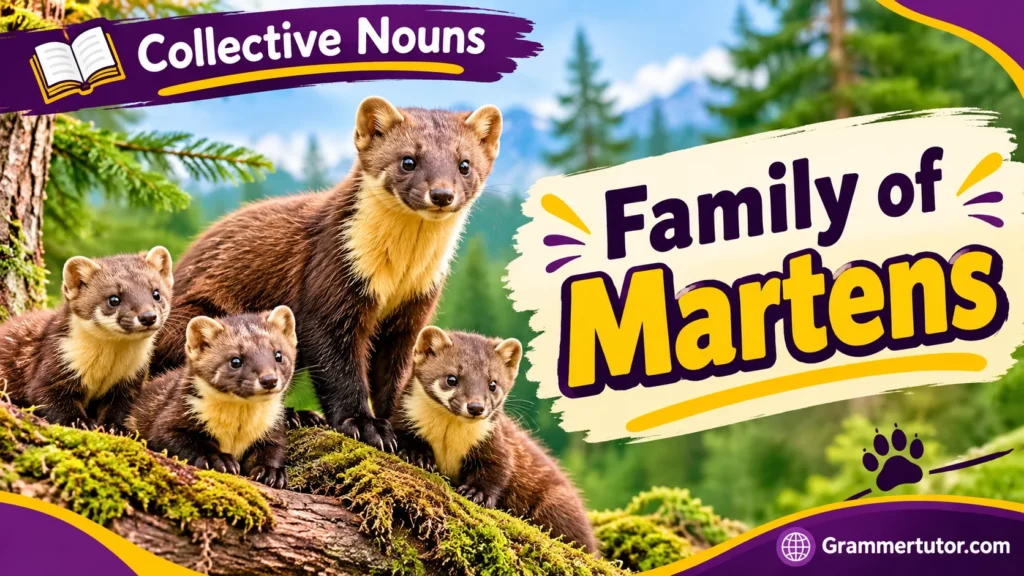
A family of martens describes related animals, particularly a mother and her offspring. Female martens raise their young in protected dens, which may be located in tree cavities, hollow logs, rock crevices, or other sheltered places.
Young martens depend on their mother for nourishment, warmth, and protection during their early development. As they grow, they become more active and gradually learn the skills required to survive independently. A family is therefore a useful expression when describing a mother marten caring for her young.
Examples of “Family of Martens”
- A family of martens sheltered inside a hollow tree.
- The naturalist discovered a family of martens near the ridge.
- A family of martens rested in a secluded woodland den.
- The mother led her family of martens through the undergrowth.
- A family of martens remained hidden during the daytime.
- The wildlife film showed a family of martens exploring their surroundings.
- A family of martens occupied a protected space among the rocks.
- The researcher observed a family of martens from a distance.
- A family of martens emerged from its shelter at dusk.
- The forest guide explained how a family of martens raises its young.
Pair of Martens
A pair of martens refers to two animals together. The phrase is useful when describing two martens encountered in the wild, particularly during the breeding season. It does not necessarily mean that the animals are a permanent couple.
Adult martens often spend time alone outside their breeding period. Their interactions may be brief, and their territories can vary depending on habitat quality, food supplies, and the particular species. The word pair simply identifies two animals without making assumptions about their relationship.
Examples of “Pair of Martens”
- A pair of martens climbed the trunk of a pine tree.
- We noticed a pair of martens near the mountain stream.
- A pair of martens crossed the narrow woodland path.
- The camera recorded a pair of martens after dark.
- A pair of martens explored a rocky ledge.
- The ranger spotted a pair of martens near the old bridge.
- A pair of martens moved quietly through the ferns.
- A pair of martens disappeared beneath a fallen log.
- The naturalist photographed a pair of martens in the forest.
- A pair of martens appeared beside the snow-covered trail.
Litter of Martens
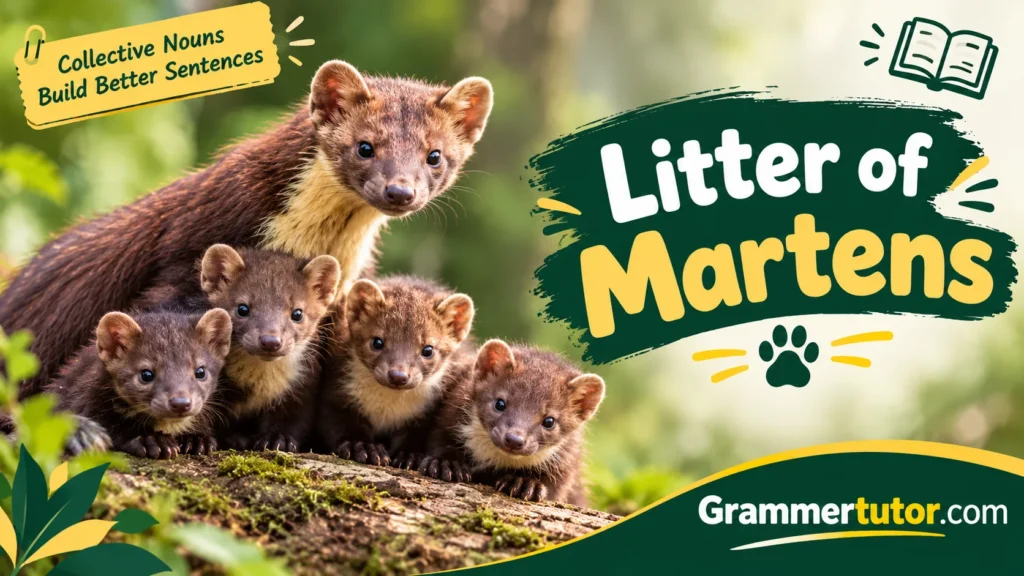
A litter of martens refers to the young born to one mother during a single reproductive period. Unlike groups, which can refer to animals of different ages and relationships, litter specifically describes offspring born together.
Depending on the species and environmental conditions, a female marten gives birth to several kits in a sheltered nesting place. The newborns are vulnerable and rely on their mother for care. As they develop, their senses, coordination, and hunting abilities improve, preparing them for independent life.
Examples of “Litter of Martens”
- A litter of martens slept safely inside the den.
- The mother watched over her litter of martens.
- A litter of martens began moving around the nesting chamber.
- The wildlife specialist examined photographs of a litter of martens.
- A litter of martens remained close to its mother.
- The forest camera captured a litter of martens at the den entrance.
- A litter of martens grew stronger during the spring.
- The mother carried food back to her litter of martens.
- A litter of martens rested beneath a covering of dry leaves.
- The researcher documented the development of a litter of martens.
Colony of Martens
A colony of martens is a possible general description for several martens living within the same broad area, but it is not a standard species-specific collective noun. The word colony is more strongly associated with animals that live in organized or closely connected communities.
Martens generally do not behave like highly social colony-forming animals. They tend to maintain individual territories and forage independently. Several martens may inhabit the same woodland region, but that does not necessarily mean they share a den or cooperate as a social unit.
For this reason, a group of martens is usually more accurate when the animals’ relationships are unknown. The word colony may be used descriptively when a source specifically defines a local aggregation, but it should not imply a typical social structure for martens.
Examples of “Colony of Martens”
- The report discussed several martens inhabiting the same forest region.
- Researchers mapped the territories of martens in the woodland.
- The wildlife team documented multiple martens living across the reserve.
- Several martens were recorded in the same mountain habitat.
- The survey examined the distribution of martens across the valley.
- The naturalist described martens occupying nearby forest territories.
- The camera network detected martens at several woodland locations.
- The research team compared marten sightings from different habitats.
- Several martens were observed within the wider study area.
- The field report described the local distribution of martens.
Types of Martens and Their Characteristics
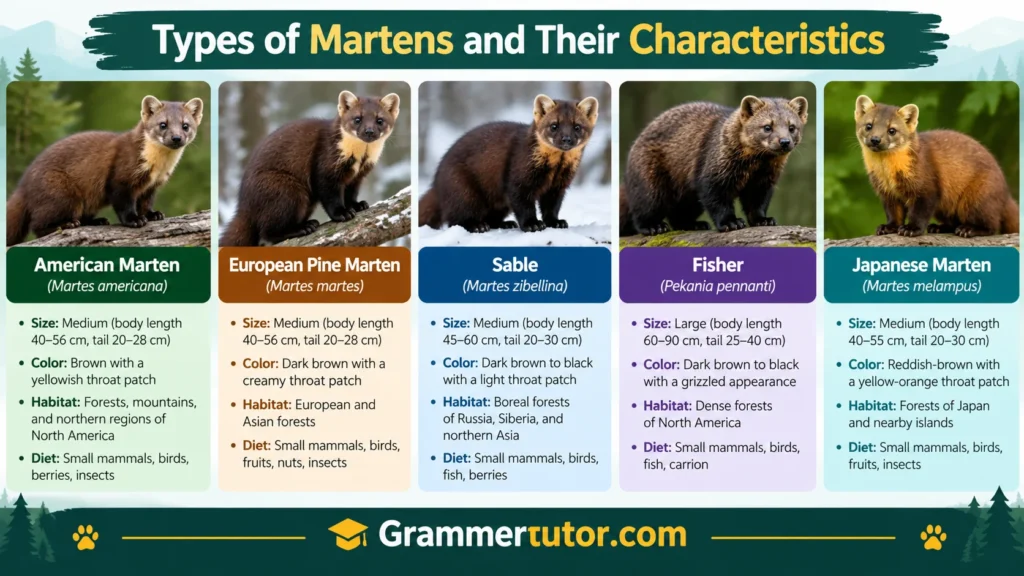
Martens include several species distributed across parts of Europe, Asia, and North America. The American marten, European pine marten, and sable are well-known members of this group. Although they share many physical traits, their fur color, body size, preferred habitats, and geographical ranges differ.
Most martens have long, flexible bodies, short legs, rounded ears, and bushy tails that help them maintain balance while moving through trees and across uneven terrain. Their sharp claws and strong limbs make them skilled climbers. Their dense coats provide insulation in cold environments, particularly for species living in northern forests and mountainous regions.
Martens inhabit a range of wooded environments, including coniferous forests, mixed woodlands, and areas with abundant natural cover. Some species spend considerable time in trees, while others also forage extensively on the ground. Their habitat choices depend on food availability, shelter, climate, and the presence of suitable nesting sites.
Examples of Marten Characteristics
- American martens inhabit forested regions of North America.
- European pine martens are skilled climbers.
- Sables are known for their dense, valuable-looking coats.
- Martens have elongated bodies and bushy tails.
- Their sharp claws help them climb tree trunks.
- Many martens are most active around dusk or at night.
- Tree cavities can provide shelter for resting and raising young.
- Martens use their keen senses to locate prey.
- Different marten species have different geographical ranges.
- Forest cover offers protection and access to food.
Interesting Facts About Martens
Martens are fascinating mammals with physical and behavioral adaptations suited to woodland life. Their longevity varies by species and living conditions. Individuals may survive for several years in the wild, while some can live longer under favorable conditions or in captivity. Predation, disease, habitat changes, food availability, and human activity can influence their survival. Their flexible bodies, sharp claws, and bushy tails help them climb and move across branches, while their dense fur offers insulation in cold weather.
Martens are carnivorous mammals, but many species have varied diets. They may eat small rodents, birds, eggs, insects, and other invertebrates. Depending on the season and what is available, fruits and berries can also form part of their diet. This flexibility allows them to take advantage of different food sources throughout the year. Their hunting habits also influence local ecosystems by helping regulate populations of small animals.
Another interesting feature of martens is their generally solitary lifestyle. Many adults occupy individual territories and use sheltered locations to rest or raise their young. Mothers care for their kits until they become increasingly independent. Although several martens may be found within the same forest, this does not automatically mean that they live in a permanent social group. These biological traits make expressions such as group of martens, family of martens, and litter of martens useful in different contexts.
READ MORE: Collective Noun for Birds: A Complete Guide With Examples
Conclusion
The collective noun for martens is not officially established as one specific term, so group of martens is a clear and natural choice. Understanding their behavior, solitary habits, and family interactions helps you describe these fascinating mammals accurately. Whether you are improving your English vocabulary, completing a school assignment, or writing about wildlife, choosing simple and appropriate expressions makes your writing clearer and more engaging.
FAQs
Q1. What is the collective noun for martens?
Group of martens is a clear general expression. There is no single universally established collective noun specifically associated with all marten species.
Q2. Can I say “a group of martens”?
Yes. A group of martens is grammatically correct and suitable for describing several martens together without making assumptions about their social behavior.
Q3. Is “family of martens” correct?
Yes. Family of martens is appropriate when describing related animals, particularly a mother and her offspring.
Q4. What is a baby marten called?
A young marten is commonly called a kit. Several young born to the same mother are referred to as a litter.
Q5. What is a litter of martens?
A litter of martens refers to the young born to one female during a single reproductive period.