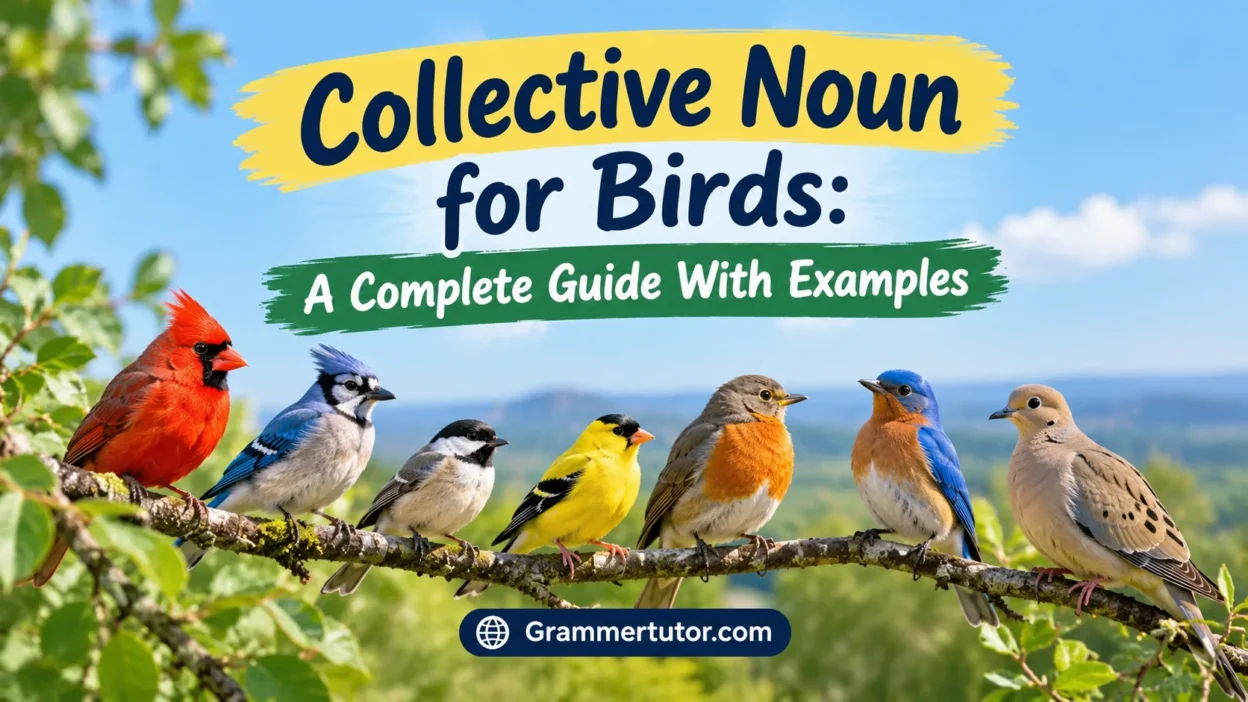
The collective noun for birds helps us describe birds gathered together, making our English sentences clearer, more natural, and easier to understand. A flock of birds is the most common expression used when several birds travel, feed, or rest together. However, English also has special group names, such as a murder of crows, a parliament of owls, and a gaggle of geese.
These collective nouns, expressions, and terms add variety and color to the English language. Learning these names can improve vocabulary, strengthen language skills, and help students, writers, and English learners create more meaningful sentences and vivid descriptions. Birds live in different natural environments, including tropical rainforests, open grasslands, wetlands, mountains, and residential gardens.
Their habits and behavior influence how they gather. Some bird species form enormous gatherings, while others prefer to stay alone or with a mate. Observing their feeding behavior, resting behavior, and group behavior helps nature enthusiasts understand wildlife more clearly. Whether you are preparing a school assignment, writing a wildlife article, or practicing nature writing, using the correct bird group names can make your writing more precise and interesting.
What Is the Collective Noun for Birds?
The most widely used collective noun for birds is flock. It refers to several birds gathered or moving together. However, English also contains traditional expressions associated with particular species.
Here are some common examples:
- Flock of sparrows: Small birds gathered in a group.
- Murder of crows: A traditional expression for a gathering of crows.
- Parliament of owls: A traditional collective noun associated with owls.
- Gaggle of geese: A familiar term for geese gathered on the ground.
- Convocation of eagles: A traditional expression for a gathering of eagles.
- Murmuration of starlings: A group of starlings flying in coordinated patterns.
- Colony of penguins: Penguins living or breeding together in a particular area.
The appropriate expression depends on the bird species and the situation. Some terms are widely used in everyday English, while others are traditional names that appear more often in books about animals and language.
Why Do We Use Collective Nouns for Birds?
Collective nouns allow us to describe multiple birds without repeating the same word several times. Instead of writing, “Many birds flew across the sky,” you can write, “A flock of birds crossed the horizon.”
These expressions also help readers imagine a particular scene. A murmuration of starlings suggests coordinated aerial movement, while a gaggle of geese often brings to mind birds gathered together on land.
Birds form groups for several reasons, including finding food, avoiding predators, migrating, nesting, and communicating with others of their species. Some gatherings are temporary, while others form around breeding colonies or established habitats.
Choosing an appropriate collective noun makes descriptions more precise and connects language with the fascinating behavior of birds.
Common Collective Nouns for Birds
| Collective noun | Simple example |
| Flock | A flock of finches visited the orchard. |
| Murder | A murder of crows circled the field. |
| Parliament | A parliament of owls appeared in the illustration. |
| Gaggle | A gaggle of geese crossed the meadow. |
| Murmuration | A murmuration of starlings swept across the evening sky. |
| Colony | A colony of penguins gathered along the shore. |
| Convocation | A convocation of eagles gathered near the cliffs. |
Note: Flock is the safest general choice for birds when no species-specific term is needed. Several of the other expressions are traditional collective nouns, and their everyday use varies.
Flock of Birds
A flock of birds describes several birds gathered or traveling together. This expression applies to many species, including finches, sparrows, pigeons, and swallows. Birds may form flocks while searching for food, resting in suitable habitats, or moving between locations.
Flocking can provide advantages. Birds may locate food more efficiently by observing others, and a large gathering can make it harder for predators to focus on a single individual. However, flocking behavior varies widely among species.
Examples of “Flock of Birds”
- A flock of finches fluttered above the sunflower patch.
- A flock of swallows darted across the riverbank.
- A flock of pigeons settled on the old clock tower.
- A flock of herons moved through the shallow marsh.
- A flock of parakeets chattered among the mango trees.
- A flock of larks rose from the wheat field.
- A flock of storks circled above the countryside.
- A flock of sandpipers searched the muddy shoreline.
- A flock of cranes passed over the distant hills.
- A flock of canaries sang from their spacious aviary.
Murder of Crows
A murder of crows is a traditional collective noun for crows. Although the expression sounds dramatic, it is simply an established phrase in English rather than a description of violent behavior.
Crows are intelligent birds that can solve problems, recognize familiar individuals, and adapt to changing environments. They may gather at feeding sites, communal roosts, or places where food is available.
The word murder is memorable because it differs from the ordinary collective noun flock. It is especially popular in literary writing, quizzes, and discussions about unusual animal group names.
Examples of “Murder of Crows”
- A murder of crows gathered beside the harvested field.
- A murder of crows called loudly from the bare branches.
- A murder of crows searched the roadside for scraps.
- A murder of crows appeared above the village rooftops.
- A murder of crows settled near the woodland entrance.
- A murder of crows watched the farmer working outdoors.
- A murder of crows moved between the telephone poles.
- A murder of crows gathered around an open meadow.
- A murder of crows flew past the ruined stone wall.
- A murder of crows rested in the tall pine trees.
Parliament of Owls
A parliament of owls is a traditional collective noun associated with owls. The word parliament usually refers to a legislative assembly, but in this expression, it provides a distinctive name for a gathering of these birds.
Owls are known for their forward-facing eyes, specialized hearing, and adaptations for hunting in low light. Many species are most active at night, although some hunt during daylight or at twilight.
In actual behavior, owls are not always highly social. Many species hunt alone and maintain individual territories. Therefore, parliament of owls is best understood as a traditional expression rather than a claim that owls regularly gather in large assemblies.
Examples of “Parliament of Owls”
- A parliament of owls appeared in the wildlife illustration.
- A parliament of owls watched from the woodland branches.
- A parliament of owls featured in the children’s story.
- A parliament of owls rested among the ancient trees.
- A parliament of owls became the subject of the nature lesson.
- A parliament of owls appeared on the illustrated poster.
- A parliament of owls inspired the artist’s latest painting.
- A parliament of owls was mentioned in the vocabulary exercise.
- A parliament of owls featured in the wildlife documentary.
- A parliament of owls stood out in the animal-name collection.
Gaggle of Geese
A gaggle of geese is a familiar collective noun for geese, particularly when they gather on the ground. When geese fly together, the word flock is also appropriate.
Geese are waterbirds often found near lakes, rivers, wetlands, and grassy areas. Many species are social and communicate through honking, body movements, and other calls. Some migrate over long distances, often traveling in recognizable formations.
The word gaggle is especially useful in everyday descriptions because it refers to geese gathered together in a group.
Examples of “Gaggle of Geese”
- A gaggle of geese wandered across the village green.
- A gaggle of geese grazed beside the quiet pond.
- A gaggle of geese approached the wooden footbridge.
- A gaggle of geese gathered near the lakeside reeds.
- A gaggle of geese honked beside the farmyard gate.
- A gaggle of geese splashed in the shallow water.
- A gaggle of geese explored the grassy riverbank.
- A gaggle of geese rested beneath the willow trees.
- A gaggle of geese followed the keeper toward the feeding area.
- A gaggle of geese crossed the open pasture at sunrise.
Murmuration of Starlings
A murmuration of starlings describes a gathering of starlings, especially when they fly together in large, coordinated patterns. Their aerial displays can create flowing shapes that appear to ripple across the sky.
Starlings respond to the movements of nearby birds, allowing the flock to change direction rapidly. These coordinated movements may help reduce the risk of predation, although the exact benefits can depend on the circumstances.
The term murmuration is one of the most distinctive bird-related collective nouns because it refers to a remarkable natural spectacle as well as a group of birds.
Examples of “Murmuration of Starlings”
- A murmuration of starlings twisted above the open fields.
- A murmuration of starlings formed dark patterns against the sunset.
- A murmuration of starlings streamed toward the distant trees.
- A murmuration of starlings changed direction in a sudden wave.
- A murmuration of starlings gathered above the wetland.
- A murmuration of starlings created rippling shapes in the sky.
- A murmuration of starlings passed over the railway bridge.
- A murmuration of starlings descended toward their evening roost.
- A murmuration of starlings fascinated the visitors watching from the hill.
- A murmuration of starlings moved across the horizon before dusk.
Colony of Penguins
A colony of penguins describes penguins living or breeding together in the same area. Colonies can contain large numbers of birds, particularly during the breeding season.
Penguins are flightless birds adapted to swimming. Their wings function as powerful flippers, helping them move through the water in search of food. Depending on the species, penguins may feed on fish, krill, squid, and other marine animals.
Living in colonies can help penguins find mates and raise their young in crowded breeding areas. However, colony size, nesting behavior, and social organization differ among species.
Examples of “Colony of Penguins”
- A colony of penguins occupied the rocky Antarctic shoreline.
- A colony of penguins gathered around their nesting sites.
- A colony of penguins waddled across the icy ground.
- A colony of penguins rested beside the cold southern sea.
- A colony of penguins cared for their chicks.
- A colony of penguins entered the water to find food.
- A colony of penguins crowded together during a cold spell.
- A colony of penguins returned to its breeding area.
- A colony of penguins attracted researchers studying seabirds.
- A colony of penguins moved between the nesting grounds and the ocean.
Convocation of Eagles
A convocation of eagles is a traditional collective noun used for a gathering of eagles. The word convocation commonly means an assembly of people, but it also appears in lists of specialized animal group names.
Eagles are powerful birds of prey with strong feet, curved talons, and hooked beaks. They hunt or scavenge for food depending on the species and circumstances. Many eagles have excellent eyesight, which helps them detect prey from a distance.
Although eagles may gather around abundant food sources or suitable habitats, many species spend much of their time alone or in pairs. The expression convocation of eagles is therefore more traditional than a description of their usual daily behavior.
Examples of “Convocation of Eagles”
- A convocation of eagles appeared in the wildlife calendar.
- A convocation of eagles soared above the rugged mountains.
- A convocation of eagles inspired the painter’s landscape.
- A convocation of eagles was featured in the nature exhibition.
- A convocation of eagles appeared in the illustrated bird guide.
- A convocation of eagles circled above the broad valley.
- A convocation of eagles became the focus of the school project.
- A convocation of eagles rested near the distant cliffs.
- A convocation of eagles appeared in the documentary’s opening scene.
- A convocation of eagles symbolized strength in the fictional story.
Interesting Facts About Birds
Birds are warm-blooded vertebrates with feathers, beaks, and lightweight skeletons adapted to their different ways of life. Their lifespans vary considerably: some small songbirds live only a few years in the wild, while certain parrots and albatrosses can survive for several decades. Their physical features are equally diverse. Hummingbirds can hover while feeding, penguins use their wings to propel themselves underwater, and owls have specialized feathers that help many species fly quietly.
Bird diets depend on their species and habitat. Some eat seeds and fruits, others catch insects, and birds of prey hunt animals such as rodents, fish, or other birds. Many waterbirds feed on aquatic organisms, while nectar-feeding birds obtain energy from flowers. Their social behavior also varies. Some species migrate in enormous flocks, starlings perform coordinated aerial displays, and seabirds may breed in dense colonies. Others defend territories or spend much of the year alone. These differences explain why collective nouns are so interesting: each expression offers a way to describe a particular gathering while encouraging us to learn more about the birds themselves.
READ MORE: Collective Noun for Yaks: Names for Groups, and Interesting Facts
Conclusion
Understanding the collective noun for birds makes it easier to describe bird groups in simple and accurate English. While a flock of birds is the most familiar expression, terms such as a murder of crows, a parliament of owls, and a gaggle of geese add variety to our vocabulary. Learning these collective nouns helps students, writers, and nature enthusiasts improve their writing skills, describe wildlife more clearly, and create more meaningful sentences.
FAQs
Q1. What is the collective noun for birds?
The most common collective noun for birds is flock. Other expressions include murder of crows, parliament of owls, and gaggle of geese.
Q2. What is a group of birds called?
A group of birds is generally called a flock. The appropriate term may change depending on the species and the situation.
Q3. What is the collective noun for crows?
A traditional collective noun for crows is a murder of crows. The word flock is also correct when describing crows gathered together.
Q4. What is the collective noun for owls?
A parliament of owls is a traditional collective noun. A group of owls can also be described simply as a group or flock, depending on the context.
Q5. What is a group of geese called?
A group of geese on the ground is commonly called a gaggle of geese. When they are flying, a flock of geese is also appropriate.