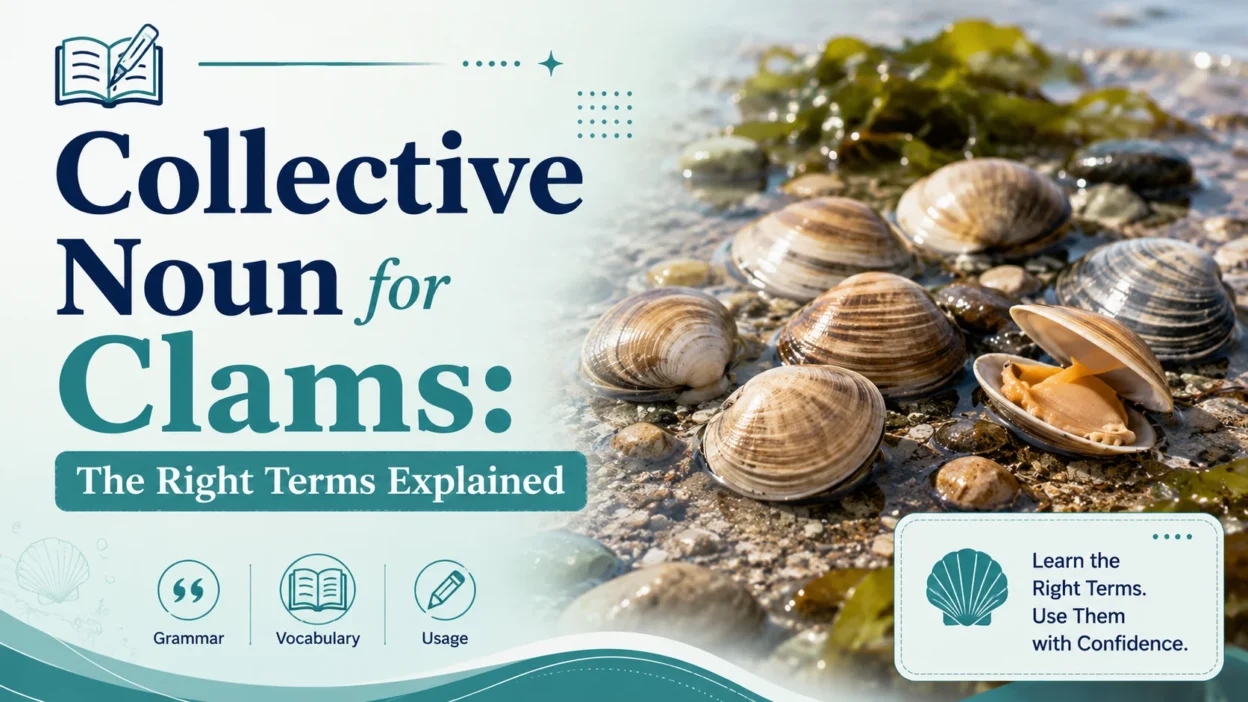
The collective noun for clams is a bed of clams, describing shellfish living together across an area of the seafloor. This term makes the group easier to picture.
A bed refers to many clams gathered in one place, while colony, cluster, and group can also describe clams in different situations. These expressions are useful when describing how clams live and gather.
In English, these descriptive terms make sentences more interesting and useful for wildlife writing, marine studies, and everyday descriptions. They help you understand how clams interact with their surrounding environment as a single unit.
Why Collective Nouns Are Used for Clams
Clams are bivalve mollusks that commonly live in groups or dense populations beneath or on the seafloor, in mud, sand, or gravel. When many clams occupy the same area, describing them as a bed of clams gives a clearer picture than simply saying many clams.
Different expressions can emphasize different aspects of a clam population. Bed is especially useful for clams living together in a particular marine or coastal area, while cluster describes clams gathered closely together. Colony and group can also be used as general descriptive terms.
Collective Nouns for Clams
| Collective Noun | Used For | Simple Example |
| Bed | A large group of clams living in one area | A bed of clams covered the seafloor. |
| Colony | A group of clams living together | A colony of clams lived near the shore. |
| Cluster | Clams gathered closely together | A cluster of clams rested in the sand. |
| Group | A general collection of clams | A group of clams was found in the mud. |
Bed of Clams
A bed is one of the most useful collective terms for clams. It refers to an area where many clams live together, often beneath sediment in coastal or marine environments.
The expression a bed of clams is particularly appropriate when discussing clam populations, shellfish habitats, or areas where clams are found in large numbers.
Examples of “Bed of Clams”
- A bed of clams covered the sandy seafloor.
- Fishermen discovered a bed of clams near the shore.
- A large bed of clams lived beneath the mud.
- The researchers studied the bed of clams.
- A bed of clams was found in the shallow water.
- The bed of clams provided food for marine animals.
- Divers observed a bed of clams beneath the waves.
- The coastal area contained a healthy bed of clams.
- A bed of clams stretched along the seabed.
- Scientists monitored the bed of clams carefully.
Colony of Clams
A colony of clams can describe a group or population of clams living together in the same area. The term colony is a general biological expression and can be useful when emphasizing that many organisms occupy a shared habitat.
However, bed is often more natural when specifically describing a dense area of clams.
Examples of “Colony of Clams”
- A colony of clams lived near the coast.
- Scientists discovered a colony of clams underwater.
- The colony of clams occupied the sandy bottom.
- A large colony of clams grew beneath the sediment.
- Researchers examined the colony of clams.
- The colony of clams survived in shallow water.
- A colony of clams was found near the estuary.
- The divers observed the colony of clams.
- The colony of clams provided habitat for other organisms.
- Scientists monitored the colony of clams.
Cluster of Clams
A cluster of clams describes clams that are gathered closely together. This term focuses on their physical arrangement rather than describing an entire clam population or habitat.
It can be useful when several clams are found close to one another in sand, mud, rocks, or another environment.
Examples of “Cluster of Clams”
- A cluster of clams rested in the sand.
- We found a cluster of clams near the shore.
- The cluster of clams was covered by mud.
- A small cluster of clams lay beneath the sediment.
- Divers discovered a cluster of clams underwater.
- The cluster of clams remained hidden in the sand.
- A cluster of clams was found near the rocks.
- Researchers photographed the cluster of clams.
- The cluster of clams contained several shells.
- We carefully examined the cluster of clams.
Group of Clams
A group of clams is a simple and general expression for several clams found together. Unlike bed, colony, or cluster, it doesn’t suggest a particular habitat or arrangement.
This expression is useful when you simply want to describe multiple clams without using a specialized collective term.
Examples of “Group of Clams”
- A group of clams was found on the beach.
- We discovered a group of clams in the mud.
- The group of clams lived beneath the sand.
- A group of clams was collected for study.
- Scientists examined a group of clams.
- A group of clams rested beneath the sediment.
- The researchers counted the group of clams.
- A group of clams was found near the shore.
- The group of clams remained buried in the sand.
- We observed a group of clams underwater.
How Clams Live and Behave
Clams are bivalve mollusks, meaning their bodies are enclosed by two shells connected by a hinge. Many clams spend most of their lives buried in sand, mud, or other soft sediments. Their ability to burrow provides protection from predators and changing environmental conditions.
Clams generally don’t move around like fish or crabs. Many species use a muscular foot to burrow into sediment. Once positioned, they can remain in the same general area while filtering food from the surrounding water.
Clams are also important members of aquatic ecosystems. They can filter particles from water while feeding and can become food for fish, birds, crabs, sea stars, and other animals. Large concentrations of clams can therefore play an important role in coastal food webs.
Examples of Clam Behavior
- Clams can burrow into sand and mud.
- Many clams spend most of their lives beneath sediment.
- Clams use a muscular foot for movement and burrowing.
- Clams can filter food from surrounding water.
- A bed of clams can cover part of the seafloor.
- Clams can provide food for marine animals.
- Clams have two shells joined by a hinge.
- Many clams live in coastal environments.
- Clams can remain buried for protection.
- Clams are important members of aquatic ecosystems.
Interesting Facts About Clams
Clams are fascinating bivalve mollusks with a body protected by two hard shells. Their shells grow as the animal grows and can display different colors, patterns, and shapes depending on the species. Clams don’t have a head or a complex brain like vertebrate animals, but they have sensory structures that help them respond to their surroundings. Some species can live for many years, and certain long-lived bivalves can survive for exceptionally long periods.
One of the most interesting physiological features of clams is their shell. The two shell halves protect the soft body from predators, physical damage, and environmental conditions. Clams also have a muscular foot that many species use to burrow into sediment. Some species have siphons that extend toward the water, allowing them to draw in water and expel it while feeding and carrying out other biological functions.
Clams are generally filter feeders. They take water into their bodies and use specialized structures called gills to capture tiny food particles, including microscopic organisms and organic matter. This feeding method means that clams can play an important role in aquatic ecosystems by filtering water and transferring nutrients through food webs.
Clams also have interesting relationships with their environments. Many species live in sand, mud, or gravel where they can burrow and remain relatively protected. Their shells and burrowing behavior help them survive in habitats where waves, tides, predators, and changing environmental conditions can create challenges.
Some clams are as important to humans as seafood. People harvest various clam species commercially and recreationally, making healthy clam beds economically and culturally valuable in many coastal communities.
Examples of Clam Facts
- Clams are bivalve mollusks.
- Their bodies are protected by two shells.
- Many clams live beneath sand or mud.
- Clams can use a muscular foot for burrowing.
- Many clams are filter feeders.
- Clams use their gills to capture food particles.
- Some clams have siphons for moving water.
- Clams are eaten by many marine animals.
- Some clam species are harvested as seafood.
- Clams can play an important role in aquatic ecosystems.
Conclusion
The collective noun for clams is commonly a bed of clams, especially when many clams live together in the same part of the seafloor. Other words, such as colony, cluster, and group, can also describe clams depending on the context. Knowing these terms can make your English more precise and your descriptions of marine life more interesting.
FAQs
Q1. What is the collective noun for clams?
The most common collective noun for clams is a bed of clams. It describes a group of clams living together in an area.
Q2. Why are clams called a bed?
The term bed refers to an area where many clams live together, often on or within the seafloor.
Q3. Can I say “a group of clams”?
Yes. A group of clams is grammatically correct and works well in general situations.
Q4. What are other collective nouns for clams?
Besides a bed, you may see a colony, cluster, or group used to describe several clams.
Q5. What does “a bed of clams” mean?
A bed of clams means a collection of clams living together in the same area, particularly on the seafloor.
Q6. Is “colony of clams” correct?
Yes, a colony of clams can be used when emphasizing clams living together in an established area or community.
Q7. Is “cluster of clams” correct?
Yes. A cluster of clams is suitable when you want to emphasize that the clams are gathered closely together.
Q8. Which collective noun for clams is most specific?
A bed of clams is the most specific and traditional expression for clams living together in a particular area of the seafloor.
Q9. Can I use these terms in everyday English?
Yes. Bed, group, cluster, and colony can all be useful, although a group of clams is the simplest choice for everyday conversation.
Q10. What is the plural of clam?
The plural of clam is clams. For example, “We found several clams along the shore.”