
The collective noun for prairie dogs is town, describing a group of small, social mammals that live together underground. A town of prairie dogs is a community where several prairie dogs gather in the same area and share connected burrow systems. This special English term helps describe how these animals live as a close group. In everyday English, you may also find colony used as a common and understandable group name.
A prairie dog town is made up of a connected burrow system, allowing these animals to live, move, and cooperate together. When learning this collective noun, you can also improve your English vocabulary while discovering how prairie dogs communicate and cooperate. From my experience explaining animal vocabulary, connecting the word with the animal’s natural behavior makes the meaning much easier to remember and use in simple sentences.
In a guide about prairie dogs, the main group names, meanings, and example sentences make the vocabulary clearer. You can use town of prairie dogs when referring to their organized community, while colony of prairie dogs is another useful expression. These interesting facts show why collective nouns are useful: they connect a simple word with how animals live, gather, and interact in their natural environment.
Why Collective Nouns Are Used for Prairie Dogs
Prairie dogs are highly social animals that live in organized communities. Their underground homes often contain many connected tunnels and chambers, allowing them to live close to one another.
Because prairie dogs gather in communities, expressions such as town and colony help describe their social organization. A prairie dog town may contain many family groups, while the word colony can describe a group living together in a particular area.
Collective nouns make it easier to describe these animals without naming every individual. They also help readers understand that prairie dogs are community-living animals rather than creatures that always live alone.
Collective Nouns for Prairie Dogs

Different expressions can be used to describe prairie dogs living together. The word town is especially useful because prairie dogs build extensive underground communities. Other expressions, such as colony and group, can also describe them.
| Collective Noun | Used For | Simple Example |
| Town | A prairie dog community | A town of prairie dogs lived on the grassland. |
| Colony | Prairie dogs living together | A colony of prairie dogs gathered near their burrows. |
| Group | A general gathering of prairie dogs | A group of prairie dogs stood near the entrance. |
Town of Prairie Dogs
A town of prairie dogs is a familiar expression for a prairie dog community. Prairie dogs create extensive underground burrow systems that may contain many entrances, tunnels, and chambers.
These communities can spread across large areas of grassland. The word town describes their organized living environment and is particularly associated with prairie dogs.
Examples of “Town of Prairie Dogs”
- A town of prairie dogs lived on the open grassland.
- We visited a town of prairie dogs during our trip.
- A large town of prairie dogs covered the hillside.
- The town of prairie dogs was full of activity.
- A town of prairie dogs appeared near the walking trail.
- The researchers studied a town of prairie dogs.
- A town of prairie dogs stretched across the prairie.
- We watched a town of prairie dogs from a distance.
- The town of prairie dogs had many underground burrows.
- A town of prairie dogs became active in the morning.
Colony of Prairie Dogs

A colony of prairie dogs refers to prairie dogs living together in the same area. It is a useful general expression for describing their social communities.
Prairie dogs often live in family groups within larger communities. They communicate with one another and may warn nearby members when danger approaches.
Examples of “Colony of Prairie Dogs”
- A colony of prairie dogs lived near the hills.
- We saw a colony of prairie dogs on the grassland.
- A colony of prairie dogs gathered around their burrows.
- The colony of prairie dogs became active at sunrise.
- A colony of prairie dogs was feeding in the field.
- The researchers observed a colony of prairie dogs.
- A colony of prairie dogs lived near the river.
- The colony of prairie dogs quickly entered their burrows.
- A colony of prairie dogs watched the surrounding area.
- The colony of prairie dogs occupied a large grassland.
Group of Prairie Dogs
A group of prairie dogs is a simple and general expression for several prairie dogs together. It does not describe a specific type of community, but it is grammatically correct and easy to understand.
You can use this expression when describing prairie dogs feeding, standing, playing, or gathering near their burrows.
Examples of “Group of Prairie Dogs”
- A group of prairie dogs stood near the burrow.
- We watched a group of prairie dogs playing.
- A group of prairie dogs crossed the grassy area.
- The group of prairie dogs searched for food.
- A group of prairie dogs gathered near the entrance.
- The children saw a group of prairie dogs at the zoo.
- A group of prairie dogs rested in the sunshine.
- The group of prairie dogs quickly disappeared underground.
- A group of prairie dogs watched the passing animals.
- We photographed a group of prairie dogs on the prairie.
Interesting Facts About Prairie Dogs
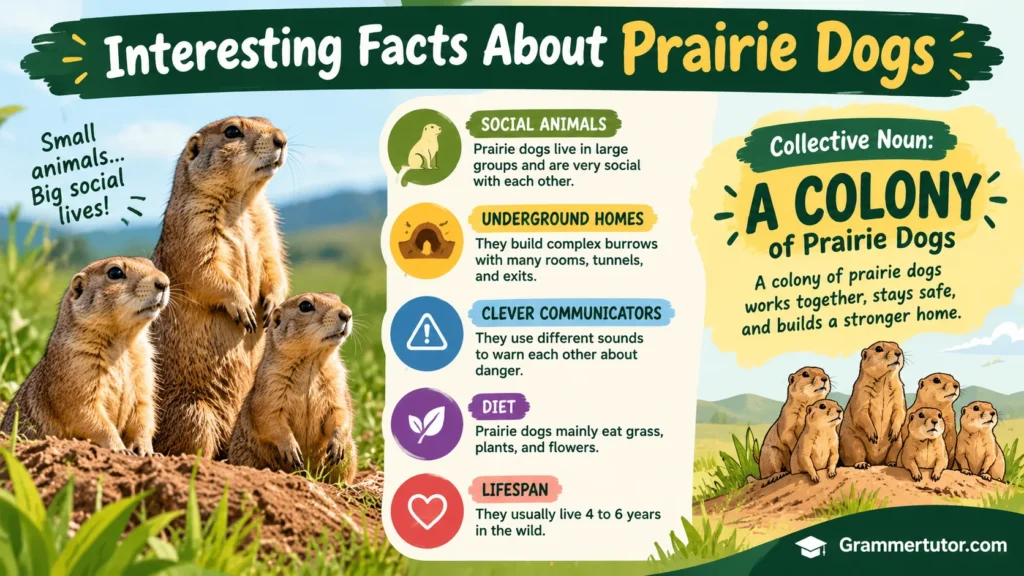
Prairie dogs are fascinating mammals with remarkable social habits and physical adaptations. Their lifespan depends on the species, habitat, predators, and environmental conditions. In the wild, many prairie dogs live for several years, while some individuals may survive longer in protected environments. Their survival can be affected by predators, disease, weather, and the availability of food.
One of their most interesting physiological features is their ability to dig extensive underground burrows. Their strong front limbs, curved claws, and sturdy bodies help them excavate soil and create tunnels. These burrows provide shelter from predators and extreme weather. Prairie dogs also have sharp eyesight and communicate through different calls, including warning sounds that alert nearby animals to possible danger.
Prairie dogs are herbivores, meaning they mainly eat plant material. Their diet commonly includes grasses, roots, seeds, and other vegetation. They may also consume certain flowers and leaves depending on the season and food availability. By feeding on plants, prairie dogs influence the grassland environment around their communities.
Their social behavior is another remarkable feature. Prairie dogs live in communities and interact with other members through calls, body movements, and physical contact. They may stand upright to observe their surroundings, warn others about danger, or communicate with nearby prairie dogs. Their underground homes and social interactions explain why the expression a town of prairie dogs is so meaningful.
READ MORE: Collective Noun for Locusts: A Complete Guide with Examples
Conclusion
The collective noun for prairie dogs is town, which describes a community of prairie dogs living together in connected burrow systems. Colony is also a common and understandable term for a group of prairie dogs. Learning these group names makes English vocabulary more interesting while helping us understand how prairie dogs live, communicate, and cooperate.
FAQs
Q1. What is the collective noun for prairie dogs?
The most widely recognized collective noun for prairie dogs is town. A group of prairie dogs can be called a town of prairie dogs.
Q2. Why are prairie dogs called a town?
The word town is used because prairie dogs live together in large communities with connected underground burrows.
Q3. Can a group of prairie dogs be called a colony?
Yes. Colony is a common and understandable term for a group of prairie dogs, although town is the widely recognized collective noun.
Q4. What is a town of prairie dogs?
A town of prairie dogs is a community where many prairie dogs live together in a connected underground burrow system.
Q5. Where do prairie dogs live?
Prairie dogs live in underground burrow systems. These connected burrows allow them to live together in organized communities.
Q6. Are prairie dogs social animals?
Yes. Prairie dogs are social mammals that live together, communicate with one another, and cooperate within their communities.
Q7. What is the plural form of prairie dog?
The plural form is prairie dogs. For example, “Several prairie dogs live in the same area.”
Q8. How can I use the collective noun in a sentence?
You can say, “A town of prairie dogs was living in the open grassland.” This clearly shows the group meaning.
Q9. Is “group of prairie dogs” correct?
Yes, group of prairie dogs is grammatically correct. However, town of prairie dogs is the more specific collective-noun expression.
Q10. Why should I learn collective nouns for animals?
Learning collective nouns can improve your English vocabulary and help you describe groups of animals more naturally and accurately.