
A group of komodo dragons can form when several Komodo dragons gather in the same area, especially when food is available. These giant reptiles are the largest living lizards on Earth, with powerful bodies, sharp claws, strong jaws, and impressive hunting abilities. Although they often live alone and hunt alone, they may still gather when conditions bring them together.
The collective noun bank of Komodo dragons is sometimes used to describe several of these fascinating reptiles as one group. Other general terms, including group and congregation, can also describe several dragons when they gather together. These descriptive terms are useful in writing because they give you different expressions for describing a gathering without changing the basic meaning.
In a simple guide to collective nouns, these terms can make descriptions easier to understand and more natural. The examples show how the words are used to describe Komodo dragons in different situations, while their meanings remain easy to understand. Choosing the right expression helps you describe these animals naturally and clearly.
Why Are Collective Nouns Used for Komodo Dragons?
Collective nouns are words that describe a number of animals, people, or things as a single group. For example, we say a pack of wolves, a pride of lions, and a flock of birds.
Komodo dragons are generally solitary reptiles, so they don’t form large permanent social groups like some mammals or birds. However, several Komodo dragons can gather around a food source, particularly when a large carcass is available. A collective noun can help describe such a gathering without repeating the phrase “a group of Komodo dragons.”
These terms also make sentences more vivid. Instead of saying, “Several Komodo dragons moved toward the carcass,” you can use a collective expression to create a stronger picture of the scene.
Collective Nouns for Komodo Dragons

The following terms can be used to describe groups or gatherings of Komodo dragons. Bank is sometimes listed specifically as a collective noun for Komodo dragons, while group, congregation, and similar words are more general descriptive expressions.
| Collective Noun | Used For | Simple Example |
| Bank | A group of Komodo dragons | A bank of Komodo dragons gathered near the carcass. |
| Group | Several Komodo dragons together | A group of Komodo dragons crossed the dry ground. |
| Congregation | A gathering of Komodo dragons | A congregation of Komodo dragons surrounded the food. |
| Gathering | Komodo dragons coming together | A gathering of Komodo dragons formed near the shore. |
| Cluster | A number of dragons close together | A cluster of Komodo dragons rested in the shade. |
| Assembly | Several dragons gathered in one place | An assembly of Komodo dragons appeared near the feeding area. |
| Crowd | An informal description of many dragons together | A crowd of Komodo dragons moved around the carcass. |
Note: Not all collective nouns have the same level of established usage. Bank is a term sometimes given specifically for Komodo dragons, while words such as group, gathering, and cluster are general descriptive terms rather than unique zoological terms.
Bank of Komodo Dragons
Bank of Komodo dragons is one expression that is sometimes used as the collective noun for these giant lizards. The word bank can describe several Komodo dragons gathered in the same area.
Komodo dragons are usually solitary, but food can bring several individuals together. When a carcass provides enough food, multiple dragons may gather and compete for access to it.
The phrase can therefore be useful when you want to describe several Komodo dragons in one scene. It gives your sentence a distinctive collective expression while keeping the focus on the animals.
Examples of “Bank of Komodo Dragons”
- A bank of Komodo dragons gathered around the carcass.
- The ranger spotted a bank of Komodo dragons near the forest edge.
- A large bank of Komodo dragons moved toward the feeding area.
- The photographer watched a bank of Komodo dragons from a safe distance.
- A bank of Komodo dragons rested beneath the trees.
- The tourists saw a bank of Komodo dragons on the island.
- A bank of Komodo dragons approached the remains of the animal.
- The guide pointed toward a bank of Komodo dragons in the distance.
- A bank of Komodo dragons gathered when food became available.
- The researchers observed a bank of Komodo dragons near the shoreline.
Group of Komodo Dragons

The simplest and most universally understandable expression is group of Komodo dragons. Unlike specialized collective nouns, this phrase doesn’t depend on a particular traditional naming convention.
Because Komodo dragons are largely solitary, using the word group can be especially useful when several individuals happen to be together. It works well in educational writing, scientific descriptions, and everyday conversation.
For example, if several Komodo dragons are seen near a food source, you can simply call them a group of Komodo dragons.
Examples of “Group of Komodo Dragons”
- A group of Komodo dragons gathered near the carcass.
- The guide noticed a group of Komodo dragons on the hillside.
- A group of Komodo dragons moved slowly across the island.
- The researchers studied a group of Komodo dragons.
- A group of Komodo dragons rested in the shade.
- The visitors watched a group of Komodo dragons from far away.
- A group of Komodo dragons approached the feeding site.
- The camera captured a group of Komodo dragons walking together.
- A group of Komodo dragons appeared near the forest.
- The ranger observed a group of Komodo dragons during the survey.
Congregation of Komodo Dragons
Congregation refers to a gathering of individuals in one place. It isn’t a Komodo-dragon-specific zoological term, but it can be used descriptively when several dragons come together.
This word is particularly suitable for writing that describes a noticeable gathering. For example, if several Komodo dragons assemble around a food source, calling them a congregation of Komodo dragons creates a strong image of many reptiles occupying the same area.
The term should be understood as a descriptive expression rather than a universally recognized technical name.
Examples of “Congregation of Komodo Dragons”
- A congregation of Komodo dragons gathered around the food.
- The ranger observed a congregation of Komodo dragons near the carcass.
- A large congregation of Komodo dragons appeared in the open area.
- The documentary showed a congregation of Komodo dragons feeding.
- A congregation of Komodo dragons moved through the dry grass.
- The researcher photographed a congregation of Komodo dragons.
- A congregation of Komodo dragons formed near the feeding site.
- The guide warned visitors about a nearby congregation of Komodo dragons.
- A congregation of Komodo dragons gathered after the discovery of food.
- The camera recorded a congregation of Komodo dragons in the wild.
Gathering of Komodo Dragons
A gathering of Komodo dragons is another natural way to describe several of these reptiles in one location. The word gathering focuses on the action of coming together rather than suggesting that Komodo dragons normally live as a permanent group.
This expression works especially well when describing temporary meetings caused by food or other environmental conditions.
Examples of “Gathering of Komodo Dragons”
- A gathering of Komodo dragons formed near the carcass.
- The guide noticed a gathering of Komodo dragons ahead.
- A gathering of Komodo dragons attracted the attention of researchers.
- The documentary showed a gathering of Komodo dragons feeding.
- A gathering of Komodo dragons appeared near the forest.
- The ranger carefully watched the gathering of Komodo dragons.
- A sudden gathering of Komodo dragons developed around the food.
- The photographer captured a gathering of Komodo dragons.
- A gathering of Komodo dragons moved across the rocky ground.
- The researchers recorded the behavior of the gathering of Komodo dragons.
Cluster of Komodo Dragons

The word cluster usually describes individuals or objects that are positioned close together. It can therefore describe several Komodo dragons occupying the same small area.
A cluster of Komodo dragons may be useful in descriptive writing, particularly when the animals are resting or gathering around a limited food source. It doesn’t imply that Komodo dragons normally form permanent clusters.
Examples of “Cluster of Komodo Dragons”
- A cluster of Komodo dragons rested under the trees.
- The ranger saw a cluster of Komodo dragons near the rocks.
- A small cluster of Komodo dragons gathered around the food.
- The photographer noticed a cluster of Komodo dragons in the distance.
- A cluster of Komodo dragons moved across the dry ground.
- The researchers observed a cluster of Komodo dragons near the coast.
- A cluster of Komodo dragons gathered in the shade.
- The documentary featured a cluster of Komodo dragons.
- A cluster of Komodo dragons appeared near the feeding area.
- The guide pointed out a cluster of Komodo dragons to the visitors.
Assembly of Komodo Dragons
Assembly means a collection of individuals gathered together. It can be used creatively to describe multiple Komodo dragons in one location.
This term is more literary than scientific when applied to Komodo dragons. It can work well in stories, descriptive passages, and educational writing where you want to avoid repeating the word group.
Examples of “Assembly of Komodo Dragons”
- An assembly of Komodo dragons gathered near the carcass.
- The researchers observed an assembly of Komodo dragons.
- An assembly of Komodo dragons appeared along the trail.
- The documentary showed an assembly of Komodo dragons feeding.
- An assembly of Komodo dragons rested beneath the trees.
- The ranger watched an assembly of Komodo dragons from a distance.
- An assembly of Komodo dragons moved toward the food.
- The photographer captured an assembly of Komodo dragons.
- An assembly of Komodo dragons gathered near the shoreline.
- The visitors saw an assembly of Komodo dragons in the wild.
Why Do Komodo Dragons Gather Together?
Komodo dragons are not highly social animals, so seeing several together doesn’t necessarily mean they live as a close-knit group. Their gatherings are often connected to food availability.
A large carcass can provide enough food to attract multiple dragons. When this happens, individuals may gather in the same area and compete for access to the meal. Larger Komodo dragons generally have advantages during feeding because of their size and strength.
Komodo dragons may also encounter one another during the breeding season. These interactions can involve territorial behavior, courtship, and competition between males.
Their social behavior is therefore quite different from animals that regularly live in permanent groups. A collection of Komodo dragons is often temporary rather than a stable social unit.
Interesting Facts About Komodo Dragons
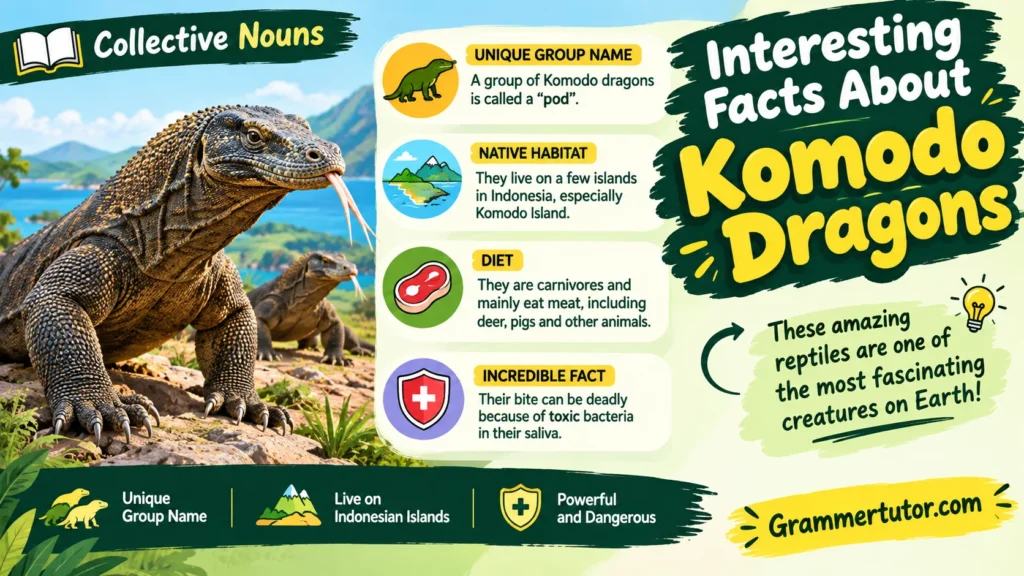
Komodo dragons are native to several Indonesian islands, including Komodo, Rinca, Flores, Gili Motang, and Gili Dasami. They are famous for their enormous size and can reach around 10 feet in length, including the tail. Their powerful bodies make them the largest living lizards.
These reptiles have strong jaws, sharp teeth, muscular legs, and long claws. They also have a long, forked tongue that helps them detect chemical information in their surroundings.
Komodo dragons are carnivores and eat a wide variety of animal prey. Their diet can include deer, wild pigs, smaller reptiles, birds, and carrion. They can consume a surprisingly large amount of food during one feeding session.
Another interesting feature is their ability to reproduce through sexual reproduction and, in some circumstances, parthenogenesis. Parthenogenesis allows a female to produce offspring without fertilization by a male. This unusual reproductive ability has attracted considerable scientific interest.
Komodo dragons also have strong survival adaptations. Their rough skin, muscular tails, claws, teeth, and keen senses help them survive in the challenging environments of the Indonesian islands.
How to Use the Collective Noun for Komodo Dragons
When writing about Komodo dragons, choose the expression that fits your context.
If you want a term sometimes specifically associated with Komodo dragons, you can use bank of Komodo dragons. If you’re writing a straightforward sentence, a group of Komodo dragons is the clearest choice.
For descriptive writing, expressions such as gathering, cluster, or assembly can add variety. However, these should be understood as general descriptive phrases rather than established special names.
For example:
- Specific collective expression: A bank of Komodo dragons gathered near the carcass.
- Simple expression: A group of Komodo dragons moved across the island.
- Descriptive expression: A gathering of Komodo dragons formed around the food.
- Visual description: A cluster of Komodo dragons rested in the shade.
READ MORE: Collective Noun for Swine: A Complete Guide with Examples
Conclusion
The group of Komodo dragons can be described with terms such as bank, group, or congregation, depending on the context. These giant reptiles usually spend much of their time alone, but several may gather together when food is available. Knowing these collective nouns makes your writing more precise and helps you describe these fascinating animals naturally.
FAQs
Q1. What is a group of Komodo dragons called?
A group of Komodo dragons may be called a bank. The general word group is also clear and widely understandable.
Q2. Do Komodo dragons live in groups?
Komodo dragons generally spend much of their time alone. However, several may gather in the same area when food is available.
Q3. Why do Komodo dragons gather together?
Food is one important reason they may gather. Several Komodo dragons can be found together around a food source.
Q4. Are Komodo dragons social animals?
Komodo dragons are mainly solitary reptiles. They can tolerate or interact with other dragons, particularly around food.
Q5. What does “bank of Komodo dragons” mean?
A bank of Komodo dragons refers to several Komodo dragons considered together as one group.
Q6. Can I use “group of Komodo dragons” in writing?
Yes. The group of Komodo dragons is simple, clear, and easy for readers to understand.
Q7. Can “congregation” describe Komodo dragons?
Yes, congregation can be used as a descriptive term for several Komodo dragons gathered together.
Q8. Are Komodo dragons the largest living lizards?
Yes. Komodo dragons are recognized as the largest living lizards in the world.
Q9. How should I describe several Komodo dragons in a sentence?
You can use a phrase such as, “A group of Komodo dragons gathered near a food source.” This clearly describes several dragons in one location.