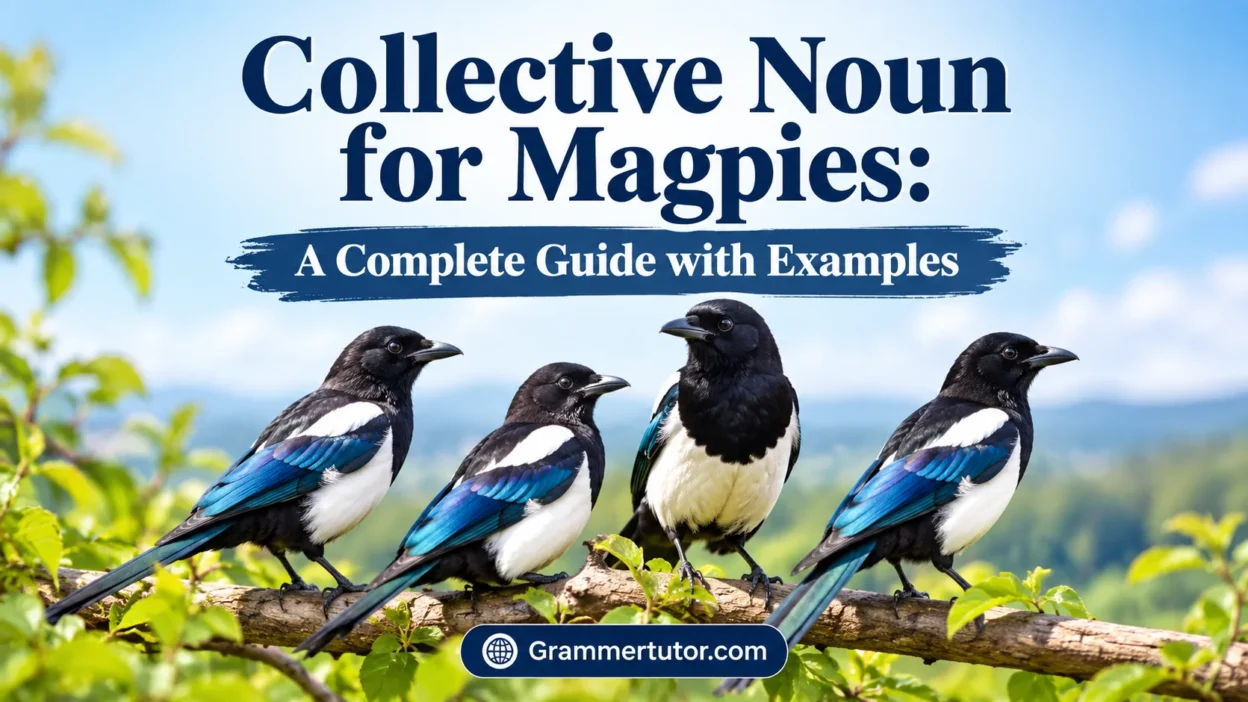
The Collective Noun for Magpies gives you a specific way to describe several magpies when they appear together as one group.Magpies are intelligent, curious birds with striking black-and-white feathers, long tails, and bold behavior.
Their lively nature makes them interesting birds to describe, while their clever appearance gives them a memorable image. When learning about these birds, knowing the right group names can make English more colorful and expressive.A collective noun is a word used to refer to several birds as one group.
Different terms can highlight their lively behavior or create a more descriptive and traditional image of these clever birds. In everyday writing, choosing a specific expression can make your sentence clearer and more natural when the context allows it.
Why Are Collective Nouns Used for Magpies?
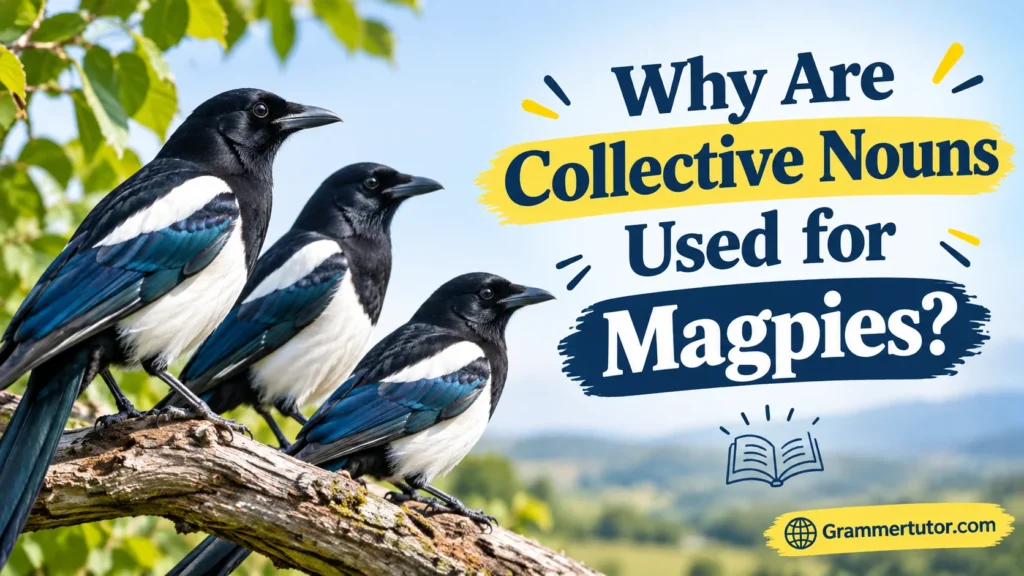
Collective nouns make language shorter, clearer, and more expressive. Rather than repeatedly saying “many magpies,” a single collective noun can describe the birds as a group.
Magpies are especially interesting because they are social and highly active birds. They may gather around food, communicate with one another, defend territory, or move between trees and open areas. Their noticeable behavior has inspired several descriptive group names.
For example, the mischief of magpies gives the impression of a lively group getting into trouble, while a congregation of magpies presents the birds as a gathered group. These expressions can add personality to ordinary sentences.
It is also important to remember that not every collective noun has the same level of common usage. Some are traditional or playful expressions rather than terms you will hear in everyday conversation.
Collective Nouns for Magpies
Here are some collective nouns that are associated with magpies:
| Collective Noun | Used For | Simple Example |
| Mischief | A group of magpies | A group of magpies gathered near the garden. |
| Congregation | A gathered group of magpies | A congregation of magpies sat in the trees. |
| Charm | A group of magpies | A charm of magpies flew across the field. |
| Tiding | A group of magpies | A tidbit of magpies appeared near the woods. |
| Flock | A general group of magpies | A flock of magpies moved between the rooftops. |
Among these, mischief of magpies is one of the most recognizable colorful expressions. Flock is the straightforward general term and works well when you simply want to describe several birds together.
Mischief of Magpies
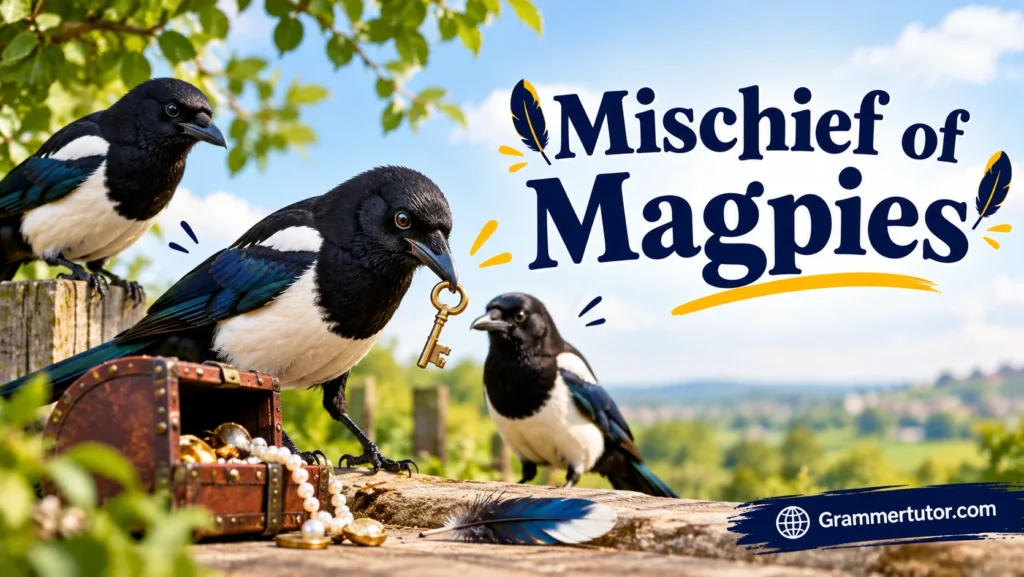
One of the most interesting expressions for magpies is a mischief of magpies. The word “mischief” fits the birds’ reputation for being curious, active, and sometimes troublesome.
Magpies are intelligent birds that investigate objects, search for food, and interact with their surroundings. Because of these behaviors, “mischief” creates a playful image of several magpies moving around together.
The expression works especially well in creative writing, nature descriptions, and informal English.
Examples of “Mischief of Magpies”
- A group of magpies gathered beside the old barn.
- We watched a mischief of magpies searching for food.
- A noisy mischief of magpies flew into the garden.
- The children spotted a mischief of magpies in the trees.
- A group of magpies moved across the meadow.
- The farmer noticed a mischief of magpies near the fields.
- A group of magpies landed on the fence.
- We heard a mischief of magpies before we saw them.
- The mischief of magpies scattered when the dog appeared.
- A large group of magpies rested in the branches.
Congregation of Magpies
Congregation is another descriptive collective noun that can be used for a group of magpies. The word normally refers to people gathered together, but it can also create a vivid image when applied to birds.
When several magpies gather in trees, on rooftops, or around a particular area, “congregation” emphasizes the idea of coming together in one place.
This term can be useful when you want your writing to sound descriptive rather than simply saying “a group of magpies.”
Examples of “Congregation of Magpies”
- A congregation of magpies gathered in the tall trees.
- We saw a congregation of magpies near the woodland.
- A noisy congregation of magpies filled the branches.
- The congregation of magpies moved from tree to tree.
- A congregation of magpies appeared beside the road.
- The children watched a congregation of magpies in the park.
- A congregation of magpies gathered around the open field.
- The congregation of magpies became louder as more birds arrived.
- A small congregation of magpies rested on the roof.
- We photographed a congregation of magpies at sunset.
Charm of Magpies
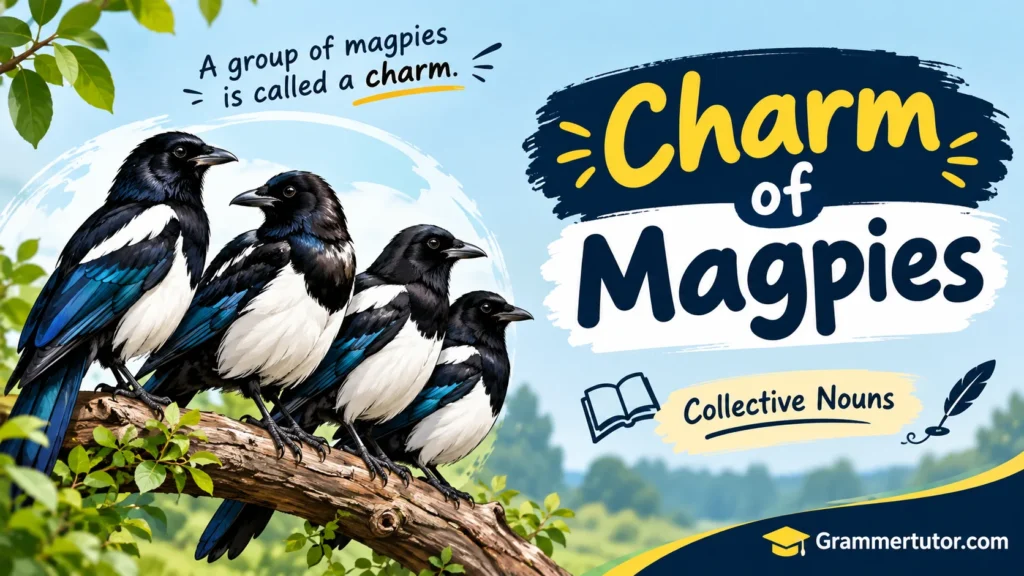
Another colorful expression associated with magpies is a charm of magpies. The word “charm” gives the group a pleasant and attractive feeling.
Magpies are visually distinctive birds. Their dark feathers can show beautiful shades in the right light, and their long tails make them easy to recognize. A group moving together can therefore be described in a way that highlights their appearance and appeal.
“Charm” is particularly suitable for descriptive or literary writing where the writer wants to focus on the birds’ beauty rather than their noisy or playful behavior.
Examples of “Charm of Magpies”
- A charm of magpies flew over the garden.
- We watched a charm of magpies settle in the trees.
- A beautiful charm of magpies crossed the open field.
- The photographer captured a charm of magpies near the lake.
- A charm of magpies rested on the branches.
- The children admired the charm of magpies in the park.
- A charm of magpies appeared above the rooftops.
- The charm of magpies moved toward the woodland.
- We noticed a charm of magpies gathering in the distance.
- A charm of magpies disappeared behind the trees.
Tiding of Magpies
Tiding is another traditional expression that may be used for a group of magpies. It is less familiar in everyday speech than “flock,” but it can add an old-fashioned or literary quality to writing.
The word “tiding” is interesting because it is connected with the idea of news or an occurrence. When used as a collective noun, it gives the group a distinctive and memorable name.
Because this expression is uncommon in ordinary conversation, it is best suited to creative writing, word lists, nature writing, or discussions of unusual collective nouns.
Examples of “Tiding of Magpies”
- A tiding of magpies appeared near the woodland.
- We saw a tidying of magpies flying across the valley.
- A tiding of magpies gathered around the trees.
- The birdwatchers noticed a tiding of magpies nearby.
- A tiding of magpies moved over the fields.
- The tiding of magpies settled on the fence.
- A small tiding of magpies gathered beside the stream.
- We watched a tiding of magpies disappear into the woods.
- A tiding of magpies made its way toward the garden.
- The children pointed at a tiding of magpies in the distance.
Flock of Magpies
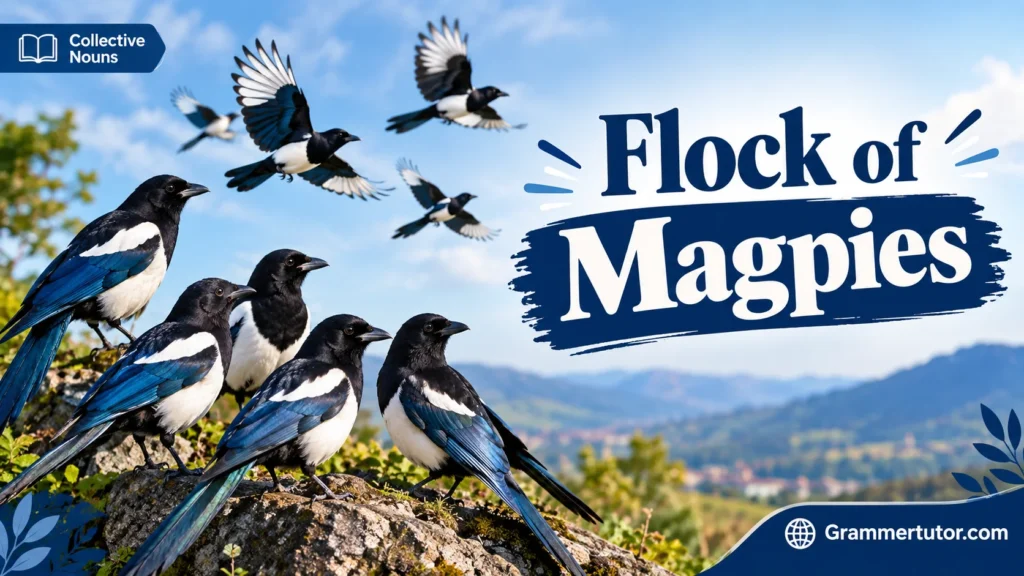
Flock is the simplest and most practical term for several magpies together. Unlike some of the more unusual expressions, “flock” is a general collective noun for birds and is easy for everyone to understand.
You can use “flock” when you don’t need a special or poetic expression. It works naturally in everyday conversation, school assignments, general descriptions, and factual writing.
For example, “A flock of magpies flew across the field” sounds natural and immediately tells the reader that several magpies were moving together.
Examples of “Flock of Magpies”
- A flock of magpies flew over the village.
- We saw a flock of magpies near the trees.
- A flock of magpies landed on the roof.
- The flock of magpies searched for food.
- A large flock of magpies crossed the field.
- We watched a flock of magpies gather in the garden.
- A flock of magpies moved from one tree to another.
- The farmer noticed a flock of magpies near the crops.
- A flock of magpies suddenly took flight.
- The flock of magpies disappeared into the woodland.
How Do Magpies Behave in Groups?
Magpies are active and intelligent birds, and their behavior can make a group fascinating to watch. They communicate through different calls and may become particularly noisy when several birds are together.
A group of magpies may search for food across lawns, fields, gardens, or woodland edges. They can also move between trees, fences, rooftops, and other high places. Their long tails and contrasting plumage make them easy to spot when they gather.
Magpies are also known for their curiosity. They investigate objects in their environment and are capable of learning from experience. Their intelligence is one reason they have attracted so much attention in bird studies and popular culture.
Their social behavior also explains why collective nouns can be useful. A word such as mischief describes more than just the number of birds. It gives the reader a feeling about the group’s lively character.
Interesting Facts About Magpies
Magpies belong to the crow family, Corvidae, which includes other intelligent birds such as crows, ravens, and jays. Their intelligence is one of their most notable characteristics. They can learn from their surroundings, remember locations, and adapt their behavior when conditions change.
Magpies have distinctive black-and-white plumage, although their feathers can show attractive blue, green, or purple tones depending on the light. Their long tails also give them a recognizable silhouette. These physical features make them easy to identify compared with many other garden birds.
Their diet is varied. Depending on the species and environment, magpies may eat insects, worms, seeds, fruit, small animals, eggs, and food they find while scavenging. This flexible diet helps them live successfully in many different habitats.
Magpies are also highly vocal. Their calls can alert other birds to danger, signal activity, or help maintain contact. When several magpies gather together, their combined calls can make the group particularly noticeable.
Another interesting feature is their adaptability. Some magpie species live comfortably around human settlements, including gardens, parks, farms, and suburban areas. Their ability to take advantage of different food sources and nesting locations has helped them thrive in a variety of environments.
Collective Noun for Magpies in a Sentence
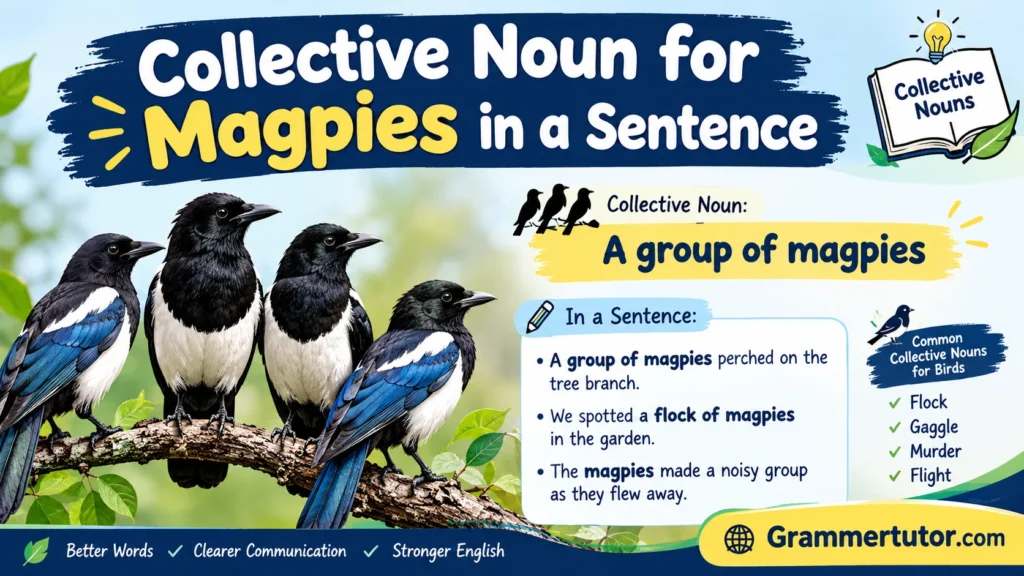
Using a collective noun correctly is an easy way to make your sentences more descriptive. The best choice depends on the kind of writing you are doing.
For everyday English, the flock of magpies is simple and clear. If you want a more colorful expression, the mischief of magpies can add personality to your sentence.
Here are a few examples:
- A flock of magpies flew across the open field.
- A group of magpies gathered near the garden.
- We watched a congregation of magpies sitting in the trees.
- A charm of magpies crossed the morning sky.
- The birdwatchers noticed a tiding of magpies near the woodland.
When writing for school or general readers, choose the expression that best matches the context. You don’t need to use an unusual collective noun simply because it exists.
READ MORE: Collective Noun for Peacocks: Names, Meanings, and Examples
Conclusion
Learning the collective noun for magpies gives you a more interesting way to describe these clever and curious birds. Instead of always saying “a group of magpies,” you can use suitable group terms to make your English more descriptive. Understanding these expressions also helps you write and speak about magpies more naturally and confidently.
FAQs
Q1. What is a collective noun for magpies?
A collective noun for magpies is a word or phrase used to describe several magpies as one group.
Q2. Why are collective nouns used for magpies?
Collective nouns make language more descriptive and provide a specific way to talk about a group of magpies.
Q3. What are magpies known for?
Magpies are known for their intelligence, curiosity, striking black-and-white feathers, long tails, and bold behavior.
Q4. Can I say “a group of magpies”?
Yes. “A group of magpies” is a clear and correct general expression.
Q5. Are collective nouns for magpies commonly used?
Some collective nouns are traditional or literary rather than common in everyday conversation.
Q6. How many magpies are needed to use a collective noun?
There is no fixed number. A collective noun can be used when two or more magpies are being considered as a group.
Q7. Are collective nouns for birds important in English?
Yes. They add variety and detail when describing groups of birds and other animals.
Q8. Can collective nouns make writing more interesting?
Yes. A suitable collective noun can make descriptions more vivid and help avoid repeating phrases such as “a group of birds.”
Q9. Should I always use a special collective noun for magpies?
No. Use one when it fits the context. “A group of magpies” is perfectly acceptable when a specific term is unnecessary.
Q10. What is the benefit of learning collective nouns?
Learning collective nouns expands your vocabulary and helps you describe groups of animals in a clearer and more colorful way.