
The collective noun for crocodiles is a bask of crocodiles, an interesting expression used to describe these powerful reptiles when they gather together. A collective noun is a word or expression used to refer to several individuals as one group. The term bask of crocodiles is especially suitable when they are resting in the sun.
Crocodiles often live near rivers, lakes, swamps, and wetlands. They may gather in the same area when suitable food, water, or resting places are available. Their behavior has helped English develop several colorful expressions for groups of crocodiles. From my experience with English vocabulary, using the right group term can make descriptions of wildlife sound much more natural.
When several crocodiles are resting together, a bask of crocodiles is a best-known expression and a particularly useful choice. However, general expressions such as a group of crocodiles can also be used in everyday writing and English vocabulary. These terms make sentences more descriptive while keeping the meaning clear for readers learning about wildlife.
Why Collective Nouns Are Used for Crocodiles
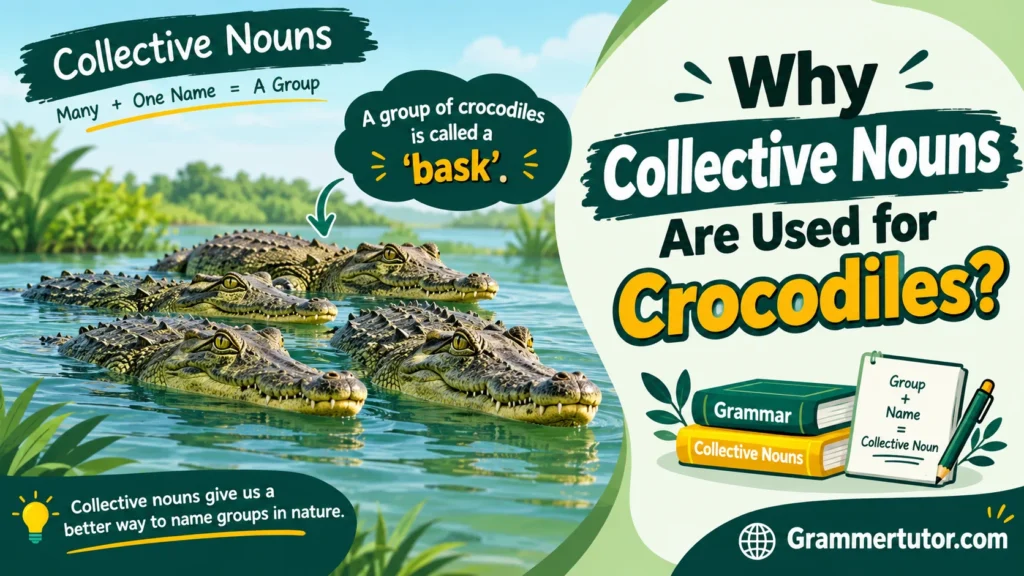
Crocodiles are usually associated with warm aquatic environments where they can find food, water, and suitable places to rest. Several crocodiles may gather along a riverbank or around a body of water, particularly when environmental conditions are favorable.
The expression a bask of crocodiles is commonly associated with crocodiles lying together in the sun. The word bask relates to the behavior of warming the body in sunlight, making the expression especially descriptive.
Other expressions, including congregation of crocodiles, may also be encountered when referring to crocodiles gathered in one place. However, these terms are less familiar in ordinary conversation than simply saying a group of crocodiles.
Using collective nouns allows writers to describe several crocodiles more creatively while connecting language with their natural behavior.
Collective Nouns for Crocodiles
| Collective Noun | Used For | Simple Example |
| Bask | Crocodiles resting together in the sun | A bask of crocodiles rested by the river. |
| Congregation | Crocodiles gathered in one place | A congregation of crocodiles gathered near the water. |
| Group | A general collection of crocodiles | A group of crocodiles moved through the river. |
| Gathering | Several crocodiles together | A gathering of crocodiles appeared near the bank. |
Bask of Crocodiles
A bask of crocodiles is one of the most recognizable collective expressions associated with crocodiles. It is especially suitable when crocodiles are lying together in the sunlight to warm themselves.
Crocodiles are ectothermic animals, which means they rely heavily on external sources of heat to regulate their body temperature. This makes basking an important part of their daily behavior.
Examples of “Bask of Crocodiles”
- A bask of crocodiles rested beside the river.
- We saw a bask of crocodiles lying in the sun.
- A bask of crocodiles gathered on the muddy bank.
- The bask of crocodiles remained near the water.
- A large bask of crocodiles was visible from the boat.
- The ranger observed a bask of crocodiles at noon.
- A bask of crocodiles rested quietly on the shore.
- We photographed a bask of crocodiles near the riverbank.
- The bask of crocodiles moved toward the water.
- A bask of crocodiles enjoyed the warm afternoon sun.
Congregation of Crocodiles
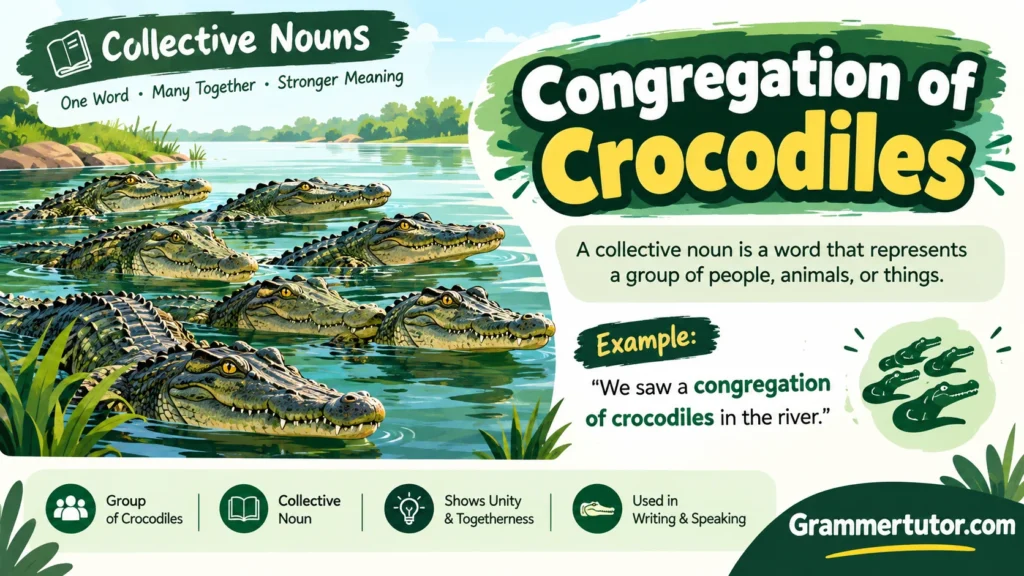
A congregation of crocodiles is another expression that can describe crocodiles gathered together in one location. The word congregation generally suggests a collection of individuals assembled in the same place.
This expression is less common in everyday English, but it can add variety to wildlife writing and descriptions of large gatherings.
Examples of “Congregation of Crocodiles”
- A congregation of crocodiles gathered near the river.
- We noticed a congregation of crocodiles along the bank.
- A congregation of crocodiles rested beside the lake.
- The congregation of crocodiles stayed close to the water.
- A large congregation of crocodiles appeared after the rain.
- The guide pointed toward a congregation of crocodiles.
- A congregation of crocodiles gathered in the shallow water.
- We watched a congregation of crocodiles from a safe distance.
- The congregation of crocodiles slowly moved into the river.
- A congregation of crocodiles was resting near the wetland.
Group of Crocodiles
A group of crocodiles is a straightforward expression that can be used whenever several crocodiles are together. Unlike some traditional animal group names, group does not describe a particular behavior.
It is a useful choice when the situation is unclear or when you simply want to communicate the number of crocodiles without using a specialized term.
Examples of “Group of Crocodiles”
- A group of crocodiles lived in the river.
- We saw a group of crocodiles near the bank.
- A group of crocodiles moved through the water.
- The group of crocodiles rested beside the lake.
- A group of crocodiles gathered near the shore.
- The guide spotted a group of crocodiles in the distance.
- A group of crocodiles disappeared beneath the water.
- We watched a group of crocodiles from the boat.
- The group of crocodiles moved toward the muddy bank.
- A group of crocodiles was feeding near the river.
Gathering of Crocodiles
A gathering of crocodiles is a general descriptive phrase for several crocodiles assembled in one area. It is not as specialized as bask, but it can be useful in ordinary descriptions.
The expression works well when crocodiles are together but their particular activity is not the main focus of the sentence.
Examples of “Gathering of Crocodiles”
- A gathering of crocodiles appeared near the riverbank.
- We saw a gathering of crocodiles beside the lake.
- A gathering of crocodiles rested near the water.
- The gathering of crocodiles attracted the attention of visitors.
- A large gathering of crocodiles was seen in the wetland.
- The ranger noticed a gathering of crocodiles.
- A gathering of crocodiles moved slowly through the water.
- We observed the gathering of crocodiles from a safe location.
- The gathering of crocodiles remained close to the shore.
- A gathering of crocodiles disappeared into the river.
Types of Crocodiles and Their Characteristics
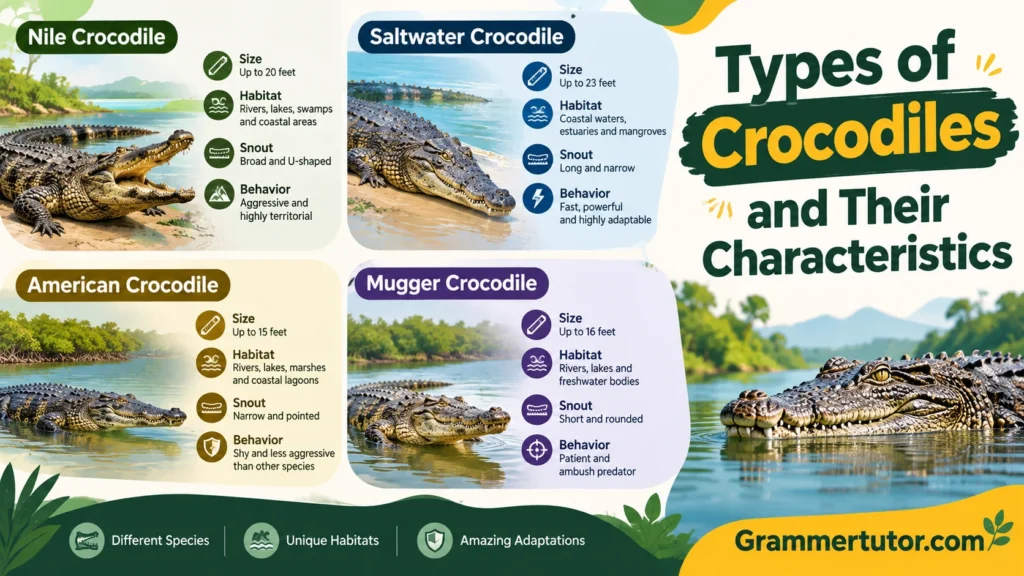
Crocodiles belong to the reptile family Crocodylidae and are closely related to other crocodilian animals such as alligators, caimans, and gharials. Several crocodile species live in tropical and subtropical regions around the world.
The Nile crocodile, saltwater crocodile, American crocodile, and mugger crocodile are examples of crocodile species. They differ in size, habitat, behavior, and geographic distribution.
Crocodiles are well adapted to life in and around water. Their long bodies, powerful tails, strong jaws, and eyes and nostrils positioned high on the head help them survive as aquatic predators.
Examples of Crocodile Characteristics
- Crocodiles are reptiles.
- Crocodiles are ectothermic animals.
- Crocodiles have powerful jaws.
- Crocodiles have strong muscular tails.
- Many crocodiles spend considerable time in water.
- Crocodiles have tough, scaly skin.
- Their eyes and nostrils can remain above the water while much of the body is submerged.
- Crocodiles are carnivorous animals.
- Different crocodile species live in different regions.
- Crocodiles have existed in various forms for millions of years.
Interesting Facts About Crocodiles
Crocodiles are among the longest-lived reptiles, and some individuals can survive for many decades when environmental conditions are favorable. Their longevity varies according to species, habitat, food availability, disease, and other factors. Their long lives are one reason crocodiles are often described as ancient and highly successful reptiles.
One of their most distinctive physiological features is their powerful jaw system. Crocodiles have strong muscles that allow them to close their jaws with tremendous force. Their teeth are adapted for gripping and holding prey rather than chewing food in the same way mammals do. When teeth are lost, crocodiles can replace them throughout their lives.
Crocodiles also have a remarkable body structure suited to aquatic environments. Their muscular tails help them move through water, while their eyes and nostrils are positioned toward the top of the head. This allows a crocodile to remain mostly submerged while keeping its senses available above the water.
Their dietary habits are mainly carnivorous. Crocodiles can eat fish, birds, reptiles, mammals, and other suitable prey. Younger crocodiles generally consume smaller animals, while larger individuals are capable of taking much larger prey. Their feeding opportunities often depend on the habitat and species.
Another interesting feature is their ability to regulate body temperature through behavior. Because crocodiles are ectothermic, they may bask in sunlight to warm themselves and move into water or shade when they need to cool down. This behavior helps explain why the expression a bask of crocodiles is such a fitting collective term.
READ MORE: Collective Noun for Seagulls: A Complete Guide with Examples
Conclusion
The collective noun for crocodiles is commonly a bask of crocodiles, especially when these reptiles are gathered together and resting in the sun. In general situations, a group of crocodiles is also clear and correct. Understanding these expressions can make your English vocabulary more descriptive when writing about wildlife.
FAQs
Q1. What is the collective noun for crocodiles?
The most commonly known collective noun is a bask of crocodiles.
Q2. Why are crocodiles called a bask?
The word bask refers to resting or lying in the warmth of the sun, which crocodiles often do together.
Q3. Is “a group of crocodiles” correct?
Yes. A group of crocodiles is a general and easy-to-understand expression.
Q4. Where can crocodiles gather together?
Crocodiles may gather near rivers, lakes, swamps, and wetlands, especially where food, water, and suitable resting places are available.
Q5. What does “bask of crocodiles” mean?
It means a group of crocodiles, particularly when they are gathered together and resting in the sun.
Q6. Is “bask of crocodiles” a collective noun?
Yes. Bask of crocodiles is a collective expression used to describe crocodiles as one group.
Q7. Can I use “group of crocodiles” in everyday English?
Yes. Group of crocodiles is a simple general expression that works well in everyday writing and conversation.
Q8. What is the difference between “bask” and “group” of crocodiles?
Bask is a more specific collective expression, often connected with crocodiles resting together, while group is a general term.
Q9. Which collective noun should I use in wildlife writing?
You can use a bask of crocodiles when describing crocodiles resting together. A group of crocodiles is suitable when you simply want to describe several crocodiles together.
Q10. Is “a bask of crocodiles” singular or plural?
The phrase a bask of crocodiles is grammatically singular because bask is the collective noun, although it refers to several crocodiles.