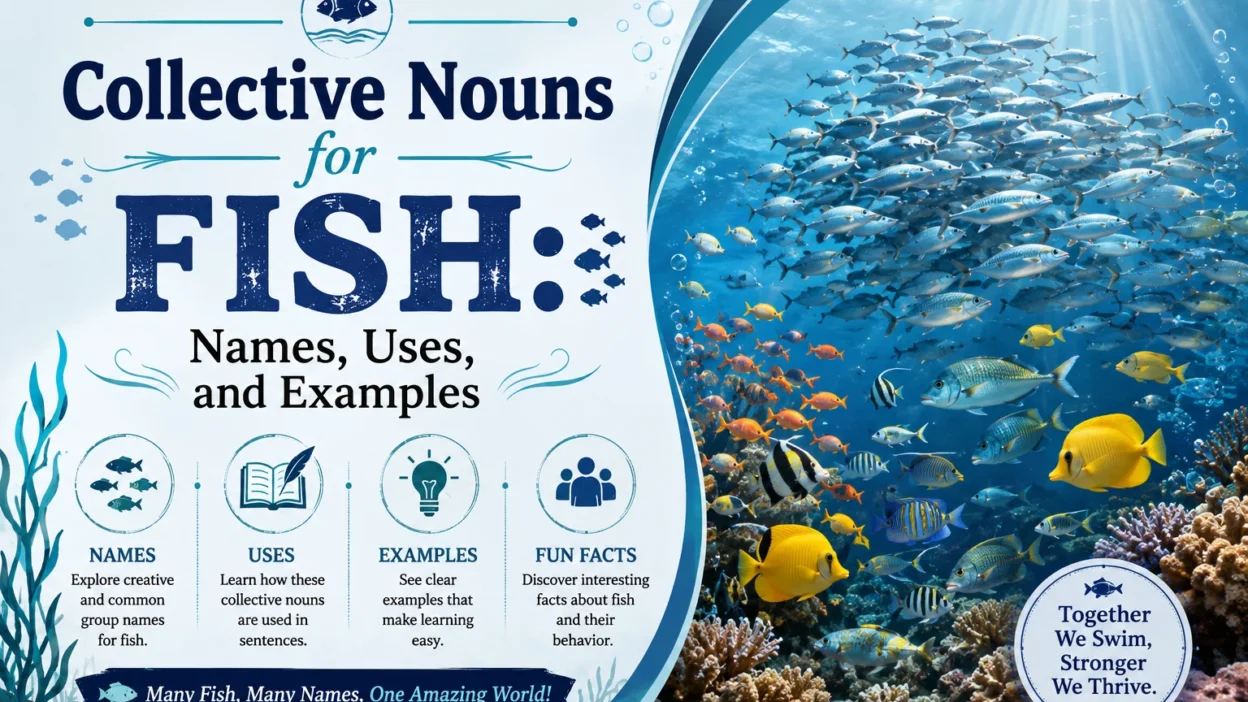
The collective noun for fish helps you describe fish together in a clear and natural way. In English, animal group names such as school of fish make everyday writing more descriptive. These aquatic animals may gather or move together in water, so the right expression can explain what several fish are doing.
A shoal describes fish gathered in the same area, while run, catch, and haul can have different meanings depending on the situation. These terms are useful when describing wildlife, nature writing, or fish caught by fishermen. Learning these collective nouns can also help you choose the right expression when talking about a group of fish.
When learning English or studying marine life, knowing these animal group names can expand your vocabulary. Expressions such as school of fish and shoal make descriptions more vivid, especially when you explain how fish move together or gather. Understanding these terms makes marine life easier to describe and gives your writing a more natural flow.
Why Collective Nouns Are Used for Fish
Fish often gather in groups for feeding, migration, protection, or reproduction. Some species form tightly coordinated groups that move almost as if they were a single organism. Others gather more loosely in the same area without moving in such close coordination.
Because fish can gather in different ways, English has several terms for them. School is commonly used when fish swim together in a coordinated manner, while shoal can describe fish gathered together more generally.
Understanding these differences helps you choose a collective noun that matches the situation.
Collective Nouns for Fish
| Collective Noun | Used For | Simple Example |
| School | Fish swimming together in a coordinated group | A school of fish swam through the reef. |
| Shoal | A group of fish gathered together | A shoal of fish gathered near the rocks. |
| Run | Fish moving together, especially during migration | A run of salmon moved upstream. |
| Catch | Fish caught by a person or fishing group | The fisherman brought in a large catch of fish. |
| Haul | A quantity of fish caught during fishing | The boat returned with a heavy haul of fish. |
School of Fish
A school is the most familiar and widely used collective noun for fish. It usually describes fish swimming together in a coordinated way.
Fish may form schools to improve protection against predators, find food, or make movement more efficient. When hundreds or thousands of fish move together, the group can create a spectacular sight underwater.
Examples of “School of Fish”
- A school of fish swam through the reef.
- We watched a school of fish near the coral.
- The school of fish moved quickly through the water.
- A large school of fish crossed the bay.
- The school of fish changed direction suddenly.
- A school of fish gathered near the rocks.
- The divers followed a school of fish.
- The school of fish disappeared into deeper water.
- A school of fish moved around the reef.
- We photographed a colorful school of fish.
Shoal of Fish
A shoal refers to a group of fish gathered together in the same area. Unlike school, the word doesn’t necessarily emphasize coordinated swimming.
A shoal may contain fish that are simply staying in the same general location. In everyday English, school of fish is more familiar, but shoal is a useful and accurate term in descriptions of fish groups.
Examples of “Shoal of Fish”
- A shoal of fish gathered near the rocks.
- We saw a shoal of fish in the shallow water.
- The shoal of fish moved around the reef.
- A large shoal of fish appeared near the coast.
- The shoal of fish searched for food.
- Divers observed a shoal of fish.
- A shoal of fish rested near the seabed.
- The shoal of fish moved into deeper water.
- A shoal of fish surrounded the boat.
- The shoal of fish disappeared beneath the waves.
Run of Fish
A run is used for fish that move together during a particular migration, especially fish such as salmon that travel upstream to reproduce.
The word emphasizes movement from one location to another rather than simply describing fish gathered together.
Examples of “Run of Fish”
- A run of salmon moved upstream.
- The river attracted a large run of fish.
- We watched the run during the migration.
- The run of fish entered the river in spring.
- A strong run of salmon reached the upper river.
- The fishermen waited for the annual run of fish.
- The run of fish moved toward the spawning grounds.
- Scientists monitored the run of salmon.
- The river became busy during the fish run.
- The run of fish continued upstream.
Catch of Fish
A catch of fish refers to fish that have been caught by a person, fishing boat, or fishing group. It doesn’t describe a naturally occurring social group of fish in the water.
This expression is especially common when discussing fishing, seafood, or the results of a fishing trip.
Examples of “Catch of Fish”
- The fisherman brought home a large catch of fish.
- The boat returned with a fresh catch of fish.
- The crew sorted the catch of fish.
- The fisherman displayed his catch of fish.
- We saw the day’s catch of fish.
- The fishing boat carried a large catch of fish.
- The crew divided the catch of fish.
- The market received a fresh catch of fish.
- The fishermen recorded their catch of fish.
- The boat returned after a successful catch of fish.
Haul of Fish
A haul of fish refers to a quantity of fish caught during a fishing trip. Like catch, it describes the result of fishing rather than a naturally occurring group swimming together.
The expression is particularly useful when emphasizing the amount of fish brought in by fishermen.
Examples of “Haul of Fish”
- The boat returned with a heavy haul of fish.
- The fishermen brought in a large haul of fish.
- The crew celebrated their successful haul of fish.
- The haul of fish was taken to the market.
- The fishing boat carried a substantial haul of fish.
- The fishermen sorted their haul of fish.
- The crew recorded the day’s haul of fish.
- A large haul of fish filled the boat.
- The fishermen divided the haul of fish.
- The boat returned to shore with its haul of fish.
Fish Behavior and Social Life
Many fish species are highly social and spend part of their lives in groups. Swimming together can provide several advantages. A large group can make it harder for predators to focus on a single individual, while coordinated movement can help fish locate food and navigate their environment.
Schooling is especially fascinating because fish can change direction almost instantly while maintaining their spacing. They respond to the movements of nearby individuals rather than relying on one leader. This creates the impressive coordinated movement often seen in large schools of fish.
Fish also use their senses to communicate and respond to their surroundings. Depending on the species, they can detect movement, vibration, chemical signals, light, and sounds in the water. Their social behavior varies greatly, however, and not every species forms large schools.
Examples of Fish Behavior
- Many fish gather in groups.
- Fish may form schools for protection.
- Schools can move in coordinated patterns.
- Fish can respond quickly to nearby individuals.
- Some fish migrate in large groups.
- Fish may gather around food sources.
- Some species live in loose shoals.
- Fish use their senses to detect predators.
- Certain fish travel together during migration.
- Schooling behavior can improve survival.
Interesting Facts About Fish
Fish are a remarkably diverse group of aquatic vertebrates, with thousands of species living in oceans, rivers, lakes, streams, and other aquatic environments. Their lifespans vary greatly. Some small fish live only a few years, while certain species can live for several decades. Their longevity depends on species, habitat, genetics, food availability, predators, and environmental conditions.
Fish have several unique physiological features that allow them to live underwater. Most fish use gills to extract oxygen from water. Their bodies are often covered with scales that provide protection, while fins help them maintain balance, steer, and move through the water. Many fish also have a swim bladder, which helps certain species control buoyancy.
Fish have extremely diverse dietary habits. Some species are herbivores that feed mainly on algae and aquatic plants, while others are carnivores that hunt smaller fish, crustaceans, insects, or other animals. Some fish are omnivores and consume both plant and animal material. Their diets are closely connected to their habitat and physical adaptations.
Fish also play essential roles in aquatic ecosystems. They can act as predators, prey, scavengers, grazers, and consumers of plankton. Their activities help move nutrients through aquatic food webs and contribute to the overall balance of rivers, lakes, coral reefs, wetlands, and oceans.
Examples of Fish Facts
- Fish are aquatic vertebrates.
- Most fish use gills to obtain oxygen.
- Fish live in freshwater and saltwater environments.
- Many fish have scales.
- Fins help fish move and maintain balance.
- Some fish have swim bladders.
- Fish have diverse diets.
- Some fish eat plants and algae.
- Other fish are predators.
- Many fish form schools or shoals.
- Some fish migrate during their life cycle.
- Fish are important parts of aquatic food webs.
Conclusion
Learning the collective noun for fish makes your English more descriptive and precise. The most common term is school of fish, but words such as shoal, run, catch, and haul can also be useful in different contexts. Knowing these expressions helps you describe fish, marine life, and wildlife more naturally while expanding your vocabulary.
FAQs
Q1. What is the collective noun for fish?
The most common collective noun for fish is school. You can say, “A school of fish swam through the water.”
Q2. What is a group of fish called?
A group of fish is commonly called a school of fish. Shoal is another term used for fish gathered in the same area.
Q3. Is “school of fish” correct?
Yes. School of fish is the most widely recognized and commonly used expression for a group of fish.
Q4. What is another collective noun for fish?
Shoal is a common alternative. Other words, such as run, catch, and haul, can apply in specific contexts.
Q5. What is the difference between a school and a shoal of fish?
A school usually refers to fish moving together in a coordinated way. A shoal generally refers to fish gathered in the same area, whether or not they move together.
Q6. Can I use “group of fish” instead of “school of fish”?
Yes. The group of fish is grammatically correct and easy to understand, but the school of fish is more specific and descriptive.
Q7. Why do fish swim in schools?
Fish often swim together for protection, feeding, navigation, and other survival benefits. Moving as a group can also make it harder for predators to target one fish.
Q8. Is “shoal of fish” grammatically correct?
Yes. Shoal of fish is a correct expression, particularly when describing fish gathered in a particular area.
Q9. What is the collective noun for fish caught by fishermen?
Depending on the context, catch or haul can describe fish caught by fishermen. These terms refer to the fish obtained rather than simply describing a natural group.
Q10. How can learning collective nouns for fish improve English?
Learning these expressions can expand your vocabulary and make your writing more natural and descriptive. It also helps you describe wildlife and marine life more accurately.