
The collective noun for falcons helps describe groups of these birds of prey when they gather together.Falcons are impressive and remarkable birds known for their sharp eyesight, powerful talons, hooked beaks, and great speed. Although they often go hunting alone, several birds may share the same area during migration, nesting, or feeding.
Their behavior can therefore change depending on the situation, making different terms useful for describing them. Collective nouns give English speakers clear expressions for groups and can make writing more vivid. When I explain these terms, I find that focusing on what the birds are doing makes it easier to understand how to describe them naturally.
A good guide to the collective noun for falcons should also explain how different terms are used in sentences. The most useful term can depend on how the falcons are behaving and why they have come together. Learning these expressions shows how collective nouns work in everyday English and helps you choose the right wording naturally.
Why Are Collective Nouns Used for Falcons?

A collective noun is a word or phrase that describes a group of similar people, animals, or things. Instead of saying “a group of falcons,” you can use a more specific expression to make the sentence shorter and more descriptive.
Falcons are often associated with flight, hunting, speed, and aerial movement, so some group terms emphasize what the birds are doing rather than simply stating that they are together.
For example, instead of saying:
A group of falcons flew over the valley.
You could say:
A flock of falcons flew over the valley.
The right collective noun can add character to a sentence and help readers picture the birds more clearly.
Collective Nouns for Falcons
Different sources and contexts may use different expressions for groups of falcons. Flock is the safest general term when several falcons are together, while terms such as cast can appear in falconry contexts.
| Collective Noun | Used For | Simple Example |
| Flock of Falcons | Falcons flying or staying together | A flock of falcons crossed the sky. |
| Cast of Falcons | Falcons discussed in falconry | The cast of falcons was prepared for the hunt. |
| Flight of Falcons | Falcons viewed together in flight | A flight of falcons soared above the cliffs. |
| Pair of Falcons | Two falcons together | A pair of falcons nested on the cliff. |
| Group of Falcons | General use when no specific term is needed | A group of falcons gathered near the ridge. |
These expressions aren’t all equally common. Flock of falcons works well as a general collective noun, while cast has a more specialized connection with falconry.
Flock of Falcons

Flock of falcons is a straightforward expression for several falcons gathered or moving together. Although falcons are frequently solitary hunters, they may sometimes be observed together, particularly during migration or in areas where food and suitable habitat are available.
The word flock is familiar and easy to understand. It works especially well when you’re describing falcons flying through the air or gathering in one location.
Examples of “Flock of Falcons”
- A flock of falcons flew across the open sky.
- We watched a flock of falcons circling above the valley.
- A large flock of falcons appeared near the cliffs.
- The flock of falcons moved toward the mountains.
- Several people photographed a flock of falcons in flight.
- A flock of falcons soared above the forest.
- The flock of falcons disappeared behind the ridge.
- We spotted a flock of falcons during our morning walk.
- The flock of falcons followed the river for several miles.
- A flock of falcons filled the sky with graceful movement.
Cast of Falcons
The cast of falcons is associated particularly with falconry, the traditional practice of training and hunting with birds of prey. In this setting, falcons are handled, trained, and cared for by falconers.
Because of this specialized use, cast shouldn’t be treated as the everyday term for any group of wild falcons. It makes more sense when the sentence has a falconry context.
For example, if several trained falcons are being discussed by a falconer, “cast” can provide a more traditional expression.
Examples of “Cast of Falcons”
- The falconer prepared the cast of falcons for the demonstration.
- A skilled trainer cared for the cast of falcons.
- The cast of falcons was kept in carefully maintained mews.
- Visitors watched the cast of falcons during the display.
- The falconer introduced the cast of falcons to the audience.
- Each bird in the cast of falcons received individual attention.
- The cast of falcons was trained regularly.
- The handler checked the equipment before working with the cast of falcons.
- The cast of falcons attracted attention at the traditional event.
- The experienced falconer knew the habits of every bird in the cast of falcons.
Flight of Falcons

Flight of falcons is a descriptive expression that focuses on the birds while they are airborne. It highlights their movement rather than simply describing them as a group.
This phrase is particularly effective in nature writing because falcons are famous for their speed and aerial abilities. A flight of falcons can create a strong visual image of birds gliding, diving, or circling above the landscape.
Examples of “Flight of Falcons”
- A flight of falcons swept across the blue sky.
- We saw a flight of falcons above the rocky cliffs.
- The flight of falcons moved quickly toward the hills.
- A graceful flight of falcons appeared at sunrise.
- The photographer captured a flight of falcons in the distance.
- A flight of falcons circled above the open field.
- The flight of falcons disappeared into the clouds.
- We stood quietly as a flight of falcons passed overhead.
- A sudden flight of falcons startled the smaller birds.
- The flight of falcons created an impressive sight over the valley.
Pair of Falcons
A pair of falcons refers specifically to two falcons. This expression is useful when describing two birds that are together, especially during breeding or nesting activities.
Many falcon species form breeding pairs, and these pairs may share a territory and participate in raising their young. Therefore, “pair” is often more precise than using a broad group term when only two birds are involved.
Examples of “Pair of Falcons”
- A pair of falcons built a nest on the cliff.
- We spotted a pair of falcons above the canyon.
- The pair of falcons guarded their nesting area.
- A pair of falcons rested on a rocky ledge.
- The researchers observed a pair of falcons during the breeding season.
- A pair of falcons flew over the river.
- The pair of falcons returned to the same nesting site.
- We photographed a pair of falcons at sunset.
- The pair of falcons searched the valley for food.
- A pair of falcons circled above the mountain.
Group of Falcons
When you aren’t sure which specialized expression fits the situation, a group of falcons is always clear and natural. It doesn’t suggest a particular behavior, activity, or falconry tradition.
This makes it useful in general writing, educational material, reports, and everyday conversation. You can use it when several falcons are together without needing to describe exactly what they are doing.
Examples of “Group of Falcons”
- A group of falcons gathered near the cliffs.
- We noticed a group of falcons flying over the valley.
- The group of falcons moved toward the forest.
- A group of falcons rested on the rocky peaks.
- The guide pointed out a group of falcons in the distance.
- A group of falcons appeared above the mountains.
- The group of falcons flew away when people approached.
- Researchers studied a group of falcons in the region.
- A group of falcons searched for prey across the open land.
- The group of falcons disappeared beyond the hills.
How Do Falcons Behave in Groups?
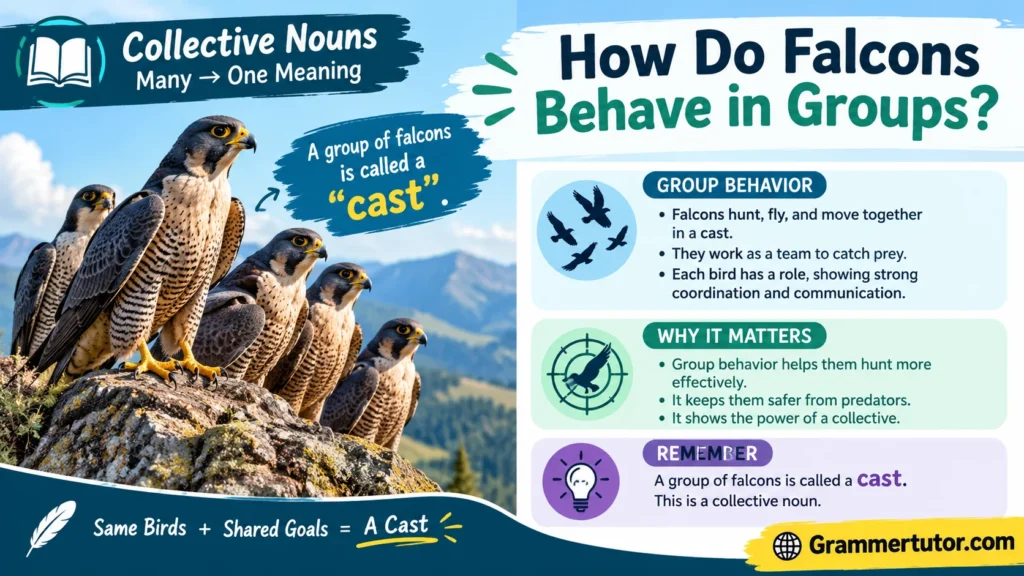
Falcons aren’t always highly social birds. Many species spend considerable time alone, particularly while hunting. Their hunting style often depends on speed, surprise, and excellent vision.
However, seeing multiple falcons in one area isn’t unusual under the right conditions. Migration can bring birds into the same region, while suitable nesting locations and abundant food can also result in several individuals being observed relatively close together.
Breeding behavior provides another important example. A male and female may establish a territory and work together during nesting. In these situations, a pair of falcons is more appropriate than a broad term such as “flock.”
The behavior of falcons also varies considerably by species. Some species are more likely to be observed around other birds, while others maintain more strongly defended territories.
Interesting Facts About Falcons
Falcons belong to the family Falconidae, a group of birds known for their powerful flight and hunting abilities. They occur in many parts of the world and occupy habitats ranging from mountains and grasslands to coastal areas and urban environments.
One of the most famous falcons is the peregrine falcon. It is renowned for its extraordinary diving speed. During a hunting dive, known as a stoop, a peregrine can reach extremely high speeds, making it one of the fastest animals known.
Falcons also have excellent eyesight. Their vision allows them to detect potential prey from considerable distances. Their hooked beaks and strong talons help them capture and handle prey efficiently.
Their diet generally includes other birds and a variety of smaller animals, depending on the species and habitat. Some falcons have adapted surprisingly well to cities, where tall buildings can provide structures similar to natural cliffs.
Falcons also play an important role in ecosystems. As predators, they help regulate populations of other animals and form an important part of food webs. Their presence can therefore tell us something about the health and balance of an environment.
Choosing the Right Collective Noun for Falcons
The best expression depends on what you want your sentence to communicate.
If you’re simply describing several falcons together, flock of falcons is a useful general choice. If you’re writing about trained birds in a traditional falconry setting, the cast of falcons may fit better.
When your focus is on movement through the sky, flight of falcons creates a more descriptive image. If you’re talking about two birds, particularly a breeding pair, a pair of falcons is more precise.
For situations where you don’t want to imply a specific behavior, a group of falcons is perfectly clear.
| Situation | Suitable Term |
| Several falcons together | Flock of falcons |
| Falconry context | Cast of falcons |
| Birds moving through the air | Flight of falcons |
| Two falcons | Pair of falcons |
| General description | Group of falcons |
Using the right term helps your writing sound more natural and gives readers a clearer picture of the birds.
READ MORE: Collective Noun for Dolphins: A Complete Guide With Examples
Conclusion
The collective noun for falcons helps you describe these impressive birds when they gather together. Falcons are often seen hunting alone, but they can also appear in groups during migration, nesting, feeding, or when several birds share the same area. Understanding the different terms used for falcons makes your English more precise and your writing more vivid. The best expression depends on the situation and the behavior of the birds.
FAQs
Q1. What is the collective noun for falcons?
A collective noun for falcons is a term used to describe a group of falcons. The appropriate expression can depend on the context in which the birds gather.
Q2. What do you call a group of falcons?
A group of falcons can be described using a collective noun. The exact term may vary depending on the situation and how the falcons are behaving.
Q3. Do falcons usually live in groups?
Falcons often hunt alone, but some may gather during migration, nesting, feeding, or when they occupy the same area.
Q4. Why are collective nouns used for falcons?
Collective nouns make it easier to describe several falcons as a group. They can also make wildlife writing clearer and more interesting.
Q5. Are falcons birds of prey?
Yes. Falcons are birds of prey with features such as sharp eyesight, powerful talons, hooked beaks, and strong flight abilities.
Q6. Why do falcons gather together?
Falcons may gather for reasons such as migration, feeding, nesting, or occupying the same area. Their social behavior can vary by species and circumstance.
Q7. Can I use a collective noun for falcons in a sentence?
Yes. A collective noun can be used to describe a group of falcons naturally in a sentence, especially when discussing their movement or behavior.
Q8. Are collective nouns for falcons commonly used in everyday English?
Some collective terms for birds are more familiar than others. In everyday English, a group of falcons is always clear when a more specific collective term isn’t familiar to the reader.