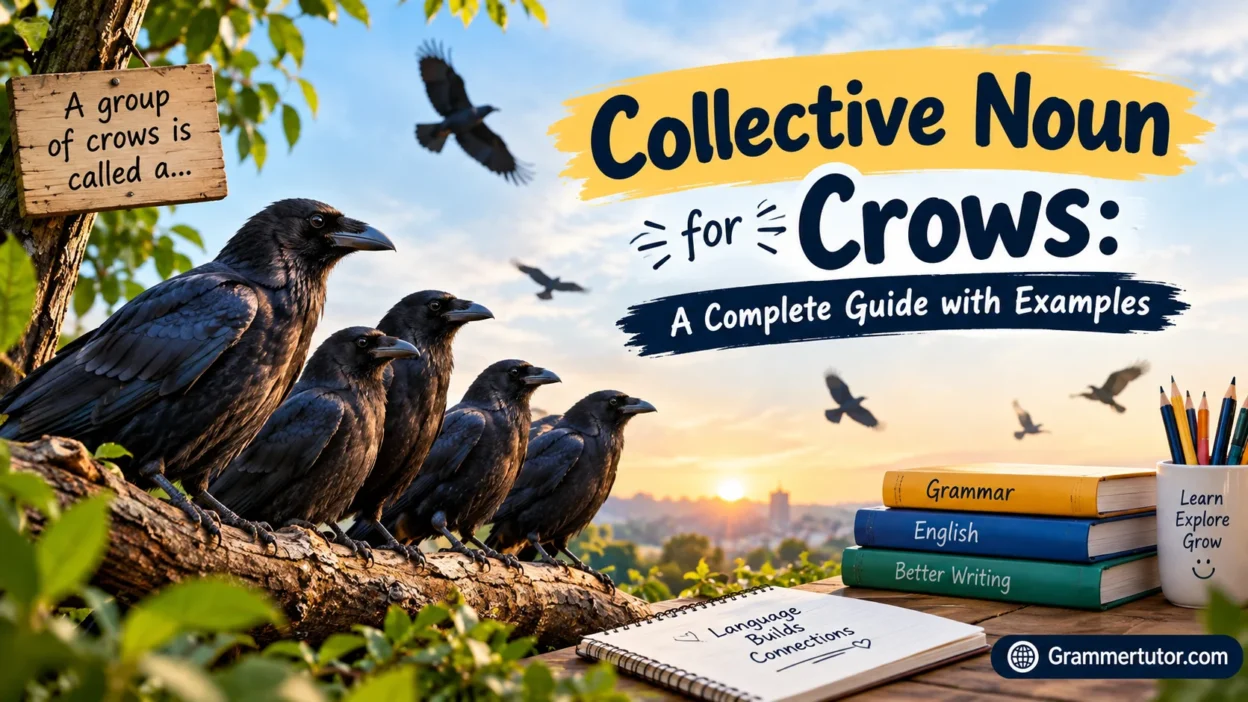
The collective noun for crows adds a vivid, descriptive touch when English speakers describe these intelligent, social birds.The best-known and most familiar expression is a murder of crows, where murder works as a particular collective noun for these birds.
However, flock, group, and horde can also describe a group of crows in general. These alternatives don’t have the same traditional association with crows, but they can still fit different situations. Choosing a suitable term can make a sentence more interesting while keeping the meaning clear and natural.
Crows are highly intelligent animals known for their unusual behavior. They communicate with one another, cooperate in groups, recognize individuals, and adapt to different environments. These traits have helped crows earn a memorable place in English vocabulary. In this guide, the main terms, meanings, examples, and fascinating facts help explain how people refer to groups of crows and why these expressions remain memorable.
Why Collective Nouns Are Used for Crows
Crows are naturally social birds and often gather in groups for feeding, roosting, communication, and protection. Large numbers of crows may gather in trees or other suitable places, especially before settling down for the night.
Because people have observed these gatherings for centuries, English developed colorful expressions to describe them. The famous phrase a murder of crows is especially memorable, while flock is a straightforward term for crows that are together or flying.
These expressions allow writers to describe crows in different ways without repeatedly using the phrase a group of crows.
Collective Nouns for Crows
| Collective Noun | Used For | Simple Example |
| Murder | A traditional term for a group of crows | A murder of crows gathered in the tree. |
| Flock | Crows flying or staying together | A flock of crows flew over the field. |
| Horde | A large or numerous group | A horde of crows covered the trees. |
| Group | A general collection of crows | A group of crows searched for food. |
| Mob | A group behaving noisily or aggressively | A mob of crows chased the hawk. |
Murder of Crows
A murder of crows is the most famous traditional collective noun associated with crows. It has a striking sound and is often used in literature, storytelling, and descriptions of these birds.
The term doesn’t mean that the crows themselves are murderous. Its unusual wording comes from traditional English collective-noun naming practices and the long-standing association of crows with dark or mysterious imagery.
Examples of “Murder of Crows”
- A murder of crows gathered in the old tree.
- We watched a murder of crows fly across the field.
- A murder of crows settled on the rooftop.
- The murder of crows became noisy at sunset.
- A murder of crows searched the meadow for food.
- The murder of crows flew toward the forest.
- We noticed a murder of crows near the road.
- A murder of crows circled above the trees.
- The murder of crows disappeared into the distance.
- A murder of crows gathered around the field.
Flock of Crows
A flock of crows is a simple and practical expression for crows that are together or flying in the same area. While murder is the famous traditional term, flock is often easier and more natural for ordinary descriptions.
You can use flock when focusing on the birds’ movement rather than their traditional collective name.
Examples of “Flock of Crows”
- A flock of crows flew over the village.
- We saw a flock of crows near the river.
- The flock of crows landed in the field.
- A flock of crows searched for food.
- The flock of crows moved from tree to tree.
- A flock of crows crossed the open sky.
- The flock of crows gathered near the farm.
- A flock of crows flew toward the woods.
- The flock of crows became active at sunrise.
- A flock of crows rested on the branches.
Horde of Crows
A horde of crows can be used descriptively for a very large or overwhelming number of crows. It isn’t as established a traditional collective noun as murder, but it can work well in creative or descriptive writing.
The word horde emphasizes the size and appearance of the gathering.
Examples of “Horde of Crows”
- A horde of crows covered the trees.
- We watched a horde of crows gather in the field.
- A horde of crows filled the sky.
- The horde of crows moved toward the farmland.
- A horde of crows gathered around the food.
- The horde of crows flew across the valley.
- A horde of crows settled near the river.
- The horde of crows became noisy.
- A horde of crows surrounded the field.
- The horde of crows disappeared into the forest.
Mob of Crows
A mob of crows is a descriptive expression that can fit situations where crows gather together and behave noisily or aggressively. Crows sometimes cooperate to drive away predators or other threats, a behavior known as mobbing.
Because of this behavior, mob can be a useful word when the group is actively confronting another bird or animal.
Examples of “Mob of Crows”
- A mob of crows chased the hawk.
- The mob of crows surrounded the predator.
- A mob of crows gathered around the owl.
- The crows formed a noisy mob.
- A mob of crows attacked the intruding bird.
- The mob of crows drove the hawk away.
- A mob of crows filled the trees with noise.
- The mob of crows followed the predator.
- A mob of crows gathered near the nest.
- The noisy mob of crows scattered suddenly.
Group of Crows
A group of crows is a general expression that can be used in almost any situation. Unlike murder, it doesn’t have a traditional or specialized connection with crows, but it’s perfectly clear and natural.
Use a group when you want straightforward English without emphasizing a particular type of behavior.
Examples of “Group of Crows”
- A group of crows gathered near the field.
- We saw a group of crows in the trees.
- The group of crows searched for food.
- A group of crows flew across the road.
- The group of crows rested on the branches.
- A group of crows gathered near the farm.
- The group of crows moved toward the river.
- A group of crows landed in the meadow.
- The group of crows became noisy.
- A group of crows disappeared into the forest.
How to Use “Murder of Crows” Correctly
The phrase a murder of crows follows the same basic structure as other collective nouns:
a + collective noun + of + animal
For example:
A murder of crows gathered in the tree.
Here, murder acts as the collective noun, while crows identify the birds in the group.
You can use the phrase when writing creatively, describing wildlife, or simply discussing the traditional vocabulary associated with crows. However, if you want the clearest everyday expression, a group of crows or a flock of crows may be easier for all readers to understand.
Examples of Correct Usage
- A murder of crows was sitting in the tree.
- A flock of crows was flying overhead.
- The crows were searching for food.
- A murder of crows gathered near the road.
- A flock of crows crossed the field.
- The group of crows moved toward the trees.
- A mob of crows chased the hawk.
- The crows were calling loudly.
- A murder of crows settled on the branches.
- A flock of crows returned to the trees.
Interesting Facts About Crows
Crows are among the most intelligent birds in the world. They belong to the corvid family, which also includes ravens, rooks, and jays. Their intelligence allows them to solve problems, remember locations, learn from experience, and adapt to changing environments. Some crow species can even use or modify objects as tools to obtain food.
Crows have impressive communication abilities. They use a variety of calls and body movements to communicate with one another. They can warn other crows about predators and may gather together to drive away a threatening bird. This cooperative behavior is one reason expressions such as mob of crows can be useful in certain descriptions.
Crows also have remarkable memories. They can recognize individual people and remember faces associated with positive or negative experiences. Their ability to learn from past encounters helps them survive in environments where they regularly interact with humans and other animals.
Their diet is highly flexible. Crows are omnivores, which means they can eat both plant and animal foods. Depending on availability, they may consume insects, seeds, fruits, grains, eggs, small animals, carrion, and food scraps. This adaptable diet is one reason crows have successfully occupied a wide range of habitats.
Crows are also very adaptable birds. They can live in woodlands, farmland, grasslands, cities, suburbs, and coastal areas. Their intelligence, flexible diet, strong social behavior, and ability to learn from their surroundings help them survive in environments that change frequently.
Examples of Crow Facts
- Crows are highly intelligent birds.
- Crows belong to the corvid family.
- Crows can solve certain problems.
- Some crows use tools.
- Crows can recognize individual people.
- Crows communicate through different calls.
- Crows can cooperate to defend themselves.
- Crows are omnivores.
- Crows eat insects, seeds, fruits, grains, and other foods.
- Crows can adapt to urban environments.
- Some crows gather in large groups to roost.
- Crows can learn from previous experiences.
READ MORE: Collective Noun for Butterflies: Common Terms and Example Sentences
Conclusion
The most recognized collective noun for crows is murder, as in a murder of crows. While words such as flock, group, and horde can describe several crows, murder has the strongest traditional connection with these intelligent and social birds. Knowing these terms helps you choose the right expression and make your English more precise and descriptive.
FAQs
Q1. What is the collective noun for crows?
The most well-known collective noun for crows is murder, as in a murder of crows.
Q2. Why are crows called a murder?
Murder is a traditional collective noun associated with crows. Its exact historical origin is uncertain.
Q3. Is “a murder of crows” grammatically correct?
Yes. A murder of crows is a grammatically correct and widely recognized expression.
Q4. Can I use “flock” for crows?
Yes. Flock can describe a group of birds, including crows, although it isn’t the traditional collective noun specifically associated with crows.
Q5. Can “group” be used for crows?
Yes. The group of crows is completely understandable and works in ordinary English.
Q6. What is another collective noun for crows?
Besides murder, you may encounter flock, group, and horde. However, murder is the most distinctive traditional term.
Q7. Are crows intelligent birds?
Yes. Crows are known for their intelligence, problem-solving abilities, communication, and ability to recognize individuals.
Q8. Do crows live in groups?
Crows often gather and cooperate in groups. Their social behavior is one reason they’re frequently described collectively.
Q9. What is the plural of crow?
The ordinary plural of crow is crows. For example, “Several crows were sitting in the tree.”
Q10. Is “murder of crows” used in everyday English?
It’s recognized in English, but it can sound literary, playful, or descriptive. In everyday speech, a group of crows is also very common.