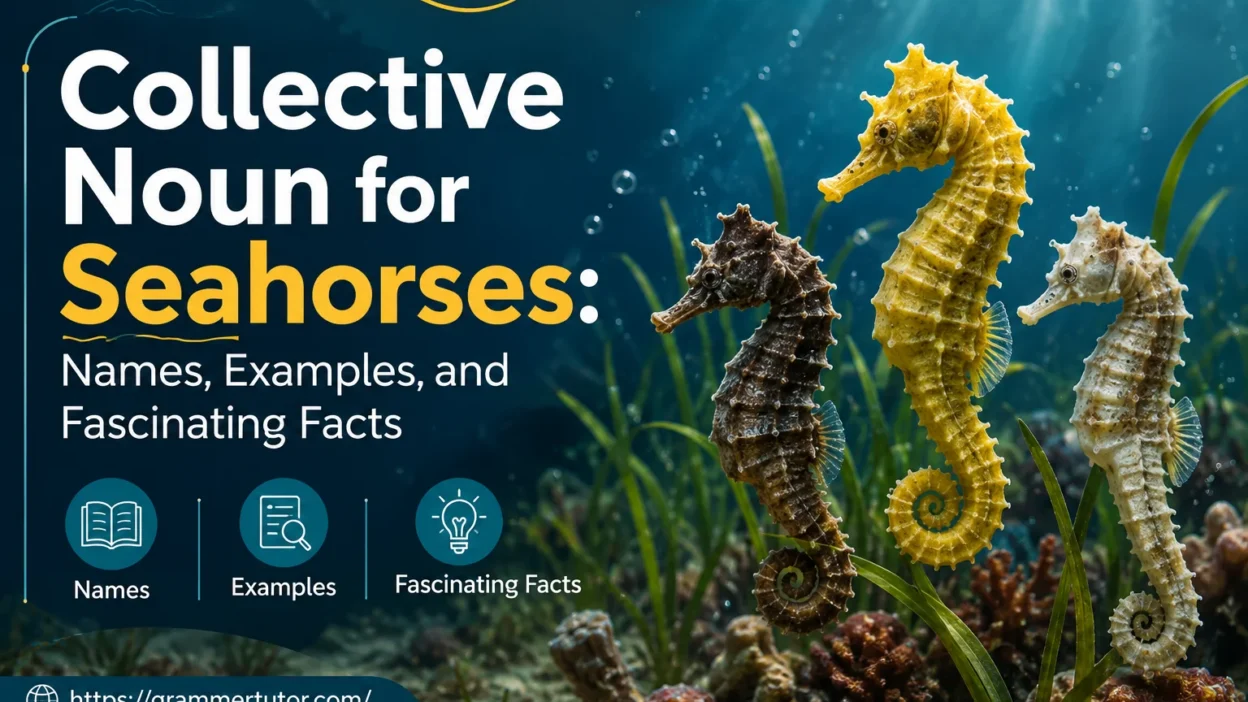
A collective noun for seahorses gives you a simple way to describe a group of these unusual marine animals when they gather together in the water. The familiar term herd is often used, giving us the phrase a herd of seahorses. Instead of always using the simple phrase group of seahorses, you can choose this descriptive expression when you want to help readers imagine how these small creatures live and move. From my experience with English vocabulary, herd sounds especially useful when the group is being described as a whole.
Other general terms, including group and shoal, may also be used for several seahorses together, although the choice depends on the context. In English, a shoal commonly describes fish that stay together, while group remains a broad and flexible term. Seahorses are especially interesting because their behavior is different from that of many other fish. Their upright bodies, curled tails, and tube-like snouts make these fascinating marine animals easy to recognize.
The remarkable reproductive system of seahorses also makes their biology unusual. The male carries the developing young, which gives you another interesting opportunity to explore both vocabulary and biology while learning about these animals. Understanding the collective nouns connected with seahorses therefore helps you describe their groups naturally while also learning more about how these creatures live and move in their marine environment.
Why Collective Nouns Are Used for Seahorses
Collective nouns make language more expressive by giving a name to several animals considered together. Seahorses may gather around seagrass, coral, mangroves, or other suitable habitats, and some species form pairs or small social groups.
Because seahorses are often associated with groups or aggregations, expressions such as herd can be used to describe them collectively. The exact social behavior varies among species, so not every seahorse lives permanently in a large group.
Using a collective noun also helps avoid repetitive phrases such as a group of seahorses. For example, “a herd of seahorses moved through the seagrass” creates a more memorable description.
Collective Nouns for Seahorses
| Collective Noun | Used For | Simple Example |
| Herd | A group of seahorses | A herd of seahorses moved through the seagrass. |
| Shoal | Several seahorses gathered together | A shoal of seahorses stayed near the reef. |
| Group | A general collection of seahorses | A group of seahorses lived among the plants. |
| Pair | Two seahorses together | A pair of seahorses swam near the coral. |
| Aggregation | Seahorses gathered in one area | An aggregation of seahorses formed near the habitat. |
Herd of Seahorses
A herd of seahorses is a commonly used collective expression for several seahorses together. The word herd is especially memorable because it is more commonly associated with land animals, yet it can also be used descriptively for seahorses.
Seahorses may gather in suitable habitats where food and shelter are available. Their curled tails allow them to hold onto seagrass, coral, mangrove roots, and other objects while remaining relatively stable in the water.
Examples of “Herd of Seahorses”
- A herd of seahorses moved through the seagrass.
- We spotted a herd of seahorses near the reef.
- The herd of seahorses remained close to the plants.
- A small herd of seahorses lived in the shallow water.
- Divers observed a herd of seahorses near the coral.
- The herd of seahorses disappeared among the seaweed.
- A herd of seahorses gathered around the vegetation.
- We watched a herd of seahorses in the clear water.
- The herd of seahorses stayed close to the seafloor.
- A herd of seahorses moved gently with the current.
Shoal of Seahorses
A shoal is a general term for a group of fish that stay together. Since seahorses are fish, shoal can be used when describing several seahorses gathered in the same area.
However, seahorses don’t always behave like tightly coordinated schooling fish. For this reason, shoal is better understood as a general descriptive term rather than a uniquely seahorse-specific collective noun.
Examples of “Shoal of Seahorses”
- A shoal of seahorses gathered near the reef.
- We saw a shoal of seahorses among the plants.
- The shoal of seahorses remained close to the coral.
- A shoal of seahorses moved through the shallow water.
- Divers photographed a shoal of seahorses.
- The shoal of seahorses stayed near the seagrass.
- A shoal of seahorses appeared near the rocks.
- The shoal of seahorses moved with the gentle current.
- We discovered a shoal of seahorses near the mangroves.
- The shoal of seahorses remained in the sheltered area.
Group of Seahorses
A group of seahorses is the simplest general expression for several seahorses. Unlike specialized collective nouns, group doesn’t suggest a particular behavior or arrangement.
It’s useful in everyday English and scientific descriptions when you simply want to say that several seahorses are present in the same place.
Examples of “Group of Seahorses”
- A group of seahorses lived near the seagrass.
- We found a group of seahorses near the reef.
- The group of seahorses stayed close to the coral.
- A group of seahorses moved through the water.
- Divers observed a group of seahorses.
- The group of seahorses rested among the plants.
- A group of seahorses gathered near the rocks.
- We photographed a group of seahorses underwater.
- The group of seahorses remained in the sheltered habitat.
- A group of seahorses disappeared into the vegetation.
Pair of Seahorses
A pair of seahorses refers specifically to two seahorses together. This expression is particularly useful because many seahorse species form notable relationships between mates.
Some seahorse species engage in elaborate courtship behaviors. Mates may interact through movements and color changes, and some species form pair bonds that can last for a period of time.
Examples of “Pair of Seahorses”
- A pair of seahorses stayed together near the coral.
- We spotted a pair of seahorses in the seagrass.
- The pair of seahorses moved slowly through the water.
- A pair of seahorses held onto the same plant.
- Divers photographed a pair of seahorses.
- The pair of seahorses remained close to each other.
- A pair of seahorses appeared near the reef.
- We watched a pair of seahorses during their courtship.
- The pair of seahorses moved with the current.
- A pair of seahorses disappeared behind the seaweed.
Aggregation of Seahorses
Aggregation is a more scientific and neutral term for several seahorses gathered in the same area. It doesn’t necessarily mean that the animals are behaving as a tightly organized social group.
This word can be useful in marine biology and wildlife descriptions when researchers are discussing the number of animals found within a particular habitat.
Examples of “Aggregation of Seahorses”
- An aggregation of seahorses was found near the reef.
- Scientists studied an aggregation of seahorses.
- The aggregation of seahorses occupied the seagrass habitat.
- Divers discovered an aggregation of seahorses.
- An aggregation of seahorses formed near the mangroves.
- Researchers recorded an aggregation of seahorses.
- The aggregation of seahorses remained close to the vegetation.
- An aggregation of seahorses was observed underwater.
- The scientists monitored the aggregation carefully.
- An aggregation of seahorses appeared near the sheltered coast.
Seahorse Behavior and Social Life
Seahorses have an unusual way of moving through the water. Unlike many fast-swimming fish, they use a small dorsal fin and pectoral fins to move and steer. Their swimming speed is relatively slow, so they often depend on their ability to grasp objects with their prehensile tails.
Their tails are one of their most distinctive features. A seahorse can wrap its tail around seagrass, coral branches, mangrove roots, or other structures. This helps it remain anchored when currents move through its habitat.
Seahorses also display interesting courtship behavior. Depending on the species, couples may interact through synchronized movements, changes in coloration, and other displays. These behaviors can help establish or maintain relationships between mates.
One of the most remarkable aspects of seahorse social behavior is their reproductive system. During reproduction, the female transfers eggs to a specialized brood pouch on the male’s body. The male then fertilizes and carries the developing embryos until they are ready to be released.
This unusual reproductive strategy makes seahorses one of the best-known examples of male pregnancy in the animal kingdom.
Examples of Seahorse Behavior
- Seahorses use their tails to hold onto plants.
- Seahorses can change color during certain interactions.
- Some seahorses form pair bonds.
- Seahorses perform distinctive courtship displays.
- Male seahorses carry developing embryos.
- Seahorses often live among seagrass and other vegetation.
- Their tails help them remain anchored in currents.
- Seahorses use fins for movement and steering.
- Seahorses can gather in suitable habitats.
- Seahorses are relatively slow swimmers.
Read More: Collective Nouns for Donkeys: The Right Terms to Know
Interesting Facts About Seahorses
Seahorses are marine fish belonging to the genus Hippocampus. Their name comes from their unusual shape, which resembles the head and neck of a horse. They are found in coastal marine environments, including seagrass beds, coral reefs, mangroves, and other shallow-water habitats. Their lifespan varies among species, but many seahorses live for roughly one to several years, depending on their species and environmental conditions.
Their physiology is particularly unusual. Unlike most fish, seahorses swim in an upright position. They have a horse-like head, a long snout, independently moving eyes, and a curled prehensile tail. Their bony body plates provide protection, while their small fins help them maneuver through vegetation and other complex habitats.
Seahorses are also masters of camouflage. Many species can change color and blend into their surroundings. Some can even develop skin structures or other features that make them resemble nearby plants or other objects. This camouflage helps them remain difficult for predators to detect.
Their dietary habits are equally interesting. Seahorses are carnivorous and primarily eat tiny crustaceans and other small marine organisms. They don’t have teeth, so they use their long, tubular snouts to suck prey into their mouths. Small shrimp-like creatures, copepods, and other tiny animals can form an important part of their diet.
Because seahorses are relatively weak swimmers, their habitat is extremely important. Seagrass meadows, mangroves, coral reefs, and other coastal environments provide places where they can attach themselves with their tails and find food. Damage to these habitats can therefore threaten seahorse populations.
Perhaps the most famous fact about seahorses is their unusual reproductive system. The male seahorse carries the developing embryos in a specialized brood pouch. After pregnancy, the male releases the young seahorses into the surrounding water. This is one of the most remarkable reproductive adaptations found among fish.
Examples of Seahorse Facts
- Seahorses are fish, not mammals.
- Their scientific genus is Hippocampus.
- Seahorses swim in an upright position.
- Their tails are prehensile.
- They use their tails to anchor themselves.
- Seahorses are generally slow swimmers.
- They can use camouflage to blend into their surroundings.
- Seahorses are carnivorous.
- They eat tiny crustaceans and other small marine organisms.
- Seahorses don’t have teeth.
- They use their snouts to suck up prey.
- Male seahorses carry developing embryos.
- Seahorses live in coastal marine habitats.
- Seagrass and mangroves can provide important shelter.
Conclusion
The collective noun for seahorses is commonly expressed as a herd, as in “a herd of seahorses.” You can also use group or shoal depending on the context. Knowing these terms makes your writing more precise while giving you a better understanding of these unusual marine animals and their fascinating behavior.
FAQs
Q1. What is the collective noun for seahorses?
The most commonly used collective noun for seahorses is herd, as in “a herd of seahorses.”
Q2. Can I say “a group of seahorses”?
Yes. A group of seahorses is clear, natural, and easy to understand.
Q3. Is “shoal” used for seahorses?
Yes, shoal can describe several seahorses together, particularly when discussing them as aquatic animals or fish.
Q4. Which term is most commonly associated with seahorses?
Herd is the term most commonly associated with seahorses as a collective noun.
Q5. Why are seahorses called a herd?
The word herd provides a descriptive way to refer to seahorses gathered together, similar to how collective nouns describe groups of other animals.
Q6. Are seahorses fish?
Yes. Seahorses are fish, although their upright bodies, curled tails, and tube-like snouts make them look very different from many other fish.
Q7. What makes seahorses unusual?
Seahorses have several unusual features, including an upright body, curled tail, tube-like snout, and a reproductive system in which the male carries the developing young.
Q8. Can “herd” be used in formal writing?
Yes. You can use herd when referring to a group of seahorses, especially in descriptive or educational writing.
Q9. Should I use “group” or “herd of seahorses”?
Both are understandable. The group of seahorses is general, while the herd of seahorses is more specific and descriptive.
Q10. What is the best phrase to use in a sentence?
A natural example is: “A herd of seahorses moved through the water.”