
The collective noun for cats helps you describe several cats together and makes English vocabulary easier to understand, learn, and use correctly. A clowder of cats is a recognized collective noun for a group of cats. You can also use a group of cats as a simple, general expression.
When several kittens are born together, kittens litter is the more appropriate term. These familiar expressions fit different situations and help you write clear sentences about these curious and independent animals. Cats are popular domestic animals known for their agility, sharp senses, playful behavior, and distinctive personalities. Cats belong to the family Felidae and have flexible bodies, retractable claws, and excellent night vision.
Although many cats prefer spending time alone, they may form social groups when food, shelter, or other resources are available. Learning collective nouns improves English vocabulary and helps students, teachers, writers, and cat lovers describe groups naturally. In my experience, understanding how a word fits its context makes it easier to choose the right expression and create descriptive sentences about animals.
Why Are Collective Nouns Used for Cats?

Cats are often described as independent animals, but they sometimes gather in groups. Domestic cats may live together in homes, shelters, farms, or places where food is readily available. Feral cats can also form social groups, particularly when resources allow them to live near one another.
The word clowder is a traditional collective noun for a group of cats. It is especially useful when describing several cats gathered in one place. A litter of kittens, on the other hand, refers to kittens born to the same mother during one birth.
Choosing the correct expression depends on the situation. For example, you can describe several cats resting in a garden as a clowder of cats, while a mother cat and her newborn kittens can be described as a litter of kittens.
Collective Nouns for Cats
| Collective Noun | Used For | Simple Example |
| Clowder | A group of cats | A clowder of cats rested in the garden. |
| Glaring | A traditional term for a group of cats | A glaring of cats sat near the wall. |
| Litter | Kittens born together | A litter of kittens slept in a basket. |
| Colony | Cats living together in the same area | A colony of cats lived near the farm. |
| Pair | Two cats together | A pair of cats played indoors. |
| Group | A general gathering of cats | A group of cats gathered near the door. |
| Kindle | A traditional term for a group of kittens | A kindle of kittens slept beside their mother. |
Note: Clowder is a recognized traditional collective noun for cats. Glaring and kindle are less common terms found in lists of animal group names. Colony, pair, and group describe cats according to their living situation or number rather than being specific traditional terms for cats.
Clowder of Cats
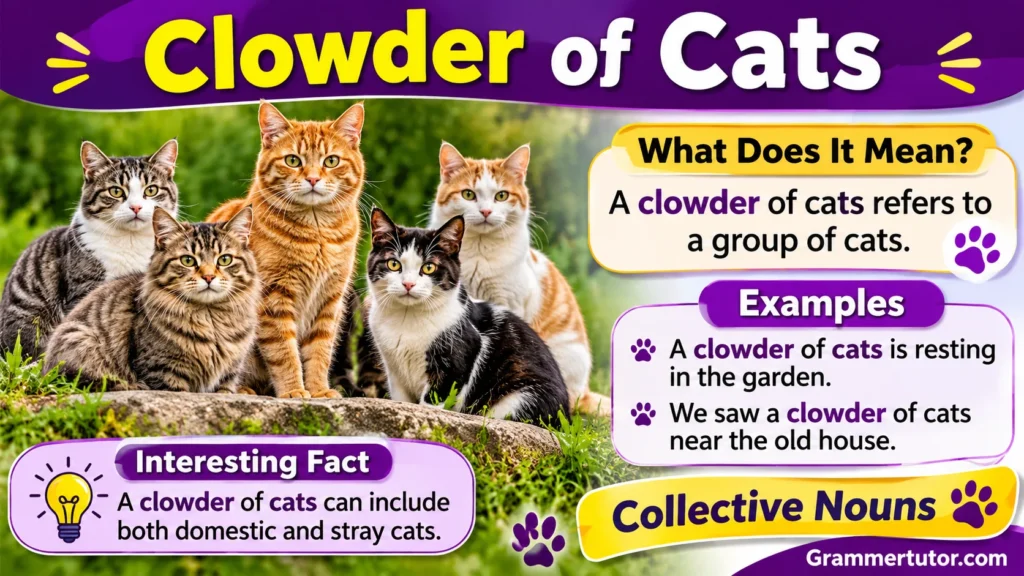
A clowder of cats is a traditional collective noun used to describe a group of cats. It is one of the best-known special expressions for cats and can be used when several cats gather in the same place.
Cats in a clowder might be resting together, sharing a feeding area, or spending time in a sheltered location. Although cats are often independent hunters, some can develop social relationships with familiar cats, especially when they grow up together or have access to sufficient resources.
The word clowder makes writing more interesting because it provides a specific expression for a group of these familiar animals.
Examples of “Clowder of Cats”
- A clowder of cats gathered near the garden gate.
- We saw a clowder of cats resting in the sunshine.
- A clowder of cats wandered around the farm.
- The children watched a clowder of cats playing together.
- A clowder of cats gathered near the food bowls.
- The clowder of cats rested beneath the large tree.
- A clowder of cats appeared outside the animal shelter.
- We photographed a clowder of cats sitting on the wall.
- A clowder of cats explored the quiet backyard.
- The clowder of cats settled comfortably in the courtyard.
Glaring of Cats
A glaring of cats is a traditional collective noun sometimes used for a group of cats. It is much less common in everyday English than clowder, but it appears in lists of unusual animal collective nouns.
The word glaring has a familiar meaning when someone looks at another person with an angry or intense expression. As a collective noun, however, it refers to a group of cats rather than describing their facial expressions.
This expression can add variety to creative writing, animal-themed stories, and vocabulary lessons. For ordinary conversations, a group of cats or a clowder of cats is usually clearer.
Examples of “Glaring of Cats”
- A glaring of cats sat together near the barn.
- We spotted a glaring of cats in the courtyard.
- A glaring of cats rested beside the old fence.
- The glaring of cats watched the birds from the window.
- A group of cats gathered near the shelter.
- The children learned the expression glaring of cats in class.
- A glaring of cats moved quietly through the garden.
- The photographer noticed a glaring of cats near the steps.
- A glaring of cats rested in the shade.
- We read about the glaring of cats in an animal vocabulary book.
Litter of Kittens
A litter of kittens refers to a group of young cats born to the same mother during one birth. This is a familiar and widely used expression in everyday English.
A litter may contain several kittens, and their number can vary. During their early weeks, kittens depend on their mother for nourishment, warmth, and protection. As they grow, they begin exploring their surroundings, playing with their siblings, and developing the coordination they need for adult life.
Unlike clowder, which refers to a group of cats generally, litter specifically describes kittens born together.
Examples of “Litter of Kittens”
- A litter of kittens slept in a warm basket.
- The mother cat cared for her litter of kittens.
- We found a litter of kittens in the barn.
- A litter of kittens played beside their mother.
- The children watched a litter of kittens exploring the room.
- A litter of kittens rested on a soft blanket.
- The veterinarian examined a litter of kittens.
- A litter of kittens followed their mother around the house.
- The shelter cared for a litter of abandoned kittens.
- A litter of kittens drank milk from their mother.
Colony of Cats
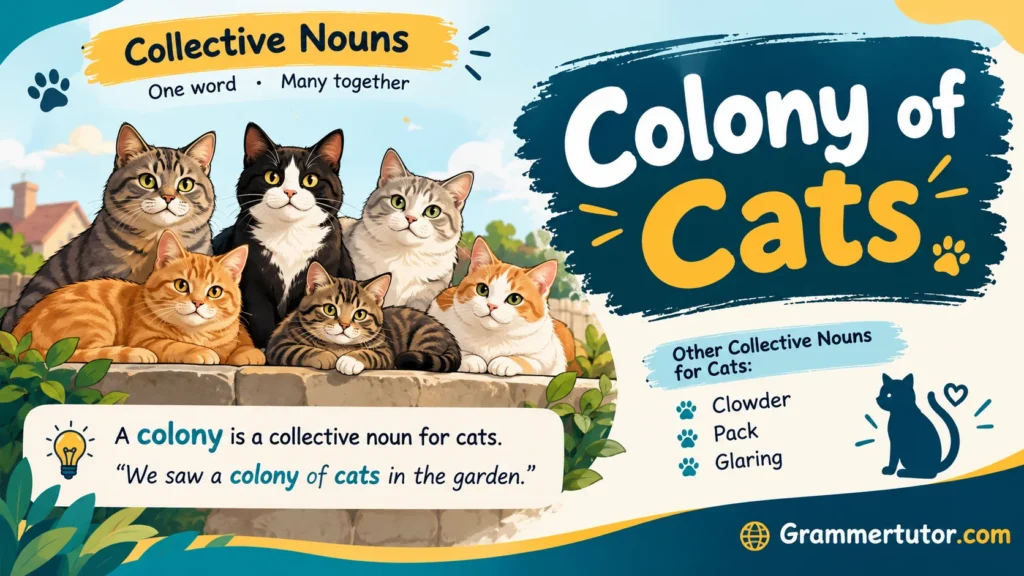
A colony of cats describes cats living in the same area, often with some degree of social interaction. This term is especially common when discussing community cats or feral cats that share a location and access to food and shelter.
A cat colony may live near farms, parks, residential neighborhoods, or abandoned buildings. These cats do not necessarily behave like a tightly organized group. Instead, they may tolerate one another because the environment provides resources that allow them to live nearby.
The word colony is useful in animal welfare discussions, particularly when people care for outdoor cats through feeding, veterinary treatment, and trap-neuter-return programs.
Examples of “Colony of Cats”
- A colony of cats lived near the old warehouse.
- Volunteers provided food for a colony of cats.
- A colony of cats gathered behind the community center.
- The farmer noticed a colony of cats near the barn.
- A colony of cats found shelter beneath the building.
- The animal rescue group monitored a colony of cats.
- A colony of cats lived near the fishing harbor.
- Volunteers arranged veterinary care for a colony of cats.
- A colony of cats rested in a sheltered courtyard.
- The neighborhood worked together to care for a colony of cats.
Pair of Cats
A pair of cats refers to two cats together. Although pair is a general term rather than a special collective noun for cats, it is a natural and useful expression.
A pair of cats may be siblings, companions, or unrelated animals that share a home. Cats that grow up together may play, groom each other, and sleep close together. However, not every pair of cats develops a close relationship, because their personalities and experiences differ.
Using pairs is particularly helpful when you want to describe exactly two cats rather than a larger group.
Examples of “Pair of Cats”
- A pair of cats slept on the sofa.
- We saw a pair of cats playing in the garden.
- A pair of cats rested beside the window.
- The pair of cats chased a toy across the room.
- A pair of cats sat together on the wall.
- She adopted a pair of cats from the shelter.
- A pair of cats explored the backyard.
- The pair of cats watched birds from the window.
- A pair of cats shared a comfortable bed.
- We photographed a pair of cats in the sunshine.
Group of Cats
A group of cats is a simple, general expression for several cats gathered in the same place. It is suitable for everyday conversation, school assignments, and general writing.
Unlike clowder, the word group is not specific to cats. It can describe almost any collection of people, animals, or objects. Nevertheless, it is clear and grammatically correct, making it a practical option when you do not want to use a specialized term.
For example, you can use a group of cats when describing cats playing together, gathering around food, or resting in a shared space.
Examples of “Group of Cats”
- A group of cats gathered near the house.
- We saw a group of cats playing in the yard.
- A group of cats rested beneath the tree.
- The group of cats searched for food.
- A group of cats walked along the garden path.
- The children observed a group of cats near the fence.
- A group of cats gathered outside the shelter.
- The group of cats slept on the warm pavement.
- A group of cats explored the empty room.
- We watched a group of cats playing with a ball.
Kindle of Kittens
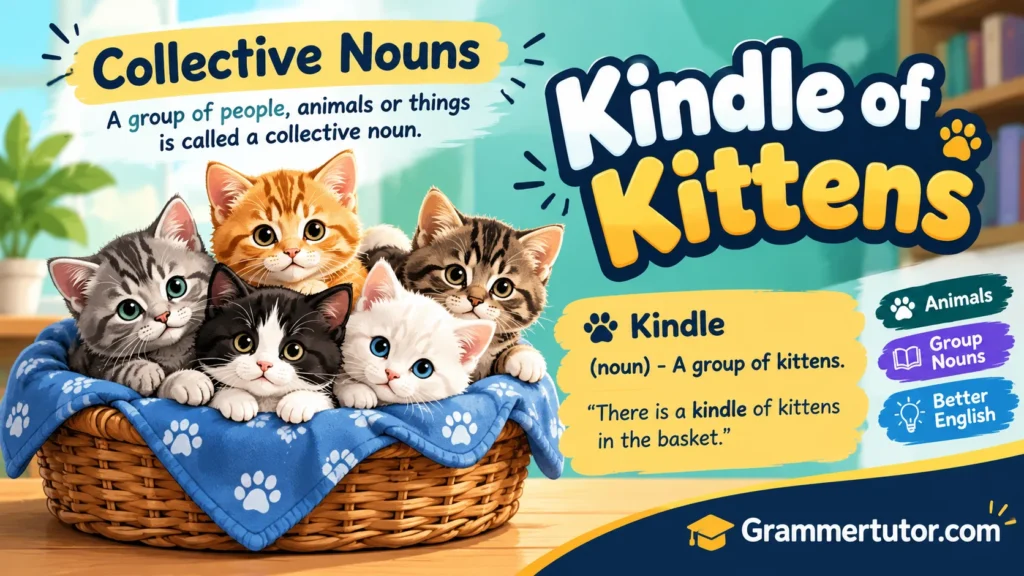
A kindle of kittens is an unusual traditional expression sometimes used for a group of young cats. It is less familiar than litter of kittens, which remains the clearest and most widely used term.
The word kindle has other meanings in English, including to ignite or inspire something. In this animal-related expression, it refers to a group of kittens. It may appear in traditional collective-noun lists or animal vocabulary articles.
If you want your writing to be easily understood by a broad audience, use a litter of kittens in ordinary situations and introduce kindle as an uncommon alternative.
Examples of “Kindle of Kittens”
- A kindle of kittens slept beside their mother.
- We watched a kind of kitten playing in a basket.
- A kindle of kittens explored the warm room.
- The farmer discovered a kindle of kittens in the barn.
- A kindle of kittens rested on a soft blanket.
- The children learned the term kindle of kittens.
- A kindle of kittens played near the garden door.
- The mother cat watched over her kindle of kittens.
- A kindle of kittens curled up together for a nap.
- The shelter cared for a kindle of kittens.
Types of Cats and Their Characteristics
Cats come in many forms, from domestic pets to wild species such as lions, tigers, and leopards. Domestic cats are known for their flexible bodies, sharp claws, sensitive whiskers, and excellent hearing. Their retractable claws help them climb, grasp objects, and catch prey, while their whiskers provide sensory information about their surroundings.
Domestic cats can have different coat colors, patterns, body sizes, and temperaments. Some have short fur, while others have long, thick coats. Their behavior also varies. Certain cats enjoy social interaction, while others prefer quiet places and more independence.
Cats are carnivorous mammals with dietary needs that require nutrients found in animal tissues. They have sharp teeth suited to catching and eating prey. Although domestic cats may sleep for much of the day, they often show bursts of activity when chasing toys or exploring their surroundings.
Examples of Cat Characteristics
- Cats have sensitive whiskers that help them navigate their surroundings.
- Their retractable claws assist with climbing and catching prey.
- Cats have excellent hearing and can detect high-frequency sounds.
- Their eyes are adapted for seeing in low-light conditions.
- Cats use body posture and vocalizations to communicate.
- Domestic cats are obligate carnivores.
- Cats groom themselves using their rough tongues.
- Many cats enjoy climbing and exploring elevated places.
- Cats use scent marking to communicate information.
- Kittens develop coordination and hunting behaviors through play.
Interesting Facts About Cats
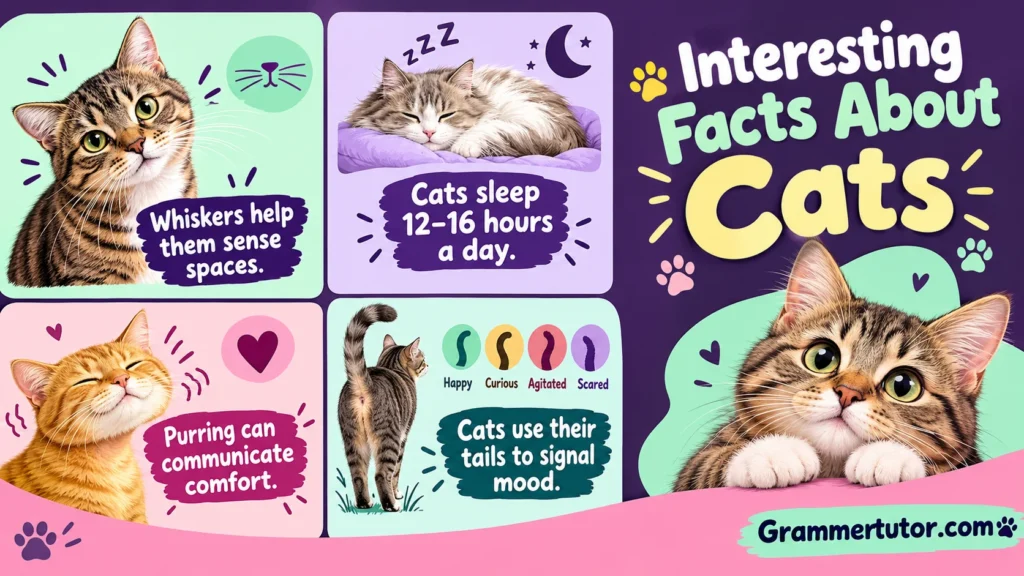
Cats have fascinating biological features, varied behavior, and different lifespans depending on their environment and care. Many domestic cats live around 12–18 years, although some live longer with suitable nutrition, preventive veterinary care, and a safe living environment. Their bodies are highly flexible, and their specialized inner ears help them maintain balance during movement. Cats also have retractable claws, sensitive whiskers, and eyes adapted to low-light conditions, although they cannot see in complete darkness. As obligate carnivores, cats need nutrients found in animal tissues, including taurine, and their natural diets include meat. Wild cats hunt prey, while domestic cats may eat nutritionally complete commercial cat food or appropriately formulated diets. Their behavior can include solitary hunting, playful interaction, scent marking, and social grooming. Some cats form close relationships with other cats, while others prefer to keep their distance. These differences help explain why expressions such as clowder of cats, colony of cats, and litter of kittens describe different situations.
READ MORE: Collective Noun for Insects: A Complete Guide with Examples
Conclusion
Understanding the collective noun for cats helps you describe groups of cats clearly and naturally. Clowder of cats is a recognized term, while group of cats is a simple, general expression. You can use litter of kittens when referring to kittens born together. Learning these collective nouns improves your English vocabulary and helps you write more accurate and descriptive sentences about animals.
FAQs
Q1. What is the collective noun for cats?
The traditional collective noun for cats is clowder. Therefore, a group of cats can be called a clowder of cats.
Q2. What is a group of cats called?
A group of cats is commonly called a clowder of cats. The general expression group of cats is also correct.
Q3. Is “clowder of cats” correct?
Yes. Clowder of cats is a recognized traditional collective expression used to describe several cats gathered together.
Q4. What is a group of kittens called?
A group of kittens born to the same mother during one birth is called a litter of kittens. Kindle of kittens is a less common traditional alternative.
Q5. What is the glaring of cats?
A glaring of cats is an uncommon traditional collective noun sometimes listed for a group of cats. Clowder is more familiar in general usage.