
When learning the collective noun for racehorses, it helps to understand how groups of specially trained horses are described in English. Racehorses are known for their speed, strength, stamina, and competitive spirit, and they often train, travel, and compete together.
The most useful collective noun is string, which describes a group of racehorses that are trained, managed, or owned by the same person or racing organization. Other words, including stable, team, and herd, can also describe horses, depending on the situation. However, each term can create a slightly different meaning.
Learning these collective nouns makes your writing more precise and natural. Whether you are discussing horse racing, describing a training yard, or referring to several horses together, choosing the right group word helps your sentences communicate the idea clearly and accurately.
Why Are Collective Nouns Used for Racehorses?
A collective noun gives us a convenient way to talk about several racehorses as a group. Instead of repeatedly saying “a group of racehorses,” you can use a more specific expression such as a string of racehorses.
The word you choose can also tell the reader something about the horses. For example, string often focuses on racehorses belonging to or being managed by the same trainer or owner. Herd is more general and emphasizes horses living or moving together.
In horse-racing writing, these terms are especially useful when discussing trainers, owners, racing yards, competitions, and training routines.
Common Collective Nouns for Racehorses

Different collective nouns can be used for racehorses according to the context. Some are directly connected with racing, while others are general terms for horses.
| Collective Noun | Used For | Simple Example |
| String | Racehorses trained or managed together | The trainer has a strong string of racehorses. |
| Stable | Horses kept or managed at the same racing yard | The stable contains several promising racehorses. |
| Team | Racehorses considered together for racing or training | The team of racehorses trained every morning. |
| Herd | Horses moving or living together | A herd of horses crossed the field. |
| Group | A general term for several racehorses | A group of racehorses entered the track. |
| Band | A group of horses, especially in freer or natural settings | A band of horses moved across the open land. |
| Troop | A less common collective expression for horses | A troop of horses moved toward the paddock. |
Among these, string is particularly useful when you’re specifically talking about racehorses under the care of a trainer, owner, or racing operation.
String of Racehorses
String is one of the most useful terms when discussing racehorses. In horse-racing language, a string can mean a collection of horses trained or managed by the same trainer or racing establishment.
A trainer may have a small string consisting of only a few horses, while a major racing operation may have a much larger string. These horses can have different ages, abilities, racing records, and training schedules.
The expression is especially appropriate when the horses are connected through the same racing operation rather than simply standing together in a field.
Examples of “String of Racehorses”
- The trainer prepared a strong string of racehorses for the new season.
- The owner recently added three horses to his string.
- A talented string of racehorses arrived at the training yard.
- The trainer’s string of racehorses includes several young competitors.
- The stable is known for producing a successful string of racehorses.
- The owner inspected his string of racehorses before the morning workout.
- A promising string of racehorses was prepared for the major event.
- The trainer carefully managed every horse in his string.
- Her string of racehorses has been training consistently.
- The racing yard expanded its string of racehorses this year.
Stable of Racehorses
Stable can also be used when talking about a collection of racehorses connected with the same racing yard or organization. The word has a double connection with horses because a stable is both a physical place where horses are kept and, in racing contexts, a term associated with a trainer’s or owner’s horses.
When someone says that a racehorse belongs to a particular stable, the phrase can identify the racing operation behind that horse. In everyday usage, however, stable is often better understood as the place or racing establishment rather than a strict collective noun.
Examples of “Stable of Racehorses”
- The trainer manages a successful stable of racehorses.
- A talented stable of racehorses was prepared for the season.
- The owner built a new stable for his racing horses.
- The racing yard is home to a large stable of racehorses.
- Each horse in the stable of racehorses follows a careful routine.
- The trainer introduced his stable of racehorses to the visitors.
- The stable of racehorses includes several experienced competitors.
- The team carefully monitored every horse in the stable.
- The young trainer hopes to develop a successful stable of racehorses.
- Several members of the stable of racehorses will compete this weekend.
Team of Racehorses

The word team can describe racehorses when they are being considered together for a particular purpose, such as training, competition, or representation of an owner or racing operation.
Unlike string, which has a more established connection with a trainer’s collection of horses, team is broader. It emphasizes cooperation or shared participation rather than ownership or management.
For example, if several racehorses are preparing for races under the same racing operation, you may describe them as a team when discussing their collective role.
Examples of “Team of Racehorses”
- The team of racehorses trained before sunrise.
- The trainer selected a strong team of racehorses for the competition.
- Every horse on the team followed a strict exercise program.
- The team of racehorses performed well during the trials.
- The owner was proud of his talented team of racehorses.
- The horses formed a competitive team for the racing season.
- The trainer evaluated the entire team of racehorses.
- A young team of racehorses began training at the new yard.
- The team included both experienced and younger horses.
- The racing organization prepared its team of racehorses carefully.
Herd of Racehorses
Herd is the familiar collective noun for horses in general. It can also be used for racehorses when the focus is on several horses being together rather than on their racing connection.
For example, racehorses may form a herd when they are turned out into a field or allowed to move together. In this situation, the herd describes their social grouping rather than their status as competitors.
If you specifically mean horses belonging to the same trainer, string is usually more precise. If you simply mean horses gathered together, the herd can work naturally.
Examples of “Herd of Racehorses”
- A herd of racehorses moved across the training field.
- The herd of racehorses grazed peacefully after exercise.
- The trainer watched the herd from the edge of the field.
- A herd of racehorses was released into the pasture.
- The horses stayed together as a herd.
- The herd of racehorses returned to the stable before sunset.
- Several young horses joined the herd.
- The herd of racehorses moved toward the water.
- The trainer allowed the horses to socialize as a herd.
- A herd of racehorses rested in the field after training.
Band of Racehorses

Band is a less common and more descriptive word for a group of horses. It is more suitable when the horses are moving or living together in a relatively natural environment.
For racehorses, this term isn’t as closely associated with racing terminology as string. Still, it can appear in descriptive writing when the writer wants to focus on the horses as a group.
It works especially well when racehorses are temporarily turned out together or when the writing has a more literary style.
Examples of “Band of Racehorses”
- A band of racehorses moved across the open field.
- The band of racehorses gathered near the fence.
- A small band of racehorses rested after their exercise.
- The trainer watched the band from a distance.
- The band of racehorses walked slowly toward the paddock.
- Several horses formed a band in the large pasture.
- The band of racehorses stayed close together.
- A young horse followed the band across the field.
- The band of racehorses moved toward the stable.
- The sight of the band was impressive in the morning light.
Group of Racehorses
Group is the simplest and safest general expression for several racehorses. It doesn’t suggest a specific relationship between the horses.
You can use a group of racehorses when you don’t know whether the horses belong to the same owner, train under the same trainer, or simply happen to be together.
Although it isn’t a specialized racing collective noun, it is completely clear and natural in everyday English.
Examples of “Group of Racehorses”
- A group of racehorses entered the training area.
- The trainer watched a group of racehorses running around the track.
- A group of racehorses was waiting near the paddock.
- The photographer captured a group of racehorses during practice.
- A group of racehorses arrived at the racing venue.
- The group of racehorses completed its morning exercise.
- Several horses joined the group near the field.
- The trainer examined each horse in the group.
- A group of racehorses rested after a long workout.
- The group of racehorses returned to the stable together.
How Racehorses Behave in Groups
Racehorses are highly trained athletes, but they are still social animals. Their behavior can change depending on whether they’re training, racing, traveling, or spending time in a field.
During training, racehorses often follow carefully planned routines. They may exercise individually or alongside other horses. Working near other horses can help create a controlled training environment, although each horse still receives individual attention.
When horses are turned out together, they may graze, walk, rest, and interact with one another. Social contact is a normal part of horse behavior. Trainers and handlers therefore consider both physical training and general well-being when managing a group of racehorses.
Interesting Facts About Racehorses
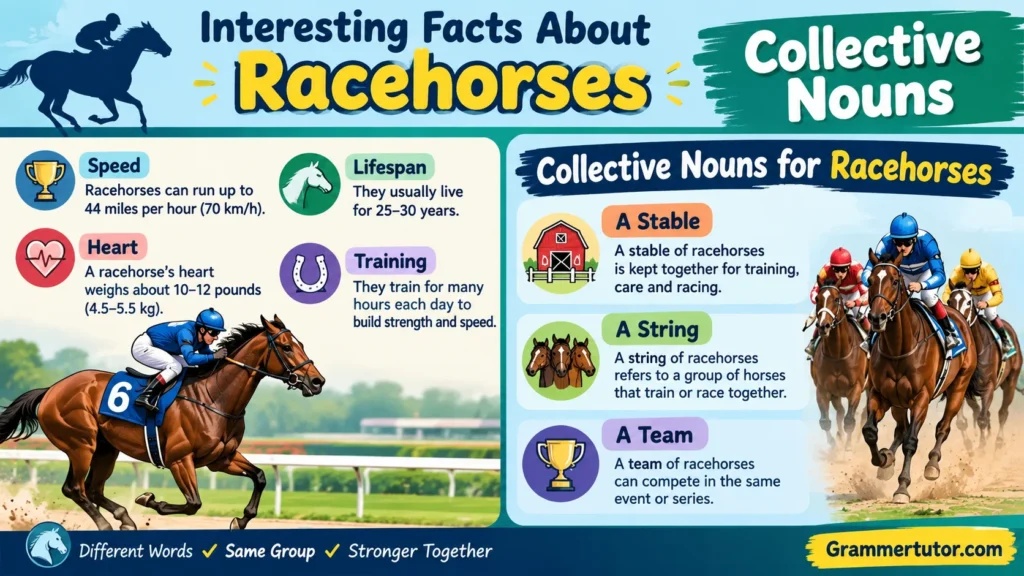
Racehorses are bred and trained for athletic performance, and their bodies are adapted for speed and endurance. Thoroughbreds, one of the best-known breeds used in racing, are generally tall, lean, and muscular, with long legs that help them cover ground efficiently. A racehorse’s heart, lungs, muscles, bones, and nervous system all play important roles in athletic performance. Their diet is carefully managed because nutrition provides the energy needed for training and competition. Racehorses may eat combinations of forage, grains, and specially formulated feeds depending on their individual needs. They also require regular exercise, rest, grooming, veterinary care, and hoof maintenance. Although racing horses can be extremely competitive on the track, they still have natural social behaviors when they are allowed to interact with other horses.
Choosing the Right Collective Noun for Racehorses
The best collective noun depends on what you want your sentence to communicate.
If you’re discussing horses managed by the same trainer or racing operation, string is a particularly useful choice. It has a strong connection with racing and training.
If the horses are simply living or moving together, the herd is more natural. If you’re talking about horses connected with a racing yard, stable may work depending on the sentence.
For a general statement, a group is perfectly acceptable. Meanwhile, teams can emphasize horses being considered together for training or competition.
Here is a simple way to remember the difference:
- String → racehorses managed or trained together
- Stable → horses associated with a racing yard or stable
- Team → horses considered together for a purpose
- Herd → horses living or moving together
- Band → a less common descriptive term for horses together
- Group → a general term for several horses
Conclusion
The collective noun for racehorses is most commonly string, especially when a group of racehorses is trained, managed, or owned by the same person or racing organization. Other terms, such as stable, team, and herd, may also be used depending on the situation. Understanding these terms helps you choose the most precise and natural word when writing or speaking about racehorses.
READ MORE: Collective Noun for Swine: A Complete Guide with Examples
FAQs
Q1. What is the collective noun for racehorses?
The most specific collective noun for racehorses is string.
Q2. What does “string” mean in horse racing?
A string is a group of racehorses trained, managed, or owned by the same person or racing organization.
Q3. Can “team” be used for racehorses?
Yes. Team can describe racehorses that work or compete together in a particular setting.
Q4. Can “herd” describe racehorses?
Yes, herd can refer generally to a group of horses, although string is more specific in racing contexts.
Q5. Can “stable” be a collective noun for racehorses?
Yes. Stable can refer to a group of horses associated with the same racing operation.
Q6. Why is “string” commonly used in horse racing?
It identifies a group of horses connected through the same training, management, or ownership arrangement.
Q7. Is “string of racehorses” grammatically correct?
Yes. For example: “The trainer has a string of racehorses preparing for the competition.”
Q8. What is the difference between “string” and “herd”?
String is associated with an organized racing group, while herd generally describes horses grouped together.
Q9. What collective noun should I use in formal writing?
Use string when you mean racehorses belonging to or managed by the same racing operation.
Q10. Can more than one collective noun describe racehorses?
Yes. String, stable, team, and herd can all be used, but the appropriate choice depends on the context.