
Collective noun for swordfish shows how the English language uses special names to describe groups of fish, especially powerful ocean predators such as swordfish. Recognized by their long, sword-like bills, streamlined bodies, and impressive swimming abilities, swordfish are fascinating marine animals. These features make their animal group names particularly interesting to people who study English vocabulary, marine wildlife, and collective nouns.
The most familiar expression is a school of swordfish, while a group of swordfish and a shoal of swordfish are also useful ways to describe multiple individuals. Unlike many smaller fish, however, swordfish are generally solitary hunters and do not usually swim in tightly coordinated schools. This makes it important to distinguish common collective nouns from the actual social behavior of these remarkable fish.
Other expressions, such as aggregation of swordfish, gathering of swordfish, and cluster of swordfish, can be used in descriptive or scientific writing. These alternatives help writers describe swordfish observed in the same area without suggesting that every expression is an established, species-specific collective noun. For anyone interested in English terminology, ocean wildlife, marine biology, or animal group names, these expressions provide an interesting connection between language and nature.
Why Collective Nouns Are Used for Swordfish
Collective nouns give groups of animals descriptive names and make writing clearer and more engaging. For swordfish, these expressions help readers understand how to describe multiple fish in the ocean without repeating the word fish in every sentence.
The word school is commonly used for groups of fish swimming in the same general area. However, swordfish usually hunt alone and are not known for forming the closely coordinated schools seen in many smaller fish species. A group of swordfish is therefore another simple and accurate expression for general writing.
Collective nouns can also vary according to context. For example, aggregation of swordfish is useful when scientists observe several individuals in one region, while population of swordfish refers to the fish of a particular species living in a defined geographical area.
Understanding these expressions helps readers appreciate both English grammar and the behavior of swordfish. It also shows how language can describe animals in ways that are informative, natural, and appropriate to different situations.
Collective Nouns for Swordfish

| Collective Noun | Used For | Simple Example |
| School | A general term for multiple fish swimming in the same area | A school of swordfish appeared in the ocean. |
| Shoal | Fish found together in the same area | A shoal of swordfish was spotted offshore. |
| Group | A general expression for several swordfish | A group of swordfish moved through the water. |
| Aggregation | Multiple swordfish gathered in one area | An aggregation of swordfish was recorded by researchers. |
| Gathering | A descriptive expression for several swordfish in one place | A gathering of swordfish appeared near the surface. |
| Cluster | Several swordfish observed relatively close together | A cluster of swordfish appeared in the footage. |
| Population | Swordfish living within a particular region | The swordfish population was studied by scientists. |
The most useful expressions for everyday English are school of swordfish, shoal of swordfish, and group of swordfish. The words aggregation, gathering, and cluster can be used descriptively, while population has a more specific ecological meaning.
School of Swordfish
A school of swordfish is a familiar expression for describing multiple swordfish swimming in the same general area. The word school is widely used for groups of fish, making it a useful choice in English writing and educational materials.
However, swordfish are generally solitary marine predators. They do not normally form tightly coordinated schools in the same way as sardines or anchovies. Therefore, the expression is best understood as a general group description rather than a claim about their usual social behavior.
Examples of “School of Swordfish”
- A school of swordfish was spotted in the open ocean.
- We observed a school of swordfish from the research boat.
- A school of swordfish appeared in the underwater footage.
- The researchers recorded a school of swordfish during their survey.
- A school of swordfish moved through the blue water.
- The documentary showed a school of swordfish in their natural habitat.
- The photographer captured a school of swordfish offshore.
- A school of swordfish was mentioned in the marine report.
- The students learned about a school of swordfish in class.
- A school of swordfish appeared on the observation screen.
Shoal of Swordfish
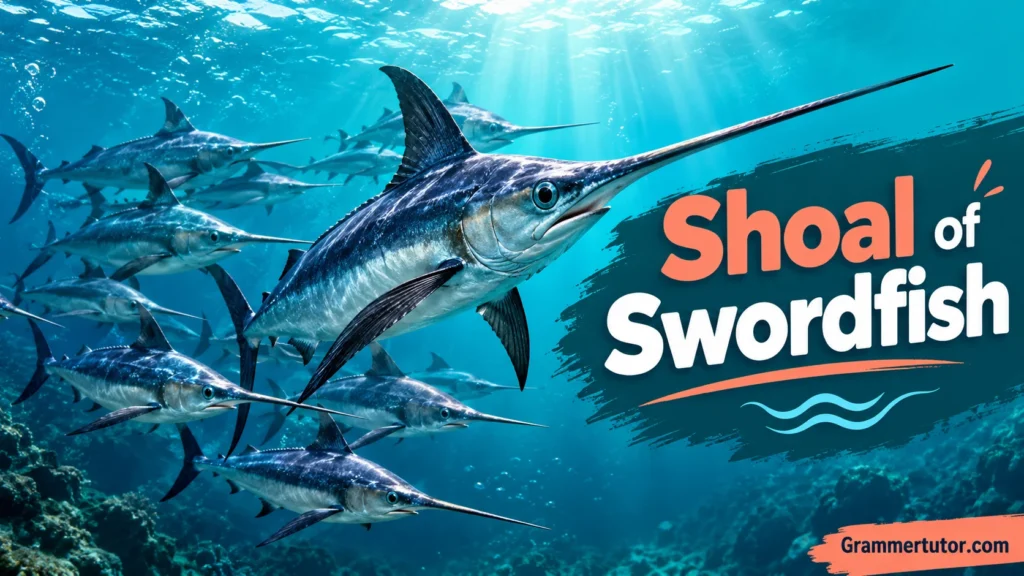
A shoal of swordfish is another expression that can describe several swordfish found in the same area. The word shoal is used in English for groups of fish and is particularly helpful when describing marine observations.
Like school, the word shoal does not necessarily mean that swordfish swim in a highly organized group. Swordfish often live and hunt independently, so this expression should be used as a general description of multiple individuals.
Examples of “Shoal of Swordfish”
- A shoal of swordfish appeared near the surface.
- The crew spotted a shoal of swordfish offshore.
- A shoal of swordfish was recorded during the marine survey.
- The photographer observed a shoal of swordfish in the distance.
- A shoal of swordfish appeared in the underwater video.
- The researchers documented a shoal of swordfish in the region.
- A shoal of swordfish was seen from the research vessel.
- The students discussed a shoal of swordfish during their lesson.
- A shoal of swordfish appeared in the ocean footage.
- The marine guide described a shoal of swordfish to the visitors.
Group of Swordfish
A group of swordfish is a simple and flexible expression for describing multiple swordfish. Unlike more specialized or traditional animal-group expressions, the word group is easy to understand and appropriate for everyday English.
This expression is particularly useful when the writer does not know whether the swordfish are swimming together, gathering temporarily, or simply appearing in the same area. It avoids suggesting a particular social behavior.
Examples of “Group of Swordfish”
- A group of swordfish was spotted in the ocean.
- The researchers observed a group of swordfish offshore.
- A group of swordfish appeared in the documentary.
- We saw a group of swordfish during the marine expedition.
- A group of swordfish moved through the deep water.
- The photographer recorded a group of swordfish underwater.
- A group of swordfish was included in the research report.
- The students learned about a group of swordfish in science class.
- A group of swordfish appeared on the underwater camera.
- The guide explained how to describe a group of swordfish in English.
Aggregation of Swordfish
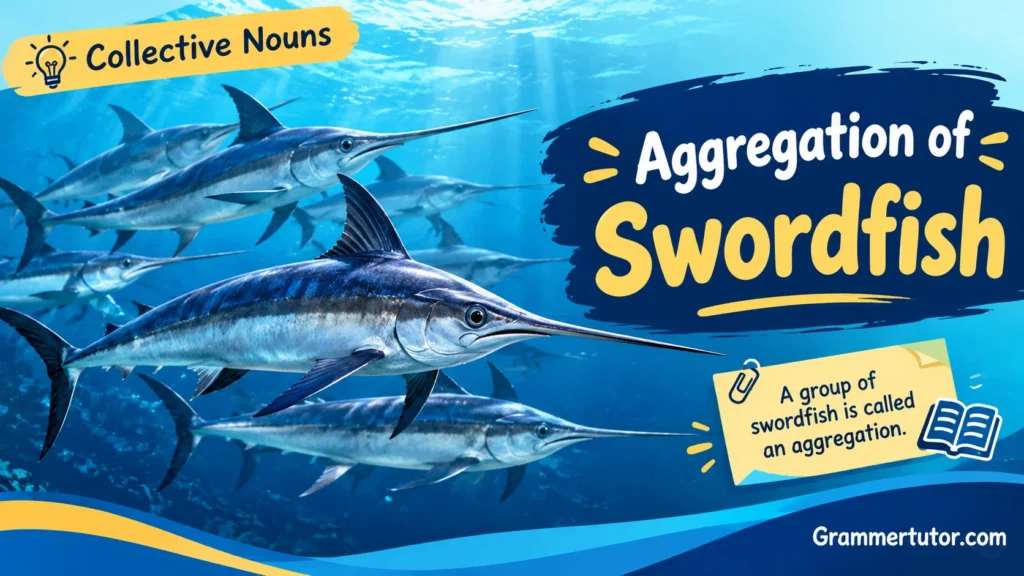
An aggregation of swordfish describes multiple swordfish gathered within the same area. This expression is particularly useful in marine biology, scientific reports, and wildlife observations.
Unlike the more familiar words school and shoal, aggregation emphasizes that several individuals are present in a particular location. It does not necessarily mean that the swordfish are cooperating, hunting together, or behaving as a social unit.
Examples of “Aggregation of Swordfish”
- An aggregation of swordfish was recorded during the survey.
- Researchers studied an aggregation of swordfish in the ocean.
- An aggregation of swordfish appeared in the tracking data.
- The marine team documented an aggregation of swordfish offshore.
- An aggregation of swordfish was observed during the expedition.
- Scientists examined an aggregation of swordfish in the region.
- An aggregation of swordfish appeared in the research report.
- The team recorded an aggregation of swordfish in deep water.
- An aggregation of swordfish was identified during marine monitoring.
- The study investigated an aggregation of swordfish in the ocean.
Gathering of Swordfish
A gathering of swordfish is a descriptive expression for several swordfish seen in the same place. Although it is not a widely established, species-specific collective noun, it can be useful in storytelling, nature writing, and informal descriptions.
The word gathering suggests that several individuals have come together or are present in one area. It should not be interpreted as proof that swordfish regularly gather in organized social groups.
Examples of “Gathering of Swordfish”
- A gathering of swordfish was spotted by the crew.
- The researchers observed a gathering of swordfish offshore.
- A gathering of swordfish appeared in the documentary.
- The photographer captured a gathering of swordfish underwater.
- A gathering of swordfish was recorded during the expedition.
- The marine guide described a gathering of swordfish in the area.
- A gathering of swordfish appeared in the ocean footage.
- The students wrote a sentence about a gathering of swordfish.
- A gathering of swordfish was mentioned in the report.
- The observer documented a gathering of swordfish near the surface.
Cluster of Swordfish

A cluster of swordfish is a descriptive expression used when several swordfish appear relatively close together. It can help writers describe an underwater observation without implying that the fish are swimming in a coordinated school.
The word cluster is also used for groups of objects or animals that appear near one another. For this reason, it is more suitable as a general descriptive expression than as a traditional collective noun specifically associated with swordfish.
Examples of “Cluster of Swordfish”
- A cluster of swordfish appeared in the underwater footage.
- The researcher noticed a cluster of swordfish offshore.
- A cluster of swordfish was recorded by the marine camera.
- The photographer observed a cluster of swordfish in the distance.
- A cluster of swordfish appeared during the ocean survey.
- The team documented a cluster of swordfish in the region.
- A cluster of swordfish was visible on the observation screen.
- The students discussed a cluster of swordfish in class.
- A cluster of swordfish appeared in the marine report.
- The documentary showed a cluster of swordfish in the open ocean.
Interesting Facts About Swordfish
Swordfish (Xiphias gladius) are remarkable marine predators found in temperate and tropical oceans around the world. They are known for their long, flattened bills, powerful bodies, and ability to move quickly through the water. Swordfish can live for approximately 9 years or longer, although their actual longevity varies according to sex, environmental conditions, and the population being studied. Their distinctive bill is used to slash or strike prey, helping them capture fish and other marine animals.
One of the most unusual features of swordfish is their specialized eye- and brain-warming system. This adaptation helps keep these organs warmer than the surrounding water, improving their visual performance when hunting in colder or deeper ocean environments. Swordfish also have streamlined bodies and strong muscles that support rapid swimming. Their ability to move between different water depths makes them effective hunters in changing marine conditions.
Swordfish mainly feed on fish and squid. They may hunt in deeper water where prey is available and move toward warmer surface waters at other times. Despite their impressive hunting abilities, swordfish are generally solitary rather than strongly social animals. Several individuals may be found in the same region, but they do not usually depend on tightly coordinated groups to find food. These biological features make swordfish fascinating to marine researchers and wildlife enthusiasts.
Quick Swordfish Facts
- Swordfish belong to the scientific species Xiphias gladius.
- Their long, flattened upper jaw resembles a sword.
- They are powerful predators found in temperate and tropical oceans.
- Swordfish mainly eat fish and squid.
- They can live for around nine years or longer.
- Their specialized warming system helps maintain the temperature of their eyes and brain.
- They can hunt in both surface waters and deeper ocean environments.
- Swordfish are generally solitary hunters.
- Their streamlined bodies help them swim rapidly.
- The words school, shoal, and group are useful expressions for describing multiple swordfish.
Conclusion
The collective noun for swordfish is commonly expressed as a school of swordfish, while group and shoal are also useful alternatives. Learning these terms improves English vocabulary and helps describe marine life accurately. Understanding swordfish’s unique features, solitary hunting behavior, and fascinating biology makes learning about these powerful ocean predators even more interesting.
FAQs
Q1. What is the collective noun for swordfish?
The most familiar expression is a school of swordfish. The general phrase a group of swordfish is also correct and easy to understand.
Q2. What is a group of swordfish called?
A group of swordfish can be described as a school, shoal, or group of swordfish. The best choice depends on the context.
Q3. Is “school of swordfish” correct?
Yes. School of swordfish is a recognizable general expression for multiple fish, although swordfish do not usually form tightly coordinated schools.
Q4. Can I use “shoal of swordfish”?
Yes. Shoal of swordfish is a suitable general expression for several fish found in the same area.
Q5. What other expressions can describe a group of swordfish?
Other useful expressions include group, aggregation, gathering, and cluster of swordfish. Some are general descriptive phrases rather than established species-specific collective nouns.
Q6. What is the scientific name of swordfish?
The scientific name of swordfish is Xiphias gladius.
Q7. Do swordfish swim in groups?
Swordfish are generally solitary animals. Several individuals may occur in the same region, but they do not usually travel in tightly coordinated schools.
Q8. What do swordfish eat?
Swordfish mainly eat fish and squid. They hunt in different parts of the ocean depending on where their prey is available.
Q9. How long do swordfish live?
Swordfish can live for approximately 9 years or longer, although lifespan varies with environmental conditions and individual characteristics.
Q10. Which collective noun is best for students and English learners?
School of swordfish is a useful expression to learn first. Group of swordfish is another simple and reliable choice for everyday English sentences.