
The collective noun for rhinoceros is crash, a memorable term for a group of these large mammals with thick skin and distinctive horns.Rhinoceroses are powerful mammals with strong bodies, but they often live alone rather than in small groups.
However, females may stay with their young, and you may also see herd or group used to describe several rhinoceroses together. The most commonly used term, crash, is an unusual term that makes descriptions of these animals more vivid and memorable.
Learning these collective nouns can improve your English vocabulary and help you write better sentences about wildlife. Whether you are completing a school assignment, preparing an article, or exploring animal names, understanding these terms is useful. For example, “A crash of rhinoceroses moved across the grassland” shows how to use the term naturally.
Why Are Collective Nouns Used for Rhinoceroses?
Collective nouns are words that describe a collection of people, animals, or things as one unit. For example, we say a flock of birds, a pack of wolves, and a herd of elephants. These expressions help us describe groups without naming every individual animal.
The word crash is a distinctive collective noun associated with rhinoceroses. It adds character to a sentence and makes wildlife descriptions more engaging. For example, “A crash of rhinoceroses resting near the waterhole” gives the reader a clear picture of several rhinos in one place.
However, rhinoceroses do not always travel in groups. Many adult rhinos prefer a solitary lifestyle, particularly males. Female rhinoceroses may spend time with their calves, while several animals may gather temporarily around food or water.
Using an appropriate collective noun allows you to describe these situations naturally. You can use crash when you want a specific and memorable expression, while group works well in everyday writing.
Collective Nouns for Rhinoceros

Several words can describe rhinoceroses gathered in one place. Some are distinctive collective nouns, while others are general terms that fit ordinary conversation.
| Collective Noun | Used For | Simple Example |
| Crash | A group of rhinoceroses | A crash of rhinoceroses crossed the plain. |
| Herd | Several rhinoceroses together | A herd of rhinos grazed near the trees. |
| Group | Rhinoceroses gathered in one place | A group of rhinoceroses stood by the river. |
| Pair | Two rhinoceroses | A pair of rhinoceroses walked through the grass. |
| Family | Related rhinoceroses, such as a mother and calf | A rhinoceros family rested in the shade. |
| Crash of rhinos | A group described using the familiar shorter name | A crash of rhinos moved across the reserve. |
| Gathering | Rhinoceroses assembled in one area | A gathering of rhinoceroses appeared near the water. |
Note: Crash is the distinctive collective noun commonly associated with rhinoceroses. Herd, group, pair, family, and gathering are useful general expressions rather than equally established special collective nouns.
Crash of Rhinoceroses
A crash of rhinoceroses is the best-known special collective noun for these animals. It sounds powerful and suits the impressive appearance of rhinos. The word can make wildlife writing more colorful, especially when describing several rhinoceroses moving through their natural habitat.
Rhinoceroses have large bodies and strong legs, and they can run surprisingly fast over short distances. When multiple rhinos move together, the phrase crash of rhinoceroses creates a memorable image for the reader.
Although rhinoceroses are often solitary, a group may form temporarily. Females and their calves may remain close to one another, and several animals may visit the same water source.
Examples of “Crash of Rhinoceroses”
- A crash of rhinoceroses wandered across the open grassland.
- We watched a crash of rhinoceroses from a safe distance.
- A crash of rhinoceroses rested beneath the afternoon sun.
- The wildlife guide spotted a crash of rhinoceroses near the waterhole.
- A crash of rhinoceroses moved slowly through the reserve.
- The photographer waited quietly to capture a crash of rhinoceroses.
- A crash of rhinoceroses appeared beyond the tall grass.
- The visitors learned about a crash of rhinoceroses during their safari.
- A crash of rhinoceroses left fresh tracks in the muddy ground.
- The conservation team observed a crash of rhinoceroses from a vehicle.
Herd of Rhinoceroses
A herd of rhinoceroses is a straightforward way to describe several rhinos together. The word herd is widely used for large land mammals, including cattle, elephants, and deer. It is also easy for young learners to understand.
Although many rhinoceroses spend much of their time alone, they may share parts of their habitat. A few animals might feed in the same area or gather around a water source without behaving like a tightly connected herd.
The word herd is especially useful when you want a simple description rather than an unusual collective noun. It fits schoolwork, wildlife reports, and everyday conversations.
Examples of “Herd of Rhinoceroses”
- A herd of rhinoceroses grazed across the wide plain.
- The herd of rhinoceroses stayed close to the water.
- We saw a herd of rhinoceroses during our wildlife tour.
- A herd of rhinoceroses moved through the protected grassland.
- The ranger watched a herd of rhinoceroses from a distance.
- A herd of rhinoceroses searched for fresh vegetation.
- The documentary showed a herd of rhinoceroses in Africa.
- A herd of rhinoceroses rested beneath a group of trees.
- The children read about a herd of rhinoceroses in their science books.
- A herd of rhinoceroses appeared on the far side of the reserve.
Group of Rhinoceroses
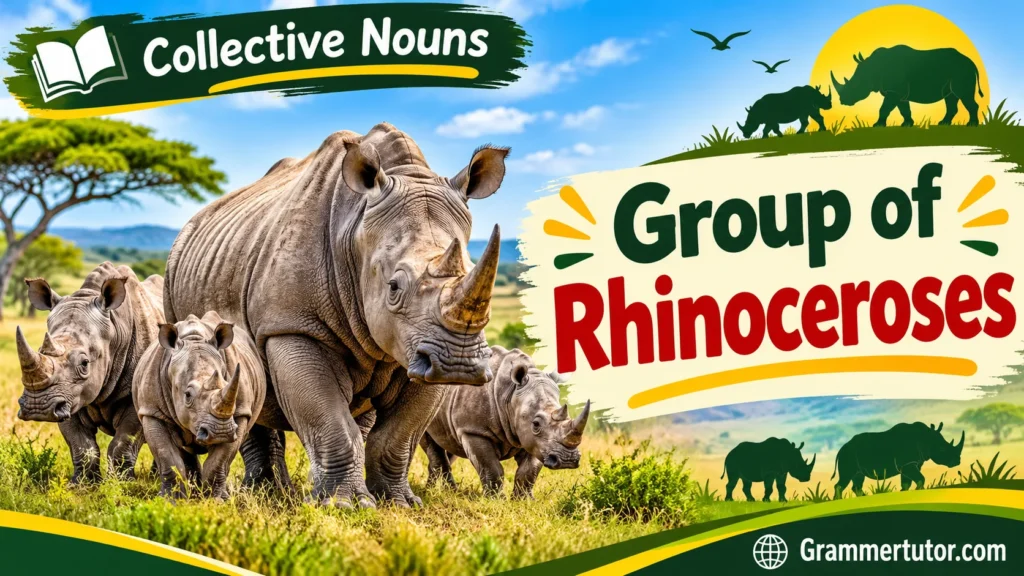
The word group is one of the easiest ways to refer to multiple rhinoceroses. Unlike a specialized collective noun, it does not suggest a particular social structure. It simply tells the reader that more than one rhino is present.
This term works well because rhinoceros behavior varies by species, age, sex, and environment. Some individuals are highly solitary, while others may tolerate nearby animals. A mother and calf, for example, can be described as a group without implying that they belong to a permanent herd.
If you are unsure which collective noun to choose, group of rhinoceroses is a reliable and natural option.
Examples of “Group of Rhinoceroses”
- A group of rhinoceroses stood near the edge of the forest.
- The guide pointed out a group of rhinoceroses in the distance.
- A group of rhinoceroses visited the same watering place.
- We observed a group of rhinoceroses through binoculars.
- A group of rhinoceroses moved across the dusty ground.
- The wildlife team recorded a group of rhinoceroses in the reserve.
- A group of rhinoceroses rested in a quiet clearing.
- The children saw a group of rhinoceroses in a wildlife documentary.
- A group of rhinoceroses searched for food among the shrubs.
- The researcher photographed a group of rhinoceroses from a safe location.
Pair of Rhinoceroses
A pair of rhinoceroses refers to two rhinos together. This expression is particularly helpful when you are describing two animals in a photograph, a wildlife observation, or a story.
A pair may consist of a mother and her calf, two animals sharing an area, or a male and female during a breeding period. The word pair describes their number rather than claiming they have a permanent relationship.
Using this term makes your sentence more precise. Instead of saying “some rhinoceroses were near the pond,” you can say “a pair of rhinoceroses stood near the pond” when exactly two animals are present.
Examples of “Pair of Rhinoceroses”
- A pair of rhinoceroses walked beside the river.
- We spotted a pair of rhinoceroses in the distance.
- A pair of rhinoceroses rested under a shady tree.
- The photographer captured a pair of rhinoceroses crossing the plain.
- A pair of rhinoceroses searched for food near the bushes.
- The ranger observed a pair of rhinoceroses from the patrol vehicle.
- A pair of rhinoceroses left deep footprints in the soil.
- A pair of rhinoceroses stood quietly in the grass.
- The wildlife program featured a pair of rhinoceroses in their natural habitat.
- A pair of rhinoceroses moved toward a nearby waterhole.
Family of Rhinoceroses

A family of rhinoceroses describes related animals, such as a female rhino and her calf. This expression is useful when the relationship between the animals matters more than the size of the group.
Rhinoceros mothers care for their young and keep them close during early development. A calf depends on its mother for milk, protection, and learning about its surroundings. Depending on the species and circumstances, the young rhino may remain with its mother for an extended period before becoming independent.
The word family is a general descriptive term rather than a special collective noun used exclusively for rhinoceroses. It is still a natural choice when writing about parental care and the bond between a mother and her offspring.
Examples of “Family of Rhinoceroses”
- A family of rhinoceroses walked through the protected reserve.
- The mother led her young calf across the grassland.
- A family of rhinoceroses rested near a cluster of bushes.
- The wildlife photographer captured a family of rhinoceroses at sunrise.
- A family of rhinoceroses stayed close to a water source.
- The documentary followed a family of rhinoceroses in the wild.
- A family of rhinoceroses moved into the shade during the heat.
- The young calf followed its mother through the tall grass.
- A family of rhinoceroses searched for plants to eat.
- The ranger observed a family of rhinoceroses from a safe distance.
Crash of Rhinos
A crash of rhinos is a shorter version of crash of rhinoceroses. The word rhino is a familiar, informal name for a rhinoceros, making this phrase suitable for accessible articles, captions, and conversations.
The expression gives a sentence a lively tone without changing its meaning. For example, “A crash of rhinos crossed the reserve” is shorter and easier to read than “A crash of rhinoceroses crossed the reserve.”
You can use rhinos when writing for a general audience, especially when the surrounding text already makes it clear which animal you mean. In formal scientific writing, the full animal name may be more appropriate.
Examples of “Crash of Rhinos”
- A crash of rhinos crossed the open savanna.
- We watched a crash of rhinos from the safari vehicle.
- A crash of rhinos rested near a muddy pool.
- The guide found a crash of rhinos beside the grassland.
- A crash of rhinos moved toward the river.
- The camera captured a crash of rhinos at dawn.
- A crash of rhinos appeared between the scattered trees.
- The children learned about a crash of rhinos at school.
- A crash of rhinos left tracks along the dirt path.
- The wildlife team monitored a crash of rhinos in the reserve.
Gathering of Rhinoceroses
A gathering of rhinoceroses describes several rhinos assembled in the same place. It is a general descriptive expression, not a uniquely established collective noun. It can be useful when the animals are temporarily together rather than moving as a coordinated group.
Rhinoceroses may use the same waterholes, feeding areas, or sheltered spaces. When several animals are spotted in one location, the word gathering describes what is happening without making assumptions about their relationships.
This term works well in creative writing and wildlife descriptions. For formal or straightforward writing, a group of rhinoceroses may be clearer.
Examples of “Gathering of Rhinoceroses”
- A gathering of rhinoceroses appeared near the waterhole.
- The ranger noticed a gathering of rhinoceroses across the plain.
- A gathering of rhinoceroses rested in a shady area.
- The visitors observed a gathering of rhinoceroses from their vehicle.
- A gathering of rhinoceroses moved through the open landscape.
- The photographer waited for a gathering of rhinoceroses to come into view.
- A gathering of rhinoceroses shared the same feeding area.
- The conservation team recorded a gathering of rhinoceroses near the river.
- A gathering of rhinoceroses stood among the tall grasses.
- The wildlife report described a gathering of rhinoceroses in the reserve.
How Rhinoceroses Behave in Groups

Rhinoceroses have different social habits depending on their species and circumstances. Many adult rhinos prefer to spend time alone, especially when feeding or resting. This means a group of rhinos may be temporary rather than a permanent social unit.
Female rhinoceroses often form a close relationship with their calves. The mother protects the young animal, guides it through its environment, and helps it learn where to find food and water. As the calf grows, it gradually becomes more independent.
Some rhinoceroses tolerate other individuals nearby, particularly where food and water are available. They may use overlapping areas without forming a close-knit group. Their behavior can also change according to age, sex, breeding activity, and environmental conditions.
Understanding these habits helps you choose the right expression. “Crash of rhinoceroses” is a distinctive collective noun, while “group of rhinoceroses” is a practical general phrase. Pair and family are helpful when you want to identify the number of animals or their relationship.
Interesting Facts About Rhinoceroses
Rhinoceroses are remarkable mammals with several features that make them stand out. Depending on the species, they may live for around 35 to 50 years, particularly under favorable conditions. Their thick skin can look armor-like, but it is sensitive and requires protection from injuries and parasites. Rhino horns are made primarily of keratin, the same protein found in human hair and fingernails. Unlike the horns of many other animals, rhinoceros horns do not have a bony core. Their diets also vary by species: white rhinos mainly graze on grasses, while black rhinos often browse on leaves, twigs, and shrubs. Other species have their own feeding preferences. Rhinoceroses have a strong sense of smell and hearing, which help them notice changes in their surroundings. Despite their size, many species can run quickly over short distances. Today, several rhinoceros species face serious threats from poaching and habitat loss, making wildlife protection and conservation programs essential for their survival.
READ MORE: Collective Noun for Animals: Names, Examples, and Usage
Conclusion
The collective noun for rhinoceros is commonly given as crash. This unusual term makes English more interesting and helps readers describe these powerful animals in a memorable way. Although rhinoceroses often live alone, they may gather in small groups, especially females with their young. You may also see words such as herd and group used in general descriptions. Learning these terms can improve your English vocabulary and help you write clearer sentences about wildlife.
FAQs
Q1. What is the collective noun for rhinoceros?
The collective noun for rhinoceros is crash. It is a traditional term used to describe a group of rhinoceroses.
Q2. What is a group of rhinoceroses called?
A group of rhinoceroses is commonly called a crash of rhinoceroses. The word “group” is also correct in everyday English.
Q3. Why is a group of rhinoceroses called a crash?
“Crash” is a traditional collective noun associated with rhinoceroses. Its exact historical origin is not firmly established.
Q4. Can I use “herd” for rhinoceroses?
Yes. Herd is a general term for a group of animals and can be used to describe rhinoceroses.
Q5. Do rhinoceroses usually live in groups?
Many rhinoceroses spend much of their time alone. However, some may gather in small groups, and females often remain with their young.
Q6. Is “crash of rhinos” grammatically correct?
Yes. “A crash of rhinos” is grammatically correct and uses the collective noun naturally.
Q7. What is the plural of rhinoceros?
Both rhinoceroses and rhinoceros are accepted plural forms. “Rhinos” is also a common, informal alternative.
Q8. How do I use “crash of rhinoceroses” in a sentence?
You can write, “A crash of rhinoceroses rested near the waterhole.” The phrase describes several rhinoceroses as one group.
Q9. Is “group of rhinoceroses” incorrect?
No. “Group of rhinoceroses” is completely correct and easy to understand. “Crash” is simply a more distinctive collective noun.
Q10. Why should students learn collective nouns for rhinoceroses?
Learning collective nouns helps students expand their English vocabulary, improve sentence writing, and describe animals more precisely.