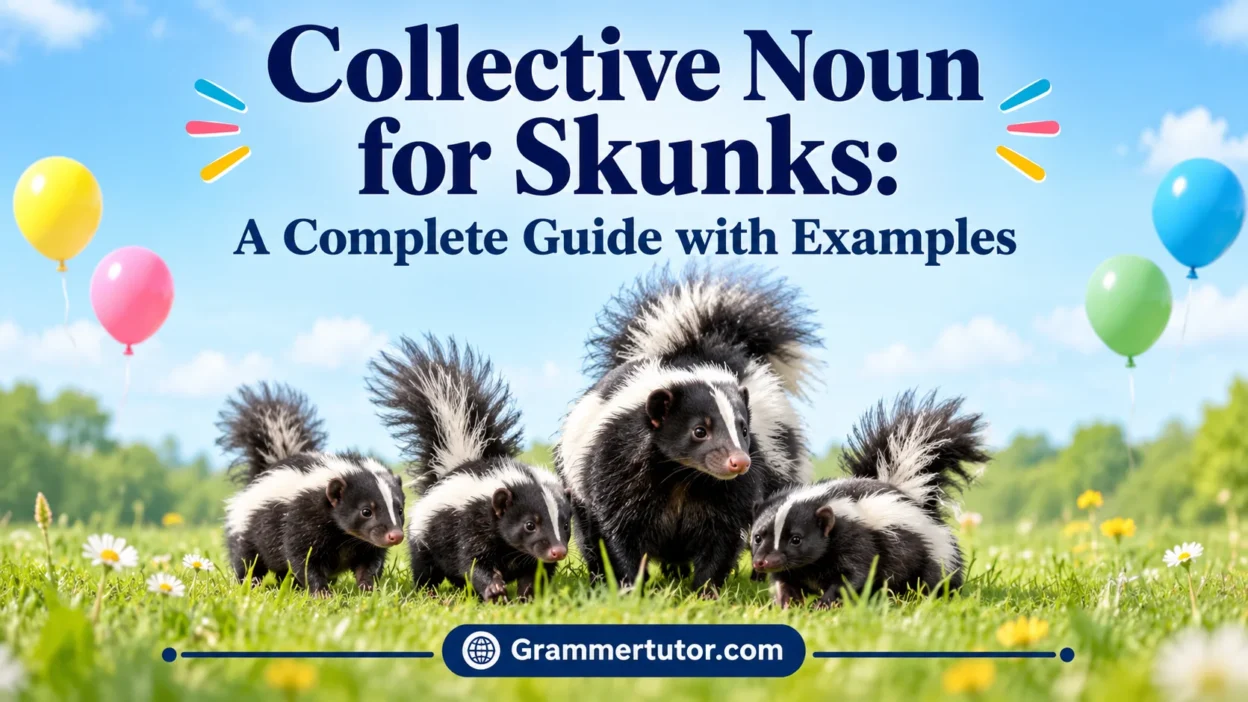
A collective noun for skunks is a useful English expression for describing several animals as one group in a clear way. The traditional term surfeit is an interesting choice because it is associated with an excessive amount or abundance. This gives the expression a distinctive character and makes it memorable for people studying English and expanding their vocabulary.
A surfeit of skunks is a traditional collective noun, but you can also use general expressions such as a group of skunks or a family of skunks. These terms are useful for everyday writing when a traditional expression is not necessary. When describing several skunks together, the simpler phrase can often make your meaning more precise, especially in a particular situation.
From my experience with English vocabulary, learners usually understand these expressions more easily when they connect the word with the wildlife it describes. Learning the collective terms associated with skunks can make writing about animals more natural and interesting. Whether you are studying wildlife or simply building your vocabulary, knowing these expressions helps you choose a suitable phrase and describe a group clearly.
Why Collective Nouns Are Used for Skunks
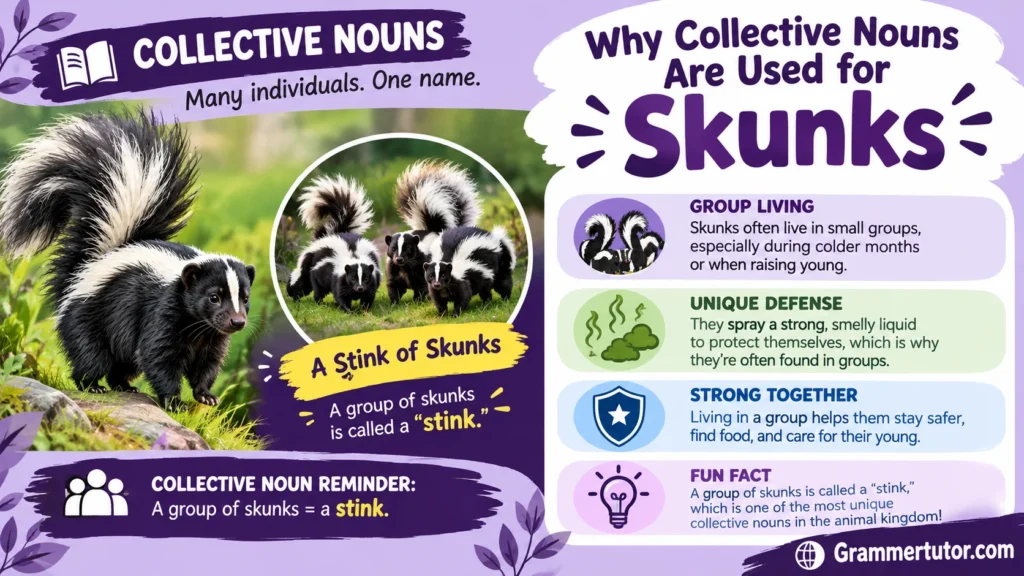
Skunks are generally solitary animals, although they may gather in certain situations. Females may stay with their young, and several skunks may sometimes be found in the same suitable shelter or feeding area.
A collective noun allows us to describe multiple skunks without repeating the word skunk several times. Instead of simply saying that many skunks are together, a traditional expression such as a surfeit of skunks gives the sentence a more distinctive style.
General expressions such as group and family can also be useful. The best expression depends on what you are describing and the context of the sentence.
These group expressions are especially helpful when writing wildlife descriptions, educational material, stories, or English vocabulary lessons.
Collective Nouns for Skunks
| Collective Noun | Used For | Simple Example |
| Surfeit | A traditional expression for skunks | A surfeit of skunks appeared near the woods. |
| Group | A general collection of skunks | A group of skunks moved through the area. |
| Family | Skunks living together, especially a mother and young | A family of skunks lived beneath the shed. |
| Colony | A number of skunks sharing an area or shelter | A colony of skunks was found nearby. |
Surfeit of Skunks
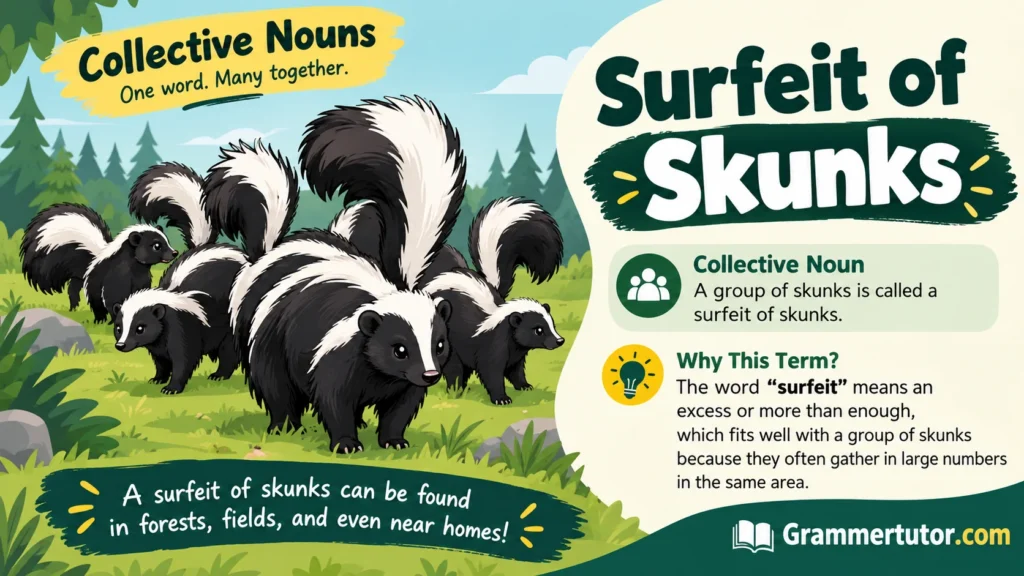
A surfeit of skunks is a traditional collective noun associated with skunks. The word surfeit refers to an excessive amount or abundance, making it a memorable expression for a group of these animals.
This term is not as common in everyday conversation as a simple phrase such as a group of skunks, but it can be useful in vocabulary lessons and wildlife writing.
Examples of “Surfeit of Skunks”
- A surfeit of skunks appeared near the woodland.
- We noticed a surfeit of skunks after sunset.
- A surfeit of skunks moved through the field.
- The ranger spotted a surfeit of skunks near the trees.
- A surfeit of skunks searched for food at night.
- The surfeit of skunks disappeared into the bushes.
- We saw a surfeit of skunks near the edge of the forest.
- A surfeit of skunks gathered around the feeding area.
- The photographer noticed a surfeit of skunks in the distance.
- A surfeit of skunks moved quietly through the grass.
Group of Skunks
A group of skunks is a simple and easily understood way to describe several skunks together. Unlike surfeit, it is a general expression and does not suggest a particular type of gathering.
This phrase can be used when you want your writing to be straightforward and clear, especially for general readers.
Examples of “Group of Skunks”
- A group of skunks walked through the garden.
- We saw a group of skunks near the forest.
- A group of skunks searched for food at night.
- The group of skunks moved toward the bushes.
- A group of skunks was seen near the road.
- The group of skunks disappeared into the darkness.
- We watched a group of skunks from a safe distance.
- A group of skunks crossed the grassy area.
- The group of skunks rested beneath the trees.
- A group of skunks moved away from the campsite.
Family of Skunks
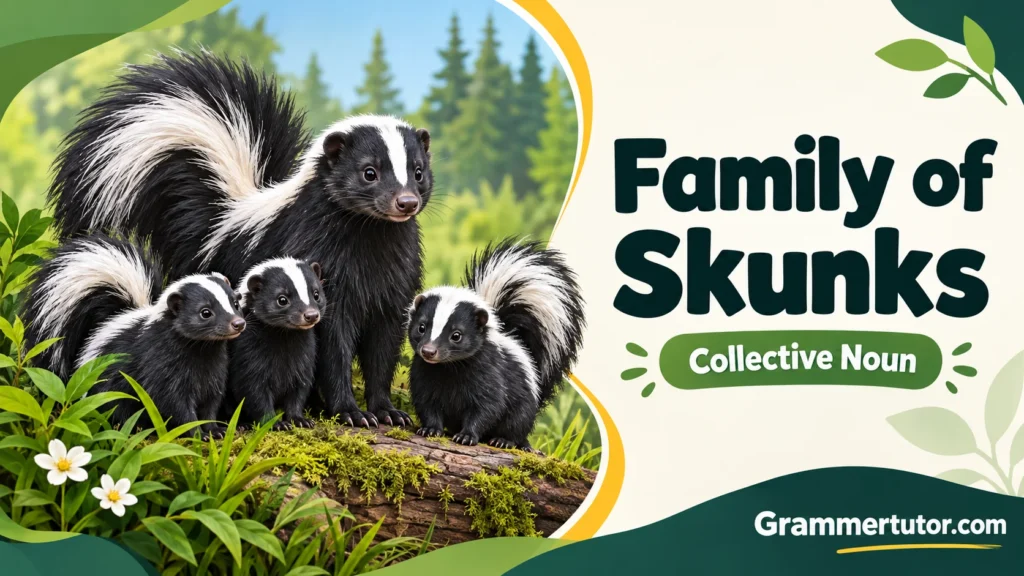
A family of skunks is a useful expression when referring to a mother skunk and her young. Baby skunks, known as kits, may remain with their mother while they grow and learn important survival skills.
The expression family of skunks focuses more on the relationship between the animals than simply the number of skunks present.
Examples of “Family of Skunks”
- A family of skunks lived beneath the old shed.
- We noticed a family of skunks near the garden.
- A family of skunks came out after dark.
- The family of skunks moved through the grass.
- A family of skunks searched for food nearby.
- The mother protected her family of skunks.
- We saw a family of skunks near the woodland.
- The family of skunks disappeared under the porch.
- A family of skunks rested in a sheltered area.
- The family of skunks moved quietly through the yard.
Colony of Skunks
A colony of skunks is a more general group expression that may be used when several skunks share an area or suitable shelter. However, skunks are not typically described as highly social animals in the same way as some other mammals.
The expression can therefore be useful in a broad descriptive context, but surfeit is the more distinctive traditional collective noun associated with skunks.
Examples of “Colony of Skunks”
- A colony of skunks was found near the woodland.
- We noticed a colony of skunks living in the area.
- A colony of skunks moved through the forest.
- The colony of skunks became active after sunset.
- A colony of skunks searched for food nearby.
- The researchers observed a colony of skunks.
- A colony of skunks used the sheltered area.
- The colony of skunks disappeared into the bushes.
- We saw a colony of skunks near the field.
- The colony of skunks moved away from the road.
Types of Skunks and Their Characteristics
Skunks are small mammals belonging to the family Mephitidae. They are best known for their distinctive black-and-white coloring and their powerful defensive spray. Different skunk species can vary in size, markings, habitat, and behavior.
Commonly known types include the striped skunk, spotted skunks, hooded skunks, and hog-nosed skunks. They can live in a variety of environments, including forests, grasslands, agricultural areas, and places close to human settlements.
Skunks are mostly active at night. Their nocturnal lifestyle allows them to search for food when temperatures are cooler and many predators are less active.
Examples of Skunk Characteristics
- Skunks are mammals.
- Skunks belong to the family Mephitidae.
- Many skunks have black-and-white markings.
- Skunks are generally active at night.
- Skunks are known for their defensive spray.
- Different skunk species have different markings.
- Skunks can live in forests and grasslands.
- Skunks often search for food after sunset.
- Skunks have strong claws for digging.
- Skunks eat a variety of foods.
Interesting Facts About Skunks
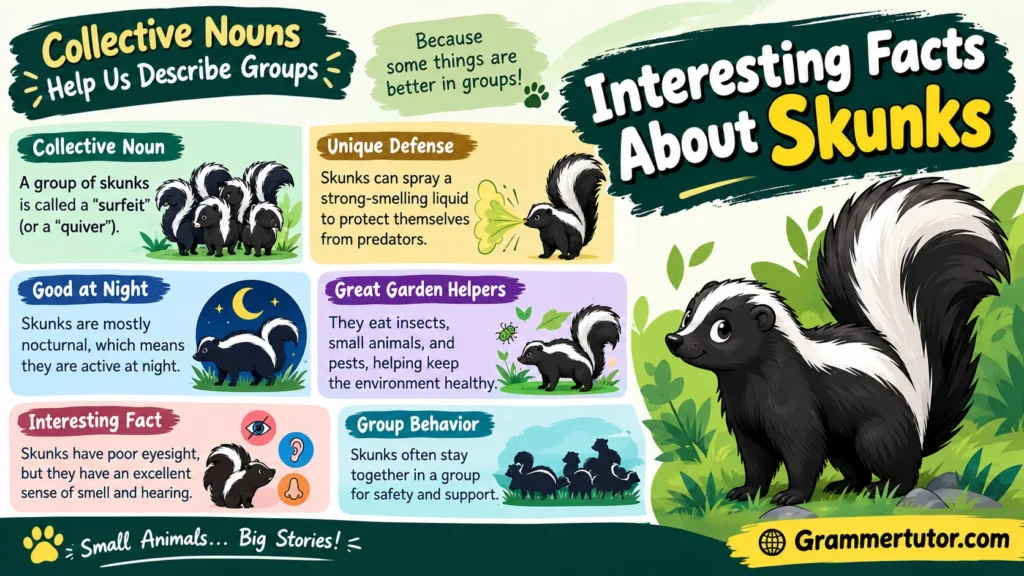
Skunks have several fascinating biological features that help them survive in the wild. Their lifespan can vary according to species, habitat, predators, disease, and other environmental conditions. Wild skunks generally face many challenges, while individuals living under protected conditions may survive longer.
One of the most recognizable physiological features of a skunk is its scent-producing defensive system. Specialized glands near the tail can release a strong-smelling liquid when the animal feels threatened. Skunks can control the direction of this spray, making it an effective defense against potential predators. Their distinctive markings may also serve as a warning to other animals.
Skunks have strong forelimbs and claws that are useful for digging. They may dig for insects, grubs, roots, and other food sources, and some species also use existing burrows or sheltered spaces as resting places.
Their dietary habits are quite varied. Skunks are omnivores, meaning they eat both plant and animal material. Their diet can include insects, worms, grubs, small animals, eggs, fruits, berries, roots, and other available foods. This flexible diet helps them find food in different environments.
Skunks are mainly nocturnal, so they usually become active after sunset. During their nighttime activities, they may search through soil, vegetation, fallen leaves, and other areas for food. Their ability to adapt their diet and habitat use has helped them survive in a variety of environments.
READ MORE: Collective Nouns for Falcons: A Complete Guide with Examples
Conclusion
The collective noun for skunks is traditionally a surfeit of skunks. The word surfeit suggests an excessive amount or abundance, which makes it a memorable expression. In everyday English, you can also use simple phrases such as a group of skunks or a family of skunks. Choosing the right expression depends on your writing style and the context in which you are describing these animals.
FAQs
Q1. What is the collective noun for skunks?
The traditional collective noun for skunks is a surfeit of skunks.
Q2. What does “surfeit” mean?
Surfeit means an excessive amount or an abundance of something.
Q3. Is “a group of skunks” correct?
Yes. A group of skunks is a simple and natural expression for describing several skunks together.
Q4. Can I say “a family of skunks”?
Yes. A family of skunks can be used when the skunks are being described as a family or related group.
Q5. Is “surfeit of skunks” commonly used?
It is a traditional collective expression, but a group of skunks is generally more straightforward for everyday writing.
Q6. Why are collective nouns used for skunks?
Collective nouns provide a concise way to describe several animals as one group.
Q7. Is “surfeit” singular or plural?
Surfeit is a singular noun referring to an excessive amount or abundance. In the phrase a surfeit of skunks, “surfeit” is the main noun.
Q8. What is the plural of skunk?
The plural of skunk is skunks. For example, “Several skunks were seen near the woods.”
Q9. Can I use “a group of skunks” in formal writing?
Yes. A group of skunks is clear, grammatically correct, and suitable for both general and formal writing.
Q10. What is the easiest collective noun for skunks to remember?
A group of skunks is the easiest general expression to remember, while a surfeit of skunks is the traditional term.