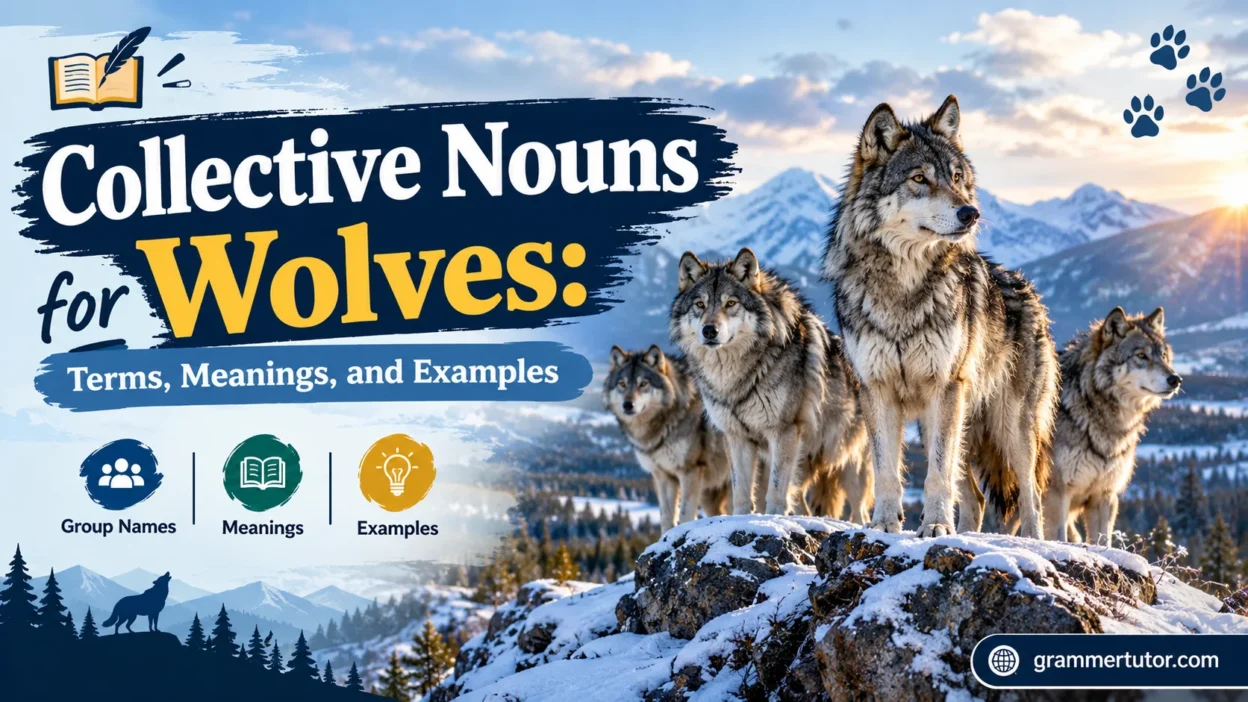
The collective noun for wolves is usually pack, a clear term for a group of wolves that live, travel, hunt, or rest together. Wolves are intelligent animals and social animals, so this word reflects their close way of life.
A pack of wolves can include animals working together during hunting, moving through the wild, or communicating with one another. This makes pack the common collective noun used in everyday English, especially when people want to describe wolves naturally and clearly.
For students, writers, and people interested in wildlife, learning this collective noun makes descriptions more precise. Although other expressions may appear in literature and descriptive writing, pack remains the clearest and most widely used term because it connects naturally with wolves’ social structures, communication methods, hunting strategies, and physical adaptations.
Why Collective Nouns Are Used for Wolves
Wolves are highly social members of the dog family. They often live in family-based groups and cooperate while traveling, raising young, defending territory, and obtaining food. This close social organization explains why pack is such a fitting collective noun for wolves.
A collective noun can also make a sentence more vivid. Saying a pack of wolves crossed the valley immediately creates a clearer picture than simply saying some wolves crossed the valley. The word pack tells the reader that the animals are part of a group.
Wolves also communicate extensively with one another. They use howls, whines, growls, body movements, facial expressions, and scent marking to maintain relationships and coordinate their activities.
Collective Nouns for Wolves
| Collective Noun | Used For | Simple Example |
| Pack | A social group of wolves | A pack of wolves traveled through the forest. |
| Group | A general collection of wolves | A group of wolves rested near the hills. |
| Family | Related wolves living together | A family of wolves stayed near the den. |
| Pair | Two wolves together | A pair of wolves crossed the trail. |
Pack of Wolves
A pack is the standard and most widely recognized collective noun for wolves. It refers to a group of wolves that live and interact together.
A wolf pack commonly consists of related individuals, although pack structure can vary. Wolves may cooperate in hunting, caring for pups, defending territory, and other activities.
Examples of “Pack of Wolves”
- A pack of wolves moved through the forest.
- We watched a pack of wolves from a safe distance.
- The pack of wolves traveled across the valley.
- A large pack of wolves gathered near the den.
- The pack of wolves hunted together.
- A pack of wolves crossed the snowy landscape.
- The wolves stayed together as a pack.
- A pack of wolves rested beneath the trees.
- The pack of wolves defended its territory.
- A pack of wolves disappeared into the forest.
Family of Wolves
A family of wolves is a useful descriptive expression when the group consists of related wolves, particularly parents and their offspring. Wolf packs are often based around family relationships, so this expression can be helpful when the family structure is the focus.
However, pack remains the normal collective noun for a group of wolves.
Examples of “Family of Wolves”
- A family of wolves lived near the mountain.
- The family of wolves stayed close to the den.
- A wolf family raised its pups together.
- The family of wolves traveled through the forest.
- A family of wolves rested after hunting.
- The mother stayed near her wolf family.
- A family of wolves moved across the valley.
- The family protected its young pups.
- A family of wolves searched for food.
- The family of wolves returned to the den.
Group of Wolves
Group is a general noun that can describe several wolves together. It doesn’t provide the same specific meaning as pack, but it is grammatically correct and easy to understand.
When you’re writing specifically about wolves, pack is usually the stronger choice. Use a group when you don’t want to emphasize the wolves’ social structure.
Examples of “Group of Wolves”
- A group of wolves crossed the river.
- We saw a group of wolves near the forest.
- The group of wolves rested on the hillside.
- A group of wolves moved through the snow.
- The group of wolves searched for food.
- A group of wolves gathered near the den.
- The researchers observed a group of wolves.
- The group of wolves traveled at night.
- A group of wolves disappeared into the trees.
- The group of wolves remained together.
Pair of Wolves
A pair of wolves simply refers to two wolves together. Wolves may form close bonds with particular individuals, and a pair can be especially important during breeding and raising young.
Pair isn’t a special collective noun specifically for wolves, but it’s a useful expression when you’re describing exactly two animals.
Examples of “Pair of Wolves”
- A pair of wolves crossed the valley.
- We spotted a pair of wolves near the forest.
- A pair of wolves approached the river.
- The pair of wolves traveled together.
- A pair of wolves rested near the rocks.
- The pair searched for food.
- A pair of wolves disappeared into the trees.
- The researchers observed a pair of wolves.
- A pair of wolves remained near the den.
- The pair moved quietly through the snow.
Wolf Pack Social Structure
A wolf pack isn’t simply a random collection of animals. In many populations, packs are strongly influenced by family relationships. A breeding pair may live with their offspring for one or more years.
Members of a pack can cooperate in raising pups and defending their territory. Older offspring may help care for younger pups, while different members can contribute to hunting and other group activities.
Pack size varies greatly depending on the species, habitat, food availability, and local conditions. Some groups may contain only a few wolves, while others can be considerably larger.
Wolves also maintain relationships through communication. Howling is one of their best-known behaviors. A howl can help wolves locate one another, maintain contact across long distances, or communicate with other packs.
Scent marking is another important behavior. Wolves use scents to communicate information about territory and social identity. Body language also plays a major role in maintaining relationships within the pack.
Examples of Wolf Pack Behavior
- A pack of wolves cooperated while hunting.
- Wolves communicate through howling.
- Pack members can help raise young pups.
- Wolves use scent marking to communicate.
- A pack may defend its territory together.
- Wolves use body language during social interactions.
- Pack members often travel together.
- Young wolves may remain with their family group.
- Wolves can form strong social bonds.
- A pack can work together to find food.
Interesting Facts About Wolves
Wolves are remarkable mammals belonging to the Canidae family, which also includes domestic dogs, foxes, and other canine species. The gray wolf is the largest living member of the dog family. Wolves can live for many years in the wild, although their lifespan varies with species, habitat, food availability, disease, injuries, and human-related threats. Wolves living under human care may sometimes live longer than wild individuals.
One of their most impressive physiological features is their body structure, which is adapted for traveling long distances. Wolves have strong legs, powerful jaws, large paws, and thick fur. Their paws help them move across different terrain, including snow, while their strong teeth and jaws allow them to process tough food. Their thick coats provide insulation in cold environments, with seasonal changes in the density of their fur.
Wolves are carnivores, and their diets mainly consist of other animals. Depending on where they live, they may hunt deer, elk, moose, wild boar, smaller mammals, and other prey. Their diet can change according to the availability of food in their habitat. Wolves are also opportunistic and may consume different foods when preferred prey is unavailable.
Wolves have impressive senses that support their survival. Their hearing and sense of smell are particularly important. Their sense of smell helps them detect prey, identify other animals, and gather information about their surroundings. Their hearing allows them to communicate with pack members and notice sounds over considerable distances.
Another fascinating feature is their ability to cooperate. Hunting as a group can allow wolves to pursue prey that would be difficult for one wolf to handle alone. Cooperation doesn’t mean every hunt follows the same pattern, though. Wolf behavior changes according to prey, terrain, weather, and the experience of individual animals.
Quick Wolf Facts
- Wolves are mammals.
- Wolves belong to the Canidae family.
- A group of wolves is commonly called a pack.
- Wolves are highly social animals.
- Many wolf packs are based on family relationships.
- Wolves communicate through howling and body language.
- Scent marking helps wolves communicate.
- Wolves have strong jaws and sharp teeth.
- Wolves are primarily carnivores.
- Wolves can travel long distances while searching for food.
- Wolves often cooperate during hunting.
- Young wolves can remain with their family group.
READ MORE: Collective Nouns for Hornets: The Right Terms and Their Meanings
Conclusion
The most common and widely accepted collective noun for wolves is pack. A pack describes wolves that live, travel, hunt, or rest together. Understanding this term makes your English more precise and helps you describe the social behavior of wolves naturally.
FAQs
Q1. What is the collective noun for wolves?
The most common collective noun for wolves is pack. You can say a pack of wolves.
Q2. What do you call a group of wolves?
A group of wolves is commonly called a pack.
Q3. Is “pack of wolves” grammatically correct?
Yes. A pack of wolves is the standard and natural expression in English.
Q4. Why are wolves called a pack?
Wolves are called a pack because they often live, travel, hunt, and rest together as a social group.
Q5. Can I use “group of wolves” instead of “pack”?
Yes, group of wolves is grammatically correct, but pack of wolves is more specific and commonly used.
Q6. Is “pack” the only collective noun for wolves?
Pack is the standard collective noun. Other descriptive expressions may appear in literature, but pack is the clearest choice.
Q7. What is a wolf pack?
A wolf pack is a social group of wolves that stays and often works together, particularly during movement, communication, and hunting.
Q8. Can “pack” be used in formal writing?
Yes. Pack is suitable for formal, educational, scientific, and general writing when referring to a group of wolves.
Q9. What is the plural form of wolf?
The plural form of wolf is wolves. For example, “Several wolves moved together as a pack.”
Q10. What is an example of a collective noun for wolves?
A simple example is: “A pack of wolves traveled through the forest.” Here, pack is the collective noun.