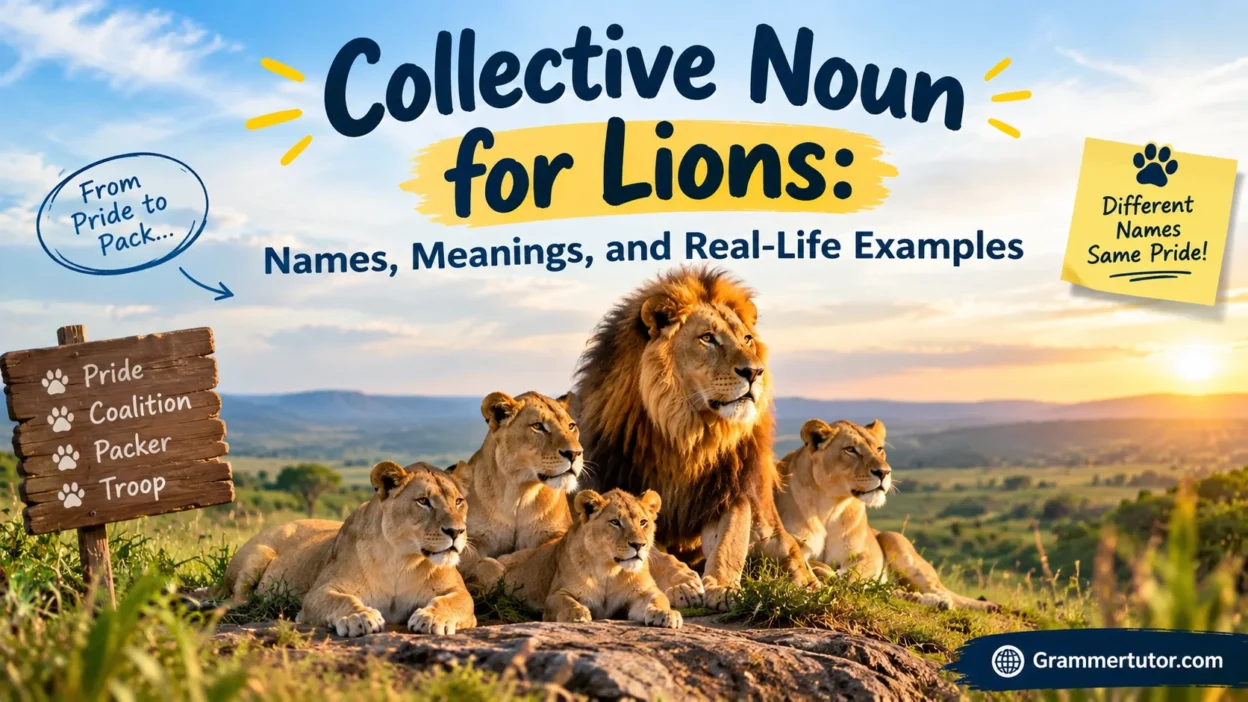
The collective noun for lions is commonly pride of lions, a familiar expression in English that describes a group of lions living and moving together. This term gives readers a more precise picture than a simple description of several lions. A pride reflects the social nature of these powerful wild animals, which often live in organized family groups. When you describe lions as a pride, you show that they aren’t simply gathered in one place; they share important parts of their social life.
Lions often hunt together, protect their territory, and care for young members, showing strong social behavior within their family groups. Their hunting behavior, diet, and feeding habits also help explain how these animal groups survive in the wild. From an explanatory point of view, connecting the word pride with real behavior makes the expression easier to remember. A pride of lions may cooperate while hunting, remain within a shared territory, and support younger members, giving the collective noun a clear connection to real wildlife.
There are also interesting facts about a lion’s lifespan, physical features, and physical characteristics that add useful context to this topic. Their powerful bodies support their hunting lifestyle, while their diet and group structure influence how they live. In a practical guide, it helps to learn when each expression is appropriate and how to use them naturally in sentences. Learning these useful collective nouns alongside facts associated with lions makes the language easier to understand and helps you use the expression confidently.
Why Collective Nouns Are Used for Lions
Lions are among the most social members of the cat family. Unlike many other big cats that usually live alone, lions commonly live in groups called prides. A pride may include related females, their cubs, and one or more adult males, although its exact structure can vary.
Because lions cooperate and interact so closely, the collective noun pride is particularly suitable. It describes more than just several lions standing in one place. It brings to mind a social group that shares territory, protects its members, rests together, and may cooperate when hunting.
Other words can sometimes describe groups of lions, especially in literary or descriptive writing. However, pride of lions is by far the most familiar and useful expression.
Collective Nouns for Lions
| Collective Noun | Used For | Simple Example |
| Pride | A social group of lions | A pride of lions rested under the trees. |
| Troop | A group of lions in some descriptive usage | A troop of lions moved across the plain. |
| Coalition | A partnership of male lions | A coalition of lions defended its territory. |
| Group | A general collection of lions | A group of lions gathered near the water. |
Pride of Lions
A pride is the most common and widely recognized collective noun for lions. It generally refers to a social group of lions living together in a shared territory.
A pride often consists of related females, their cubs, and adult males. Lions in a pride may rest together, care for young, defend their territory, and cooperate during certain hunting situations.
Examples of “Pride of Lions”
- A pride of lions rested beneath the trees.
- We watched a pride of lions near the river.
- The pride of lions moved across the grassland.
- A large pride of lions gathered near the waterhole.
- The pride of lions protected its territory.
- A pride of lions followed the herd of buffalo.
- The researchers observed the pride of lions from a safe distance.
- A pride of lions rested after feeding.
- The pride of lions disappeared into the tall grass.
- A pride of lions watched the surrounding plain.
Troop of Lions
Troop is sometimes used in general or descriptive writing for a group of lions, but it isn’t as standard or widely accepted as pride. The word troop is more strongly associated with groups of other animals, particularly monkeys and primates.
If you’re writing about lions in ordinary English, pride of lions is the better choice.
Examples of “Troop of Lions”
- A troop of lions moved across the plain.
- We saw a troop of lions near the grassland.
- The troop of lions rested beside the trees.
- A troop of lions approached the waterhole.
- The troop of lions moved quietly through the grass.
- A troop of lions gathered near the river.
- The troop of lions watched the nearby animals.
- A troop of lions crossed the open plain.
- The troop of lions remained together.
- A troop of lions disappeared into the tall grass.
Coalition of Lions
A coalition has a more specific meaning in lion terminology. It generally describes a partnership of male lions, often unrelated males that cooperate to gain or maintain access to a territory and mating opportunities.
Male lion coalitions can work together to challenge rival males and defend territory. These partnerships can be important for survival and reproductive success.
Examples of “Coalition of Lions”
- A coalition of lions defended its territory.
- The coalition of lions moved across the grassland.
- A coalition of male lions approached the pride.
- The coalition of lions challenged rival males.
- Researchers followed a coalition of lions.
- A coalition of lions controlled part of the territory.
- The coalition of lions rested beneath the trees.
- A coalition of male lions patrolled the area.
- The coalition of lions moved toward the waterhole.
- A strong coalition of lions protected its territory.
Group of Lions
A group of lions is a general expression that can be used whenever you don’t need a specialized collective noun. It isn’t as distinctive as pride, but it’s perfectly clear and easy to understand.
For general descriptions, however, a pride of lions is usually more informative because it reflects the social organization of lions.
Examples of “Group of Lions”
- A group of lions rested near the waterhole.
- We saw a group of lions on the plain.
- The group of lions moved toward the trees.
- A group of lions gathered in the shade.
- The group of lions watched the surrounding area.
- A group of lions crossed the grassland.
- The researchers observed a group of lions.
- A group of lions approached the river.
- The group of lions rested after hunting.
- A group of lions disappeared into the grass.
How to Use “A Pride of Lions” Correctly
The phrase a pride of lions follows a simple structure:
a pride + of + lions
Here, pride is the collective noun, while lions tell us which animals make up the group.
When pride is treated as one unit, a singular verb can be used.
Example: A pride of lions is resting beneath the trees.
When you focus on the individual lions, you can use lions with a plural verb.
Example: The lions are resting beneath the trees.
Both forms can be useful depending on whether you want to emphasize the group or the individual animals.
Examples of “A Pride of Lions”
- A pride of lions is resting in the shade.
- A pride of lions was moving across the plain.
- The lions are resting near the water.
- The lions were walking through the grass.
- A pride of lions has entered the territory.
- The lions have moved toward the river.
- A pride of lions is watching the herd.
- The lions are following their prey.
- A pride of lions was sleeping beneath the trees.
- The lions were returning to their resting place.
Lion Behavior and Why “Pride” Is Appropriate
The word pride fits lions because they are highly social big cats. A pride can function as a social unit in which individual lions share territory and interact regularly.
Female lions often form the stable core of a pride. Related females may remain together for long periods and cooperate in raising cubs. Young lions can benefit from living with several adults because multiple members may help protect them from threats.
Lions also communicate in several ways. Their roars, growls, grunts, facial expressions, scent marking, and body movements help them communicate with members of their group and other lions. A lion’s roar can travel over long distances and may help advertise its presence or territory.
Hunting can also involve cooperation. Although lions don’t always hunt as a perfectly coordinated team, members of a pride may work together to approach and capture prey. Their social structure allows them to share certain responsibilities and resources.
Male lions also form coalitions. These partnerships can help males compete with other males and gain control over pride. A successful coalition may remain together for several years.
Examples of Lion Behavior
- Lions often live in social groups.
- A pride may contain several related females.
- Lion cubs stay close to adults for protection.
- Lions communicate through sounds and body language.
- Lions use scent marking to communicate.
- Male lions can form coalitions.
- Lions may cooperate when hunting.
- Members of a pride can share resting areas.
- Lionesses may cooperate in caring for cubs.
- Lions defend their territory from rivals.
Interesting Facts About Lions
Lions are large mammals belonging to the cat family, Felidae. They are one of the most recognizable big cats in the world and are native to parts of Africa, with a small population of wild Asiatic lions surviving in India. Lions have a relatively long lifespan compared with many wild mammals, although lifespan varies between wild and captive individuals. Wild lions commonly live for around 10 to 15 years, while some individuals in protected or captive environments can live longer.
One of the most distinctive physiological features of male lions is their mane. A mane develops around the head and neck of adult males and can vary in color, thickness, and size. The mane may make a male appear larger and can provide some protection during fights. Female lions generally don’t develop the prominent mane seen in adult males.
Lions also have powerful bodies adapted for hunting. Their muscular legs allow them to accelerate quickly over short distances, while their strong jaws and sharp canine teeth help them capture and consume prey. Their retractable claws provide additional grip when chasing or restraining animals.
Lions are carnivores, meaning they primarily eat meat. Their prey can include animals such as zebras, wildebeest, antelope, and buffalo, depending on the habitat and available food. Lionesses often do much of the hunting within a pride, although males also hunt and may participate in kills.
Another fascinating feature is the lion’s ability to roar. A lion’s roar can be heard from several kilometers away under suitable conditions. Roaring helps lions communicate and may signal territory, identity, or social information.
Lions also spend a large portion of their day resting. They can sleep or remain inactive for many hours, conserving energy between periods of activity and hunting. Their social lifestyle, powerful physical features, and hunting abilities make them one of the most fascinating large predators in the animal kingdom.
Examples of Lion Facts
- Lions are social big cats.
- A group of lions is commonly called a pride.
- Male lions usually develop a mane.
- Lions are carnivores.
- Lionesses often participate heavily in hunting.
- Lions can hunt animals much larger than themselves.
- Lions communicate through roars and other vocalizations.
- Male lions can form coalitions.
- Lions can rest for many hours each day.
- Wild lions commonly live around 10 to 15 years.
READ MORE: Collective Noun for Vultures: What Is a Group of Vultures Called?
Conclusion
The collective noun for lions is pride, so the natural expression is “a pride of lions.” It reflects the social lives of lions, which often live in family groups, hunt together, protect their territory, and care for young members. Using pride instead of simply saying “a group of lions” makes your writing more precise and descriptive.
FAQs
Q1. What is the collective noun for lions?
The most common collective noun for lions is pride. You can say “a pride of lions.”
Q2. Why are lions called a pride?
The word pride describes the social group in which lions live and cooperate. It has become the familiar English expression for a group of lions.
Q3. Is “a pride of lions” grammatically correct?
Yes. “A pride of lions” is grammatically correct and is the standard expression used to describe a group of lions.
Q4. Can I say “a group of lions”?
Yes. “A group of lions” is grammatically correct, but “a pride of lions” is more specific and descriptive.
Q5. How many lions are usually in a pride?
A pride can vary in size. It may contain several lions, including adult females, cubs, and one or more adult males.
Q6. Do lions live in groups?
Yes. Lions are social animals and commonly live in groups called prides. They may cooperate in hunting, territory protection, and raising young.
Q7. What do lions in a pride do together?
Members of a pride may hunt together, defend their territory, rest near one another, and help care for young lions.
Q8. What is the plural of pride when referring to lions?
The plural is prides. For example, you can say, “Several prides of lions live in the region.”
Q9. Is “pride of lions” used in formal English?
Yes. “Pride of lions” is a well-established expression and can be used in both general and formal writing.
Q10. What is an example sentence using “pride of lions”?
A simple example is: “A pride of lions rested together after hunting across the grassland.”