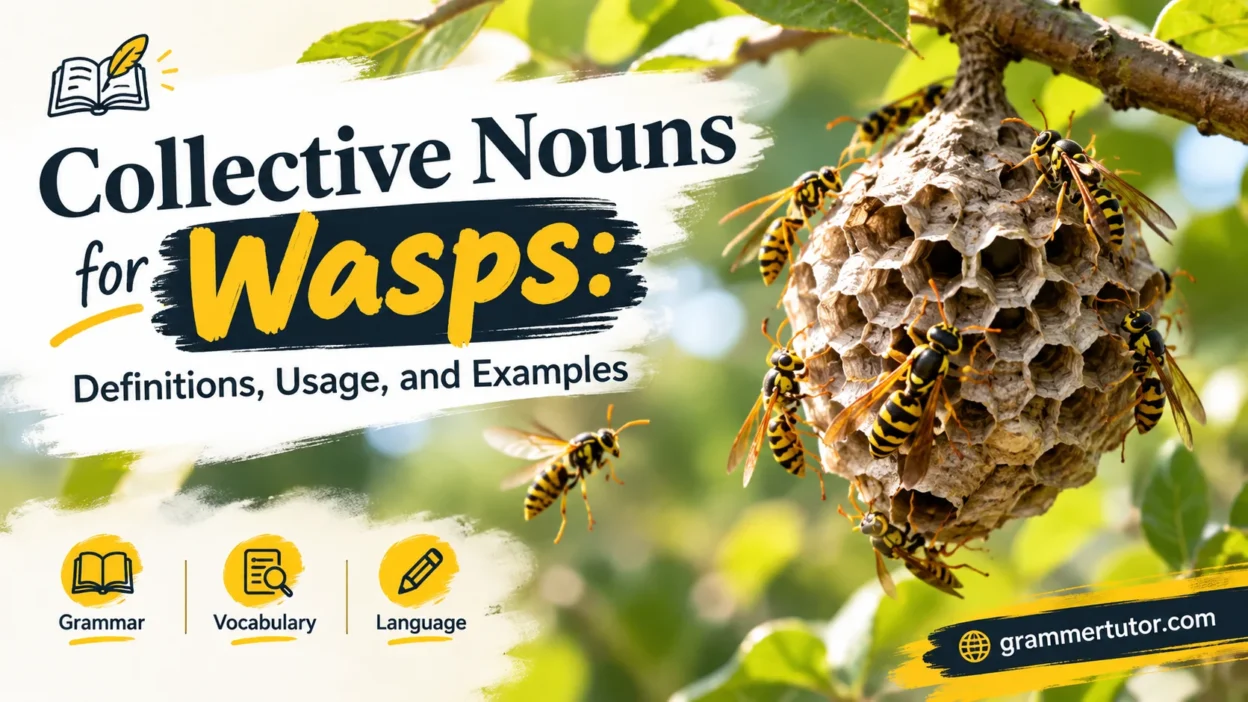
When learning the collective noun for wasps, it helps to know how these small, highly organized insects live, gather, and move together. English provides several words to describe a group of wasps, making your vocabulary more precise and your writing more engaging. Wasps are fascinating social insects because many species live in nests or colonies and show organized behaviors. They may cooperate in raising young, defend their homes, and communicate with one another. These natural behaviors help explain why terms such as colony, swarm, and nest are commonly connected with groups of wasps.
A colony is suitable when referring to wasps living together as an organized community. This term focuses on their shared home and social structure, especially when several wasps occupy nests and cooperate with one another. A swarm, however, describes many wasps moving or flying together, so the word fits a situation where the insects are traveling through the air rather than simply remaining in their home. A nest can refer to the place where wasps live, although it isn’t itself a collective noun for the insects. The exact term can depend on the situation and what you are referring to when you describe a group of wasps.
In this guide, we’ll explore these expressions, their meanings, simple examples, and useful facts about wasps. Understanding the difference between a colony and a swarm makes it easier to choose the right expression in everyday English. For example, when wasps remain together around their home, colony is more suitable; when they are moving through the air, swarms may be more natural. From an English-learning perspective, connecting each word with the wasps’ actual behavior is a simple way to remember the terms and use them accurately.
Why Collective Nouns Are Used for Wasps
Wasps can gather in large numbers, particularly social species that build and maintain nests together. A colony may contain workers, reproductive individuals, and young wasps, with different members performing different roles.
Their organized social behavior makes collective nouns particularly useful. These expressions allow you to describe not only the number of wasps but also the situation in which they are gathered. For example, a colony suggests an established social group, while swarm focuses more on movement or a large number of flying insects.
Using the right collective noun can therefore make a sentence clearer and help the reader imagine what the wasps are doing.
Collective Nouns for Wasps
| Collective Noun | Used For | Simple Example |
| Colony | Wasps living together in an organized group | A colony of wasps lived in the nest. |
| Swarm | Many wasps flying or moving together | A swarm of wasps flew around the tree. |
| Nest | Wasps associated with the same nest | A nest of wasps hung from the roof. |
| Group | A general collection of wasps | A group of wasps gathered near the garden. |
| Plague | A large or troublesome number of wasps | A plague of wasps invaded the area. |
Colony of Wasps
A colony is one of the most useful terms for describing social wasps that live together. A colony consists of wasps that share a nest or living area and cooperate in maintaining their social community.
In many social wasp species, workers build the nest, find food, care for developing young, and protect the colony. The size and structure of a colony can vary greatly between species.
Examples of “Colony of Wasps”
- A colony of wasps lived inside the nest.
- We discovered a colony of wasps under the roof.
- The colony of wasps became active during the afternoon.
- Scientists studied the colony of wasps.
- A large colony of wasps occupied the old shed.
- The colony of wasps worked together to maintain the nest.
- The gardener noticed a colony of wasps nearby.
- The colony of wasps protected its nest.
- A colony of wasps formed beneath the wooden deck.
- The colony of wasps became more active during warm weather.
Swarm of Wasps
A swarm of wasps describes a large number of wasps moving or flying together. The word swarm focuses more on their movement than on their long-term social organization.
You may see a swarm when many wasps become active around a nest, food source, or disturbed area. It creates a strong visual image of numerous insects moving through the air.
Examples of “Swarm of Wasps”
- A swarm of wasps flew around the tree.
- We noticed a swarm of wasps near the garden.
- A swarm of wasps moved across the field.
- The swarm of wasps disappeared into the bushes.
- A swarm of wasps gathered near the nest.
- The children stayed away from the swarm of wasps.
- A swarm of wasps surrounded the damaged nest.
- The swarm of wasps moved toward the shed.
- We watched the swarm of wasps from a safe distance.
- The swarm of wasps quickly scattered.
Nest of Wasps
A nest of wasps can be used to describe wasps associated with or living in the same nest. However, nest primarily names the structure where wasps live rather than functioning as a standard collective noun in the same way as colony.
Wasp nests can be built in many locations, including trees, underground spaces, wall cavities, roofs, and sheltered areas. Their shape and construction vary between species.
Examples of “Nest of Wasps”
- A nest of wasps was hanging from the tree.
- We found a nest of wasps under the roof.
- The nest of wasps was hidden behind the wall.
- A nest of wasps occupied the old shed.
- The workers discovered a nest of wasps near the entrance.
- The nest of wasps grew larger during the summer.
- A nest of wasps was attached to the branch.
- The gardener noticed a nest of wasps nearby.
- The nest of wasps was carefully avoided.
- A nest of wasps was hidden beneath the wooden structure.
Group of Wasps
A group of wasps is a simple general expression that can be used whenever several wasps are together. Unlike a colony, it doesn’t suggest a particular social structure or living arrangement.
This expression is especially useful when you’re unsure which specialized term fits the situation.
Examples of “Group of Wasps”
- A group of wasps gathered near the flowers.
- We saw a group of wasps around the tree.
- The group of wasps moved toward the nest.
- A group of wasps flew across the garden.
- The gardener noticed a group of wasps.
- A group of wasps searched for food.
- The group of wasps disappeared into the bushes.
- A group of wasps gathered near the fruit.
- A group of wasps flew around the shed.
- The group of wasps returned to the nest.
Plague of Wasps
A plague of wasps is a dramatic expression used when there are very large numbers of wasps, especially when their presence is considered troublesome or unwanted.
The word plague gives the sentence a negative or alarming tone. It isn’t the best choice for a neutral scientific description, but it can be effective in descriptive or informal writing.
Examples of “Plague of Wasps”
- A plague of wasps appeared around the garden.
- The village experienced a plague of wasps.
- A plague of wasps surrounded the abandoned building.
- The workers encountered a plague of wasps.
- A plague of wasps covered the area.
- The warm weather brought a plague of wasps.
- A plague of wasps gathered near the food.
- The farmers noticed a plague of wasps.
- A plague of wasps became a serious nuisance.
- The neighborhood dealt with a plague of wasps.
Other Ways to Describe Wasps
Not every expression used for wasps has the same level of common usage. Colony is especially useful for social wasps living together, while swarm focuses on many wasps moving or flying together. Group is a neutral alternative that works in almost any situation.
The word nest is better understood as the structure where wasps live rather than a standard collective noun. Similarly, plague is a dramatic expression that suggests a large and unwanted number of wasps.
Choosing the right term depends on what you want the sentence to communicate.
Examples of Different Expressions
- A colony of wasps lived inside the nest.
- A swarm of wasps flew across the garden.
- A group of wasps gathered near the flowers.
- A nest of wasps hung beneath the roof.
- A plague of wasps caused problems in the area.
- The colony of wasps protected its young.
- The swarm of wasps moved through the air.
- The group of wasps disappeared into the bushes.
- The nest of wasps was attached to the tree.
- The plague of wasps eventually moved away.
Interesting Facts About Wasps
Wasps are remarkable insects belonging to the order Hymenoptera, which also includes bees and ants. There are thousands of wasp species, and they vary greatly in size, appearance, behavior, and lifestyle. Some wasps are solitary, meaning they live alone, while others are highly social and form organized colonies. This difference is important because not every wasp species lives in a large group.
Social wasps have impressive physiological and behavioral adaptations. Their slender bodies, strong wings, flexible antennae, and powerful jaws help them move, locate food, construct nests, and defend themselves. Many wasps also have a sting that can be used for defense. Unlike honey bees, many wasps can sting repeatedly because their stingers generally don’t become lodged in the target.
Wasps have varied dietary habits. Adult wasps of many species consume sugary substances such as nectar, fruit juices, and other plant-based sources. Social wasps also collect protein-rich foods, including insects and other small organisms, to feed their developing larvae. This makes many wasps important predators of other insects and can help regulate insect populations.
Some wasps play important roles as pollinators, while others are valuable biological control agents because they prey on insects that can damage plants. Parasitic wasps are particularly important in ecosystems because they lay their eggs in or on other insects, with their developing larvae eventually using the host as a food source.
Social wasps also have complex colonies. Workers may construct nests from a paper-like material made by chewing plant fibers and mixing them with saliva. The resulting material can form surprisingly strong structures. Inside these colonies, individuals cooperate to build the nest, find food, care for young, and defend the group.
Examples of Wasp Facts
- Wasps belong to the order Hymenoptera.
- There are thousands of wasp species.
- Some wasps are solitary.
- Other wasps live in social colonies.
- Many social wasps build nests.
- Wasps can have powerful jaws.
- Many wasps have stingers for defense.
- Many wasps feed on sugary substances as adults.
- Some wasps hunt insects.
- Wasps can help control insect populations.
- Some wasps contribute to pollination.
- Social wasps can cooperate in raising young.
READ MORE: Collective Nouns for Whales: Names, Meanings, and Examples
Conclusion
The most useful terms for describing a group of wasps are colony and swarm, depending on the situation. A colony describes wasps living together in an organized community, while a swarm refers to many wasps moving or flying together. Nest describes their home rather than the group itself. Understanding these differences helps you choose the right expression and use the collective noun for wasps naturally and accurately.
FAQs
Q1. What is the collective noun for wasps?
The most common terms are colony and swarm. The correct choice depends on how the wasps are behaving or where they are.
Q2. What do you call a group of wasps?
A group of wasps can be called a colony when they live together, or a swarm when many wasps are moving or flying together.
Q3. Is “colony” a collective noun for wasps?
Yes. Colony is an appropriate term for wasps that live together in an organized social group, usually around their nest.
Q4. Can you call a group of wasps a swarm?
Yes. Swarm can describe many wasps gathered together and moving or flying through an area.
Q5. Is “nest” a collective noun for wasps?
Not exactly. A nest refers to the structure or home where wasps live, rather than the group of wasps itself.
Q6. What is the difference between a colony and a swarm of wasps?
A colony emphasizes the wasps‘ social community and shared home. A swarm emphasizes their movement or flight as a group.
Q7. Why do wasps live in colonies?
Many wasp species are social insects that cooperate in activities such as raising young, finding resources, defending their nest, and maintaining their community.
Q8. What is a group of wasps called when they are flying?
A swarm of wasps is a natural expression when many wasps are flying or moving together.
Q9. Do all wasps live in colonies?
No. Wasp species have different lifestyles. Some are social and live in colonies, while many others are solitary and live independently.
Q10. What is the best way to remember collective nouns for wasps?
Think of a colony as an organized community and swarm as a group that is actively moving or flying. This simple distinction makes the terms easier to remember.