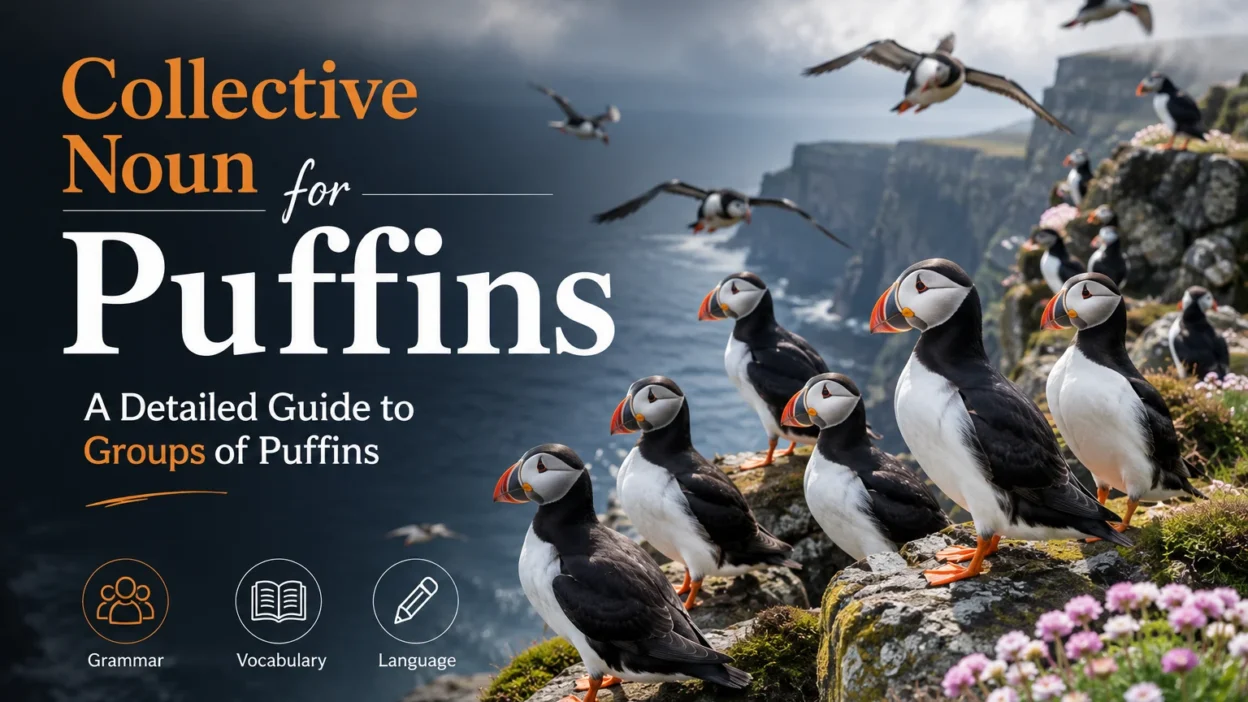
The collective noun for puffins helps describe how these colorful seabirds gather together in natural settings. The most common term is colony, which suits puffins that live and nest together during the breeding season. You may also see group, gathering, or other expressions used when describing puffins in different situations.
Puffins often return to breeding colonies after spending much of their lives at sea. They dig or use nesting burrows and gather around rocky cliffs and other coastal areas. These remarkable seabirds can gather in impressive numbers, making a colony an especially useful term when describing their nesting behavior.
Other terms, such as raft and circus, may encounter you in descriptions from different sources, although their use can vary by situation. Learning these expressions is useful for improving vocabulary and gives you an opportunity to connect English with the natural behavior of puffins flying over the sea or standing together on cliffs.
Why Collective Nouns Are Used for Puffins
Puffins are social seabirds that often gather in large numbers, particularly during the breeding season. They may nest close to one another on islands, cliffs, and coastal slopes. Outside the breeding season, puffins spend much of their time at sea and may also gather on the water.
Because puffins appear in different settings, different group terms can be useful. Colony works well for puffins nesting together, while raft can describe birds resting together on the water. Other expressions can provide a more colorful description when writing about groups of puffins.
These collective nouns make wildlife descriptions more vivid. Instead of simply telling your reader that many puffins were present, you can describe exactly how or where they were gathered.
Collective Nouns for Puffins
| Collective Noun | Used For | Simple Example |
| Colony | Puffins nesting together | A colony of puffins covered the island. |
| Raft | Puffins resting on water | A raft of puffins floated near the shore. |
| Circus | A group of puffins | A circus of puffins gathered on the rocks. |
| Gathering | Puffins gathered together | A gathering of puffins appeared near the cliffs. |
| Flock | Puffins flying together | A flock of puffins flew over the sea. |
Colony of Puffins
A colony is the most useful collective noun when talking about puffins that nest and breed together. Puffins are well known for forming breeding colonies on islands and coastal cliffs.
During the breeding season, thousands of puffins can gather in suitable nesting areas. They may dig burrows in soil or use natural cracks and spaces among rocks. Their close nesting arrangements make a colony of puffins a natural expression when describing their breeding grounds.
Examples of “Colony of Puffins”
- A colony of puffins nested on the rocky island.
- We visited a colony of puffins near the coast.
- The colony of puffins became active during spring.
- A large colony of puffins gathered on the cliffs.
- Researchers observed the colony of puffins from a distance.
- The colony of puffins returned to the island each year.
- A colony of puffins filled the grassy hillside.
- The wildlife team protected the colony of puffins.
- The colony of puffins disappeared toward the sea.
- Visitors watched the colony of puffins along the cliffs.
Raft of Puffins
A raft of puffins describes puffins gathered together while floating or resting on the water. Puffins are strong swimmers and spend much of their lives at sea, so seeing them together on the ocean can create a striking scene.
The word raft is particularly useful because it gives the impression of birds sitting closely together on the surface of the water.
Examples of “Raft of Puffins”
- A raft of puffins floated near the island.
- We spotted a raft of puffins offshore.
- The raft of puffins rested on the calm sea.
- A large raft of puffins gathered near the rocks.
- The raft of puffins drifted with the waves.
- Fishermen noticed a raft of puffins in the distance.
- A raft of puffins floated beside the boat.
- The raft of puffins disappeared beneath the waves.
- We photographed a raft of puffins from the shore.
- A raft of puffins gathered in the quiet bay.
Circus of Puffins
Circus is a colorful and less common expression that can be used for a group of puffins. It creates a lively image of these distinctive birds moving, flying, landing, and interacting around their nesting areas.
The term is especially suitable for creative or descriptive wildlife writing. For ordinary communication, colonies are generally easier and more familiar.
Examples of “Circus of Puffins”
- A circus of puffins gathered on the rocky shore.
- We watched a circus of puffins near the cliffs.
- The circus of puffins moved around the nesting area.
- A circus of puffins flew above the island.
- The circus of puffins created a lively scene.
- Tourists admired the circus of puffins from afar.
- A circus of puffins gathered before sunset.
- The circus of puffins disappeared toward the sea.
- Photographers captured the circus of puffins beautifully.
- A circus of puffins occupied the coastal rocks.
Gathering of Puffins
A gathering of puffins is a straightforward descriptive expression for puffins that have come together in one place. Unlike a colony, it doesn’t necessarily suggest a permanent breeding site.
You can use this expression when puffins are temporarily gathered on land, near the coast, or around their nesting area.
Examples of “Gathering of Puffins”
- A gathering of puffins appeared along the cliffs.
- We noticed a gathering of puffins near the shore.
- The gathering of puffins grew larger during the afternoon.
- A gathering of puffins rested on the rocks.
- Researchers observed a gathering of puffins.
- The gathering of puffins moved toward the water.
- A gathering of puffins stood near the burrows.
- Tourists photographed the gathering of puffins.
- The gathering of puffins became active at sunrise.
- A gathering of puffins returned to the nesting area.
Flock of Puffins
A flock is a familiar collective noun for birds and can be used when puffins are flying together. However, the colony is more closely associated with puffins when describing their breeding groups.
The word flock focuses mainly on the birds being together rather than on their nesting location.
Examples of “Flock of Puffins”
- A flock of puffins flew over the ocean.
- We watched a flock of puffins leave the island.
- The flock of puffins disappeared into the distance.
- A flock of puffins circled above the cliffs.
- The flock of puffins flew toward the shore.
- A flock of puffins crossed the bay.
- The flock of puffins returned before sunset.
- A flock of puffins flew low over the water.
- We photographed a flock of puffins in flight.
- The flock of puffins landed near the rocks.
Group of Puffins
A group of puffins is a simple and completely understandable expression. It doesn’t have the specialized character of terms such as colony or raft, but it can be used whenever you want to describe several puffins together.
For general writing, a group is useful when the exact behavior or location of the birds isn’t important.
Examples of “Group of Puffins”
- A group of puffins stood near the cliff.
- We saw a group of puffins on the island.
- The group of puffins moved toward the water.
- A group of puffins gathered near the rocks.
- The group of puffins returned to their burrows.
- A group of puffins floated offshore.
- Researchers studied a group of puffins.
- The group of puffins flew over the sea.
- A group of puffins rested on the shore.
- The group of puffins disappeared into the ocean.
Interesting Facts About Puffins
Puffins are fascinating seabirds that spend a large portion of their lives at sea. They return to land mainly for breeding, often using the same nesting areas repeatedly. Atlantic puffins, one of the best-known puffin species, can live for many years, with some individuals reaching 20 years or more. Their relatively long lifespan allows them to return to breeding colonies over many seasons.
One of the puffin’s most distinctive physiological features is its large, colorful bill. During the breeding season, the bill becomes especially bright, helping create the familiar appearance associated with puffins. Puffins also have compact bodies, strong wings, and specially adapted feet that help them move both in the air and on land. Underwater, their wings work like flippers, allowing them to swim after fish.
Puffins are excellent divers and swimmers. They can propel themselves underwater using their wings while steering with their feet. Their diet mainly consists of small fish and other marine organisms. Puffins often catch several fish during a feeding trip and can carry multiple small fish in their bills at once.
Their feeding habits are closely connected to their role in marine ecosystems. Puffins commonly feed on small schooling fish, including species such as sand eels. They may travel considerable distances from their nesting colonies to find suitable feeding areas.
Puffins also have fascinating breeding behavior. Many puffins nest in burrows, where they lay a single egg. Both parents can take part in incubating the egg and caring for the chick. After spending time at sea, adult puffins return to their breeding colonies, where they interact with their mates and offspring.
The social nature of puffins is one reason collective nouns are so useful. A colony on a coastal cliff can contain many birds, creating a spectacular sight as puffins fly between the sea and their nesting sites.
Examples of Puffin Facts
- Puffins are seabirds.
- Puffins spend much of their lives at sea.
- Many puffins return to land for breeding.
- Some puffins can live for 20 years or more.
- Puffins have distinctive colorful bills.
- Puffins are excellent swimmers.
- Puffins use their wings to move underwater.
- Puffins mainly eat small fish and marine organisms.
- Many puffins nest in burrows.
- Puffins commonly lay a single egg.
- Both parents may help care for the chick.
- Puffins can carry several small fish in their bills.
Conclusion
Understanding the collective noun for puffins makes it easier to describe these colorful seabirds accurately. Colony is the most familiar term for puffins living and nesting together, especially during the breeding season. Other terms, such as raft, circus, and gathering, may appear in different descriptions, but their use can depend on the situation. Learning these terms also helps you connect language with the fascinating social and nesting behavior of puffins.
FAQs
Q1. What is the collective noun for puffins?
The most common collective noun for puffins is colony. It describes puffins living and nesting together, particularly during the breeding season.
Q2. What do you call a group of puffins?
A group of puffins can be called a colony, especially when the birds are gathered at a breeding or nesting site.
Q3. Is “colony” the correct term for puffins?
Yes. Colony is a well-established term for puffins that gather to breed and nest in the same area.
Q4. Can “raft” be used for puffins?
Yes, raft can appear in descriptions of puffins gathered on the water. However, colony is more commonly associated with their breeding groups.
Q5. What is a group of puffins called on land?
A group of puffins on land, particularly at a nesting site, is commonly called a colony.
Q6. What is a group of puffins called at sea?
Puffins gathering on the water may be described as a raft. The exact term can depend on the context.
Q7. Why are puffins called seabirds?
Puffins are called seabirds because they spend much of their lives at sea and depend heavily on marine environments for food.
Q8. Where do puffins form colonies?
Puffins form breeding colonies in coastal areas, often on rocky cliffs, islands, and other suitable nesting locations.
Q9. Do puffins nest together?
Yes. Puffins commonly return to breeding colonies and nest near one another. They often use burrows or spaces among rocks for nesting.
Q10. What other collective nouns are used for puffins?
Besides colony, you may encounter terms such as raft, circus, and gathering. Their use can vary depending on the source and situation.