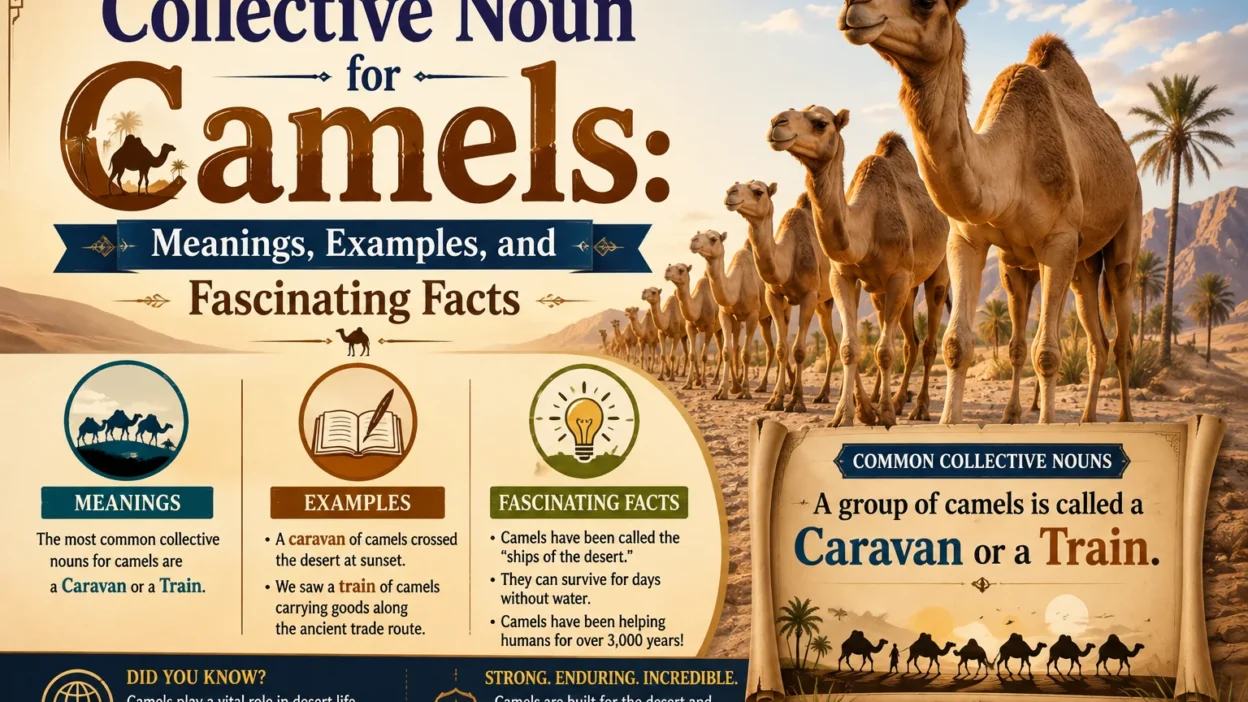
The collective noun for camels is often caravan, a familiar term for groups of camels that travel together across a desert on long journeys. Other terms, including flock, herd, train, and scorn, can also describe camel groups in different situations. Caravan remains the clearest choice when you want to describe camels moving together as a traveling group.
Camels are remarkable mammals with a strong ability to survive in hot, dry environments. Their specialized bodies help them conserve water, tolerate heat, and feed on tough vegetation. Their humps store fat, not water, while this stored energy helps them survive when food becomes scarce. These features help explain why camels have played such an important role in human travel.
The word caravan also connects camel groups with human history. For thousands of years, camels have transported people and goods across deserts, making this vocabulary especially meaningful. The word creates a clear picture of camels moving and traveling together over long distances, often carrying people, supplies, and valuable goods.
What Is the Collective Noun for Camels?
Several collective nouns can describe a group of camels. Caravan is probably the best-known term and it is especially appropriate when camels are traveling together.
Other expressions include flock, herd, train, and scorn. Different dictionaries and collective-noun references list these terms for camels.
A Caravan of Camels
The expression “a caravan of camels” is one of the clearest and most recognizable ways to describe several camels traveling together.
A caravan often suggests a group making a journey across a desert or another difficult landscape. Historically, camel caravans carried merchandise, supplies, and people over long distances.
Simple Example Sentences
- A caravan of camels crossed the desert.
- We watched a caravan of camels traveling toward the village.
- A caravan of camels appeared beyond the dunes.
- The travelers joined a caravan of camels.
- A caravan of camels moved slowly across the valley.
- The merchants followed a caravan of camels.
- A caravan of camels arrived before sunset.
- The guide watched the caravan of camels carefully.
- A caravan of camels crossed the sandy trail.
- The caravan of camels continued its journey.
How to Use “A Caravan of Camels” Correctly
Using a caravan of camels is straightforward. The basic structure is:
a caravan + of + camels
For example:
A caravan of camels crossed the desert.
Here, caravan is the collective noun while camels identify the animals belonging to the group.
The expression works especially well when you want to emphasize travel. If the camels are simply standing together or grazing, a herd of camels may fit the situation better.
Example
A caravan of camels is approaching the town.
This sentence treats the camels as one traveling group.
You can also focus on the individual animals:
The camels are approaching the town.
The first sentence emphasizes the group while the second focuses on the individual camels.
Simple Example Sentences
- A caravan of camels is approaching the village.
- The camels are walking toward the water.
- A caravan of camels was seen across the desert.
- The camels were resting near the trees.
- A caravan of camels is moving toward the mountains.
- The camels are searching for food.
- A caravan of camels traveled through the valley.
- The camels were following their leader.
- A caravan of camels crossed the desert road.
- The camels disappeared behind the dunes.
Other Collective Nouns and Expressions for Camels
English has several expressions for groups of camels. These terms don’t always carry exactly the same meaning and some are much more common than others.
A Flock of Camels
Flock is a recognized collective noun for camels. It is more commonly associated with birds or sheep but several animal references list a flock of camels.
Example: A flock of camels moved across the plain.
A Herd of Camels
Herd is a general collective noun that can describe camels. It works particularly well when you’re simply talking about several camels living, feeding, or moving together.
Example: A herd of camels gathered near the water.
A Train of Camels
Train is another recognized collective noun for camels. It can create the image of several camels moving one after another in a line.
Example: A train of camels traveled across the desert.
This expression is particularly appropriate when the camels are traveling together in an organized line.
A Scorn of Camels
Scorn is an unusual collective noun associated with camels. It appears in traditional collective-noun lists but is much less common in ordinary modern English.
Example: A scorn of camels moved across the dry landscape.
Because this term is uncommon, caravan or herd will usually be clearer for general readers.
A Group of Camels
Group is a general expression rather than a camel-specific collective noun. However, it is completely natural and easy to understand.
Example: A group of camels rested beside the road.
When you’re unsure which specialized term to use, a group of camels is always a clear option.
Simple Example Sentences
- A flock of camels crossed the plain.
- A herd of camels gathered near the oasis.
- A train of camels moved in a long line.
- A scorn of camels appeared in the distance.
- A group of camels rested beneath the trees.
- A caravan of camels traveled across the desert.
- The herd of camels searched for vegetation.
- The flock of camels moved toward the water.
- The train of camels followed the narrow path.
- A group of camels gathered near the settlement.
Collective Noun for Camels vs. Other Expressions
Not every phrase used to describe several camels is a specialized collective noun. Caravan, flock, herd, train, and scorn are commonly listed as collective nouns for camels. Group is simply a general noun that can describe any collection of camels.
| Expression | Meaning | Simple Example |
| A caravan of camels | Camels traveling together | A caravan of camels crossed the desert. |
| A flock of camels | A group of camels | A flock of camels moved across the plain. |
| A herd of camels | Camels living or moving together | A herd of camels gathered near the water. |
| A train of camels | Camels traveling in a line | A train of camels crossed the valley. |
| A scorn of camels | An uncommon collective term | A scorn of camels moved across the land. |
| A group of camels | General description | A group of camels rested nearby. |
| Several camels | Simple plural expression | Several camels were grazing. |
For general English writing, a caravan of camels is an excellent choice when the camels are traveling. A herd of camels is also clear when you’re simply describing several animals together.
Simple Example Sentences
- A group of camels gathered near the mountain.
- Several camels were walking across the valley.
- A herd of camels rested near the oasis.
- A caravan of camels crossed the desert.
- A flock of camels moved toward the village.
- A train of camels followed the narrow road.
- The camels gathered around the water.
- A group of camels disappeared behind the dunes.
- The herd of camels searched for food.
- The caravan continued toward the distant settlement.
Camel Behavior and Why “Caravan” Is Useful
The expression a caravan of camels creates a strong image of camels traveling together across a difficult landscape. It doesn’t necessarily mean that every group of camels is a caravan. Instead, the term is particularly useful when the animals are traveling as part of a journey.
Camels are social animals and can live or move in groups. Modern observations also show that camel groups can vary considerably in size. Feral camels in Australia, for example, may travel in herds ranging from fewer than ten animals to several hundred.
The historical importance of camel travel makes caravan especially memorable. Camels were domesticated thousands of years ago and became valuable transport animals because they could carry heavy loads through dry environments. Dromedary camels have been domesticated for roughly 3,500 years.
A camel group may also gather around food or water. Camels are herbivores and can feed on vegetation that grows in harsh environments. Their tough lips help them eat dry and thorny plants that would be difficult for many other animals to handle.
Simple Example Sentences
- A caravan of camels crossed the mountains.
- A herd of camels gathered near the water.
- Several camels searched for vegetation.
- A group of camels moved across the desert.
- The camels traveled together for several miles.
- A caravan carried supplies across the dry region.
- The herd stopped near a watering place.
- The camels followed one another along the trail.
- A train of camels moved slowly through the sand.
- The caravan disappeared beyond the dunes.
Interesting Facts About Camels
Camels are among the most remarkable mammals adapted to dry environments. Their famous humps don’t store water. Instead, the humps store fat, which can provide energy when food is unavailable. When a camel uses the stored fat, its hump can become smaller and may droop.
Camels can also tolerate substantial periods without drinking under suitable conditions. When water becomes available, they can drink a surprisingly large amount in a short period. National Geographic reports that a very thirsty camel can drink about 30 gallons of water in only 13 minutes.
Their bodies contain several impressive adaptations for difficult environments. Their nostrils can close to keep out blowing sand while long eyelashes and bushy eyebrows help protect their eyes. Their broad footpads help them move over sand and rough ground.
Camels also have impressive longevity. Bactrian camels can live for up to about 50 years in captivity, while wild camels can also survive for decades under suitable conditions. National Geographic lists an average captive lifespan of up to 50 years for Bactrian camels.
Their diet is another interesting feature. Camels are herbivores and can consume grasses, leaves, shrubs, and tough desert vegetation. Their large, tough lips allow them to pick through dry and thorny plants.
Camels also have a distinctive way of walking called pacing. They move both legs on one side of the body forward at the same time. This gait is also found in some other animals such as giraffes.
Quick Camel Facts
- Camels are herbivorous mammals.
- A camel’s hump stores fat rather than water.
- Dromedaries have one hump.
- Bactrian camels have two humps.
- Camels can conserve water extremely well.
- Their nostrils can close against blowing sand.
- Long eyelashes help protect their eyes.
- Their broad footpads help them walk across difficult terrain.
- Some camels can live for several decades.
- Camels can eat tough and thorny vegetation.
- Camel groups can be called caravans, herds, flocks, or trains.
- Scorn is another less-common collective noun for camels.
Common Mistakes With the Collective Noun for Camels
One common mistake is believing that caravan is the only possible collective noun for camels. English actually has several recognized terms. References list caravan, flock, herd, train, and scorn among the collective nouns associated with camels.
Another mistake is assuming that every term has exactly the same meaning. Caravan strongly suggests traveling camels while the herd provides a broader description.
Incorrect Approach
A caravan is the only word that can describe several camels.
This is too restrictive because other collective nouns are also used.
Better Approach
A caravan of camels crossed the desert.
Or:
A herd of camels gathered near the water.
Both sentences are natural because the collective noun matches the situation.
Another common mistake is thinking that a camel’s hump stores water.
Incorrect Fact
A camel stores water inside its hump.
Correct Fact
A camel stores fat inside its hump.
Fat can be used as an energy source when food is scarce.
Conclusion
The collective noun for camels can vary with the situation, but caravan remains the most familiar and useful term. Words such as herd, flock, and train may also describe groups of camels, depending on context. Because camels have traveled with people and carried goods across deserts for thousands of years, caravans have a strong connection with their history and movement.
FAQs
Q1. What is the collective noun for camels?
The most familiar collective noun for camels is caravan. It commonly describes a group of camels traveling together, especially across a desert.
Q2. What do you call a group of camels?
A group of camels is commonly called a caravan. You may also encounter terms such as herd, flock, or train in different contexts.
Q3. Is “caravan of camels” correct?
Yes. Caravan of camels is a well-established expression, particularly when the camels travel together over a long distance.
Q4. Can you say “herd of camels”?
Yes, a herd of camels is understandable and can be used to describe multiple camels together. However, a caravan is more distinctive when they’re traveling.
Q5. What is a caravan of camels?
A caravan of camels refers to a group of camels traveling together. Historically, camel caravans transported people and goods across deserts.
Q6. Why are camels associated with caravans?
Camels can survive harsh, dry environments and travel long distances with limited water. These qualities made them valuable for desert transportation and trade.
Q7. Is “flock of camels” correct?
Flock can appear as a collective term for camels, although it’s less common than caravan. Caravan better emphasizes a traveling group.
Q8. What is the plural of camel?
The plural of camel is camels. For example, “Several camels crossed the desert.”
Q9. What is the difference between a caravan and a herd of camels?
A caravan usually emphasizes camels traveling together, often with people or goods. A herd simply refers to a group of animals.
Q10. What is the best collective noun to use for camels?
Caravan is generally the best choice when you’re describing camels traveling together, especially across a desert. It’s familiar, descriptive, and historically connected with camel travel.