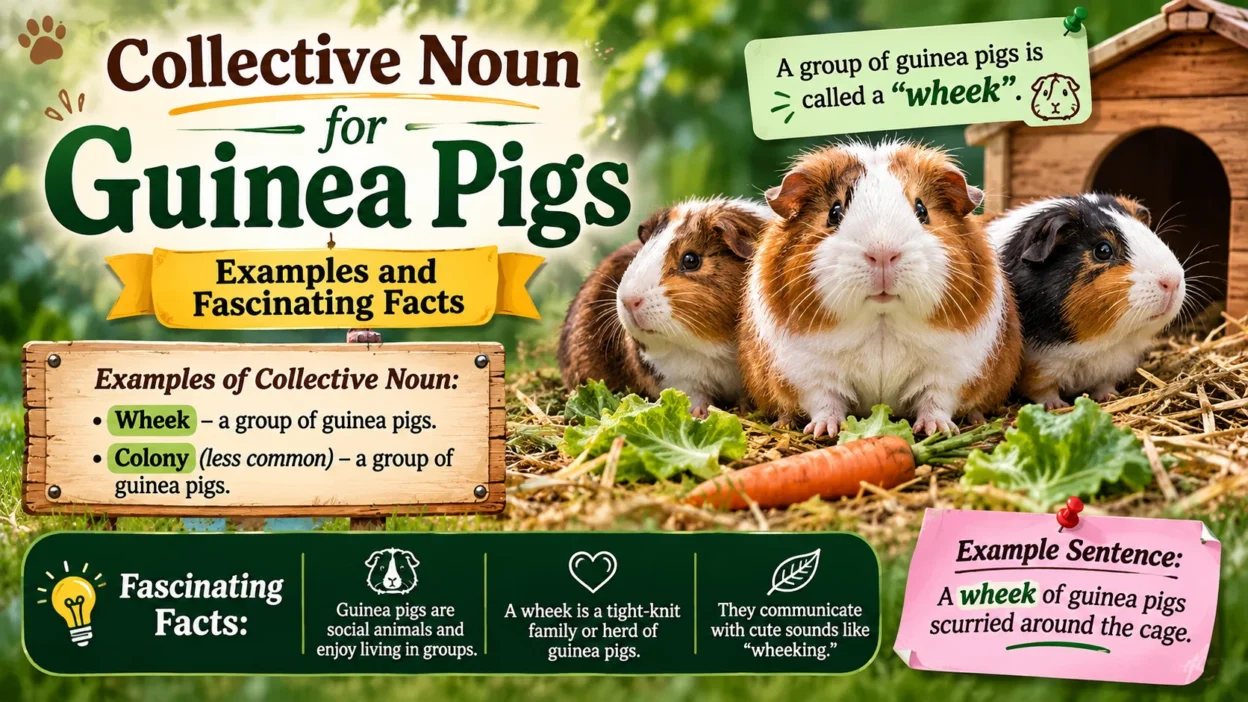
The collective noun for guinea pigs is usually a herd. You may also encounter a cavy of guinea pigs, as cavy is the common name for members of the guinea pig family. Guinea pigs are social animals that naturally live in groups, so this group-based collective expression fits their nature well. They often feel more secure with companionship and use squeaks, chirps, purrs, and other sounds to communicate.
Collective nouns are words that describe animals, people, or things as one unit. English has many familiar examples, such as a flock of birds, a pack of wolves, and a herd of cattle. These expressions can improve your vocabulary and make writing more descriptive. When you discuss guinea pigs, herd works naturally, while cavy also relates to their broader family classification.
The phrase Collective Noun for Guinea Pigs is especially useful when discussing their social behavior, care, habitat, and interactions. For example, when discussing several guinea pigs, calling them a herd shows that you’re referring to the animals as a group rather than one animal. Understanding their social nature can also help when talking about proper care and their natural habitat.
What Is the Collective Noun for Guinea Pigs?
The most straightforward expression is “a herd of guinea pigs.” It can describe several guinea pigs living or moving together.
A Herd of Guinea Pigs
A herd of guinea pigs is a simple and understandable expression for a group of guinea pigs.
Guinea pigs are naturally social creatures. In the wild, their relatives live in groups, and domestic guinea pigs often benefit from appropriate companionship. A herd can therefore describe several guinea pigs kept or observed together.
Example: A herd of guinea pigs gathered around the food bowl.
| Type | Simple Example |
| Collective noun | Herd |
| Animal | Guinea pigs |
| Complete phrase | A herd of guinea pigs |
| Singular example | A guinea pig is eating grass. |
| Plural example | Several guinea pigs are eating grass. |
| Collective example | A herd of guinea pigs gathered near the food. |
The basic structure is:
a herd + of + guinea pigs
Example: A herd of guinea pigs is resting in the enclosure.
When you want to emphasize the individual animals, you can simply say:
The guinea pigs are resting in the enclosure.
Simple Example Sentences
- A herd of guinea pigs gathered near the food.
- We watched a herd of guinea pigs moving around the enclosure.
- A herd of guinea pigs was resting together.
- The children observed a herd of guinea pigs.
- A herd of guinea pigs gathered around the hay.
- The herd of guinea pigs moved toward the shelter.
- A herd of guinea pigs explored the enclosure.
- The keeper fed a herd of guinea pigs.
- A herd of guinea pigs stayed together.
- The guinea pigs were happily eating vegetables.
How to Use “A Herd of Guinea Pigs” Correctly
Using a herd of guinea pigs is straightforward.
The basic structure is:
a herd + of + guinea pigs
For example:
A herd of guinea pigs gathered around the food bowl.
Here, the herd identifies the group, while guinea pigs identify the animals.
When the group is treated as a single unit, you can use a singular verb:
Example:
A herd of guinea pigs is resting in the enclosure.
When you focus on the individual animals, use the plural noun guinea pigs with a plural verb:
Example:
The guinea pigs are resting in the enclosure.
Simple Example Sentences
- A herd of guinea pigs is resting together.
- The guinea pigs are eating hay.
- A herd of guinea pigs was seen in the enclosure.
- The guinea pigs were exploring their surroundings.
- A herd of guinea pigs is gathering near the shelter.
- The guinea pigs are communicating with one another.
- A herd of guinea pigs was moving toward the food.
- The guinea pigs were running around the enclosure.
- A herd of guinea pigs is staying together.
- The guinea pigs are making different sounds.
Can You Say “A Cavy of Guinea Pigs”?
You may encounter cavy in discussions about guinea pigs. A cavy is a member of the cavy family, which includes guinea pigs and related rodents.
However, cavy is primarily an animal name rather than a universally established collective noun equivalent to herd. Therefore, a herd of guinea pigs is generally the clearer expression for ordinary writing.
Simple Example Sentences
- A herd of guinea pigs lived together.
- The cavy family includes guinea pigs and related rodents.
- The guinea pigs gathered near the shelter.
- A group of guinea pigs explored the enclosure.
- Several guinea pigs rested together.
- A herd of guinea pigs moved toward the food.
- The guinea pigs stayed close to one another.
- A group of cavies was observed nearby.
- The animals gathered around the hay.
- The guinea pigs remained together.
Herd of Guinea Pigs vs. Other Expressions
Not every expression describing several guinea pigs is a specialized collective noun. You can also use ordinary phrases such as a group of guinea pigs, several guinea pigs, or a family group depending on the situation.
| Expression | Meaning | Simple Example |
| A herd of guinea pigs | Group of guinea pigs | A herd of guinea pigs gathered together. |
| A group of guinea pigs | General description | A group of guinea pigs was nearby. |
| Several guinea pigs | Simple plural expression | Several guinea pigs were eating hay. |
| A family group | Related guinea pigs living together | A family group stayed near the shelter. |
| A cavy | A guinea pig or related animal | The cavy was eating grass. |
For simple English writing, a herd of guinea pigs is the easiest collective expression to understand.
Simple Example Sentences
- A group of guinea pigs gathered near the hay.
- Several guinea pigs were eating vegetables.
- A herd of guinea pigs moved around the enclosure.
- The guinea pigs stayed close together.
- A family group rested inside the shelter.
- Several guinea pigs explored the area.
- A herd of guinea pigs gathered around the food.
- The guinea pigs moved toward their shelter.
- A group of guinea pigs played together.
- The animals remained close to one another.
Guinea Pig Behavior and Why “Herd” Is Useful
Guinea pigs are social animals, which makes a group expression particularly appropriate. Unlike animals that commonly live alone, guinea pigs often interact with other members of their species. They communicate using a variety of vocalizations and body movements.
Guinea pigs can make sounds when they’re excited, hungry, frightened, or interacting with their companions. Their famous “wheeking” sound is often associated with excitement, particularly when they anticipate food.
Social interaction is also important for their well-being. Guinea pigs can become attached to familiar companions and often spend time eating, resting, exploring, and moving together.
However, simply placing unfamiliar guinea pigs together doesn’t guarantee that they’ll immediately get along. Their personalities, sex, age, previous social experience, and introduction process can all influence their relationships.
The collective noun describes the animals when they’re together, but it doesn’t mean every group behaves in exactly the same way.
Simple Example Sentences
- Guinea pigs often enjoy social interaction.
- A herd of guinea pigs gathered around the food.
- The guinea pigs stayed close to their companions.
- Guinea pigs communicate through different sounds.
- A group of guinea pigs explored the enclosure.
- The animals rested together.
- Guinea pigs can become familiar with their companions.
- A herd of guinea pigs moved toward the shelter.
- The guinea pigs made excited sounds when food arrived.
- The animals interacted with one another throughout the day.
Interesting Facts About Guinea Pigs
Guinea pigs are fascinating small mammals belonging to the rodent family Caviidae. Despite their name, they aren’t pigs and aren’t native to Guinea. Their origins trace back to South America, where wild relatives have lived for thousands of years. Domestic guinea pigs have become popular companion animals because of their gentle nature, distinctive sounds, and social behavior.
Guinea pigs have several unique physiological features. Their teeth continue growing throughout their lives, so they need to chew regularly to help maintain healthy tooth length. Their digestive system is also adapted to a diet rich in fiber, making hay an important part of a domestic guinea pig’s diet. Guinea pigs also have a compact body, short legs, sensitive whiskers, and excellent hearing.
Their dietary habits are especially important. Guinea pigs are herbivores, meaning they eat plant-based foods. A healthy diet generally includes plenty of grass hay, appropriate fresh vegetables, and a suitable source of vitamin C. Unlike many mammals, guinea pigs cannot produce vitamin C on their own, so they need to obtain it through their diet.
Guinea pigs also produce a special type of soft fecal pellet called cecotropes, which they consume as part of normal digestion. This process helps them recover nutrients from their food and is an important part of their digestive system.
Their social behavior is another remarkable characteristic. Guinea pigs use sounds such as wheeks, purrs, chirps, squeals, and teeth chattering to communicate. Different sounds can signal excitement, comfort, fear, annoyance, or other emotional states. Their communication helps explain why observing a group of guinea pigs can be so entertaining.
Quick Guinea Pig Facts
- Guinea pigs are rodents.
- They belong to the family Caviidae.
- Guinea pigs originated in South America.
- They are herbivores.
- Their teeth continue growing throughout life.
- Hay is an important part of their diet.
- Guinea pigs need dietary vitamin C.
- They are highly social animals.
- Guinea pigs communicate through many different sounds.
- A herd of guinea pigs is a simple collective expression for a group.
Conclusion
The collective noun for guinea pigs is commonly expressed as a herd of guinea pigs. This simple phrase describes a group of guinea pigs and works well in everyday English, educational writing, and discussions about their social behavior.Guinea pigs are naturally social animals, and they communicate through a variety of sounds and body movements. Their interesting biological traits, including continuously growing teeth, a fiber-rich diet, and their need for vitamin C, make them fascinating animals to study. Understanding the collective noun also adds useful vocabulary while helping you appreciate how language connects with the behavior of animals.
FAQs
Q1. What is the collective noun for guinea pigs?
The commonly used collective expression is a herd of guinea pigs.
Q2. Is “a herd of guinea pigs” correct?
Yes. A herd of guinea pigs is a clear and commonly used expression for describing a group of guinea pigs.
Q3. What do you call a group of guinea pigs?
A group of guinea pigs can be called a herd of guinea pigs. You can also simply say a group of guinea pigs.
Q4. Are guinea pigs social animals?
Yes. Guinea pigs are social animals that generally enjoy appropriate companionship and interaction with other guinea pigs.
Q5. What is a cavy?
A cavy is a member of the Caviidae family, which includes guinea pigs and related rodents. The word isn’t necessarily a specialized collective noun for guinea pigs.
Q6. What do guinea pigs eat?
Guinea pigs are herbivores. They mainly eat grass hay and other suitable plant-based foods and need a reliable dietary source of vitamin C.
Q7. Why do guinea pigs need vitamin C?
Guinea pigs can’t produce sufficient vitamin C on their own, so they need to obtain it through their diet.
Q8. Why do guinea pigs chew frequently?
Guinea pigs have continuously growing teeth. Regular chewing helps naturally wear down their teeth and supports healthy dental development.
Q9. How do guinea pigs communicate?
Guinea pigs communicate using different sounds and body language. Their vocalizations can include wheeking, purring, squealing, chirping, and teeth chattering.
Q10. Why is “herd” a suitable collective noun for guinea pigs?
Herd provides a simple way to describe several guinea pigs together. It also fits the fact that guinea pigs are generally social animals that interact and live alongside companions.