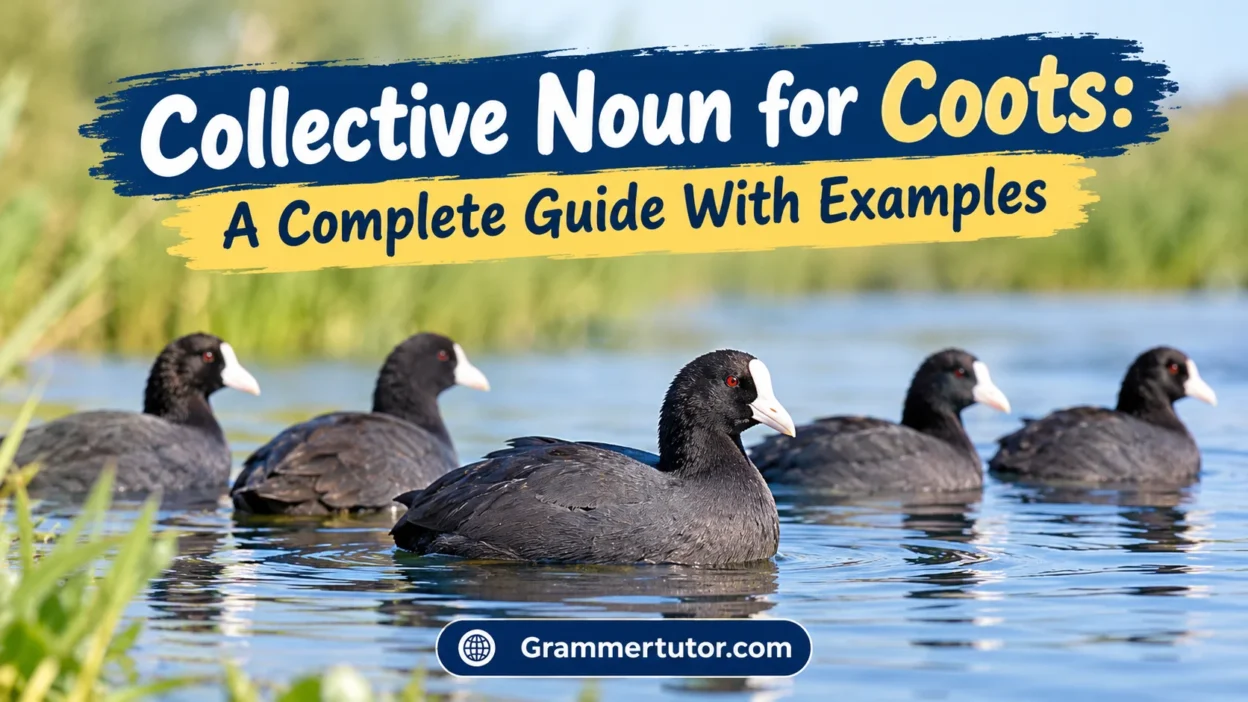
The collective noun for coots is commonly listed as a covert of coots, although a flock of coots is also natural in everyday English. These fascinating waterbirds often gather around ponds, marshes, and other freshwater habitats, where they paddle across the water, glide between aquatic plants, and search for food. Learning these collective expressions helps you describe bird gatherings clearly and adds variety to your English vocabulary.
Coots belong to the rail family, scientifically known as Rallidae. The Eurasian coot is recognizable by its blackish plumage, rounded body, short tail, strong feet, white bill, and distinctive frontal shield. These birds spend much of their time in freshwater habitats, where they swim, dive, and forage for aquatic vegetation. Observing their feeding habits and movements can help you understand their behavior and recognize them in ponds and marshes. Such details are useful when writing about wildlife, bird species, and aquatic ecosystems.
A collective noun is a word that refers to several people, animals, or things as one group. For example, you can write, “A covert of coots moved across the pond,” or “A flock of coots gathered near the marsh.” Both expressions make sense, but flock of coots is more familiar in everyday English, while covert of coots appears in traditional lists of bird-group names. Whether you are completing a school assignment, preparing a nature article, or learning English grammar, understanding these terms can improve your vocabulary, sentence structure, and wildlife descriptions.
Why Are Collective Nouns Used for Coots?
Coots often gather on lakes, reservoirs, ponds, and wetlands where food and shelter are available. During certain seasons, large numbers may congregate on suitable waters, while breeding pairs can become territorial around nesting sites. Collective nouns provide a convenient way to describe these different situations without repeatedly naming each bird.
The traditional expression covert of coots appears in some collections of bird collective nouns. However, it is relatively uncommon in everyday conversation and should not be confused with a universally established scientific term. In ordinary descriptions, flock of coots and group of coots are easier for most readers to understand.
The expression you choose depends on the scene. A flock may describe coots swimming together on a lake, while a group is suitable for a general observation. Learning these terms also helps readers distinguish traditional bird vocabulary from expressions used in everyday English.
Collective Nouns for Coots
| Collective Noun | Used For | Simple Example |
| Covert | A traditional expression listed for coots | A covert of coots rested near the reeds. |
| Flock | Several coots gathered together | A flock of coots crossed the lake. |
| Group | Coots considered together | A group of coots searched for food. |
| Raft | Waterbirds floating together on a lake | A raft of coots drifted across the pond. |
| Gathering | Coots assembled in one place | A gathering of coots occupied the wetland. |
| Congregation | Numerous coots assembled in the same area | A congregation of coots filled the shallow water. |
| Colony | A breeding community when the context supports this description | A colony of coots nested near the marsh. |
Note: Covert is a traditional collective-noun expression, while flock and group are straightforward choices for general writing. Raft is commonly used for waterbirds floating together, and gathering and congregation are descriptive terms rather than specialized names exclusive to coots. Colony is appropriate only when the context describes a breeding or nesting community.
Covert of Coots
A covert of coots is a traditional collective noun found in lists of bird-group expressions. The word covert has other meanings in English, including a sheltered or concealed place, but in this expression it serves as a specialized name for a gathering of coots.
Although the term can add character to creative writing, it is not commonly heard in everyday wildlife discussions. Birdwatchers and nature writers will usually find flock of coots more immediately understandable.
Using traditional collective nouns can be an enjoyable way to explore the history and variety of English. Still, when accuracy and clarity matter most, it helps to explain an unusual term when it first appears.
Examples of “Covert of Coots”
- A covert of coots appeared beside the marsh grasses.
- We spotted a covert of coots near the water lilies.
- A covert of coots rested in a sheltered inlet.
- The naturalist recorded a covert of coots in the wetland.
- A covert of coots moved between patches of reeds.
- The old bird guide mentioned a covert of coots.
- A covert of coots gathered in the quiet backwater.
- The illustration showed a covert of coots on a pond.
- A covert of coots emerged from behind the vegetation.
- The writer used covert of coots in a passage about wetland birds.
Flock of Coots
A flock of coots is a clear and practical expression for several coots gathered in the same area. It is suitable for describing birds swimming across a lake, feeding in shallow water, or resting on a reservoir.
Coots may gather in substantial numbers when suitable feeding and resting locations are available. Their dark bodies are often easy to distinguish against the pale surface of open water, especially when they move between patches of aquatic vegetation.
The word flock is widely understood and works well in schoolwork, birdwatching notes, wildlife articles, and everyday conversation.
Examples of “Flock of Coots”
- A flock of coots paddled past the wooden pier.
- We photographed a flock of coots beneath the morning sunlight.
- A flock of coots explored the edges of the reservoir.
- The flock of coots scattered when a dog approached the bank.
- A flock of coots rested among floating leaves.
- Several children watched a flock of coots near the boating area.
- A flock of coots searched the shallows for tender shoots.
- The flock of coots disappeared behind a patch of reeds.
- A flock of coots crossed the sheltered bay.
- We counted a flock of coots during our afternoon walk.
Group of Coots
A group of coots is a general expression for several birds seen together. It does not suggest a particular social structure, breeding arrangement, or traditional naming convention.
This phrase is especially useful when the observer does not know whether the birds belong to a larger flock or are simply gathered temporarily. It also fits naturally into educational writing because its meaning is immediately clear.
Coots may feed close to one another in productive wetlands, although their behavior can change during the breeding season when individuals defend nesting territories.
Examples of “Group of Coots”
- A group of coots gathered beside the muddy shoreline.
- We noticed a group of coots near the fishing platform.
- A group of coots dived beneath the rippling surface.
- The group of coots moved toward a bed of pondweed.
- A group of coots occupied the sheltered corner of the lake.
- The photographer followed a group of coots through the reeds.
- A group of coots searched beneath floating vegetation.
- The group of coots rested near an old wooden bridge.
- A group of coots appeared after the morning mist cleared.
- We observed a group of coots from the birdwatching hide.
Raft of Coots
A raft of coots describes waterbirds floating together on the surface of a lake or other body of water. The word raft is particularly useful because it creates a visual picture of birds gathered closely together while afloat.
Coots are strong swimmers and frequently forage in aquatic environments. When many birds rest or feed on open water, describing them as a raft can make a nature passage more vivid.
This expression is not exclusive to coots. It is also associated with other waterbirds, so it is best understood as a descriptive collective expression rather than a name used only for this species.
Examples of “Raft of Coots”
- A raft of coots floated beyond the shoreline.
- We watched a raft of coots resting on the blue lake.
- A raft of coots gathered beside the floating vegetation.
- The raft of coots drifted slowly toward the island.
- A raft of coots occupied the quiet reservoir.
- The children counted a raft of coots from the wooden jetty.
- A raft of coots moved away from the passing boat.
- The morning breeze carried a raft of coots across the pond.
- A raft of coots gathered in the sheltered bay.
- The wildlife photographer captured a raft of coots on calm water.
Gathering of Coots
A gathering of coots refers to several birds assembled in one location. It is a descriptive expression that works whether the birds are resting, feeding, or occupying a wetland together.
Unlike a specialized traditional collective noun, gathering does not imply a particular biological relationship between the birds. It simply emphasizes that multiple coots are present in the same place.
This expression is useful in nature writing when the writer wants to avoid repeating flock or when describing a temporary assembly around an attractive feeding area.
Examples of “Gathering of Coots”
- A gathering of coots occupied the flooded meadow.
- We discovered a gathering of coots near the drainage channel.
- A gathering of coots fed among the submerged plants.
- The gathering of coots attracted several visiting birdwatchers.
- A gathering of coots rested beside the reed-covered bank.
- The ranger photographed a gathering of coots at sunrise.
- A gathering of coots moved toward the deeper water.
- The gathering of coots became visible after the fog lifted.
- A gathering of coots shared the pond with several ducks.
- We watched a gathering of coots near the nature reserve.
Congregation of Coots
A congregation of coots is a descriptive way to refer to a sizable assembly of these waterbirds. The word congregation commonly refers to people gathered together, but it can also be used figuratively to describe animals assembled in one place.
This expression can suit literary passages, wildlife observations, or descriptions of a wetland crowded with birds. It is not a standard technical term in ornithology, so it should be used for stylistic effect rather than presented as the only correct collective noun.
Coots may congregate where food is plentiful or where open water offers suitable resting conditions. The number of birds present can vary with habitat, season, and local environmental conditions.
Examples of “Congregation of Coots”
- A congregation of coots covered part of the lake.
- We observed a congregation of coots near the marshland.
- A congregation of coots gathered beyond the grassy shore.
- The congregation of coots moved across the open water.
- A congregation of coots rested in the afternoon sunshine.
- The wetland supported a congregation of coots during winter.
- A congregation of coots appeared beside the flooded fields.
- The naturalist described a congregation of coots in her journal.
- A congregation of coots shared the inlet with other waterbirds.
- We admired a congregation of coots from the observation tower.
Colony of Coots
A colony of coots can describe a breeding or nesting community when the circumstances support that meaning. The word colony is more closely associated with birds that nest in groups or maintain a shared breeding area, so it should not automatically replace flock in every situation involving coots.
Coots generally build nests near water, often among reeds and other vegetation. During breeding, they may defend areas around their nests, and neighboring pairs can show territorial behavior. Therefore, the term colony should be used carefully when describing a particular population.
For ordinary observations of birds swimming together, flock of coots remains a clearer choice. When writing about nesting activity, explain the circumstances so readers understand what kind of gathering you mean.
Examples of “Colony of Coots”
- A colony of coots nested among the marsh plants.
- The researchers examined a colony of coots during the breeding season.
- A colony of coots occupied a sheltered wetland.
- The conservation team monitored a colony of coots near the lake.
- A colony of coots raised their young among dense vegetation.
- The report described a nesting colony of coots in the reserve.
- A colony of coots used the reed beds for shelter.
- The observer recorded breeding activity among the nesting coots.
- A colony of coots remained close to its nesting habitat.
- The wetland provided suitable conditions for a nesting community of coots.
Types of Coots and Their Characteristics
Coots are waterbirds belonging to the rail family, Rallidae. Several species occur in different parts of the world, and their appearance, habitat preferences, and distribution vary. The Eurasian coot (Fulica atra) is widespread across parts of Europe, Asia, Africa, and Australasia. The American coot (Fulica americana) is found across much of North America and parts of Central America.
Eurasian coots are generally dark-bodied birds with a prominent white bill and frontal shield. American coots also have dark plumage and a white bill, often with a reddish-brown marking near the upper bill. Their feet are especially interesting: instead of fully webbed feet like those of many ducks, coots have lobed toes that assist with swimming and movement across soft, muddy surfaces.
These birds inhabit lakes, ponds, marshes, reservoirs, and other wetlands with suitable vegetation. Their ability to swim and dive helps them reach underwater food sources, while their strong legs allow them to move through vegetation and along the water’s edge.
Examples of Coot Characteristics
- Eurasian coots have a distinctive white bill and frontal shield.
- American coots have dark plumage and lobed toes.
- Coots belong to the rail family, Rallidae.
- Their feet help them swim and walk across muddy ground.
- Many coots live in freshwater wetlands.
- They can dive beneath the surface to search for food.
- Their nests are often built among aquatic vegetation.
- Coots may defend nesting areas during the breeding season.
- Different coot species occupy different geographical regions.
- Their calls and movements help birdwatchers identify them.
Interesting Facts About Coots
Coots have several fascinating adaptations that help them survive in wetland environments. Their lifespan varies by species and environmental conditions, including food availability, predation, disease, and habitat quality. Individual coots may survive for several years in the wild, although many face hazards during their early lives. Their lobed toes are a particularly distinctive physical feature, helping them paddle efficiently and move over soft ground. Their dark plumage, compact bodies, and specialized bills make them well suited to life around water.
Coots also display interesting social behavior. Outside the breeding season, some populations gather in substantial numbers on lakes and reservoirs. During nesting, however, pairs may become territorial and protect their nests from intruders. Their nests are often constructed from plant material and placed among reeds or other waterside vegetation. These differences in behavior explain why several expressions can be useful when describing coots: a flock emphasizes birds together, a raft highlights those floating on water, and a gathering simply describes an assembly. Learning these terms connects English vocabulary with the real habits and biological features of these adaptable waterbirds.
Conclusion
The collective noun for coots is commonly listed as a covert of coots, while a flock of coots and a group of coots are also clear and natural expressions. Understanding these terms helps you describe bird gatherings accurately and improve your English vocabulary. Whether you are writing a school assignment or a wildlife article, choosing the right collective noun makes your sentences clearer, more natural, and more engaging.
FAQs
Q1. What is the collective noun for coots?
Covert of coots is a traditional collective-noun expression listed for these birds. Flock of coots is a more familiar and practical phrase for everyday use.
Q2. Can I use “flock of coots” in a sentence?
Yes. For example: “A flock of coots swam across the lake.” This is a clear, natural way to describe several coots together.
Q3. Is “covert of coots” commonly used?
No, it is relatively uncommon in everyday English. It appears in traditional lists of bird collective nouns, while flock of coots is more immediately recognizable.
Q4. What is a raft of coots?
A raft of coots describes coots floating together on a body of water. The word raft emphasizes their position on the water’s surface.
Q5. Where do coots usually live?
Coots commonly inhabit lakes, ponds, marshes, reservoirs, and other wetlands. They prefer places where aquatic vegetation and suitable feeding areas are available.