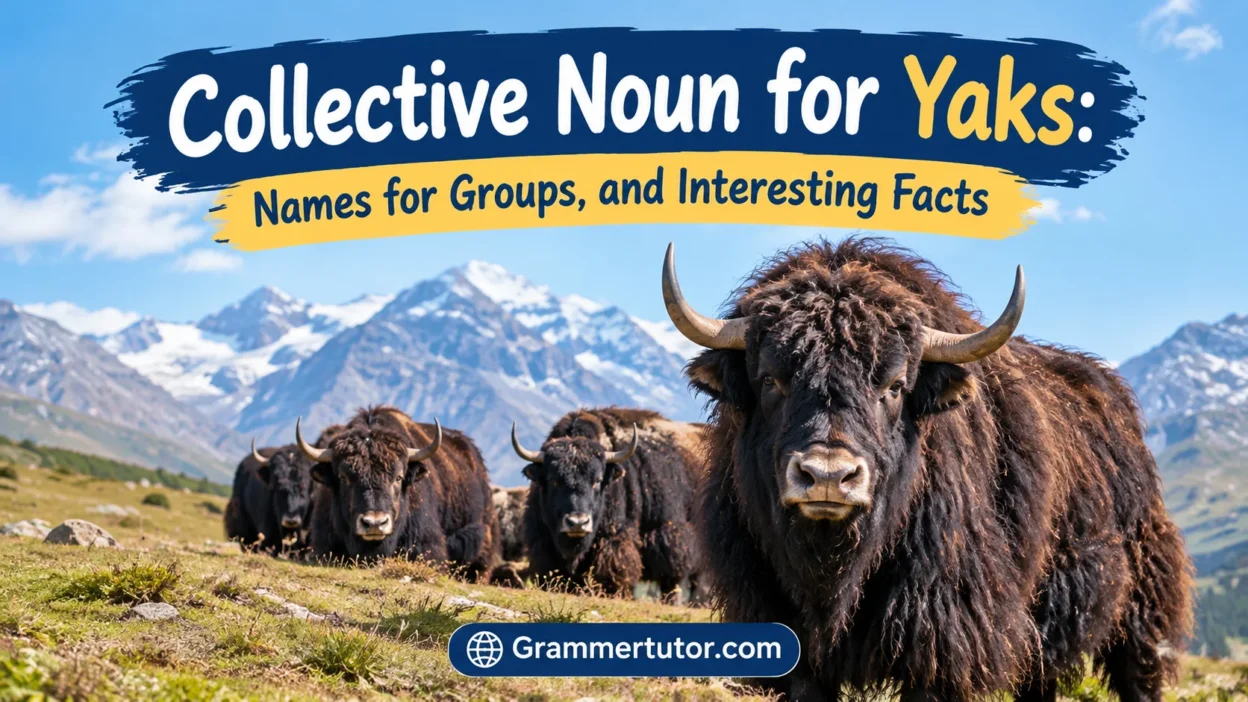
The collective noun for yaks helps you describe these powerful mammals when they gather in the cold, high mountains of Central Asia. A herd of yaks is a natural expression because these long-haired mammals are adapted to high-altitude regions, rugged mountains, and a harsh cold climate. These hardy animals survive freezing temperatures by relying on their thick coats and grazing on grasses and other vegetation. Their feeding habits, survival, and adaptation to their environment make them an interesting part of wildlife.
The word herd is commonly used for grazing mammals that live in groups and travel in groups. You can also say a group of yaks when you need a simple, general expression. Other terms, such as band of yaks and aggregation of yaks, may appear in descriptive writing, but they are not as widely established as herd. Learning these collective expressions helps you improve vocabulary, build your English vocabulary, and understand linguistic expressions, collective terminology, and general terminology. It also gives you a clearer way to describe animal groups, group behavior, social behavior, animal movement, and herd behavior in accurate wildlife descriptions.
Yaks live in mountain habitats and natural habitats across parts of Central Asia, where high altitude and a challenging environment shape their daily lives. Studying these animals connects language with the natural world and shows the relationship between language and nature. It also expands your knowledge of animal classification, wildlife terminology, and the English language. By exploring their habitat, nature, gathering patterns, and vegetation consumption, you can create accurate descriptions of yak behavior and learn how words help explain the lives of animals in their natural surroundings.
What Do You Call a Group of Yaks?
A group of yaks is commonly called a herd of yaks. The word herd describes a group of grazing or hoofed mammals that live, feed, or move together.
For example: A herd of yaks grazed on the grassy slopes of the Himalayas.
Other expressions can be used according to the situation, but herd of yaks is the clearest choice for everyday English.
Common Terms for Groups of Yaks
The following table compares useful expressions for describing yaks in different situations.
| Collective Term | Meaning or Use | Simple Example |
| Herd | A group of yaks living or moving together | A herd of yaks crossed the meadow. |
| Group | A general term for several yaks | A group of yaks rested near the stream. |
| Band | A descriptive term for a group of animals | A band of yaks moved along the hillside. |
| Aggregation | Animals gathered in the same place | An aggregation of yaks stood near the pasture. |
| Pair | Two yaks together | A pair of yaks grazed beside the fence. |
Note: Herd is the most natural general expression for yaks. Group, band, and aggregation are broader descriptive terms, not specialized collective nouns uniquely associated with this animal. Pair specifically refers to two yaks.
Herd of Yaks: The Most Natural Expression
A herd of yaks is the most appropriate everyday expression for several yaks living, grazing, or traveling together. Yaks are social animals, and groups can help individuals remain close to one another while moving through their mountain habitats.
Domestic yaks are important livestock in parts of Tibet, Nepal, Bhutan, and other high-altitude regions. They provide milk, meat, fiber, hides, and transport in places where the terrain and climate can make other forms of livestock management difficult.
The size and composition of a herd vary with the animals’ environment and how people manage them. Wild yaks and domestic yaks also differ in their social patterns, so not every herd behaves in exactly the same way.
Examples of “Herd of Yaks”
- A herd of yaks grazed on the mountain pasture.
- We watched a herd of yaks crossing a rocky trail.
- A herd of yaks rested beside a cold mountain stream.
- The shepherd guided a herd of yaks toward fresh grass.
- A herd of yaks moved slowly across the high plateau.
- The photographer captured a herd of yaks against the snowy peaks.
- A herd of yaks gathered near the village.
- The herd of yaks searched for vegetation among the rocks.
- A herd of yaks walked through the misty valley.
- The travelers spotted a herd of yaks on the mountainside.
Group of Yaks: A Simple General Term
A group of yaks is a straightforward expression for any number of yaks found together. Unlike herd, which suggests animals living or moving together, a group does not imply a particular social structure or behavior.
This phrase is useful in school assignments, wildlife descriptions, and general conversation. It works whether the yaks are grazing, resting, being transported, or gathered at a farm.
When you are unsure whether a specialized term is suitable, a group of yaks is a clear and grammatically correct alternative.
Examples of “Group of Yaks”
- A group of yaks rested beneath the mountain trees.
- We saw a group of yaks near the grazing field.
- A group of yaks climbed a narrow hillside path.
- The guide pointed toward a group of yaks in the distance.
- A group of yaks gathered around a feeding area.
- The children observed a group of yaks at the farm.
- A group of yaks crossed the open plateau.
- The group of yaks moved toward the water.
- A group of yaks stood beside a traditional mountain home.
- The wildlife researcher photographed a group of yaks in their habitat.
Band of Yaks: A Descriptive Alternative
A band of yaks can be used as a descriptive phrase for a collection of yaks traveling or staying together. The word band is used for groups of animals in some contexts, but it is not the standard collective noun specifically associated with yaks.
This expression may suit nature writing when the writer wants to describe animals moving together across an open landscape. However, readers will generally find the herd of yaks more familiar and precise.
For educational writing, it is helpful to distinguish descriptive expressions from widely established animal group terms.
Examples of “Band of Yaks”
- A band of yaks moved across the broad mountain slope.
- We noticed a band of yaks near the rocky ridge.
- A band of yaks traveled through the high-altitude valley.
- The guide watched a band of yaks crossing the pasture.
- A band of yaks appeared through the morning fog.
- The photographer followed a band of yaks from a distance.
- A band of yaks rested on the grassy hillside.
- The band of yaks slowly approached the grazing area.
- A band of yaks moved between the mountain streams.
- A band of yaks stood against the distant peaks.
Aggregation of Yaks: When Animals Gather
An aggregation of yaks describes several yaks gathered in the same place. In biology, aggregation is a broad term for organisms that come together, whether temporarily or for a longer period.
Unlike herd, the word does not necessarily suggest a stable social group. It can be useful when describing a gathering at a feeding site, watering area, or livestock enclosure.
Although the expression is grammatically correct, it is more formal and less natural in everyday conversation than a herd of yaks.
Examples of “Aggregation of Yaks”
- An aggregation of yaks gathered near the feeding station.
- The researcher observed an aggregation of yaks in the pasture.
- An aggregation of yaks stood beside the mountain shelter.
- The guide described an aggregation of yaks near the village.
- An aggregation of yaks appeared in the open valley.
- The animals formed an aggregation near a source of water.
- An aggregation of yaks was visible from the hillside.
- The photographer recorded an aggregation of yaks during the survey.
- An aggregation of yaks gathered in the enclosed pasture.
- The report described an aggregation of yaks in the grazing area.
Pair of Yaks: Two Animals Together
A pair of yaks refers specifically to two yaks. It is useful when describing two animals grazing side by side, walking together, or standing in the same enclosure.
The word pair does not indicate that the animals are necessarily mates. They could be related, unrelated, or simply sharing the same space.
This distinction matters because a pair is defined by its number, whereas a herd may contain many animals.
Examples of “Pair of Yaks”
- A pair of yaks grazed beside the wooden fence.
- We saw a pair of yaks on the mountain trail.
- A pair of yaks rested near the barn.
- The farmer led a pair of yaks across the field.
- A pair of yaks stood together in the snow.
- The photographer captured a pair of yaks near the river.
- A pair of yaks walked toward the grazing ground.
- The pair of yaks remained close to the shelter.
- A pair of yaks searched for grass among the rocks.
- A pair of yaks appeared in the morning sunlight.
Wild Yak Groups and Domestic Yak Herds
Yaks can be broadly divided into wild yaks and domestic yaks. Both belong to the bovine family, but their habitats, behavior, and relationship with humans differ.
Wild yaks are native to the high-altitude regions of the Tibetan Plateau and surrounding areas. They generally inhabit remote grasslands and open mountain landscapes. Domestic yaks are raised by people for their milk, meat, fiber, hides, and ability to carry loads across difficult terrain.
The word herd can describe groups of both wild and domestic yaks. However, domestic herds may be managed by herders, while wild yak groups live independently of livestock management.
Examples of Yak Groups in Different Settings
- A herd of wild yaks grazed on a remote plateau.
- A domestic yak herd rested near a mountain settlement.
- A group of wild yaks moved across the open grassland.
- The herder guided a herd of domestic yaks toward fresh pasture.
- A herd of yaks traveled through a high mountain valley.
- Wildlife observers watched wild yaks from a safe distance.
- Domestic yaks gathered near their nighttime enclosure.
- A group of yaks moved across a rocky landscape.
- The conservation team studied wild yak habitat.
- A domestic yak herd returned to the village at dusk.
How Yak Behavior Helps Us Understand Collective Nouns
Collective nouns are easier to understand when we connect them with animal behavior. Yaks are grazing mammals that often move and feed in groups, making herd a particularly suitable word.
Group living can provide opportunities for social interaction and may offer some protection against predators. Yaks also need to find suitable grazing areas and water sources, so their movements are influenced by food availability, weather, terrain, and human management.
Domestic yaks may follow familiar routes between grazing grounds and settlements. Wild yaks, meanwhile, depend on natural habitats and seasonal conditions. Their group sizes and social patterns can vary.
Understanding these differences helps us choose accurate expressions. Use a herd of yaks for a group of grazing animals, a pair of yaks when referring to exactly two, and a group of yaks when you want a general term without implying a specific social arrangement.
Interesting Facts About Yaks
Yaks possess several remarkable features that help them survive in cold, high-altitude environments. Their thick coats provide insulation, while their large lungs and other physiological adaptations help them cope with the low oxygen levels found at high elevations. Wild yaks are generally larger than domestic yaks, and males can be particularly imposing. Their lifespan varies with genetics, habitat, nutrition, disease, and other conditions, but domestic yaks commonly live around 15 to 20 years, with some surviving longer under favorable care.
Yaks are herbivores, meaning they eat plant material rather than meat. Their diet includes grasses, sedges, herbs, and other vegetation available in their habitat. During seasons when fresh plants are scarce, they may rely on dry grasses and other available forage. Their ability to feed on vegetation in harsh mountain environments makes them valuable to communities that raise livestock in these regions.
Domestic yaks have supported mountain communities for centuries. People use them for milk, meat, fiber, hides, and transport. Yak milk can be processed into butter, cheese, and other dairy products, while their dense undercoat provides a useful fiber. Wild yaks, on the other hand, are important parts of high-altitude ecosystems and face threats such as habitat disturbance and competition with livestock in some areas. These characteristics show how the collective noun herd connects with the real behavior and importance of these mountain mammals.
READ MORE: Collective Noun for Porpoises: Names for Groups, and Facts
Conclusion
The collective noun for yaks is commonly expressed as a herd of yaks, especially when describing these animals grazing or moving together. You can also use a group of yaks as a simple, general alternative. Learning these terms improves your English vocabulary and helps you describe yak behavior, mountain habitats, and wildlife more accurately. By understanding collective nouns, you can make your writing clearer while exploring the fascinating connection between language and the natural world.
FAQs
Q1. What is the collective noun for yaks?
The most useful collective noun for yaks is herd. You can say a herd of yaks when describing several yaks living, grazing, or moving together.
Q2. What is a group of yaks called?
A group of yaks is commonly called a herd of yaks. You can also use a group of yaks as a simple general expression.
Q3. Is “herd of yaks” grammatically correct?
Yes. A herd of yaks is grammatically correct and natural in English. The word herd commonly refers to a group of grazing mammals.
Q4. Can I use “group of yaks” instead of “herd of yaks”?
Yes. The group of yaks is correct and easy to understand. However, herd of yaks is more specific because it uses a familiar collective noun for grazing mammals.
Q5. What is the difference between wild yaks and domestic yaks?
Wild yaks live independently in high-altitude habitats, while domestic yaks are raised by people for products such as milk, meat, fiber, and transport.