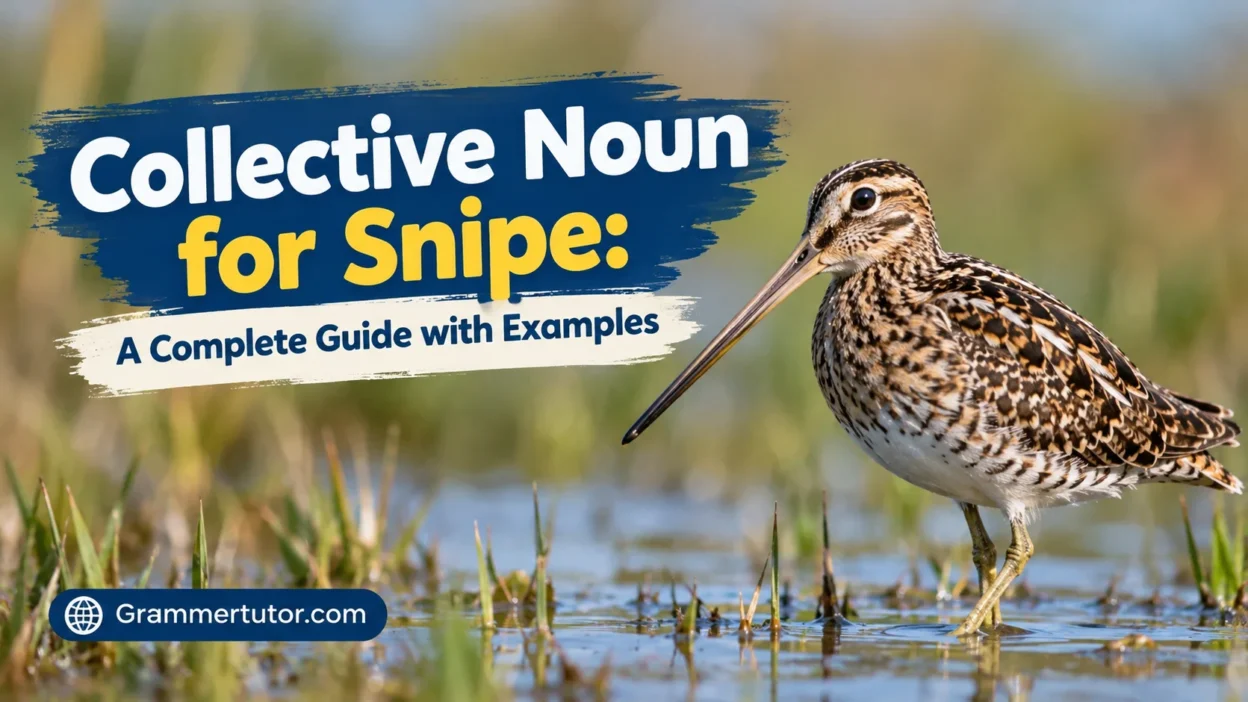
The collective noun for snipe is wisp, a traditional term used to describe a group of these interesting birds. For example, “A wisp of snipe flew across the wetland.” This phrase helps English learners understand how collective nouns describe animals as a group.
Snipe are wading birds with long bills, patterned feathers, and a natural ability to blend into marshes and wetlands. When several snipe gather together, the word wisp gives readers a simple way to picture their movement. Learning expressions such as a wisp of snipe, a flock of birds, a school of fish, and a herd of deer can improve English vocabulary and make writing more descriptive.
In everyday English, collective nouns make sentences clearer and more interesting. For instance, “A wisp of snipe rested near the marsh” describes the birds without listing each one separately. Exploring the collective noun for snipe also helps learners develop their grammar skills while discovering more about bird behavior and natural habitats.
Why Collective Nouns Are Used for Snipe
Snipe often inhabit wetlands, marshes, muddy fields, and other damp environments where they search for food. Their brown and patterned feathers help them blend into their surroundings, making them difficult to spot.
Collective nouns allow us to describe several snipe together without repeatedly using the word birds. The traditional expression a wisp of snipe is a distinctive example of how English uses special words for groups of animals.
When writing everyday English, a group of snipe or a flock of snipe can also communicate the meaning clearly. The best expression depends on whether you want a traditional collective noun or a simple, familiar phrase.
Collective Nouns for Snipe
The following table shows collective nouns and group expressions that can be used for snipe. Wisp is the distinctive traditional term, while flock and group are straightforward choices for general use. Traditional lists also record walks for snipe.
| Collective Noun | Used For | Simple Example |
| Wisp | A traditional name for a group of snipe | A wisp of snipe flew over the marsh. |
| Walk | A traditional collective noun for snipe | A walk of snipe moved across the wetland. |
| Flock | A group of birds | A flock of snipe rose into the air. |
| Group | A general gathering of snipe | A group of snipe searched for food. |
| Flight | Snipe seen flying together; a descriptive expression | A flight of snipe passed over the field. |
Wisp of Snipe
A wisp of snipe is the traditional collective noun most often associated with these birds. The word wisp can suggest something light, slender, or fleeting, making it a memorable term for a group of birds moving quickly through the air. It is an uncommon expression in everyday conversation but useful for learning traditional animal group names.
Examples of “Wisp of Snipe”
- A wisp of snipe flew over the marsh.
- We spotted a wisp of snipe near the wetland.
- A wisp of snipe rose suddenly from the grass.
- The wisp of snipe disappeared into the distance.
- A wisp of snipe moved across the muddy field.
- The birdwatcher photographed a wisp of snipe.
- A wisp of snipe landed beside the shallow pond.
- We watched a wisp of snipe flying above the reeds.
- A wisp of snipe searched for food in the marsh.
- The wisp of snipe flew away when we approached.
Walk of Snipe
A walk of snipe is another traditional collective noun recorded in lists of animal group names. It is less familiar than wisp, so readers may find it unusual in modern English. For clear everyday writing, a group of snipe or a flock of snipe is easier to understand.
Examples of “Walk of Snipe”
- A walk of snipe moved across the wetland.
- We noticed a walk of snipe near the reeds.
- A walk of snipe searched for food in the mud.
- The walk of snipe rested near the shallow water.
- A snipe walk of snipe appeared in the marsh.
- The photographer observed a walk of snipe from afar.
- A walk of snipe moved through the damp grass.
- We watched a walk of snipe near the pond.
- A walk of snipe scattered across the wet field.
- The walk of snipe disappeared behind the reeds.
Flock of Snipe
A flock of snipe is a clear and familiar expression for several snipe gathered together. Although wisp is the distinctive traditional collective noun, flock is widely understood because it is commonly used for groups of birds.
This expression works well in general writing, birdwatching descriptions, and educational articles.
Examples of “Flock of Snipe”
- A flock of snipe flew over the marsh.
- We saw a flock of snipe near the pond.
- A flock of snipe landed in the wet grass.
- The flock of snipe moved across the field.
- A flock of snipe rose into the sky.
- The birdwatcher spotted a flock of snipe.
- A flock of snipe searched for insects in the mud.
- The flock of snipe flew away at sunset.
- We watched a flock of snipe near the reeds.
- A flock of snipe gathered in the wetland.
Group of Snipe
A group of snipe is a simple, general expression for several snipe found together. Unlike wisp and walk, it does not depend on knowing a traditional collective noun. It is a useful choice for students, beginners, and anyone who wants to describe these birds clearly.
Examples of “Group of Snipe”
- A group of snipe gathered near the pond.
- We saw a group of snipe in the marsh.
- A group of snipe searched for food in the mud.
- The group of snipe flew over the wetland.
- A group of snipe rested among the reeds.
- The birdwatcher observed a group of snipe.
- A group of snipe landed in the grassy field.
- We photographed a group of snipe near the stream.
- The group of snipe moved toward the shallow water.
- A group of snipe disappeared into the tall grass.
Flight of Snipe
A flight of snipe is a descriptive expression for snipe seen flying together. It is easy to understand because flight can describe birds moving through the air. However, it is not as well established as the traditional term wisp specifically for snipe.
Examples of “Flight of Snipe”
- A flight of snipe passed over the marsh.
- We watched a flight of snipe cross the sky.
- A flight of snipe rose above the wetland.
- The flight of snipe moved toward the river.
- A flight of snipe appeared at sunrise.
- The photographer captured a flight of snipe in the distance.
- A flight of snipe flew over the grassy fields.
- We noticed a flight of snipe near the reeds.
- The flight of snipe disappeared beyond the hills.
- A flight of snipe crossed the marsh at dusk.
Types of Snipe and Their Characteristics
Snipe are wading birds belonging to the sandpiper family, Scolopacidae. Different species inhabit wetlands, marshes, damp grasslands, and muddy areas in various parts of the world. Common examples include the common snipe, Wilson’s snipe, and jack snipe. These birds are known for their long, slender bills, which help them probe soft soil for food.
Examples of Snipe Characteristics
- Snipe have long, slender bills.
- Many snipe live in wetlands and marshes.
- Their patterned feathers help them blend into their surroundings.
- Snipe use their bills to search for food in soft mud.
- Different snipe species live in different regions.
- Some snipe migrate between breeding and wintering grounds.
- Snipe can take off quickly when disturbed.
- Their long bills help them find small invertebrates.
- Snipe often forage in damp soil.
- Their natural camouflage can make them difficult to spot.
Interesting Facts About Snipe
Snipe are remarkable birds with several adaptations that help them survive in wetlands and other damp habitats. Their lifespan varies according to species, environmental conditions, food availability, and predation, so there is no single lifespan that applies to every snipe. One of their most distinctive physiological features is their long, sensitive bill, which allows them to probe soft ground for small invertebrates. Their eyes are positioned relatively high on their heads, helping them remain aware of their surroundings while feeding.
Their brown, black, and pale patterned feathers provide excellent camouflage among reeds, grasses, and muddy vegetation. Snipe primarily feed on small invertebrates, including worms, insect larvae, and other tiny soil-dwelling animals, although their exact diet varies with the species and habitat. Their feeding habits and preference for damp ground make wetlands particularly important to their survival. These birds can also perform quick, twisting flights when startled, which makes them challenging to observe in the wild. The traditional collective noun wisp of snipe adds an interesting linguistic detail to their natural history and gives English learners a memorable example of an unusual animal group name.
READ MORE: Collective Noun for Polecats: A Complete Guide With Examples
Conclusion
The collective noun for snipe is traditionally wisp, as in the phrase “a wisp of snipe.” Learning this expression helps improve English vocabulary and makes writing more descriptive. By exploring collective nouns for birds and other animals, English learners can strengthen their grammar skills while discovering interesting facts about wildlife and nature.
FAQs
Q1. What is the collective noun for snipe?
The traditional collective noun for snipe is a wisp of snipe. It is an unusual but memorable expression used to describe a group of these birds.
Q2. Can I use “flock of snipe”?
Yes. A flock of snipe is a clear and natural expression because flock is commonly used for groups of birds.
Q3. What is another collective noun for snipe?
Walk is another traditional collective noun recorded for snipe. However, wisp is the better-known traditional answer in many collective-noun lists.
Q4. What is the plural of snipe?
The plural is commonly snipe, although snipes is also used. For example, “We saw several snipe near the marsh.”
Q5. Why are snipe difficult to spot?
Snipe have patterned feathers that blend into muddy ground, reeds, and wet grass. Their camouflage helps them avoid predators and makes them difficult for birdwatchers to notice.