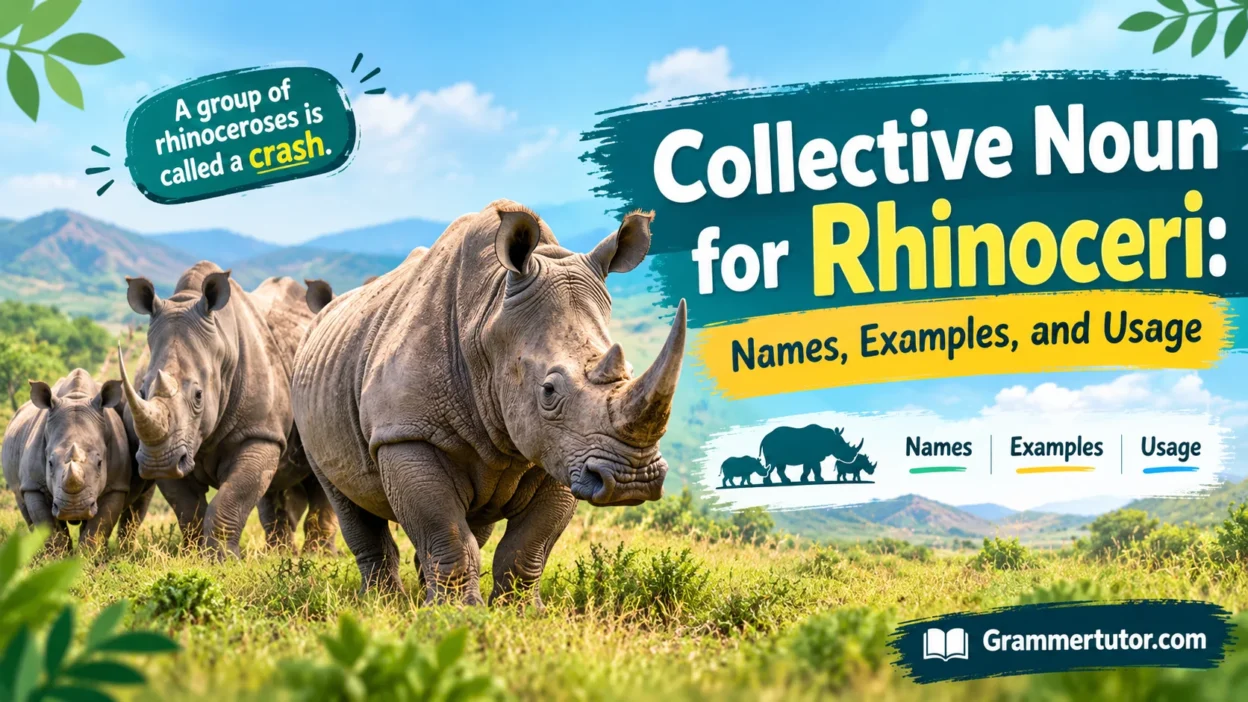
Collective noun for rhinoceri is a useful way to describe several rhinoceroses when they are seen together in wildlife writing. A collective noun is a term or expression that describes multiple animals as one group. In English, a crash of rhinoceroses is a traditional collective expression associated with these powerful mammals. The general expression a group of rhinoceroses is also clear and natural in educational writing, nature observations, and wildlife articles.
Rhinoceroses are large, strong mammals known for their thick skin, prominent horns, powerful bodies, and plant-based diets. They live in parts of Africa and Asia and are famous for their impressive size and unique physical features. Many adult rhinoceroses are solitary, meaning they usually spend much of their time alone. However, mothers and calves stay together, and some rhinos may gather temporarily near water or food. Learning how to describe these fascinating animals helps readers improve their English vocabulary and write more interesting wildlife descriptions.
Depending on the context, writers may use different expressions to describe rhinoceroses. Crash of rhinoceroses is a distinctive traditional term, while herd of rhinoceroses and group of rhinoceroses are understandable alternatives. Knowing these expressions helps readers choose natural wording without assuming that all rhinoceroses live in large social groups.
Why Do We Use Collective Nouns for Rhinoceri?
Collective nouns help us describe several animals without repeatedly using phrases such as “many rhinoceroses” or “several rhinoceroses.” Instead, we can use expressions such as a crash of rhinoceroses to make sentences more descriptive and interesting.
Rhinoceroses have different social habits depending on their species, age, and circumstances. Some may be seen feeding or resting near other rhinos, while others prefer to remain alone. For this reason, understanding collective nouns helps us describe their behavior while improving our knowledge of English.
Using the right expression also makes wildlife articles, school assignments, and educational writing easier to understand. Although crash is the traditional term often associated with rhinoceroses, a group of rhinoceroses remains a simple and reliable choice for everyday communication.
Collective Nouns for Rhinoceri
| Collective Noun | Used For | Simple Example |
| Crash | A group of rhinoceroses | A crash of rhinoceroses crossed the grassland. |
| Group | Several rhinoceroses together | A group of rhinoceroses rested near the trees. |
| Herd | Several rhinoceroses considered together | A herd of rhinoceroses grazed in the field. |
| Gathering | Rhinoceroses found together in one place | A gathering of rhinoceroses appeared near the waterhole. |
| Family group | Related rhinoceroses, such as a mother and calf | A family group of rhinoceroses stayed near the bushes. |
| Pair | Two rhinoceroses | A pair of rhinoceroses walked across the reserve. |
Note: Crash of rhinoceroses is the traditional collective expression commonly associated with these animals. Group is the clearest general term. Other expressions in the table describe particular situations and are not necessarily established special collective nouns.
Crash of Rhinoceroses
A crash of rhinoceroses is a traditional expression used to describe a group of rhinos. It is one of the most recognizable collective nouns associated with these large mammals. Using this phrase can make wildlife writing more engaging and help readers learn distinctive English animal vocabulary.
Rhinoceroses are powerful animals, but they do not always move together in large groups. Depending on the species and circumstances, they may gather temporarily or remain apart. The word crash is useful when discussing multiple rhinoceroses in a general or descriptive context.
Examples of “Crash of Rhinoceroses”
- A crash of rhinoceroses grazed peacefully in the grassland.
- We saw a crash of rhinoceroses during our wildlife tour.
- A crash of rhinoceroses gathered near a waterhole.
- The crash of rhinoceroses moved slowly across the reserve.
- A crash of rhinoceroses rested beneath the trees.
- The guide photographed a crash of rhinoceroses in the distance.
- A crash of rhinoceroses searched for fresh grass.
- The crash of rhinoceroses walked across the dusty plain.
- A crash of rhinoceroses attracted the attention of visitors.
- We watched a crash of rhinoceroses from a safe viewing area.
Group of Rhinoceroses
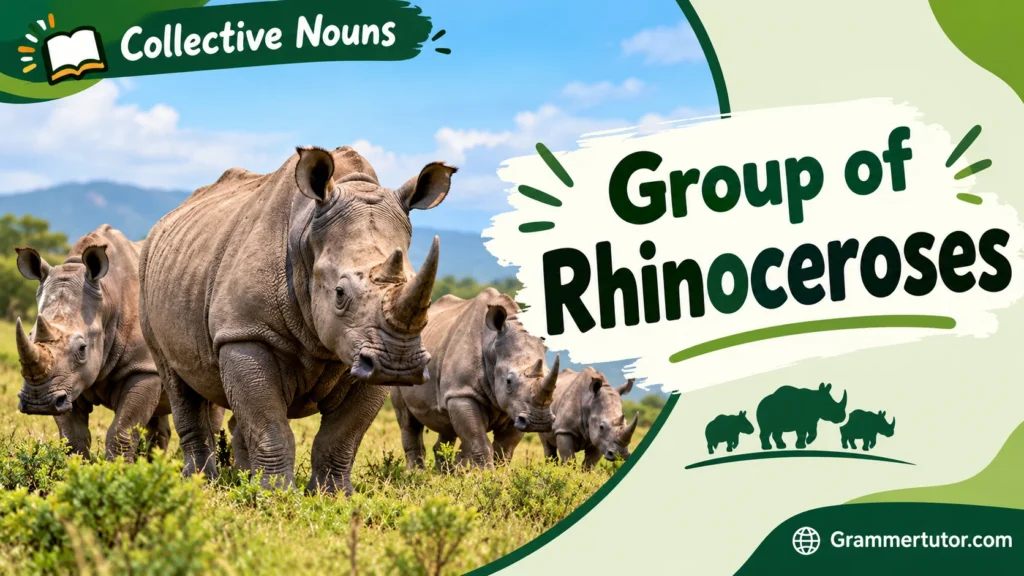
A group of rhinoceroses is the simplest expression when several rhinos are being described together. Unlike crash, the word group is a general collective term that can describe almost any collection of animals.
This phrase is especially useful for students, beginners, and writers who want to use clear English. It does not suggest that rhinoceroses have a particular social structure, so it works well when describing animals seen together in a wildlife reserve, grassland, or natural habitat.
Examples of “Group of Rhinoceroses”
- A group of rhinoceroses stood near the trees.
- We spotted a group of rhinoceroses during our safari.
- A group of rhinoceroses grazed beside the waterhole.
- The group of rhinoceroses moved toward the river.
- A group of rhinoceroses rested in the shade.
- The children learned about a group of rhinoceroses at the zoo.
- A group of rhinoceroses appeared in the wildlife documentary.
- The group of rhinoceroses walked across the reserve.
- Researchers observed a group of rhinoceroses in their natural habitat.
- A group of rhinoceroses searched for food in the grassland.
Herd of Rhinoceroses
A herd of rhinoceroses is another understandable expression for several rhinos together. The word herd is commonly used for mammals such as elephants, cattle, and buffalo. It can also be used descriptively for rhinoceroses, although many adult rhinos do not naturally live in large herds.
This expression can be useful when describing several rhinoceroses feeding or moving through the same area. However, when you want the simplest and most neutral wording, a group of rhinoceroses is often the better choice.
Examples of “Herd of Rhinoceroses”
- A herd of rhinoceroses grazed in the open field.
- The herd of rhinoceroses walked toward the water.
- We observed a herd of rhinoceroses during our safari.
- A herd of rhinoceroses rested beneath the trees.
- The herd of rhinoceroses searched for fresh plants.
- A herd of rhinoceroses moved through the wildlife park.
- The herd of rhinoceroses drank water at the pond.
- A herd of rhinoceroses crossed the grassland.
- The photographer captured a herd of rhinoceroses on camera.
- A herd of rhinoceroses remained near the feeding area.
Gathering of Rhinoceroses
A gathering of rhinoceroses is a descriptive expression for rhinos that come together in one place. The word gathering is not a specialized traditional collective noun for rhinoceroses, but it can describe a temporary meeting or concentration of these animals.
Rhinoceroses may be observed near water sources, feeding areas, or other suitable parts of their habitat. Their reasons for being together can vary, so this expression is useful when describing a particular observation without suggesting that the animals form a permanent group.
Examples of “Gathering of Rhinoceroses”
- A gathering of rhinoceroses appeared near the waterhole.
- We observed a gathering of rhinoceroses in the reserve.
- A gathering of rhinoceroses rested in the shade.
- The gathering of rhinoceroses attracted the attention of tourists.
- A gathering of rhinoceroses moved across the open land.
- Researchers photographed a gathering of rhinoceroses.
- A gathering of rhinoceroses was seen near the grassland.
- The gathering of rhinoceroses slowly moved away.
- We watched a gathering of rhinoceroses from a safe distance.
- A gathering of rhinoceroses appeared in the wildlife documentary.
Pair and Family Group of Rhinoceroses
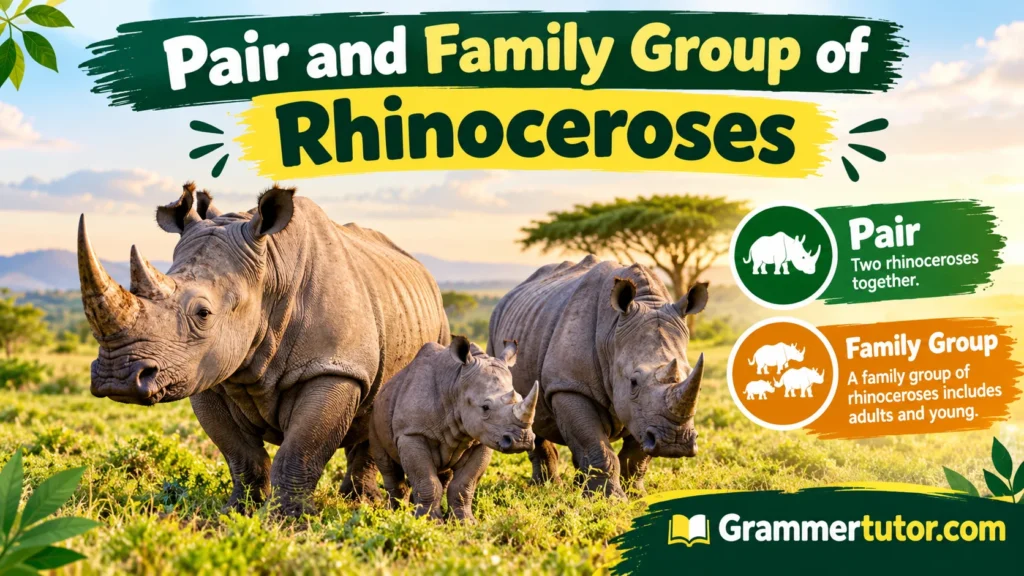
A pair of rhinoceroses describes two rhinos together, while a family group of rhinoceroses can describe related animals, especially a mother and her calf. These expressions are useful when the number or relationship of the animals is important.
Many rhinoceroses live mostly solitary lives, but mothers provide care and protection to their young. A mother and calf may travel together while the calf grows and learns to survive. Describing them as a pair or family group helps readers understand the situation more clearly.
Examples of “Pair of Rhinoceroses”
- A pair of rhinoceroses walked across the reserve.
- We saw a pair of rhinoceroses near the waterhole.
- A pair of rhinoceroses rested beneath a tree.
- The pair of rhinoceroses moved through the grassland.
- A pair of rhinoceroses appeared near the forest.
- The photographer captured a pair of rhinoceroses.
- A pair of rhinoceroses searched for food.
- We watched a pair of rhinoceroses from a safe distance.
- A pair of rhinoceroses crossed the dusty path.
- The pair of rhinoceroses disappeared behind the bushes.
Examples of “Family Group of Rhinoceroses”
- A family group of rhinoceroses stayed near the bushes.
- A mother rhinoceros and her calf walked together.
- The family group of rhinoceroses rested in the shade.
- A mother rhinoceros protected her young calf.
- We observed a family group of rhinoceroses in the reserve.
- The young calf followed its mother across the grassland.
- A family group of rhinoceroses moved toward the water.
- The mother rhinoceros guided her calf through the field.
- A family group of rhinoceroses appeared near the trees.
- The calf remained close to its mother in the wildlife park.
Group of Rhinoceroses in Their Natural Habitat
Rhinoceroses live in different habitats depending on their species. African rhinos are found in suitable grasslands, savannas, and shrublands, while Asian species inhabit environments that include tropical forests and grasslands. Access to food, water, shelter, and suitable territory is important for their survival.
Their thick skin, muscular bodies, and powerful legs help them move through challenging environments. Their horns are made mainly of keratin, the same protein found in human hair and fingernails. Rhinoceroses use their horns in defense and other interactions, although their behavior varies among species and individuals.
Examples of Rhinoceros Characteristics
- Rhinoceroses are large mammals.
- They have thick skin and powerful bodies.
- Their horns are made mainly of keratin.
- Rhinoceroses are herbivores.
- White rhinoceroses mainly graze on grass.
- Black rhinoceroses often browse on leaves and shoots.
- Rhinos have a strong sense of smell.
- Their eyesight is relatively poor.
- Many adult rhinoceroses prefer solitary lives.
- Mother rhinoceroses care for their calves.
Interesting Facts About Rhinoceroses
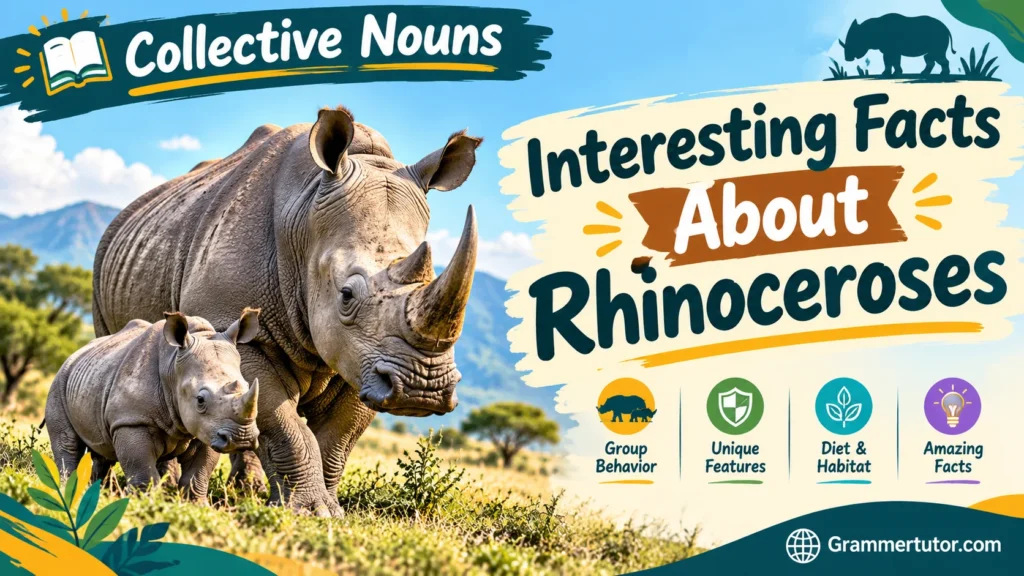
Rhinoceroses are fascinating mammals with unique physical features and survival habits. Depending on the species and living conditions, they can live for approximately 35–50 years, and some individuals may reach around 50 years. Their most recognizable feature is their horn, which is made mainly of keratin rather than bone. Their thick skin provides protection, while their powerful bodies and strong legs help them move through grasslands, shrublands, and other habitats. Rhinoceroses also have a well-developed sense of smell and hearing, although their eyesight is relatively poor. Their dietary habits depend on their species: white rhinoceroses mainly graze on grasses, while black rhinoceroses often feed on leaves, shoots, and branches. Asian rhinoceroses also consume different types of vegetation depending on their habitats. These herbivores play important roles in their ecosystems through their feeding habits and movement. Although people may imagine rhinos living in large herds, many adults are solitary, while mothers remain with their calves for an extended period. These behaviors make it important to distinguish between a traditional collective noun, such as crash, and a general description, such as group of rhinoceroses.
Conclusion
Collective noun for rhinoceri helps us describe these remarkable animals using clear and interesting English expressions. Crash of rhinoceroses is the traditional term commonly associated with them, while group of rhinoceroses is a simple and reliable alternative. Learning these expressions improves vocabulary and helps readers appreciate the unique physical features, feeding habits, and social behavior of rhinoceroses.
FAQs
Q1. What is the collective noun for rhinoceri?
The traditional collective noun is crash. The phrase a crash of rhinoceroses is commonly used to describe a group of rhinos.
Q2. What is a collective noun?
A collective noun is a word or phrase used to describe several people, animals, or objects as one group.
Q3. Can I say “a group of rhinoceroses”?
Yes. A group of rhinoceroses is a clear and natural expression for everyday English, educational writing, and wildlife descriptions.
Q4. Are rhinoceroses usually found in groups?
Many adult rhinoceroses are solitary animals. However, mothers and calves stay together, and some rhinos may gather temporarily in suitable areas.
Q5. Why is a group of rhinoceroses called a crash?
Crash is a traditional English collective expression associated with rhinoceroses. It is mainly used in animal vocabulary and descriptive writing.
Q6. What is the plural of rhinoceros?
The most common plural form is rhinoceroses. Rhinoceri is also sometimes used, but it is less common in everyday English.
Q7. What do rhinoceroses eat?
Rhinoceroses are herbivores. Depending on their species, they eat grasses, leaves, shoots, branches, and other plant material.
Q8. How long do rhinoceroses live?
Many rhinoceroses live for approximately 35–50 years, although their lifespan varies according to species, habitat, and individual circumstances.
Q9. What are the main physical features of rhinoceroses?
Rhinoceroses have thick skin, powerful bodies, strong legs, and one or two horns depending on the species. Their horns consist mainly of keratin.
Q10. Why is learning collective nouns for rhinoceroses useful?
Learning collective nouns improves English vocabulary, strengthens writing skills, and helps readers describe wildlife in a more engaging and accurate way.