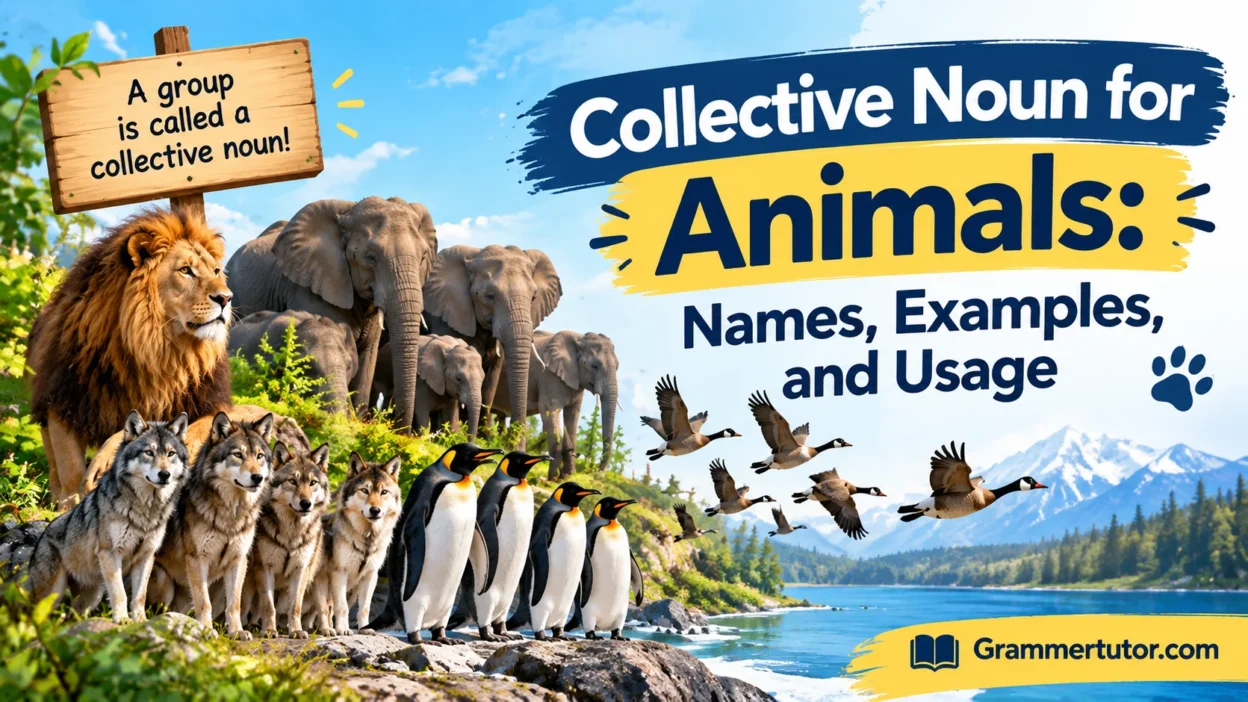
Collective noun for animals is a useful way to describe different animals when they are seen together in wildlife writing. A collective noun is a word or expression that describes multiple animals as one group. In English, expressions such as a herd of elephants, a pride of lions, and a flock of birds are commonly used in educational writing, nature observations, and wildlife articles. Learning these expressions helps readers understand how to describe animals clearly and naturally.
Animals have different social behaviors, physical features, and feeding habits. Some animals live in large groups for protection, while others gather to find food, travel, or raise their young. For example, elephants often travel in family herds, lions live in social groups called prides, and dolphins may swim together in pods. These group names make descriptions more interesting and help readers learn about the natural world.
Depending on the animal and the context, writers may use different collective nouns to describe a gathering. Some expressions are widely recognized, while others are traditional or less common. Learning the correct wording improves vocabulary, supports better English writing, and makes sentences easier to understand. When a specific collective noun is uncertain, a group of animals remains a clear and natural expression.
Why Do We Use Collective Nouns for Animals?
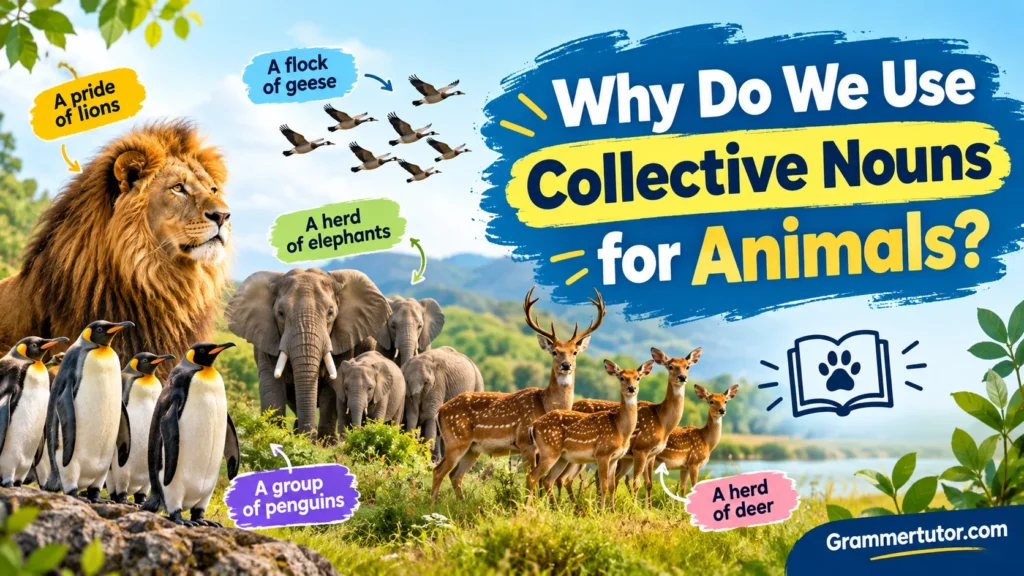
Collective nouns help speakers and writers describe several animals without repeating the names of individual animals. Instead of saying that many lions were resting together, we can say that a pride of lions was resting in the shade. This makes sentences shorter, clearer, and more engaging.
Animals gather for different reasons. Elephants may travel in family groups, wolves may cooperate while hunting, and birds may form flocks during migration. Understanding these behaviors helps readers connect animal group names with the ways animals live in nature.
The correct expression depends on the type of animal and the situation being described. A herd is commonly used for elephants and cattle, while a school is often used for fish swimming together. When no specialized term is familiar or appropriate, a group of animals is a simple and reliable choice.
Collective Nouns for Animals
| Collective Noun | Used For | Simple Example |
| Pride | Lions | A pride of lions rested nearby. |
| Herd | Elephants, cattle, and deer | A herd of elephants crossed the plain. |
| Pack | Wolves and dogs | A pack of wolves entered the forest. |
| Flock | Birds and sheep | A flock of birds flew away. |
| School | Fish swimming together | A school of fish swam past. |
| Pod | Dolphins and whales | A pod of dolphins approached the boat. |
| Troop | Monkeys and baboons | A troop of monkeys climbed the trees. |
| Swarm | Bees and other insects | A swarm of bees flew overhead. |
| Colony | Ants and penguins | A colony of ants built a nest. |
| Gaggle | Geese on the ground | A gaggle of geese crossed the field. |
| Murder | Crows | A murder of crows gathered in the trees. |
| Parliament | Owls | A parliament of owls appeared in the story. |
| Tower | Giraffes | A tower of giraffes stood near the trees. |
| Shiver | Sharks | A shiver of sharks moved through the water. |
| Army | Frogs | An army of frogs appeared near the pond. |
Note: Some terms, such as murder of crows, parliament of owls, and shiver of sharks, are traditional collective nouns. Their use varies by context, and a simple expression such as a group of animals is also correct.
Pride of Lions
A pride of lions is one of the best-known collective nouns for animals. Lions are social mammals that often live in groups consisting of related females, their cubs, and one or more adult males. Living together can help lions protect their young, defend their territory, and cooperate when hunting.
The word pride makes wildlife descriptions more specific and interesting. It is commonly used in nature documentaries, animal books, and educational articles about African wildlife.
Examples of “Pride of Lions”
- A pride of lions rested under a tree.
- We saw a pride of lions in the wildlife park.
- A pride of lions walked across the grassland.
- The pride of lions searched for food.
- A pride of lions protected its young cubs.
- The guide showed us a pride of lions.
- A pride of lions slept in the shade.
- The pride of lions moved through the tall grass.
- A pride of lions gathered near the waterhole.
- The young cubs played beside the pride of lions.
Herd of Elephants
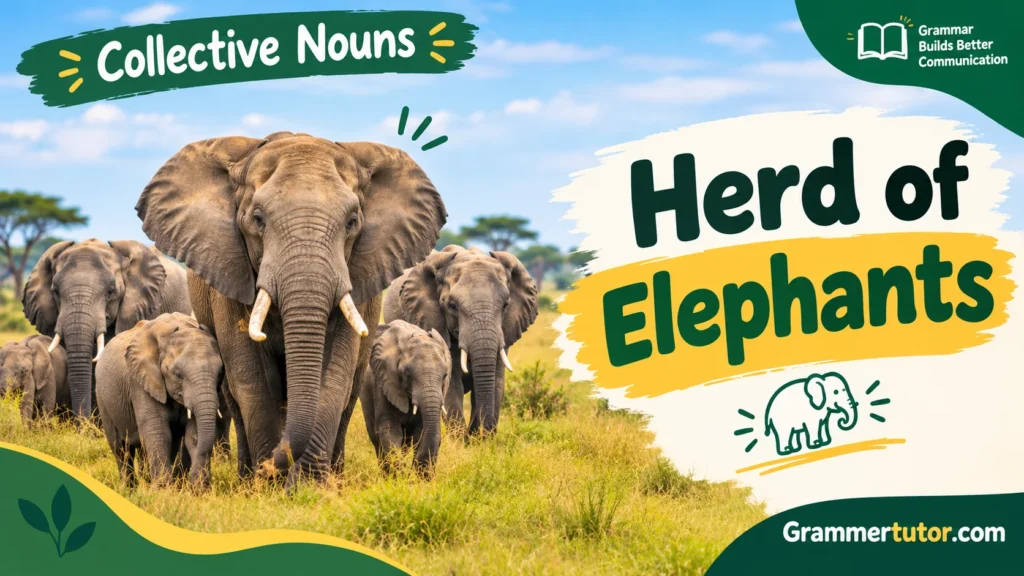
A herd of elephants is a common collective noun used to describe several elephants living or traveling together. Elephant herds often consist of related females and their young, and an experienced female known as a matriarch frequently leads the group.
Elephants use their trunks to smell, drink water, collect food, and communicate through touch. Their family groups help young elephants learn important behaviors and receive protection from other members.
Examples of “Herd of Elephants”
- A herd of elephants walked across the plain.
- We watched a herd of elephants near the river.
- The herd of elephants searched for fresh grass.
- A herd of elephants crossed the dusty road.
- The young elephants followed their herd.
- A herd of elephants rested under the trees.
- The herd of elephants moved toward a waterhole.
- A herd of elephants drank water together.
- The photographer captured a herd of elephants.
- A herd of elephants walked slowly through the forest.
Pack of Wolves
A pack of wolves is a widely used collective noun for wolves that live and travel together. Wolf packs often consist of a breeding pair and their offspring, although pack structures can vary depending on the species and environment.
Wolves use sounds, body movements, and scent marking to communicate. Cooperation within a pack can help members hunt, protect their territory, and care for young wolves.
Examples of “Pack of Wolves”
- A pack of wolves ran through the forest.
- The pack of wolves searched for food.
- We heard a pack of wolves howling at night.
- A pack of wolves crossed the snowy path.
- The pack of wolves stayed close together.
- A pack of wolves moved across the valley.
- The wolves returned to their den as a pack.
- A pack of wolves followed a scent.
- The pack of wolves protected its young.
- We watched a pack of wolves from a safe distance.
Flock of Birds
A flock of birds is a common collective noun used when several birds gather, feed, or fly together. Birds may form flocks to find food, travel between seasonal habitats, or reduce their individual risk from predators.
Some birds move in highly coordinated formations, while others gather loosely around feeding areas. The word flock is useful in everyday English because it can describe many different kinds of birds.
Examples of “Flock of Birds”
- A flock of birds flew over the garden.
- The flock of birds rested in a tree.
- We saw a flock of birds near the lake.
- A flock of birds crossed the blue sky.
- The flock of birds searched for seeds.
- A flock of birds landed on the roof.
- The children watched a flock of birds in the park.
- A flock of birds flew toward the forest.
- The flock of birds made beautiful sounds.
- A flock of birds gathered near the field.
School of Fish

A school of fish describes fish that swim together in a coordinated manner. Schooling can help fish respond quickly to danger, locate food, and move efficiently through the water. Some fish species spend much of their lives in groups, while others gather only under particular conditions.
The word school is commonly used in marine biology and everyday wildlife descriptions. Another word, shoal, can describe a group of fish gathered in the same area, whether or not they swim in a coordinated formation.
Examples of “School of Fish”
- A school of fish swam near the coral reef.
- The diver saw a school of fish underwater.
- A school of fish moved through the clear water.
- The school of fish changed direction quickly.
- We watched a school of fish in the aquarium.
- A school of fish searched for tiny organisms.
- The school of fish swam away from a shark.
- A school of fish gathered near the rocks.
- The school of fish moved through the ocean.
- The children learned about a school of fish.
Pod of Dolphins
A pod of dolphins is a common collective noun for dolphins that travel, communicate, or interact together. Dolphins are intelligent marine mammals known for their social relationships, playful behavior, and use of sounds to communicate.
Depending on the species and circumstances, dolphin groups can change in size and membership. Some dolphins cooperate when searching for fish, while others use coordinated movements to remain close to group members.
Examples of “Pod of Dolphins”
- A pod of dolphins swam beside the boat.
- We saw a pod of dolphins in the ocean.
- The pod of dolphins jumped above the water.
- A pod of dolphins searched for fish.
- The pod of dolphins moved along the coast.
- The children watched a pod of dolphins from the shore.
- A pod of dolphins followed the waves.
- The pod of dolphins made clicking sounds.
- A pod of dolphins swam through the blue sea.
- The researchers observed a pod of dolphins.
Troop of Monkeys

A troop of monkeys is a collective noun commonly used for certain groups of monkeys. Many monkey species live in social communities where individuals interact, search for food, groom one another, and help protect younger members.
The structure of a troop varies by species. Some groups contain several adult males and females, while others have different social arrangements. The word troop is particularly useful when describing monkeys moving or feeding together.
Examples of “Troop of Monkeys”
- A troop of monkeys climbed the trees.
- The troop of monkeys searched for fruit.
- We saw a troop of monkeys in the forest.
- A troop of monkeys played near the river.
- The troop of monkeys moved between branches.
- A troop of monkeys rested in the shade.
- The young monkeys followed their troop.
- A troop of monkeys gathered around a tree.
- The troop of monkeys looked for food.
- We watched a troop of monkeys from a distance.
Interesting Facts About Animals
Animals have remarkable biological features that help them survive in different environments. Their lifespans vary greatly: some small mammals live only a few years, while elephants can live for many decades. Their bodies are adapted to their lifestyles, from the powerful legs of lions to the strong digging claws of aardvarks and the streamlined bodies of dolphins. Many animals also have specialized senses that help them locate food, detect danger, and communicate with others.
Dietary habits are equally diverse. Lions are carnivores that mainly eat other animals, elephants are herbivores that consume grasses, leaves, bark, and other plant material, and bears are generally omnivores that eat both plant and animal foods. Dolphins mainly eat fish and squid, while many birds feed on seeds, insects, or nectar. These differences influence how animals search for food and whether they benefit from living in groups. Herds, packs, flocks, and schools can provide advantages such as protection, cooperation, and shared awareness of danger, although not all animals are social. Understanding these biological traits makes learning collective nouns for animals more meaningful and connects English vocabulary with real wildlife behavior.
Conclusion
The collective noun for animals helps us describe groups of wildlife in clear and interesting English. Expressions such as a pride of lions, a herd of elephants, a pack of wolves, and a flock of birds make writing more natural and informative. Learning these terms improves vocabulary, supports better communication, and helps us appreciate the social behavior, physical features, and dietary habits of animals.
FAQs
Q1. What is the collective noun for animals?
There is no single specialized collective noun for all animals. A group of animals is a general expression, while specific animals have familiar terms such as a herd of elephants and a pride of lions.
Q2. What is a collective noun?
A collective noun is a word or expression that refers to several people, animals, or objects considered together as a group.
Q3. What is the collective noun for lions?
The common collective noun for lions is a pride of lions. A pride often includes related females, their cubs, and one or more adult males.
Q4. What is the collective noun for elephants?
The collective noun for elephants is a herd of elephants. These herds commonly include related females and their young.
Q5. What is the collective noun for wolves?
The collective noun for wolves is a pack of wolves. Pack members may cooperate in hunting, defending territory, and caring for their young.
Q6. What is the collective noun for birds?
A flock of birds is the most common general expression. Some birds have traditional terms, such as a gaggle of geese and a murder of crows.
Q7. What is the collective noun for fish?
A school of fish is commonly used for fish swimming together in a coordinated group. A shoal of fish is another expression for fish gathered in the same area.
Q8. What is the collective noun for dolphins?
The collective noun for dolphins is a pod of dolphins. Dolphins often travel and interact in social groups.
Q9. Why are collective nouns important in English?
Collective nouns make sentences more concise and descriptive. They also help readers learn animal vocabulary and understand how animals gather and interact.
Q10. Do all animals have special collective nouns?
No. Some animals have widely recognized collective nouns, while others do not have a commonly established special term. In such cases, a group of animals is a clear and correct expression.