
When learning English, the collective noun for cricketers is useful for describing players who participate in the same cricket activity as one group. A team of cricketers is the most natural and common expression when players are playing together as an organized side.
Other expressions fit different situations. A squad of cricketers can describe a particular selection group, while a group of cricketers may refer to a training group or general gathering. The best choice depends on the situation and what the players are doing.
If you are studying English, improving vocabulary, or writing about cricket, these expressions help you describe cricket players accurately. In my experience, choosing the right collective expression becomes easier when you consider whether players are competing, training, traveling, or simply gathered together.
Why Collective Nouns Are Used for Cricketers
Cricket is a team sport in which players work together toward a shared goal. A cricket team normally includes several players who have different responsibilities, such as batting, bowling, wicketkeeping, and fielding.
Because many players can be considered as one organized unit, collective expressions make communication easier. Instead of naming every player individually, we can simply say a team of cricketers.
Other terms can be useful in different situations. For example, squad can refer to a selected group of players, while group is a general expression for several cricketers together.
These expressions make cricket-related writing clearer and help readers understand how the players are connected.
Collective Nouns for Cricketers
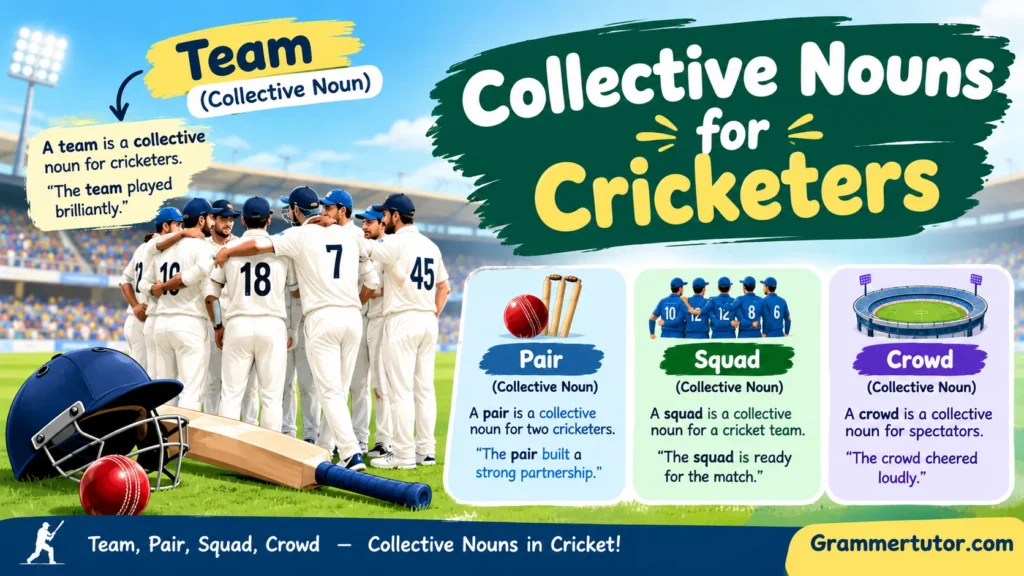
| Collective Noun | Used For | Simple Example |
| Team | Players competing together | A team of cricketers won the match. |
| Squad | Selected players | The squad of cricketers arrived early. |
| Group | Several cricketers together | A group of cricketers trained outside. |
| Side | Players representing one team | The side of cricketers played well. |
| Line-up | Players selected to play | The line-up of cricketers looked strong. |
Team of Cricketers
A team of cricketers is the most common and natural expression when several players are organized to compete against another team. The players usually have different roles but work together during the match.
This expression is appropriate for professional cricket, school cricket, club cricket, and informal matches. It clearly shows that the cricketers form one playing unit.
Examples of “Team of Cricketers”
- A team of cricketers arrived at the stadium early.
- The team of cricketers practiced before the match.
- A strong team of cricketers won the tournament.
- The team of cricketers celebrated their victory.
- We watched a team of cricketers warming up.
- A team of cricketers traveled to another city.
- The team of cricketers played confidently.
- A young team of cricketers impressed the crowd.
- The coach trained the team of cricketers every morning.
- The team of cricketers prepared carefully for the final.
Squad of Cricketers
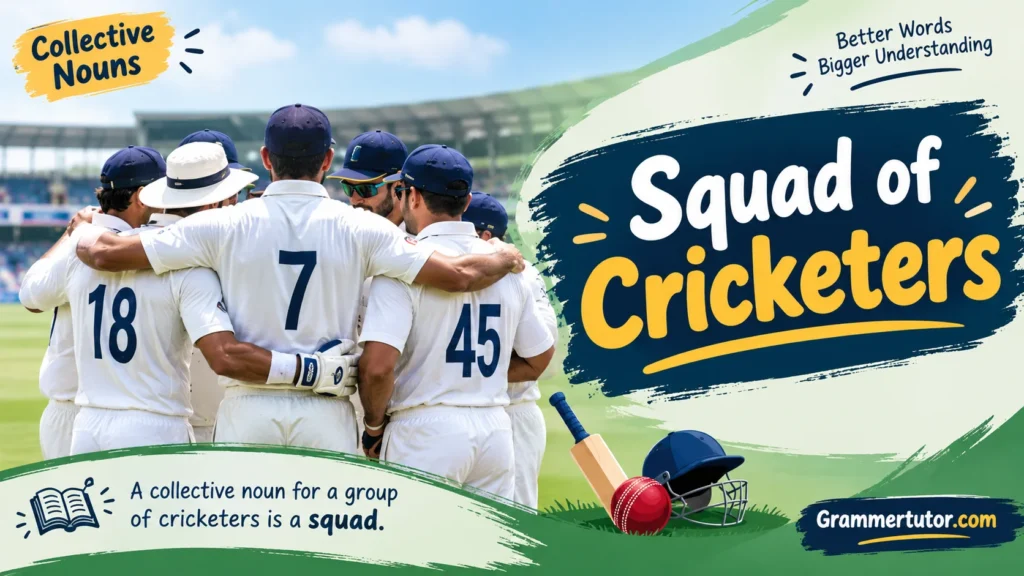
A squad of cricketers refers to a selected group of players who are available or chosen for a particular competition, tour, series, or event. A squad may contain more players than the number who actually play in one match.
The term is especially useful when discussing selection and preparation for cricket competitions.
Examples of “Squad of Cricketers”
- The squad of cricketers arrived for the tournament.
- A squad of cricketers trained together for several weeks.
- The coach announced the squad of cricketers.
- The squad of cricketers traveled overseas.
- A talented squad of cricketers prepared for the series.
- The squad of cricketers practiced at the national stadium.
- The captain welcomed the new squad of cricketers.
- The squad of cricketers included several young players.
- A large squad of cricketers attended the training camp.
- The squad of cricketers prepared for the upcoming matches.
Group of Cricketers
A group of cricketers is a broad and simple expression for several cricket players who are together. Unlike a team, it does not necessarily mean that the players are competing together.
You can use this expression when cricketers are attending a practice session, meeting, event, or social gathering.
Examples of “Group of Cricketers”
- A group of cricketers practiced on the field.
- We saw a group of cricketers near the stadium.
- A group of cricketers discussed the upcoming match.
- The group of cricketers arrived for training.
- A group of cricketers gathered outside the clubhouse.
- The coach spoke to a group of cricketers.
- A group of cricketers watched the match together.
- The group of cricketers walked toward the practice area.
- A group of cricketers participated in the event.
- We met a group of cricketers after the game.
Side of Cricketers
A side of cricketers is a traditional and useful cricket expression for players representing one team in a match. In sports writing, side can mean a team or playing unit.
It is particularly suitable when discussing the players who are competing against another side.
Examples of “Side of Cricketers”
- The cricketers played an excellent match.
- A strong side of cricketers entered the tournament.
- The side of cricketers defended its total successfully.
- We watched the side of cricketers take the field.
- The opposing side of cricketers bowled well.
- A young side of cricketers performed confidently.
- The cricketers celebrated after the victory.
- The coach selected a balanced side of cricketers.
- The side of cricketers prepared for the final.
- The visiting side of cricketers impressed the spectators.
Line-up of Cricketers
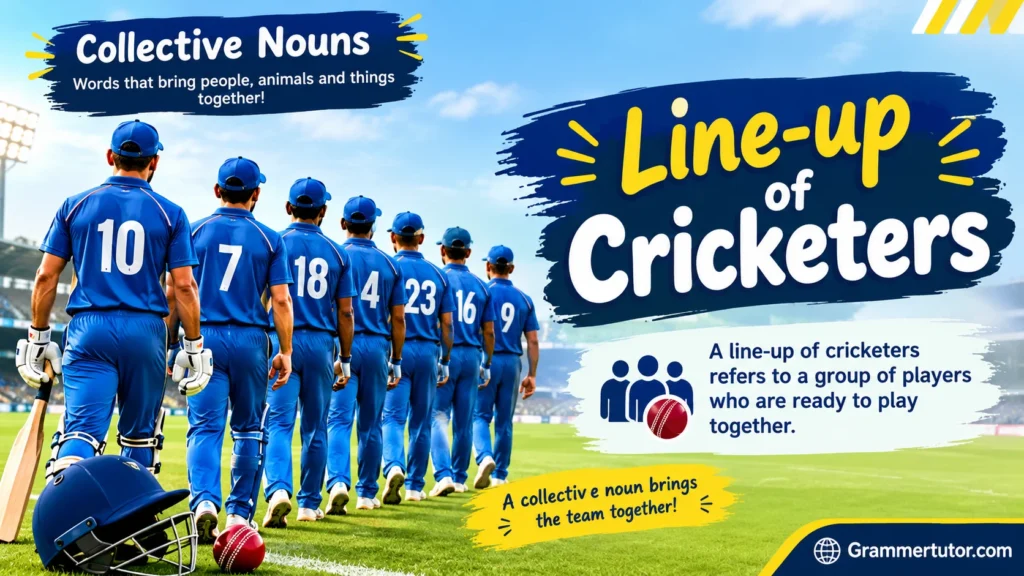
A line-up of cricketers can describe the players selected or arranged to participate in a match. It focuses more on the players chosen for the playing combination rather than simply describing a group.
This expression is useful when discussing team selection, batting order, or the players expected to appear in a match.
Examples of “Line-up of Cricketers”
- The line-up of cricketers looked strong before the match.
- The coach announced the line-up of cricketers.
- A balanced line-up of cricketers entered the field.
- The line-up of cricketers included several experienced players.
- The team changed its line-up of cricketers.
- The new line-up of cricketers performed well.
- We studied the line-up of cricketers before the game.
- The captain selected a powerful line-up of cricketers.
- The line-up of cricketers included talented young players.
- The final line-up of cricketers was announced in the morning.
Roles and Characteristics of Cricketers
Cricketers can have different responsibilities depending on their skills and the needs of their team. Batsmen or batters focus primarily on scoring runs, while bowlers attempt to dismiss opposing batters and restrict scoring.
A wicketkeeper stands behind the wickets and is responsible for collecting deliveries that pass the batter. Fielders support the team by stopping runs and attempting catches or run-outs.
Some players are known as all-rounders because they contribute significantly with both batting and bowling. This variety of roles makes cricket a sport that depends heavily on teamwork and individual skill.
Examples of Cricket Roles
- A batter attempts to score runs.
- A bowler delivers the ball to the batter.
- A wicketkeeper stands behind the wickets.
- A fielder attempts to stop the ball.
- An all-rounder contributes with bat and ball.
- A captain leads the team.
- A fast bowler uses speed to challenge batters.
- A spinner uses variations in spin.
- A batter can build a long innings.
- Fielders work together to take wickets.
Interesting Facts About Cricketers

Cricketers require a combination of physical fitness, technical ability, concentration, and teamwork. Professional players can spend many years developing their skills because cricket requires precise batting, bowling, fielding, and decision-making. A player’s career can vary considerably depending on fitness, performance, competition, and the level at which they play.
One interesting feature of cricket is the variety of physical skills required from players. Batters need hand-eye coordination and timing to control the ball, while bowlers require accuracy, strength, balance, and control. Fielders also need quick reactions because a catch or run-out can happen within a very short period.
Cricketers also have different dietary and training needs. Players generally benefit from balanced meals that provide carbohydrates for energy, protein for muscle recovery, healthy fats, vitamins, minerals, and sufficient fluids. Training routines can include running, strength exercises, agility drills, skill practice, and sport-specific conditioning.
Mental preparation is another important part of cricket. Players may need to remain focused for long periods, handle pressure, adapt to changing match conditions, and make quick decisions. This combination of physical and mental abilities helps explain why cricket is both an individual skill-based sport and a highly cooperative team game.
READ MORE: Collective Nouns for Piglets: A Complete Guide with Examples
Conclusion
The collective noun for cricketers depends on the situation. A team of cricketers is the most natural choice when players compete together as an organized side. Squad of cricketers works well for a selected group of players, while group of cricketers is a broader expression. Choosing the right term makes your English clearer and helps you describe cricket players naturally and accurately.
FAQs
Q1. What is the collective noun for cricketers?
The most common collective expression is team of cricketers. It describes cricketers playing together as one organized team.
Q2. What is a group of cricketers called?
A group of cricketers can be called a team of cricketers, squad of cricketers, or simply a group of cricketers, depending on the context.
Q3. Is “team of cricketers” a collective noun?
Yes. Team is a collective noun because it refers to several players as one organized group.
Q4. Is “squad of cricketers” correct?
Yes. Squad of cricketers is correct when referring to a selected group of players, particularly those chosen for a competition or series.
Q5. Can I say “group of cricketers”?
Yes. The group of cricketers is grammatically correct, but it is more general than the team of cricketers.
Q6. What is the best collective noun for cricket players?
A team is usually the best choice when the players are competing together as an organized side.
Q7. What collective noun is used for cricketers in a match?
Team of cricketers is the most natural expression when players are participating together in a match.
Q8. Can “squad” and “team” mean the same thing in cricket?
Not always. A squad can include all selected players, while a team usually refers to the players representing the side in a particular match.
Q9. Is “a team of cricketers” grammatically correct?
Yes. A team of cricketers is a natural and grammatically correct phrase in English.
Q10. Why is “team” commonly used for cricketers?
Team is commonly used because cricket players compete together toward the same goal and represent one organized side.