
The collective noun for herons is a useful English vocabulary term for describing these elegant water birds when they gather together in groups. A traditional name for them is a siege of herons, which refers to a group of these birds. The word siege is a distinctive traditional term, so it is worth remembering when learning interesting group names.
In everyday English, you may also see groups of herons, flock of herons, or colonies of herons. The best expression can depend on the situation and the way the birds are seen. They may be together, flying, nesting, or gathered in a particular habitat. From an English-learning perspective, connecting these terms with real wildlife descriptions makes the vocabulary easier to understand and use.
Learning these expressions can make descriptions more interesting while improving your English vocabulary. Herons are elegant water birds, and knowing how to describe their group, individuals, and habitat adds variety to nature writing. When you need the most distinctive traditional term, siege of herons is the expression worth remembering.
Why Are Collective Nouns Used for Herons?
Herons often gather around wetlands, rivers, lakes, ponds, marshes, and coastal areas where they can find food. Several herons may be seen together while feeding, resting, nesting, or moving between different areas.
A collective noun gives us a convenient way to describe these birds without repeatedly saying “a group of herons.” Traditional animal group names also add an interesting historical element to English vocabulary.
The phrase a siege of herons is particularly memorable because it is an unusual expression. In general writing, however, a group of herons is also perfectly clear when you simply want to describe several birds together.
Collective Nouns for Herons
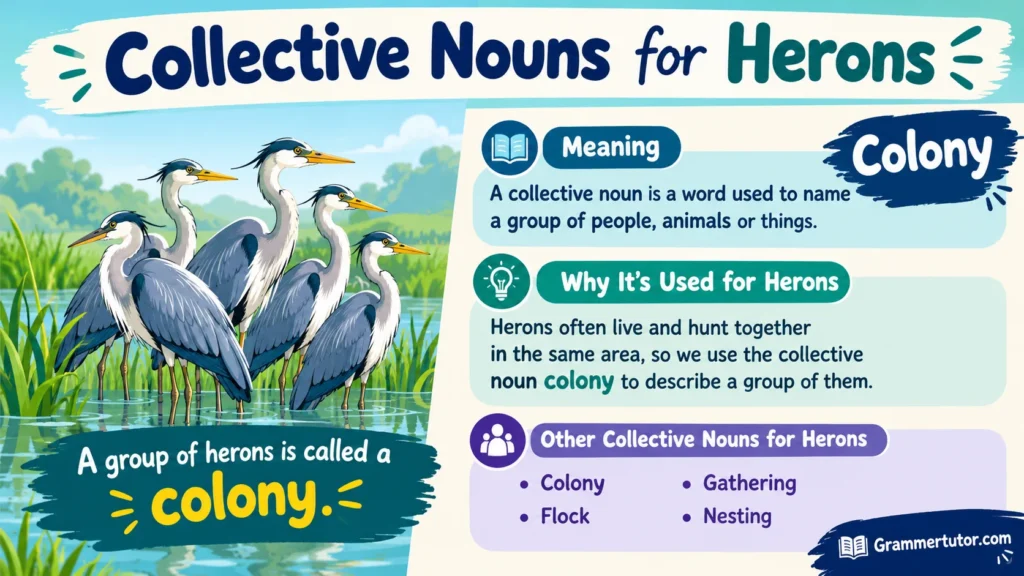
| Collective Noun | Used For | Simple Example |
| Siege | A traditional group name for herons | A siege of herons stood near the water. |
| Group | A general gathering of herons | A group of herons fed by the river. |
| Flock | Herons gathered or flying together | A flock of herons crossed the wetland. |
| Colony | Herons nesting together | A colony of herons built nests in the trees. |
Siege of Herons
A siege of herons is the traditional collective noun most closely associated with herons. It is an unusual and memorable term that can make wildlife writing more colorful.
The word siege is not a term that most people would immediately expect to describe birds, which makes this collective noun especially interesting for English learners. It can be used when referring to a group of herons gathered together.
Examples of “Siege of Herons”
- A siege of herons stood beside the river.
- We watched a siege of herons near the wetland.
- A siege of herons gathered around the shallow pond.
- The photographer spotted a siege of herons at sunrise.
- A siege of herons rested near the reeds.
- We saw a siege of herons feeding in the marsh.
- A siege of herons moved along the edge of the lake.
- The siege of herons remained still near the water.
- A siege of herons appeared in the wetland during the morning.
- The children watched a siege of herons from a safe distance.
Group of Herons
A group of herons is a simple and completely understandable way to describe several herons together. Unlike the traditional term siege, the word group does not have a specialized or historical association with herons.
This expression is useful when you want your writing to be straightforward and easy for everyone to understand.
Examples of “Group of Herons”
- A group of herons stood near the river.
- We saw a group of herons in the marsh.
- A group of herons gathered beside the pond.
- The group of herons was searching for food.
- A group of herons flew across the wetland.
- We photographed a group of herons near the lake.
- The group of herons rested among the reeds.
- A group of herons moved along the shoreline.
- The group of herons disappeared behind the trees.
- We watched a group of herons feeding in the shallow water.
Flock of Herons

A flock of herons is a general expression that can describe several birds together, particularly when they are moving or flying in the same area. Although siege is the traditional collective noun associated with herons, flock is easy to understand in a general bird-related context.
Using flock can be useful when the main focus is on the birds’ movement rather than their specific nesting or feeding location.
Examples of “Flock of Herons”
- A flock of herons flew over the lake.
- We watched a flock of herons cross the wetland.
- A flock of herons landed near the river.
- The flock of herons moved toward the marsh.
- A flock of herons flew across the evening sky.
- The photographer captured a flock of herons in flight.
- A flock of herons rested near the shoreline.
- We saw a flock of herons above the trees.
- The flock of herons disappeared beyond the lake.
- A flock of herons returned to the wetland.
Colony of Herons
A colony of herons refers to herons nesting or living together in a particular area. Herons can form nesting colonies where many birds build their nests close to one another.
The word colony is especially useful when the focus is on breeding or nesting behavior rather than simply seeing several herons together.
Examples of “Colony of Herons”
- A colony of herons nested in the tall trees.
- We discovered a colony of herons near the wetland.
- The colony of herons built nests above the water.
- A large colony of herons lived near the lake.
- Researchers studied a colony of herons during nesting season.
- The colony of herons returned to the same area.
- A colony of herons gathered in the forest near the river.
- We observed a colony of herons from a distance.
- The colony of herons became active in the morning.
- A protected wetland provided shelter for a colony of herons.
Types of Herons and Their Characteristics
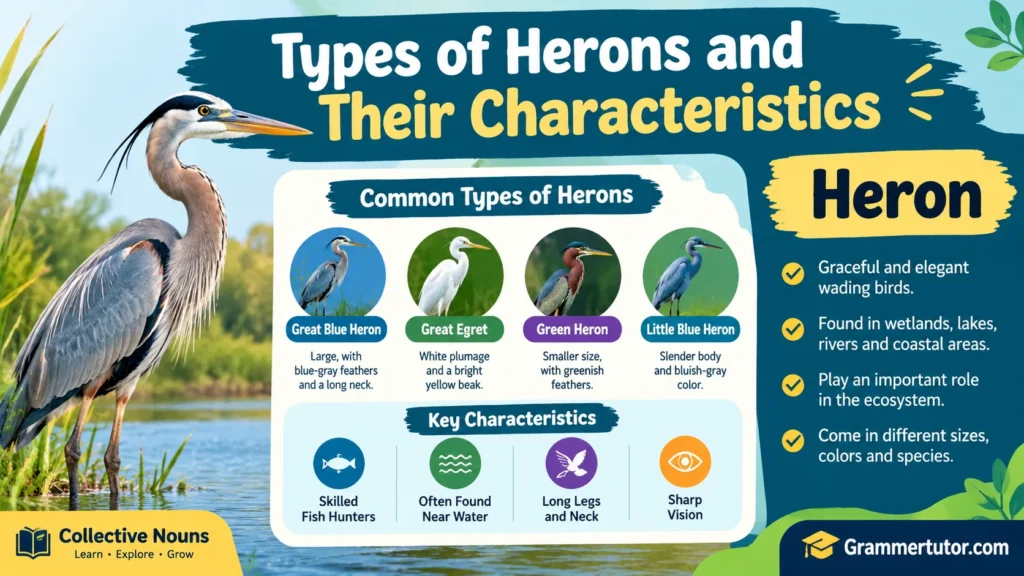
Herons belong to a group of long-legged birds commonly associated with wetlands and waterways. They have long necks, pointed bills, and elongated legs that help them move through shallow water while searching for prey.
Different types of herons vary in size, color, habitat, and behavior. Some are commonly found beside freshwater ponds and rivers, while others may inhabit coastal wetlands and marshes.
Herons are well adapted for hunting. They often stand very still before quickly extending their necks and bills to catch fish or other small animals.
Examples of Heron Characteristics
- Herons have long legs.
- Herons have long, pointed bills.
- Many herons live near water.
- Herons can hunt in shallow wetlands.
- Many herons eat fish.
- Herons may also eat frogs and insects.
- Some herons nest in colonies.
- Herons can remain still while hunting.
- Their long legs help them walk through shallow water.
- Different heron species vary in size and appearance.
Interesting Facts About Herons
Herons are remarkable birds with physical features that are closely connected to their lifestyle. Their lifespan can vary depending on the species, habitat, predators, disease, and environmental conditions. With suitable conditions, some herons can survive for many years in the wild.
One of the most noticeable physiological features of a heron is its long neck and long legs. These features allow the bird to wade through shallow water while keeping much of its body above the surface. Herons also have long, pointed bills that work effectively as hunting tools. They can remain almost motionless while watching their prey and then make a rapid movement to capture it.
Herons are primarily carnivorous birds. Their diet commonly includes fish, frogs, insects, crustaceans, and other small aquatic animals. Their exact food choices depend on the species and the habitat available to them. By hunting around ponds, rivers, marshes, and other wetlands, herons occupy an important position in aquatic food chains.
Another interesting feature of heron behavior is their nesting habits. Some heron species gather in breeding colonies where many birds build nests relatively close together. These nesting areas can contain numerous birds and may become active during the breeding season.
Herons are therefore closely connected with healthy wetland environments. Their presence around rivers, lakes, marshes, and ponds makes them a familiar and fascinating part of many ecosystems.
READ MORE: Collective Noun for Group of Angelfish: A Complete Guide with Examples
Conclusion
The collective noun for herons is a siege of herons, a distinctive traditional expression used for a group of these elegant birds. You may also use common terms such as group of herons, flock of herons, or colony of herons, depending on the context. Learning these expressions can make your English vocabulary richer and your wildlife descriptions more interesting.
FAQs
Q1. What is the collective noun for herons?
The traditional collective noun for herons is a siege of herons.
Q2. What does “a siege of herons” mean?
A siege of herons means a group of herons. It is a traditional collective expression.
Q3. Can I say “a group of herons”?
Yes. A group of herons is a simple and clear expression that works well in everyday English.
Q4. Can “flock” be used for herons?
Yes. A flock of herons can be used to describe several herons together, especially when discussing birds in general.
Q5. Can I use “colony of herons”?
Yes. A colony of herons can describe herons living or nesting together in a particular place.
Q6. Is “siege” the most traditional term for herons?
Yes. A siege of herons is the distinctive traditional term commonly associated with a group of herons.
Q7. When might herons gather together?
Herons may gather while nesting, feeding, resting, or staying in a suitable habitat.
Q8. What is the plural of heron?
The plural of heron is herons.
Q9. Why should I learn collective nouns for birds?
Collective nouns add variety to your English vocabulary and help you create more precise and interesting descriptions of wildlife.
Q10. What collective noun should I remember for herons?
The main traditional expression to remember is a siege of herons. It is the most distinctive term for this group of birds.