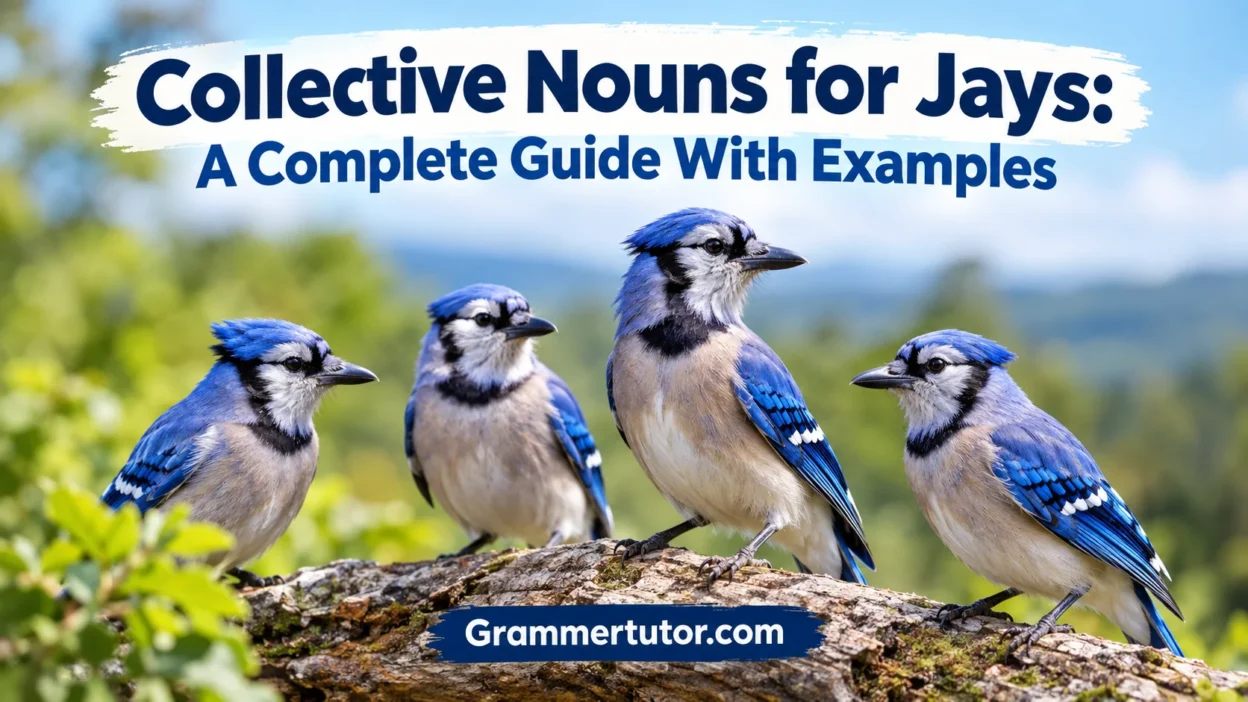
When learning the collective noun for jays, you may notice how these colorful, intelligent birds use loud calls and active behavior while living in different environments.Jays have a remarkable ability to adapt, and when several jays appear together, English provides different words to describe their group.
A collective noun is a word for a group of the same kind of animals or birds. These terms can make descriptions more vivid and help readers understand what the birds are doing. Common examples for jays include band, party, scold, and cast, although their use can change in different contexts.
Some of these are common, descriptive expressions, while others are traditional or literary terms. Learning these names can make writing more interesting because you can avoid repeatedly saying groups of jays. Instead, you can choose a term that fits the birds’ behavior and the situation. From my experience, selecting a precise collective expression makes descriptions feel more natural while still keeping the meaning clear.
Why Are Collective Nouns Used for Jays?

Collective nouns give us a simple way to describe several jays as one group. They can also highlight the birds’ social behavior, movement, or noisy communication. Jays are often active and vocal, so descriptive group names can add personality to a sentence.
For example, saying “a party of jays gathered near the trees” creates a livelier picture than simply saying “some jays gathered near the trees.”
These expressions are especially useful in nature writing, stories, educational material, and birdwatching descriptions. The exact term can depend on context, region, and whether the expression is being used in a traditional or creative way.
Collective Nouns for Jays
Here are some collective nouns that can be associated with jays:
| Collective Noun | Used For | Simple Example |
| Band | A group of jays moving or feeding together | A band of jays searched the woodland floor. |
| Party | A lively group of jays | A party of jays flew between the branches. |
| Scold | A noisy group of jays | A scold of jays filled the forest with calls. |
| Cast | A group of jays, especially in descriptive or literary use | A cast of jays appeared around the clearing. |
| Flock | A general term for several jays together | A flock of jays crossed the field. |
| Group | A straightforward general expression | A group of jays rested in the trees. |
| Gathering | Several jays assembled in one place | A gathering of jays formed near the woodland edge. |
The word flock is the most straightforward general expression when you simply want to describe several jays together. Some of the other terms are more colorful and may appear more often in traditional, literary, or descriptive writing.
Band of Jays

A band of jays can describe a group of these birds moving, feeding, or traveling together. The word “band” gives the impression of several birds acting as a loose group rather than remaining completely separate.
Jays often move through woodland areas while searching for food. A band of jays may make repeated calls as they travel between trees.
Examples of “Band of Jays”
- A band of jays moved through the woodland.
- We watched a band of jays feeding beneath the oak trees.
- A noisy band of jays landed near the garden.
- The band of jays flew from tree to tree.
- A band of jays searched the ground for seeds.
- The children spotted a band of jays near the forest path.
- A band of jays gathered around the old oak.
- The band of jays disappeared into the thick branches.
- We heard a band of jays calling from the woods.
- A band of jays crossed the clearing together.
Party of Jays
A party of jays is a lively and descriptive expression for several jays together. The word “party” fits these birds particularly well in informal or creative writing because jays can be energetic and vocal.
This expression can make a nature description sound more colorful. It works well when the birds are moving, calling, or gathering in one area.
Examples of “Party of Jays”
- A party of jays flew over the garden.
- We saw a party of jays in the tall trees.
- A party of jays gathered beside the woodland path.
- The party of jays made loud calls.
- A party of jays moved between the branches.
- The children watched a party of jays near the fence.
- A party of jays landed on the oak tree.
- The party of jays suddenly flew away.
- A party of jays searched for food beneath the leaves.
- We heard a party of jays before we saw them.
Scold of Jays
A scold of jays is a colorful collective expression connected with the birds’ loud and sometimes harsh calls. Jays are well known for their vocal communication, and their calls can attract attention when several birds are together.
The term “scold” creates the image of a noisy group calling repeatedly. It is particularly suitable for descriptive or literary writing when the birds are making a lot of noise.
Examples of “Scold of Jays”
- A scold of jays broke the quiet of the morning.
- We heard a scolding of jays from the nearby trees.
- A scold of jays called loudly above us.
- The scold of jays moved deeper into the forest.
- A noisy scold of jays gathered near the branches.
- The hikers stopped when they heard a scolding of jays.
- A scold of jays filled the woodland with calls.
- The scolding of the jays suddenly became quiet.
- We followed the sound of a scolding of jays.
- A scold of jays flew across the clearing.
Cast of Jays
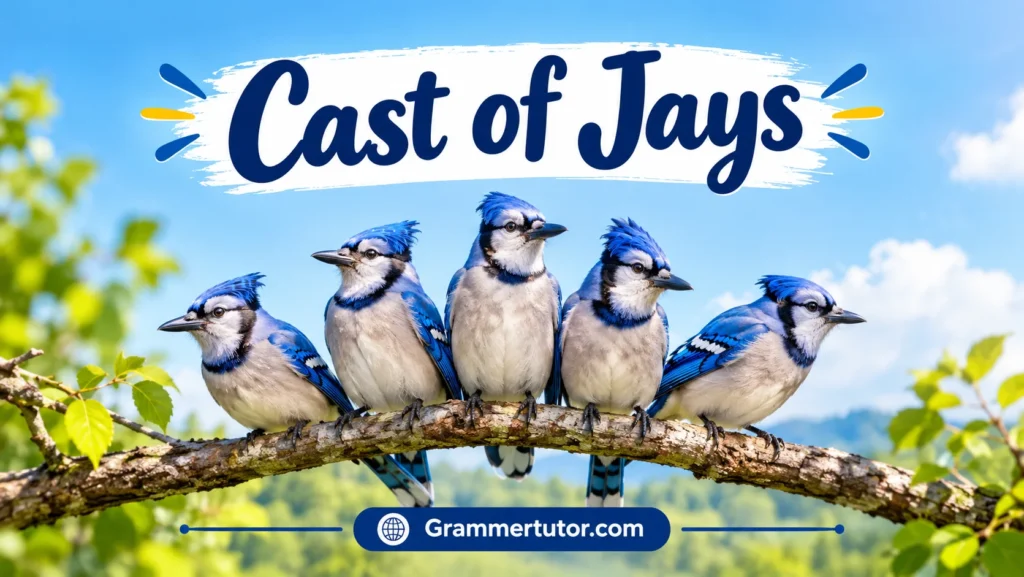
A cast of jays is a less common and more literary-sounding expression. It can be used creatively when describing several jays appearing together in a scene.
Because “cast” is not the everyday word most people use for a group of jays, it works best in imaginative nature writing rather than ordinary conversation.
Examples of “Cast of Jays”
- A cast of jays appeared among the pine trees.
- We watched a cast of jays gather near the clearing.
- A cast of jays flew across the woodland.
- The cast of jays settled on the branches.
- A cast of jays searched the forest floor.
- The photographer captured a cast of jays in the morning light.
- A cast of jays moved noisily through the trees.
- The cast of jays vanished beyond the hill.
- A cast of jays gathered around an old oak.
- We spotted a cast of jays near the edge of the forest.
Flock of Jays
Flock is a familiar general collective noun for birds, and it can be used for jays when several are together. It doesn’t describe a special jay behavior, but it is easy for readers to understand.
If you’re writing a simple sentence and don’t want to use a specialized or traditional expression, flock of jays is a natural choice.
Examples of “Flock of Jays”
- A flock of jays flew over the trees.
- We saw a flock of jays near the garden.
- A flock of jays gathered on the branches.
- The flock of jays searched for food.
- A flock of jays crossed the open field.
- The birdwatcher photographed a flock of jays.
- A flock of jays rested in the oak tree.
- The flock of jays moved toward the forest.
- We heard a flock of jays calling nearby.
- A flock of jays flew away at sunset.
Group of Jays
A group of jays is the simplest and most neutral expression. Unlike colorful collective nouns, “group” doesn’t suggest a particular behavior.
This makes it useful when you simply want to state that several jays are together. It is also easy for young readers and English learners to understand.
Examples of “Group of Jays”
- A group of jays gathered in the garden.
- We noticed a group of jays near the trees.
- A group of jays flew across the field.
- The group of jays searched for seeds.
- A group of jays rested on the branches.
- The children watched a group of jays.
- A group of jays moved through the woodland.
- The group of jays made several loud calls.
- We photographed a group of jays near the trail.
- A group of jays disappeared into the forest.
Gathering of Jays
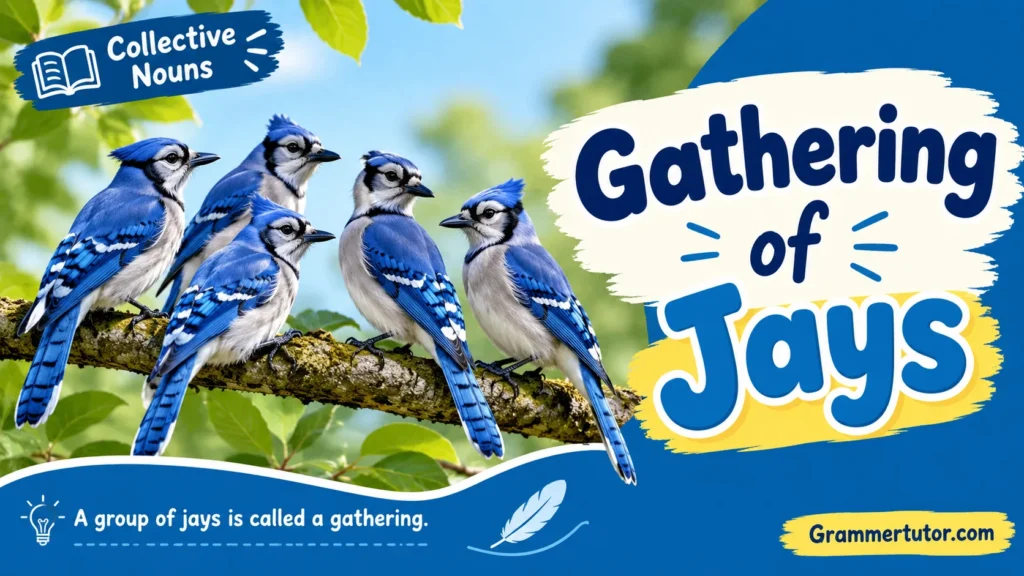
A gathering of jays is another descriptive expression that emphasizes the birds coming together in one location. It doesn’t necessarily describe a fixed or permanent group.
You might use it when several jays arrive at a feeding area, tree, garden, or other place at the same time.
Examples of “Gathering of Jays”
- A gathering of jays appeared near the feeder.
- We watched a gathering of jays in the garden.
- A gathering of jays formed beneath the trees.
- The gathering of jays became increasingly noisy.
- A gathering of jays arrived early in the morning.
- We noticed a gathering of jays near the woodland edge.
- A gathering of jays moved between the branches.
- The gathering of jays suddenly scattered.
- A gathering of jays searched for food.
- The photographer waited for a gathering of jays to settle.
How Do Jays Behave in Groups?
Jays are highly active birds, and their group behavior can be easy to notice. They communicate through a variety of calls, including loud calls that can carry through forests and gardens.
When several jays are together, they may search for food, move between trees, watch for danger, or respond to the calls of other birds. Their social interactions can be noisy and energetic, which explains why descriptive expressions such as scold of jays can feel appropriate in nature writing.
Jays are also known for their intelligence and adaptability. Depending on the species and environment, they may eat seeds, nuts, fruits, insects, and other available foods. Their ability to find and store food helps them survive in changing environments.
Interesting Facts About Jays
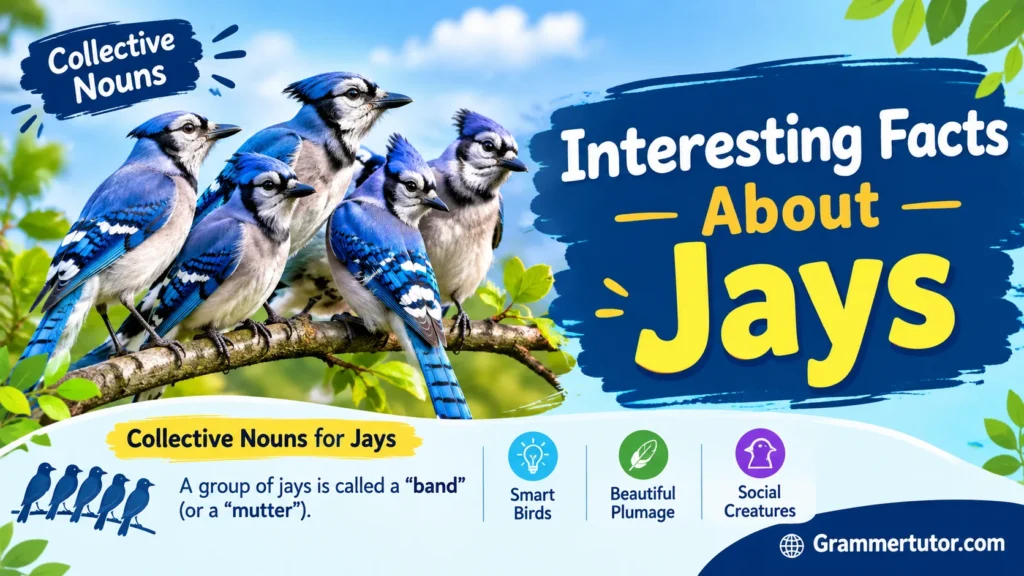
Jays belong to the crow family, Corvidae, which includes other intelligent birds such as crows, ravens, and magpies. Many jay species have strong memories and impressive problem-solving abilities.
Their diet can be varied. Jays may eat acorns, seeds, berries, fruits, insects, and other small food items. Some species are particularly important in moving and storing seeds, which can contribute to the spread of trees and plants.
Jays are also recognized for their striking appearance. Depending on the species, they may have blue, gray, brown, black, or white feathers. Their bright coloring and distinctive markings make them popular birds among birdwatchers.
Another interesting feature is their vocal ability. Jays can produce several different sounds and may use calls to communicate with other birds. Some species can also imitate sounds they hear in their surroundings.
Their intelligence makes jays fascinating subjects for bird research. They can remember locations where food has been hidden and adjust their behavior according to their surroundings.
READ MORE: Collective Noun for Buzzards: A Complete Guide with Examples
Conclusion
The collective noun for jays can vary depending on the context and the type of description you want to create. Terms such as band, party, scold, and cast can describe a group of jays. Choosing the right term can make your writing more vivid, natural, and interesting.
FAQs
Q1. What is a collective noun for jays?
A collective noun for jays is a word or expression used to describe a group of jays, such as band, party, scold, or cast.
Q2. What is the most common collective noun for jays?
There is no single collective noun that must always be used. Band, party, scold, and cast can appear in different contexts.
Q3. Can I say “a group of jays”?
Yes. A group of jays is clear, natural, and completely understandable in everyday English.
Q4. What does “a band of jays” mean?
A band of jays refers to several jays considered together as a group. It can be useful in descriptive writing.
Q5. What does “a party of jays” mean?
A party of jays is a traditional collective expression that presents several jays as a lively gathering.
Q6. What does “a scold of jays” mean?
A scold of jays is a traditional expression associated with the birds’ loud calls and noisy behavior.
Q7. What does “a cast of jays” mean?
A cast of jays is another traditional collective expression used for a group of jays, particularly in literary or descriptive contexts.
Q8. Why are jays given different collective nouns?
Different collective nouns developed through language traditions and can emphasize different aspects of the birds, including their behavior, appearance, or group activity.
Q9. Should I use collective nouns in formal writing?
You can use them when they fit the context. In formal writing, a group of jays may be the clearest choice, while traditional terms can add variety to descriptive or literary writing.
Q10. Which collective noun should I use for jays?
Choose the expression that best fits your context. If clarity is most important, a group of jays is a simple and reliable choice; traditional terms can be used when a more descriptive style is appropriate.