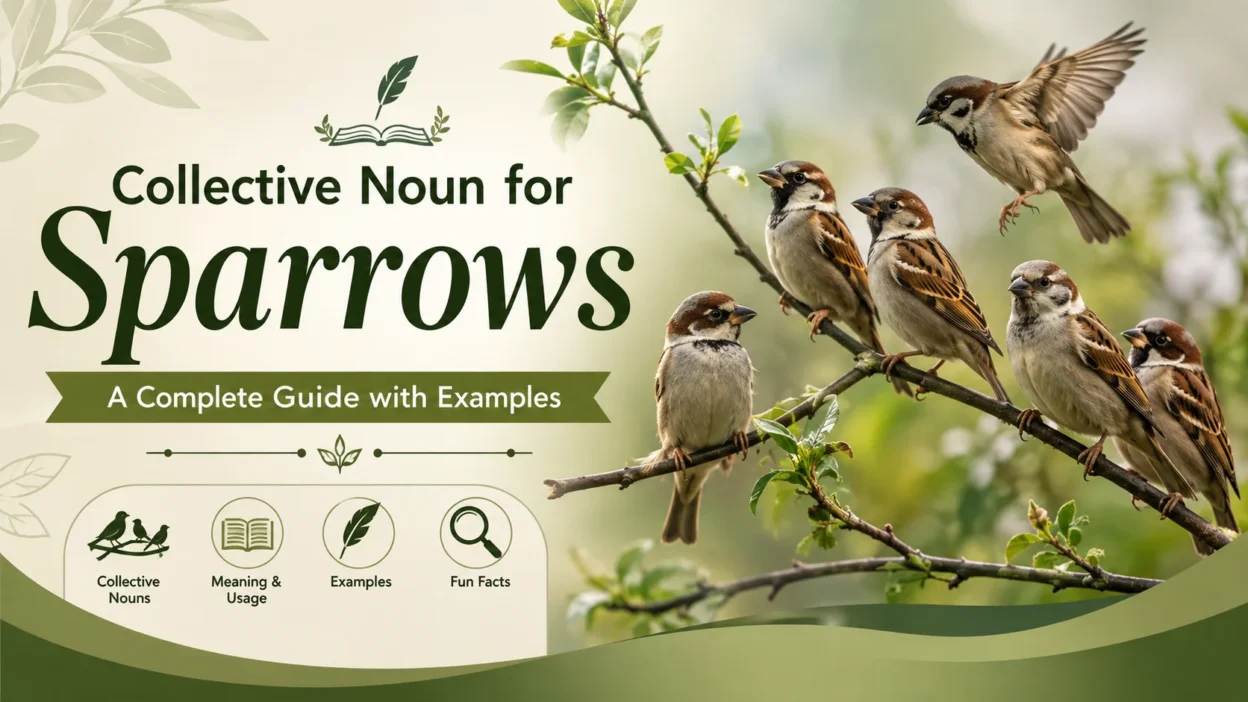
The collective noun for sparrows is commonly host, as in a host of sparrows, describing many sparrows gathered together in one place. A flock is another natural term, especially when describing several birds moving or feeding together. You may also use a group of sparrows or flight of sparrows, depending on the context. These expressions make English more precise while giving you simple ways to describe a group of birds.
Collective nouns describe people, animals, objects, or things as one unit. English includes many familiar expressions, such as a pack of wolves, a herd of elephants, and a flock of birds. These words make language more vivid and offer a convenient way to discuss groups. When teaching this topic, I find that connecting each expression with a real situation makes the meaning easier to remember.
Sparrows are social birds and are highly social in their everyday behavior. They often gather around food, nesting areas, trees, and other suitable habitats. A large gathering of these birds can therefore be called a gathering of sparrows, while a host of sparrows and a flock of sparrows provide familiar descriptive expressions. These examples give real meaning to the expressions and show how several sparrows can naturally be described as a group.
Why Collective Nouns Are Used for Sparrows
Sparrows are generally social birds that may gather in groups while feeding, resting, roosting, or moving between locations. Large groups can become especially noticeable when sparrows take flight together or gather around food sources.
Because sparrows commonly occur in groups, flock is a natural and widely understood collective noun. Traditional English also contains more colorful expressions, such as the charm of sparrows, which can add a poetic quality to descriptions.
These terms allow writers to describe not only the number of birds but also the image their movement or behavior creates.
Collective Nouns for Sparrows
| Collective Noun | Used For | Simple Example |
| Flock | A group of sparrows | A flock of sparrows flew over the garden. |
| Charm | A traditional term for sparrows | A charm of sparrows gathered in the tree. |
| Host | A large group of sparrows | A host of sparrows filled the field. |
| Group | A general group of sparrows | A group of sparrows searched for food. |
Flock of Sparrows
A flock is the most common and straightforward collective noun for sparrows. It describes sparrows that gather, feed, rest, or fly together.
The expression a flock of sparrows is easy to understand and works well in everyday conversation, educational writing, and descriptions of birds in nature.
Examples of “Flock of Sparrows”
- A flock of sparrows flew over the garden.
- We watched a flock of sparrows in the trees.
- The flock of sparrows gathered near the feeder.
- A large flock of sparrows crossed the field.
- The flock of sparrows searched for food.
- A flock of sparrows rested on the roof.
- The flock of sparrows flew away at once.
- A flock of sparrows gathered near the bushes.
- The farmer noticed a flock of sparrows in the field.
- The flock of sparrows returned before sunset.
Charm of Sparrows
A charm of sparrows is a traditional and descriptive collective expression. The word charm gives the group a pleasant and poetic quality and can be used when describing several sparrows together.
Unlike flock, which is a broad and everyday term, charm is more literary and isn’t necessary in ordinary conversation.
Examples of “Charm of Sparrows”
- A charm of sparrows gathered in the tree.
- We saw a charm of sparrows near the garden.
- The charm of sparrows flew across the field.
- A charm of sparrows rested on the branches.
- The charm of sparrows searched for food.
- A charm of sparrows filled the garden with movement.
- The charm of sparrows scattered when a cat appeared.
- A charm of sparrows gathered around the feeder.
- We photographed a charm of sparrows in the morning.
- The charm of sparrows disappeared into the trees.
Host of Sparrows
A host of sparrows can be used to describe a large number of sparrows gathered in one place. The word host emphasizes the size of the group rather than a particular behavior.
It has a more literary or descriptive tone than the simple expression flock of sparrows.
Examples of “Host of Sparrows”
- A host of sparrows filled the field.
- We saw a host of sparrows near the trees.
- The host of sparrows flew across the valley.
- A host of sparrows gathered around the grain.
- The host of sparrows covered the branches.
- A host of sparrows rose into the air.
- The host of sparrows moved toward the garden.
- A host of sparrows gathered near the farm.
- The host of sparrows scattered suddenly.
- A host of sparrows returned to the trees.
Group of Sparrows
A group of sparrows is a simple general expression rather than a specialized collective noun. It can be used whenever you want to describe several sparrows together.
Although flock is more specific, the group is completely clear and can be used in almost any context.
Examples of “Group of Sparrows”
- A group of sparrows gathered near the tree.
- We saw a group of sparrows in the garden.
- The group of sparrows searched for food.
- A group of sparrows flew across the yard.
- The group of sparrows rested on the roof.
- A group of sparrows gathered near the feeder.
- The children watched a group of sparrows.
- A group of sparrows moved through the bushes.
- The group of sparrows returned to the trees.
- A group of sparrows scattered across the field.
Sparrow Behavior and Social Life
Sparrows are small birds that can be highly social, particularly when feeding or roosting. They often gather around reliable food sources and may form groups in areas where food and shelter are available.
Sparrows communicate through calls, songs, body movements, and other visual signals. Their vocalizations can help birds maintain contact with one another, attract mates, defend territories, and warn others about potential threats.
When sparrows fly together, their movement can create an impressive sight. A flock may suddenly take off when disturbed and then return to a suitable feeding or resting location. Their ability to live around human settlements has also made sparrows familiar birds in gardens, farms, parks, and urban areas.
Sparrows spend much of their time searching for food. Depending on the species and season, they may eat seeds, grains, insects, fruits, and other small food items. Their feeding habits can bring several birds together in the same location.
Examples of Sparrow Behavior
- Sparrows often gather in groups.
- A flock of sparrows searched for food.
- Sparrows communicate through calls.
- The sparrows flew away when disturbed.
- A flock gathered around a food source.
- Sparrows may rest together in suitable locations.
- The birds returned to the garden in the morning.
- A group of sparrows searched through the grass.
- Sparrows can live near human settlements.
- The flock moved between the trees and bushes.
Interesting Facts About Sparrows
Sparrows are small birds belonging to several different species and families, depending on which sparrows are being discussed. The house sparrow is one of the most familiar species around human settlements. Sparrows have adapted well to environments associated with people and can often be found around buildings, gardens, farms, parks, and food sources. Their lifespan varies by species and environmental conditions, and many wild sparrows face threats from predators, disease, food shortages, and habitat changes.
Sparrows have several interesting physiological features that help them survive. Their small bodies are covered with feathers that provide insulation and help them maintain body temperature. Their lightweight skeletons and strong flight muscles allow them to move quickly through the air. Their short, sturdy bills are particularly useful for handling seeds and other foods.
Their dietary habits vary by species and season. Many sparrows consume seeds and grains, while insects and other small invertebrates can become important food sources, particularly during the breeding season when growing chicks need protein-rich food. Some species also consume fruits and other plant material when available.
Sparrows are also known for their social behavior. They may gather in groups when feeding, resting, or roosting. Their calls help them communicate with other members of their species, while body movements and displays can convey information about territory, courtship, and danger.
Their close association with human environments makes them one of the most familiar groups of small birds. Watching a flock of sparrows in a garden or around a building provides a simple example of how social bird behavior can be observed in everyday life.
Examples of Sparrow Facts
- Sparrows are small birds.
- Many sparrows live near human settlements.
- Sparrows can form social groups.
- A group of sparrows is commonly called a flock of sparrows.
- Sparrows communicate through calls and body language.
- Many sparrows eat seeds and grains.
- Insects can be important food for growing chicks.
- Sparrows have short, sturdy bills.
- Sparrows have feathers that provide insulation.
- Sparrows can gather around reliable food sources.
Conclusion
The collective noun for sparrows is most commonly host, as in a host of sparrows. However, flock, group of sparrows, and flight of sparrows can also describe several sparrows together. Choosing the right expression depends on the situation and the way the birds are behaving.
FAQs
Q1. What is the collective noun for sparrows?
The most commonly recognized collective noun for sparrows is host, as in “a host of sparrows.”
Q2. What is a group of sparrows called?
A group of sparrows can be called a host of sparrows or a flock of sparrows. “Group of sparrows” is also a simple general expression.
Q3. Is “flock” a collective noun for sparrows?
Yes. Flock is a natural collective term for birds, including sparrows. You can say “a flock of sparrows.”
Q4. Can I say “a host of sparrows”?
Yes. A host of sparrows is a traditional and descriptive expression for a large gathering of sparrows.
Q5. What does “host of sparrows” mean?
“A host of sparrows” means many sparrows gathered together, usually in one area.
Q6. Can “flight of sparrows” be used?
Yes. Flight of sparrows can be used when focusing on sparrows flying together or moving through the air.
Q7. Why are sparrows described with collective nouns?
Sparrows often live and move socially, gathering around food, trees, nesting places, and suitable habitats. Collective nouns make it easier to describe these gatherings.
Q8. What are some examples of collective nouns for birds?
Common examples include flock of birds, flight of birds, and other traditional expressions that describe birds gathered or moving together.
Q9. Is “group of sparrows” grammatically correct?
Yes. The group of sparrows is grammatically correct and easy to understand, although a host of sparrows or a flock of sparrows may sound more descriptive.
Q10. What is the easiest collective noun to use for sparrows?
Flock is probably the easiest everyday choice. For example: “A flock of sparrows gathered near the tree.”