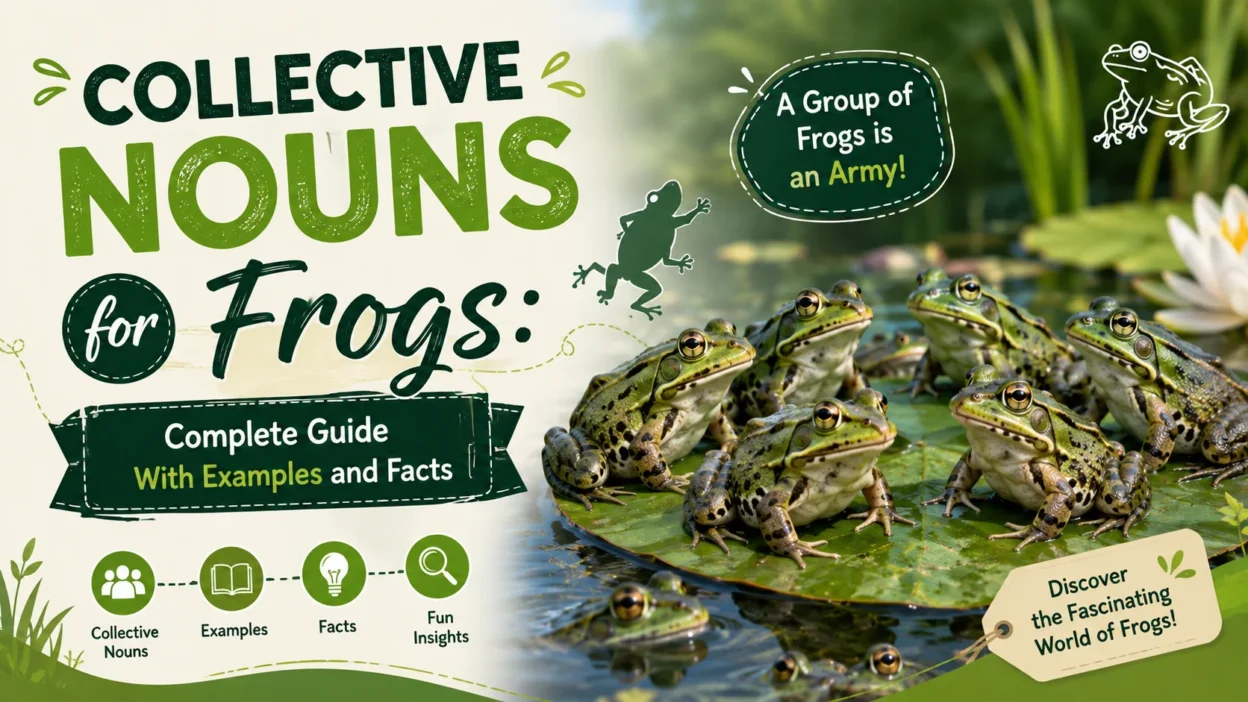
Collective Nouns for Frogs describe frogs as a group, with terms that make their behavior and surroundings easier to picture. A collective noun treats several animals as a single unit. For frogs, common choices include army, chorus, colony, and congregation. These expressions make language more descriptive and help readers understand how frogs gather, live, and behave. You may find frogs gathering around ponds, wetlands, streams, and other moist places, where their activity can make descriptions more colorful and meaningful.
The most familiar expression is army of frogs, but colony of frogs, group of frogs, and chorus of frogs can also appear depending on the situation. The choice can connect with frog behavior, especially their tendency to gather and call together. In everyday writing, these terms give you a simple way to describe several frogs without repeating the word frogs again and again. This also shows how a specific collective expression can add detail to a description.
Other familiar English examples include a flock of birds, a herd of cattle, and a pride of lions. These examples show how collective nouns work across different groups of living things. When you describe frogs using terms such as army, colony, or chorus, the wording can suggest something about how they gather or communicate. This connection between vocabulary and natural behavior makes collective nouns more useful and memorable.
Collective Noun for Frogs: Quick Reference
| Type | Simple Example |
| Army | An army of frogs crossed the wetland. |
| Colony | A colony of frogs lived near the pond. |
| Chorus | A chorus of frogs called at night. |
| Group | A group of frogs sat near the stream. |
| Congregation | A congregation of frogs gathered after the rain. |
| Clump | A clump of frogs rested among the plants. |
| Gathering | A gathering of frogs appeared beside the pond. |
An Army of Frogs
An army of frogs is one of the most colorful expressions used for a group of frogs. It creates an amusing image of many frogs moving together, especially when they gather in large numbers after rain. Although it sounds dramatic, it is mainly a descriptive expression rather than a scientific classification.
Example of “An Army of Frogs”
- An army of frogs appeared near the pond after the rain.
- We saw an army of frogs hopping across the garden.
- An army of frogs gathered beside the stream.
- The children watched an army of frogs move through the grass.
- At night, an army of frogs filled the wetland.
- An army of frogs jumped into the water.
- The farmer noticed an army of frogs near the fields.
- An army of frogs rested under the leaves.
- After the storm, an army of frogs came out of hiding.
- We heard an army of frogs calling from the pond.
A Colony of Frogs
A colony of frogs can describe frogs living together in the same general habitat. Frogs may gather around ponds, wetlands, marshes, and other areas where they can find water, food, and suitable places to reproduce.
Example of “A Colony of Frogs”
- A colony of frogs lived around the quiet pond.
- We discovered a colony of frogs near the marsh.
- A colony of frogs gathered among the reeds.
- The colony of frogs became active after sunset.
- A colony of frogs lived beside the stream.
- The researchers observed a colony of frogs in the wetland.
- A colony of frogs gathered near the shallow water.
- The pond provided a safe home for a colony of frogs.
- A colony of frogs could be heard from the garden.
- The children carefully watched a colony of frogs near the pond.
A Chorus of Frogs
A chorus of frogs is a particularly fitting expression when several frogs are calling at the same time. Frogs often produce calls during the breeding season, and a pond filled with their different voices can sound like a natural chorus.
Example of “A Chorus of Frogs”
- A chorus of frogs sang beside the pond.
- We heard a chorus of frogs after sunset.
- A loud chorus of frogs came from the marsh.
- The chorus of frogs filled the quiet night.
- A chorus of frogs called from behind the reeds.
- The children listened to a chorus of frogs near the lake.
- A chorus of frogs began after the rain stopped.
- The wetland was alive with a chorus of frogs.
- A beautiful chorus of frogs echoed across the pond.
- We could hear a chorus of frogs from our garden.
A Group of Frogs
A group of frogs is the simplest and most widely understood expression. Unlike some colorful collective nouns, it can be used in almost any situation without sounding unusual.
Example of “A Group of Frogs”
- A group of frogs sat beside the pond.
- We found a group of frogs under the leaves.
- A group of frogs jumped into the water.
- The group of frogs moved toward the stream.
- A group of frogs gathered after the rain.
- The children counted a group of frogs near the garden.
- A group of frogs rested on the wet grass.
- We watched a group of frogs feeding near the pond.
- A group of frogs disappeared into the bushes.
- The group of frogs became quiet when we approached.
A Congregation of Frogs
A congregation of frogs is a descriptive expression for frogs gathered together in one place. It works especially well when a large number of frogs assemble around water or another suitable habitat.
Example of “A Congregation of Frogs”
- A congregation of frogs gathered around the pond.
- We saw a congregation of frogs near the wetland.
- A congregation of frogs appeared after the heavy rain.
- The congregation of frogs rested among the plants.
- A large congregation of frogs lived near the marsh.
- The children noticed a congregation of frogs beside the stream.
- A congregation of frogs gathered at the edge of the lake.
- We heard a congregation of frogs calling at night.
- The wet weather attracted a congregation of frogs.
- A congregation of frogs moved through the wet grass.
A Clump of Frogs
A clump of frogs can be used informally when frogs are closely gathered together in one small area. It gives the reader a simple visual picture of frogs clustered around vegetation, rocks, or water.
Example of “A Clump of Frogs”
- A clump of frogs rested beside the pond.
- We found a clump of frogs under a large leaf.
- A clump of frogs gathered near the water.
- The clump of frogs jumped when we approached.
- A clump of frogs sat among the reeds.
- The children noticed a clump of frogs near the garden.
- A clump of frogs hid beneath the wet grass.
- A clump of frogs moved toward the stream.
- The rain brought a clump of frogs into the yard.
- A clump of frogs rested quietly on the muddy bank.
A Gathering of Frogs
A gathering of frogs is another straightforward expression for frogs assembled in one location. It is useful when the writer wants natural, easy-to-understand English rather than a highly unusual collective noun.
Example of “A Gathering of Frogs”
- A gathering of frogs appeared after the rain.
- We watched a gathering of frogs near the pond.
- A gathering of frogs formed beside the stream.
- The gathering of frogs became noisy at night.
- A gathering of frogs rested under the plants.
- The wetland attracted a gathering of frogs.
- A gathering of frogs jumped into the water.
- We discovered a gathering of frogs near the reeds.
- A gathering of frogs moved across the wet grass.
- The children enjoyed watching a gathering of frogs.
Interesting Facts About Frogs
Frogs are fascinating amphibians with several unusual biological features. Their longevity varies greatly between species: some frogs live only a few years in the wild, while others can survive for more than a decade under suitable conditions. Their bodies are specially adapted for life around water and land. Most frogs have powerful hind legs for jumping, webbed feet in many species for swimming, and moist skin that can help with respiration. Some species can absorb water through their skin rather than drinking it in the way humans do. Frogs also have a remarkable feeding habit: most adult frogs are carnivorous and commonly eat insects, spiders, worms, and other small animals. Their long, sticky tongues can rapidly capture prey, making feeding an impressive example of animal adaptation.
Why Collective Nouns for Frogs Matter
Understanding the Collective Noun for Frogs adds variety and precision to English while also encouraging us to notice how frogs behave in nature. Terms such as army, colony, and chorus create different images of frogs gathering, living, or calling together. Learning these expressions therefore connects language with the natural world and makes descriptions of wildlife more vivid.
Conclusion
Understanding Collective Nouns for Frogs makes your writing more descriptive and natural. Words such as army, chorus, colony, and congregation can describe a group of frogs, while terms like army of frogs and chorus of frogs can add a clearer picture of how frogs gather and communicate. Choosing the right expression depends on the context, but these collective nouns give you useful ways to describe frogs as a group.
FAQs
Q1. What is the collective noun for frogs?
Army is one of the most commonly recognized collective nouns for frogs. You may also encounter chorus, colony, and congregation.
Q2. What is an army of frogs?
An army of frogs is a phrase used to describe a group of frogs. It creates a vivid image of many frogs gathered together.
Q3. Is “chorus of frogs” correct?
Yes. A chorus of frogs is a natural expression, especially when several frogs are calling or croaking together.
Q4. Can I say “a colony of frogs”?
Yes. A colony of frogs can describe frogs living or gathering together in the same area.
Q5. What does “congregation of frogs” mean?
A congregation of frogs refers to a group of frogs gathered in one place. It emphasizes the idea of gathering together.
Q6. Which collective noun for frogs is most familiar?
Army of frogs is one of the most familiar expressions. However, chorus of frogs is also useful when focusing on their calls.
Q7. Can I simply say “a group of frogs”?
Yes. A group of frogs is completely clear and grammatically correct, even though it isn’t a specialized collective noun.
Q8. Why are collective nouns used for frogs?
Collective nouns make descriptions shorter and more interesting. They can also highlight how frogs gather, live, or behave together.
Q9. What is a good collective noun for frogs near a pond?
Chorus of frogs works particularly well when frogs are calling together near a pond, especially at night.
Q10. Are there different collective nouns for frogs?
Yes. Depending on the context, you can use army, chorus, colony, or congregation of frogs. The best choice depends on what you want to emphasize.