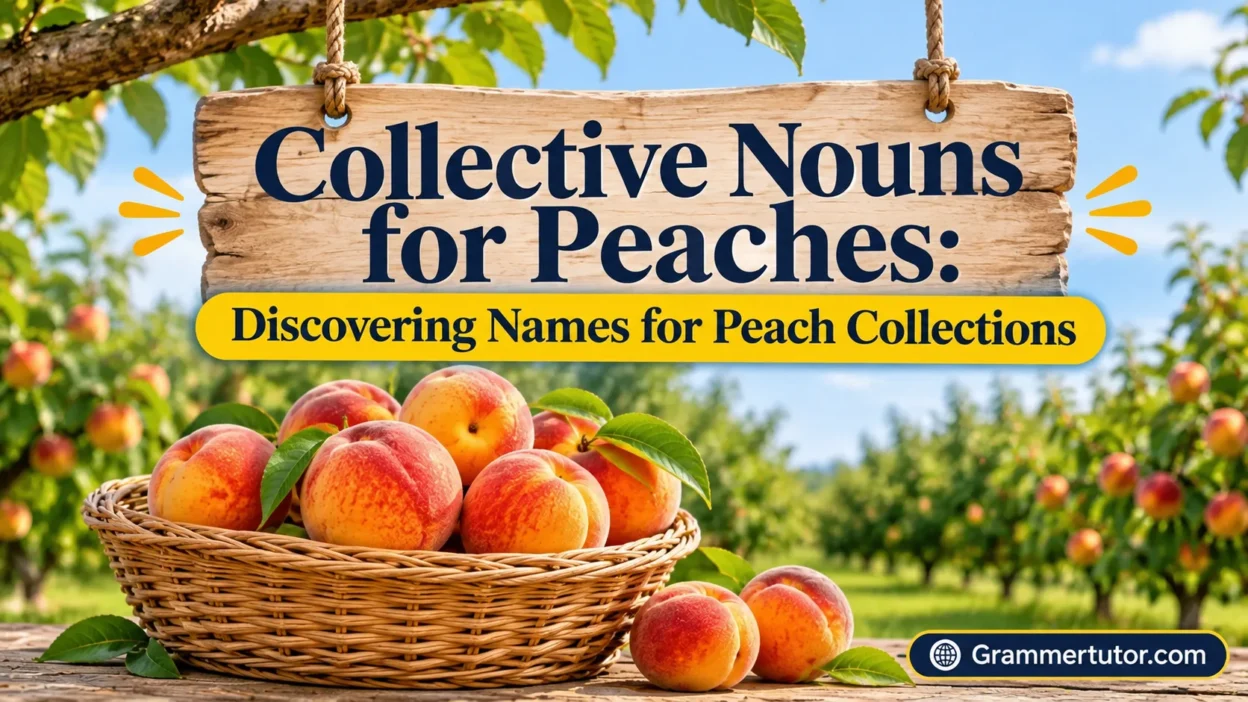
Peaches are popular fruits loved for their delicious taste, sweet flavour, soft texture, and refreshing juice. People enjoy fresh peaches on their own, mix them into fruit salads, add them to desserts, or turn them into jams and other food products. When several peaches are brought together, different expressions can describe their quantity, arrangement, or collection. These expressions are useful in everyday communication because they make descriptions more natural and specific. For example, a basket of peaches or a bowl of peaches can describe fruit gathered for serving at home.
Other collective nouns for peaches include a bushel of peaches and a crate of peaches. Each phrase suggests a different way of gathering, storing, displaying, or transporting fruit. A bowl is commonly associated with kitchens, while baskets and crates are often seen in markets. A bushel is especially useful when discussing farming, harvesting, and commercial packaging. These group-related phrases help readers understand how fruit is handled, from collection on farms to its arrival in shops. Learning these natural expressions also adds useful terms to your English vocabulary and improves your understanding of everyday language.
There are many interesting details behind peach varieties, their nutritional value, and their cultivation. Fruit cultivation and peach farming contribute to agricultural production, the food industry, and commercial fruit trade. After harvesting, proper fruit storage and fruit transportation help maintain freshness and quality. Peaches also have cultural importance in different cultures, where they may represent beauty, happiness, or good fortune. Exploring seven collective expressions through seven useful expressions, their meanings, and ten simple example sentences can make language learning more practical and enjoyable.
Why Are Group Expressions Used for Peaches?
Peaches are agricultural fruits that are usually harvested, sold, and consumed in quantities rather than individually. Farmers collect them from orchards, retailers arrange them in displays, and families store them in bowls, baskets, or refrigerators. Because of these everyday activities, different group expressions are useful when describing peaches.
For example, a basket of peaches suggests fruits gathered inside a basket, while a bowl of peaches describes peaches arranged in a serving container. Similarly, a crate of peaches is useful when discussing larger quantities prepared for transportation or sale.
These expressions also help writers create clearer descriptions without repeatedly mentioning individual fruits. They are useful in recipes, grocery shopping, agricultural reports, market conversations, and educational writing. Choosing an appropriate expression makes it easier to communicate how peaches are collected or presented.
Common Collective Expressions for Peaches
The following table introduces seven expressions that can describe peaches according to their arrangement, storage, measurement, or collection.
| Collective Expression | Type or Use | Simple Example |
| Basket of peaches | Fruits gathered in a basket | A basket of peaches stood near the door. |
| Bowl of peaches | Fruits arranged in a serving bowl | A bowl of peaches was on the table. |
| Bushel of peaches | A traditional agricultural quantity | The farmer harvested a bushel of peaches. |
| Crate of peaches | Fruits packed for storage or transportation | A crate of peaches arrived at the market. |
| Box of peaches | Fruits packed inside a box | A box of peaches was delivered yesterday. |
| Basketful of peaches | The amount that fills a basket | A basketful of peaches was collected. |
| Harvest of peaches | Peaches gathered during the harvesting season | The harvest of peaches was excellent. |
Note: These are descriptive group expressions rather than seven fixed grammatical collective nouns. They are used according to how peaches are gathered, measured, stored, or harvested.
A Basket of Peaches
A basket of peaches describes several peaches gathered inside a basket. It is a familiar expression used in homes, fruit markets, farms, and grocery stores. Baskets are convenient containers because they allow fruits to be collected and carried together without arranging each peach separately.
This expression is particularly suitable when describing freshly picked peaches or fruit prepared for sale. Farmers often use baskets during harvesting, while sellers arrange attractive baskets to display fresh produce. The phrase also appears in everyday descriptions of kitchens, picnics, and seasonal fruit shopping.
Examples of “A Basket of Peaches”
- A basket of peaches was placed beside the farmhouse entrance.
- The fruit seller arranged a basket of peaches near the shop window.
- My grandmother prepared a basket of peaches for the family gathering.
- A basket of peaches arrived from the countryside early in the morning.
- The children admired the colourful peaches inside the basket.
- She carried a basket of peaches from the orchard.
- A basket of peaches decorated the dining table.
- The farmer presented a basket of freshly picked peaches.
- We purchased a basket of peaches from the roadside market.
- A basket of peaches was waiting beside the kitchen counter.
A Bowl of Peaches
A bowl of peaches refers to several peaches placed together inside a bowl. This expression is commonly used when describing fruit prepared for serving, eating, or displaying at home. Bowls made from glass, ceramic, wood, or other materials can hold peaches while keeping them organized and accessible.
Unlike a basket, which is often associated with collecting or carrying fruit, a bowl is frequently connected with serving and presentation. A bowl of peaches may be placed on a dining table, kitchen counter, or breakfast table. It is also a natural expression in recipes and descriptions of fresh food.
Examples of “A Bowl of Peaches”
- A bowl of peaches was waiting on the breakfast table.
- She washed the peaches before placing them in a ceramic bowl.
- The guests enjoyed fresh peaches from a large serving bowl.
- My sister filled a bowl of peaches for the afternoon snack.
- A glass bowl of peaches brightened the kitchen counter.
- He selected two ripe peaches from the bowl.
- The recipe required a bowl of sliced peaches.
- A bowl of peaches was served after dinner.
- The children shared a bowl of sweet peaches.
- She placed a fresh bowl of peaches beside the fruit basket.
A Bushel of Peaches
A bushel of peaches is an agricultural measurement used to describe a substantial quantity of fruit. The term bushel has traditionally been used in farming and produce markets to measure dry or loosely packed agricultural products. In peach production, it is often used when discussing harvesting, selling, and purchasing fruit in larger quantities.
Farmers may use bushel measurements when recording the amount of peaches collected from an orchard. The expression is particularly useful in agricultural discussions because it communicates more than a small household serving. The exact weight or volume can vary depending on the fruit and the measurement system being used.
Examples of “A Bushel of Peaches”
- The orchard produced a bushel of peaches before noon.
- A farmer sold a bushel of peaches at the local market.
- We ordered a bushel of peaches for making homemade preserves.
- The workers collected a bushel of ripe peaches during harvesting.
- A bushel of peaches was delivered to the fruit processing centre.
- She purchased a bushel of peaches from a nearby farm.
- The agricultural report recorded a bushel of peaches from the test orchard.
- My uncle shared a bushel of peaches with his neighbours.
- A bushel of peaches was weighed before being sold.
- The family planned to prepare desserts using a bushel of peaches.
A Crate of Peaches
A crate of peaches describes a quantity of peaches packed inside a sturdy container, usually designed for storage and transportation. Crates are commonly used by farmers, wholesalers, distributors, and grocery businesses to move fresh fruit from orchards to markets.
Depending on the packaging design, crates may be made from plastic, wood, or cardboard.
Examples of “A Crate of Peaches”
- A crate of peaches arrived at the wholesale fruit market.
- The delivery worker unloaded a crate of peaches from the truck.
- The farmer inspected every crate of peaches before transportation.
- A crate of peaches was placed inside the cold storage facility.
- The supermarket received several crates of fresh peaches.
- The distributor prepared a crate of peaches for delivery.
- A wooden crate of peaches stood beside the warehouse entrance.
- The workers carefully packed a crate of peaches for shipment.
- The market owner checked the quality of peaches inside the crate.
- A crate of peaches was sent to the local grocery store.
A Box of Peaches
A box of peaches refers to several peaches packed inside a box for storage, gifting, transportation, or sale. Boxes provide a convenient way to organize fruit and can be made from cardboard, plastic, or other suitable materials. They are commonly used by fruit shops, supermarkets, online grocery businesses, and agricultural suppliers.
Packaging may include protective materials to reduce bruising and maintain the quality of the fruit.
Examples of “A Box of Peaches”
- A box of peaches was delivered to our home yesterday.
- She packed a box of peaches for her relatives.
- The grocery store displayed a box of yellow peaches.
- My neighbour brought a box of peaches from his farm.
- A box of peaches was placed inside the delivery van.
- The customer selected a box of fresh peaches.
- He opened the box of peaches and checked their condition.
- The company prepared a box of peaches for a special order.
- A cardboard box of peaches was waiting near the warehouse.
- We received a beautiful box of peaches as a seasonal gift.
A Basketful of Peaches
A basketful of peaches describes the quantity of peaches that fills a basket.
The word basketful gives readers a clear picture of a basket filled with fruit. It can be used in storytelling, agricultural descriptions, and everyday conversations.
Examples of “A Basketful of Peaches”
- A basketful of peaches was collected from the orchard.
- The children returned home with a basketful of ripe peaches.
- She prepared a basketful of peaches for the village festival.
- A basketful of peaches stood beside the garden gate.
- The farmer proudly displayed a basketful of freshly harvested peaches.
- We carried a basketful of peaches to the family picnic.
- My aunt distributed a basketful of peaches among her neighbours.
- A basketful of peaches filled the wooden container.
- The photographer captured a basketful of peaches in the orchard.
- They sold a basketful of peaches before lunchtime.
A Harvest of Peaches
Peach harvesting usually takes place when the fruit reaches suitable maturity, colour, and softness. The exact harvesting period depends on the variety and growing conditions. A successful harvest can provide fresh produce for local markets, food businesses, and households. This expression is especially appropriate in agricultural writing and descriptions of seasonal fruit production.
Examples of “A Harvest of Peaches”
- The orchard celebrated a successful harvest of peaches this summer.
- A harvest of peaches supplied several nearby fruit markets.
- The farmers prepared for the annual harvest of peaches.
- Heavy rainfall affected the harvest of peaches in the region.
- A plentiful harvest of peaches supported the local farming community.
- The workers completed the harvest of peaches before the weather changed.
- The village organized a festival to celebrate its harvest of peaches.
- A healthy harvest of peaches provided fresh fruit for local families.
- The agricultural team studied the quality of the harvest of peaches.
- This year’s harvest of peaches exceeded the farmer’s expectations.
Interesting Facts About Peaches
Peaches have a long history of cultivation and are believed to have originated in China, where they have been grown for thousands of years. Today, peaches are cultivated in many countries with suitable climates.
One distinctive feature of peaches is their soft, fuzzy outer skin. Their scientific name is Prunus persica, and they belong to the rose family, Rosaceae. A peach normally contains one large, hard seed, commonly called a pit or stone, surrounded by juicy flesh.
They contain water, dietary fibre, vitamin C, vitamin A-related carotenoids, and several beneficial plant compounds. Their natural sweetness makes them popular in fruit salads, smoothies, pies, jams, and desserts. They are relatively low in calories and can be included in a balanced diet. From traditional farming to modern food production, peaches continue to hold an important place in agriculture, cooking, and cultural traditions.
Conclusion
From a small bowl on a kitchen table to a large crate at a fruit market, peaches can be described in many ways depending on how they are collected and handled. Expressions such as a basket of peaches, a bushel of peaches, and a crate of peaches are useful examples of how English connects ordinary objects with specific group names. Once you understand when to use each phrase, describing fruit becomes easier, and your everyday English sounds more precise and expressive.
FAQs
Q1. What is the most common collective expression for peaches?
A basket of peaches is a common expression used to describe several peaches gathered together. Other natural expressions include a bowl of peaches and a box of peaches.
Q2. Can we say a bowl of peaches?
Yes. A bowl of peaches is correct English. It describes peaches placed together inside a bowl, usually for serving, eating, or display.
Q3. What does a bushel of peaches mean?
A bushel of peaches refers to an agricultural quantity of peaches. It is commonly used in farming, harvesting, and fruit markets.
Q4. Is a crate of peaches a collective noun?
A crate of peaches is a descriptive group expression. It refers to several peaches packed inside a container for storage or transportation.
Q5. What is the difference between a basket of peaches and a basketful of peaches?
A basket of peaches identifies the container and its contents, while a basketful of peaches emphasizes the quantity needed to fill the basket.