A collective noun for flowers describes several flowers together, helping us express their arrangement in a simple and beautiful way. Flowers appear in different groups, and each group may have a special name depending on how the flowers are gathered or where they grow. For example, a bouquet of flowers usually refers to flowers arranged together, while a bunch of flowers describes flowers gathered or held as a collection. These expressions make everyday English more natural and descriptive.
Flowers can be found in beautiful arrangements, from small collections used as gifts to large displays in gardens, parks, and natural landscapes. A bed of flowers describes an area where many flowers grow together, often creating an attractive display of colour and natural beauty. Similarly, a bouquet or bunch can be used when discussing flowers presented on special occasions. Learning these expressions helps students, teachers, and writers choose the right words when describing different floral collections.
Understanding these expressions improves English vocabulary and makes writing more interesting. When describing flowers, it is helpful to consider their appearance, fragrance, growth, and importance in nature. For example, you might describe a bouquet as a thoughtful gift or a bed of flowers as a colourful part of a garden. In my experience, learning collective nouns through simple example sentences makes their meanings easier to remember. Regular practice also helps learners use these expressions correctly in everyday conversations and develop stronger language skills.
Why Do We Use Collective Nouns for Flowers?
Collective nouns help us describe several flowers as one group or collection. They make sentences shorter, clearer, and more interesting. For example, saying a bouquet of flowers creates a clear picture of flowers arranged together, usually for decoration or as a gift. Similarly, a bed of flowers describes an area where flowers grow together in a garden or landscape.
Flowers appear in many different arrangements. They can grow naturally in fields, bloom together in gardens, or be carefully arranged by florists. Because of these different settings, several collective expressions are used to describe them.
These expressions also make English writing more descriptive. They help readers understand whether flowers are growing in a particular place, arranged for an occasion, or gathered for decoration. Learning these terms improves vocabulary and makes communication more natural.
Collective Nouns for Flowers
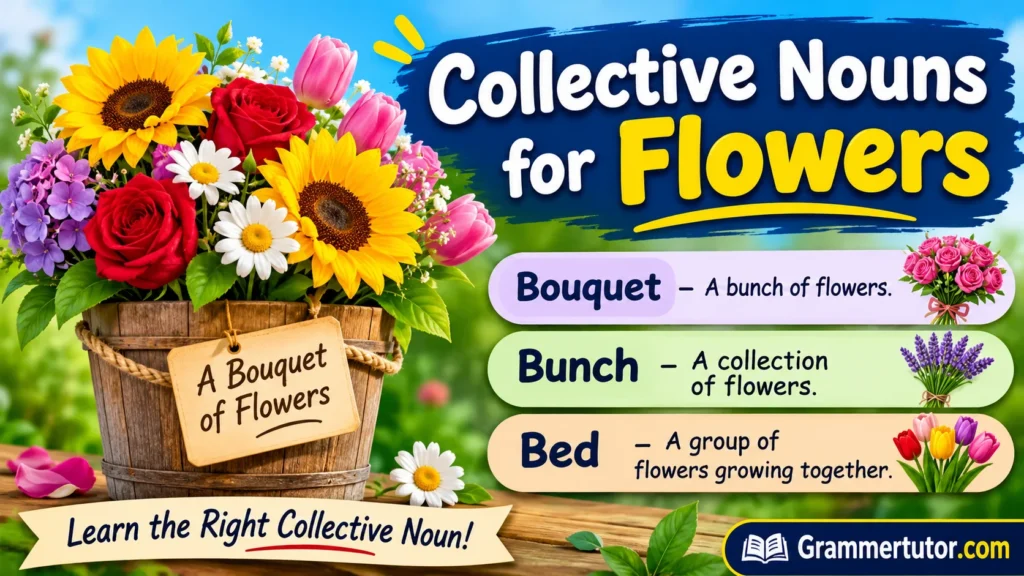
There are several common expressions used for groups of flowers. Some describe flowers arranged together, while others refer to flowers growing naturally in gardens, fields, or other places.
| Collective Noun | Type or Use | Simple Example |
| Bouquet | Flowers arranged as a gift or decoration | She received a bouquet of flowers. |
| Bunch | Flowers gathered and held together | He bought a bunch of flowers. |
| Bunch | A group of flowers with stems gathered together | A bunch of roses was on the table. |
| Bed | Flowers growing together in a garden | A bed of flowers looked beautiful. |
| Border | Flowers planted along the edge of a garden | A border of flowers surrounded the path. |
| Cluster | Flowers growing or grouped closely together | A cluster of flowers bloomed near the wall. |
| Spray | A small decorative arrangement of flowers | She carried a spray of flowers. |
| Garland | Flowers joined together in a decorative chain | A garland of flowers decorated the entrance. |
Note: Bouquet, bunch, bed, and garland are widely understood expressions. Some other terms describe particular arrangements or growing patterns rather than fixed grammatical collective nouns.
A Bouquet of Flowers
A bouquet of flowers is one of the most popular expressions used for a group of flowers. It refers to flowers arranged attractively and usually tied together with ribbon or decorative wrapping. Bouquets are commonly given as gifts on birthdays, weddings, anniversaries, graduations, and other special occasions.
Different types of flowers can be combined in a bouquet to create beautiful arrangements. Roses, lilies, tulips, carnations, and daisies are popular choices. The arrangement may also include leaves, decorative branches, and other natural materials to improve its appearance.
Examples of “A Bouquet of Flowers”
- She received a beautiful bouquet of flowers on her birthday.
- He presented a bouquet of flowers to his mother.
- A bouquet of flowers decorated the wedding table.
- The bride carried a colourful bouquet of flowers.
- I bought a bouquet of flowers for my teacher.
- A fresh bouquet of flowers stood beside the window.
- She placed the bouquet of flowers in a glass vase.
- The florist prepared a bouquet of flowers for the customer.
- A bouquet of flowers made the room look cheerful.
- He sent a bouquet of flowers to his friend.
A Bunch of Flowers
A bunch of flowers describes several flowers gathered and held together, often by their stems. Unlike a carefully arranged bouquet, a bunch may have a simpler and more natural appearance. People commonly buy bunches of flowers from markets, gardens, and flower shops.
A bunch can contain flowers of the same variety or a mixture of different types. For example, someone may collect a bunch of sunflowers, daisies, or wildflowers to decorate a home or give to another person.
Examples of “A Bunch of Flowers”
- She picked a bunch of flowers from the garden.
- He brought a bunch of flowers for his sister.
- A bunch of flowers were lying on the kitchen table.
- The little girl carried a bunch of flowers.
- I bought a bunch of flowers from the local market.
- A bunch of flowers brightened the living room.
- She tied a ribbon around the bunch of flowers.
- The gardener collected a bunch of flowers in the morning.
- He placed a bunch of flowers beside the window.
- A bunch of flowers made the celebration special.
A Bed of Flowers
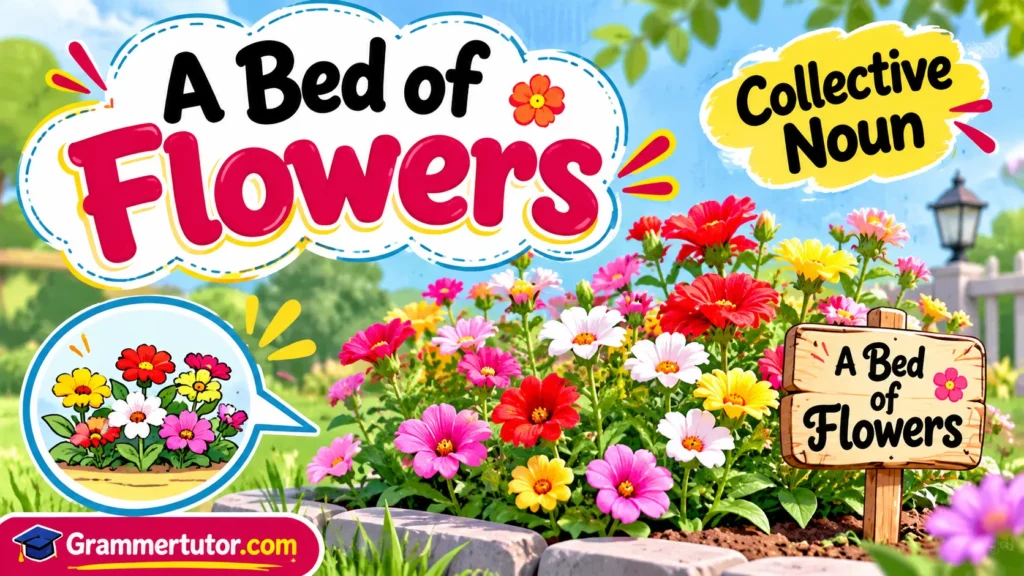
A bed of flowers refers to an area of land where flowers are planted and grown together. Flower beds are common in gardens, parks, public spaces, and residential landscapes. They are often arranged with different colours, shapes, and varieties to create an attractive display.
Gardeners carefully select flowers according to their growing seasons, sunlight requirements, and watering needs. Some flower beds contain roses and marigolds, while others feature tulips, petunias, or seasonal plants. A well-maintained flower bed can make an outdoor space more colourful and welcoming.
Examples of “A Bed of Flowers”
- A bed of flowers decorated the front garden.
- The gardener planted tulips in a bed of flowers.
- We admired a colourful bed of flowers in the park.
- A bed of flowers surrounded the garden fountain.
- The children watered the bed of flowers every morning.
- A beautiful bed of flowers grew beside the pathway.
- The park displayed a large bed of flowers.
- Butterflies visited the bed of flowers throughout the day.
- She planted new seeds in the bed of flowers.
- A bed of flowers added beauty to the entrance.
A Border of Flowers
A border of flowers describes flowers planted along the edges of a garden, pathway, lawn, or other outdoor area. These flowers create a decorative boundary and help make a landscape look organized and attractive.
Garden borders may contain one type of flower or several varieties arranged in different colours and heights. Marigolds, lavender, petunias, and other flowering plants are often used to create attractive borders. This expression is particularly useful when describing landscaping and garden design.
Examples of “A Border of Flowers”
- A border of flowers surrounded the garden path.
- The gardener planted a border of flowers near the fence.
- A colourful border of flowers decorated the lawn.
- We walked beside a border of flowers.
- The house had a beautiful border of flowers.
- She created a border of flowers around the garden.
- A border of flowers made the pathway attractive.
- The park featured a border of flowers near the entrance.
- They planted a border of flowers along the wall.
- A border of flowers added colour to the landscape.
A Cluster of Flowers
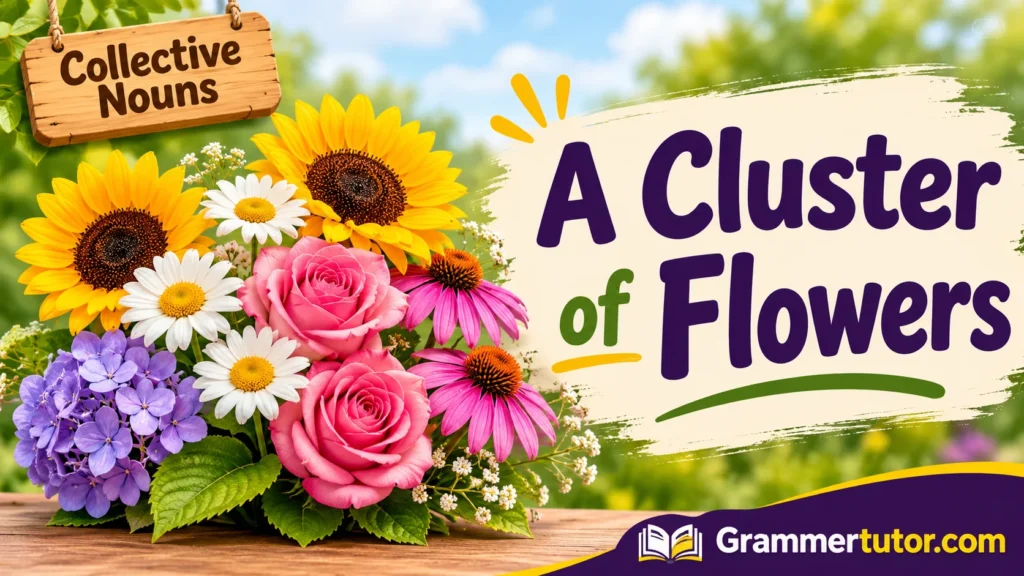
A cluster of flowers refers to several flowers growing or appearing close together. These flowers may develop naturally on one plant or be grouped closely in a particular area. The expression is useful when describing flowering plants, gardens, trees, and natural landscapes.
Some plants produce multiple small flowers in clusters, creating attractive patterns and making the plant look fuller. Hydrangeas, lilacs, and certain varieties of wildflowers are examples of plants that produce clustered blooms. This expression is especially helpful in botanical descriptions and nature writing.
Examples of “A Cluster of Flowers”
- A cluster of flowers bloomed beside the garden wall.
- She noticed a cluster of flowers near the tree.
- A colourful cluster of flowers attracted butterflies.
- The plant produced a cluster of flowers in spring.
- We photographed a cluster of flowers in the meadow.
- A cluster of flowers decorated the green landscape.
- The gardener admired a cluster of flowers on the plant.
- A cluster of flowers grew beside the pathway.
- Bees visited the cluster of flowers every morning.
- A beautiful cluster of flowers appeared after the rain.
A Spray of Flowers
A spray of flowers refers to a decorative arrangement or branch containing several flowers. It is commonly used in floral decoration, bouquets, wedding arrangements, and special displays. A spray may contain flowers growing along one stem or several stems arranged together to create an attractive design.
Florists often use sprays of flowers to decorate tables, wedding venues, churches, and other special locations. Roses, orchids, carnations, and lilies are popular choices for decorative floral sprays.
Examples of “A Spray of Flowers”
- She decorated the table with a spray of flowers.
- A spray of flowers was placed beside the entrance.
- The florist prepared a spray of flowers for the wedding.
- He gave his mother a beautiful spray of flowers.
- A spray of flowers added colour to the room.
- The bride selected a spray of flowers for the ceremony.
- She arranged a spray of flowers in a decorative vase.
- A spray of flowers rested on the wooden table.
- The event hall displayed a lovely spray of flowers.
- We admired a spray of flowers at the exhibition.
A Garland of Flowers
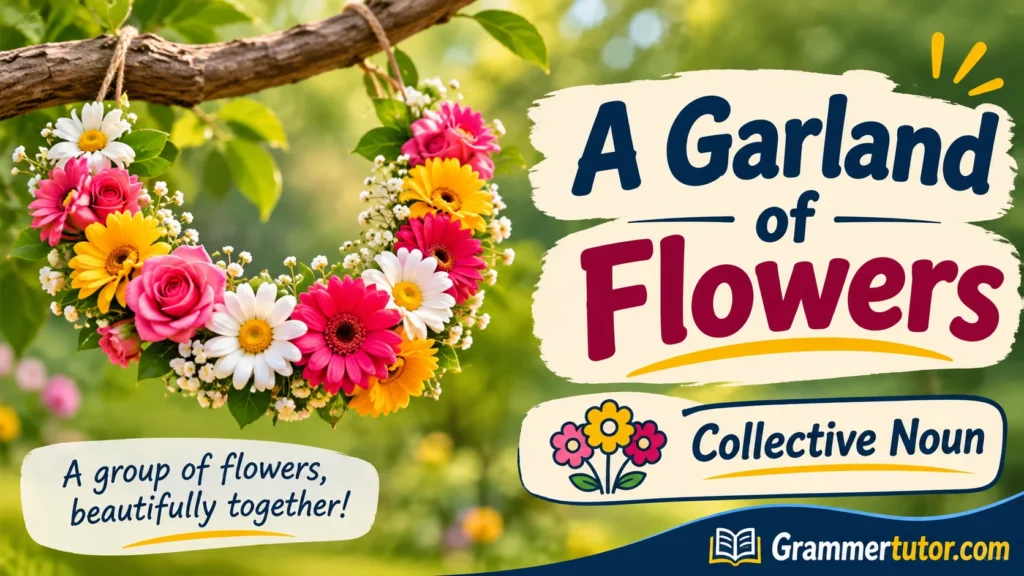
A garland of flowers is a decorative chain made by joining flowers together, often with thread, string, or another connecting material. Garlands are used in celebrations, weddings, festivals, religious ceremonies, and traditional decorations in many cultures.
They may be made from fresh flowers such as jasmine, marigolds, roses, and carnations. Some garlands are worn around the neck, while others are used to decorate doors, walls, stages, and ceremonial spaces. This expression describes flowers connected in a continuous decorative arrangement.
Examples of “A Garland of Flowers”
- She wore a garland of flowers around her neck.
- A garland of flowers decorated the entrance.
- The children made a garland of flowers for the festival.
- He placed a garland of flowers around the statue.
- A beautiful garland of flowers hung above the doorway.
- The bride received a garland of flowers during the ceremony.
- They decorated the hall with a garland of flowers.
- A garland of flowers added colour to the celebration.
- She prepared a garland of flowers using fresh jasmine.
- The guests admired the garland of flowers at the event.
Interesting Facts About Flowers
Flowers have existed for millions of years and are among the most important parts of the natural world. They are the reproductive structures of flowering plants, scientifically known as angiosperms. Fossil evidence suggests that flowering plants became widespread during the Cretaceous Period. Today, they grow in almost every environment, from tropical rainforests and grasslands to deserts and mountainous regions. Some flowers bloom for only a single day, while others remain attractive for several weeks.
One fascinating feature of flowers is their incredible variety of shapes, colours, and fragrances. These features are not simply decorative; they often help attract pollinators such as bees, butterflies, birds, and other insects. Flowers contain different structures, including petals, sepals, stamens, and pistils. The petals often provide colour and visual attraction, while the reproductive structures help plants produce seeds. Some flowers also produce nectar, a sugary liquid that provides energy for visiting pollinators.
Flowers also have different growing habits and lifespans. Annual flowers complete their life cycle within one growing season, while perennial flowers can return year after year. Some flowers, such as certain night-blooming varieties, release their fragrance after sunset to attract nighttime pollinators. Beyond their natural beauty, flowers support ecosystems, contribute to food production through pollination, and play important roles in human celebrations, traditions, gardening, and decoration.
Conclusion
Learning the collective noun for flowers makes English more descriptive and enjoyable. Expressions such as a bouquet of flowers, a bunch of flowers, and a bed of flowers help us describe different flower groups clearly. These terms are useful in everyday conversations, creative writing, and schoolwork. By practising their meanings and using them in simple sentences, learners can improve their vocabulary and describe the beauty of flowers with greater confidence.
FAQs
Q1. What is the most common collective noun for flowers?
The most common collective nouns for flowers include a bouquet of flowers and a bunch of flowers. A bouquet usually refers to an arranged group, while a bunch describes flowers gathered together.
Q2. What is a group of flowers called?
A group of flowers can be called a bunch, bouquet, collection, or cluster, depending on how the flowers are arranged or where they are found.
Q3. Is “a bouquet of flowers” a collective noun?
Yes, a bouquet of flowers is a collective expression used to describe several flowers arranged together, usually for decoration or as a gift.
Q4. What is a bed of flowers?
A bed of flowers is an area of land where flowers are planted and grown together, usually in a garden, park, or landscaped space.
Q5. What is the difference between a bunch and a bouquet of flowers?
A bunch is generally a simple gathering of flowers held together, while a bouquet is usually arranged carefully for decoration, gifting, or special occasions.