Collective Noun for Bullocks is a useful English vocabulary term for describing these strong farm animals when they gather or work together. The most common expression is a herd of bullocks, which refers to a group of animals living or moving together. The word herd is a familiar collective noun used for cattle and other farm animals, making it an important term for learning animal group names and improving English vocabulary.
In everyday English, people may also use expressions such as a team of bullocks, a pair of bullocks, a yoke of bullocks, or a group of bullocks. Each expression suits a different situation. For example, a pair or yoke of bullocks may describe animals working together to pull carts or help with traditional farming, while a herd can describe bullocks grazing in a field or gathering in one place. Choosing the right expression makes animal descriptions clearer and more natural.
Bullocks are hardworking animals that have supported agricultural communities for generations. They play an important role in farming, farm work, and traditional agricultural activities. Learning their group names also adds variety to nature writing and everyday descriptions of animal behaviour, activities, and habitats. From my perspective, using simple examples such as a herd grazing on a farm or a team pulling a cart makes these collective nouns easier to understand and remember.
Why Are Collective Nouns Used for Bullocks?

Bullocks are commonly found on farms, in pastures, and in rural communities where they may be raised for agricultural work or other purposes. Several bullocks may gather together while grazing, resting, drinking water, or moving between different areas. Working bullocks may also be paired or organized into teams to pull carts and ploughs.
A collective noun gives us a convenient way to describe several animals without repeatedly saying “a group of bullocks.” Animal group names also make English more expressive and help readers understand the situation being described.
The phrase a herd of bullocks is particularly useful when discussing animals living or moving together. The expression a team of bullocks is more suitable when the animals are working together, while a yoke of bullocks describes animals connected by a yoke for pulling equipment. In general writing, a group of bullocks is also perfectly clear when you simply want to describe several animals together.
Collective Nouns for Bullocks
| Collective Noun | Used For | Simple Example |
| Herd | Bullocks living or gathering together | A herd of bullocks grazed in the field. |
| Team | Bullocks working together | A team of bullocks pulled the cart. |
| Yoke | Bullocks joined together for work | A yoke of bullocks ploughed the field. |
| Pair | Two bullocks considered together | A pair of bullocks stood near the barn. |
| Group | A general gathering of bullocks | A group of bullocks rested under a tree. |
| Drove | Bullocks being moved together | A drove of bullocks walked along the road. |
| Collection | Bullocks kept or gathered in one place | A collection of bullocks was kept on the farm. |
Herd of Bullocks

A herd of bullocks is the most useful general expression for describing several bullocks together. The word herd is commonly used for cattle and other animals that gather, feed, or move together.
This expression is especially helpful when describing bullocks grazing in a pasture, resting near a farm, or walking towards a water source. It is simple, natural, and easy for English learners to understand.
Examples of “Herd of Bullocks”
- A herd of bullocks grazed peacefully in the green field.
- We watched a herd of bullocks near the river.
- A herd of bullocks walked slowly towards the barn.
- The children saw a herd of bullocks on the farm.
- A herd of bullocks rested beneath the shady trees.
- The farmer provided fresh grass for the herd of bullocks.
- A herd of bullocks moved together across the pasture.
- The farmer guided the herd of bullocks towards the farmyard.
- A herd of bullocks drank water from a large trough.
- The herd of bullocks returned to the enclosure before sunset.
Team of Bullocks
A team of bullocks describes bullocks working together to complete a task. The word team emphasizes cooperation and is particularly suitable for traditional agricultural activities, such as ploughing fields, pulling carts, and transporting harvested crops.
Bullocks have been used for farm work in many parts of the world. In these situations, the expression team of bullocks helps readers understand that the animals are working together rather than simply gathering in a field.
Examples of “Team of Bullocks”
- A team of bullocks pulled the farmer’s wooden cart.
- The farmer used a team of bullocks to plough the field.
- A team of bullocks helped transport crops to the market.
- The strong team of bullocks moved the heavy load.
- The farmer trained a team of bullocks for agricultural work.
- A team of bullocks pulled the cart along the village road.
- The team of bullocks worked steadily throughout the morning.
- A team of bullocks carried harvested crops from the field.
- The farmer rested his team of bullocks after a long day.
- A well-trained team of bullocks made ploughing easier.
Yoke of Bullocks
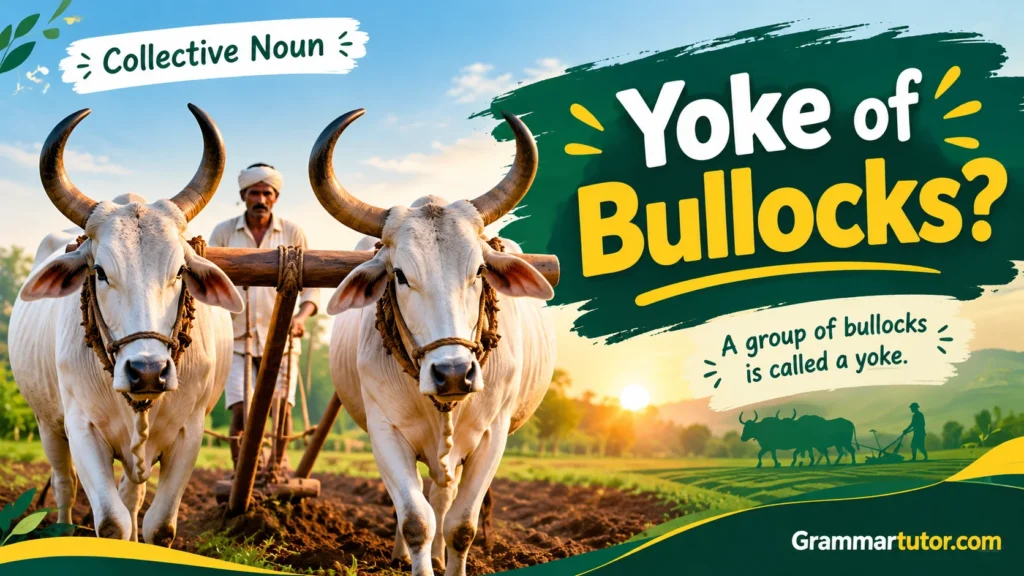
A yoke of bullocks refers to bullocks joined together with a yoke or similar harness for pulling equipment. The word yoke is closely connected with traditional farming and describes a working arrangement rather than a general gathering of animals.
This expression is particularly useful when describing bullocks pulling a plough or cart. In many traditional farming communities, a pair of suitably trained bullocks works together to move equipment across agricultural land.
Examples of “Yoke of Bullocks”
- A yoke of bullocks pulled the plough through the soil.
- The farmer prepared a yoke of bullocks for the morning’s work.
- A yoke of bullocks pulled a cart full of vegetables.
- The yoke of bullocks moved slowly along the dirt road.
- The farmer guided the yoke of bullocks across the field.
- A yoke of bullocks helped prepare the land for planting.
- The villagers watched a yoke of bullocks pulling a wooden cart.
- A strong yoke of bullocks worked together in the field.
- The farmer gave water to the yoke of bullocks after ploughing.
- A yoke of bullocks played an important role in traditional farming.
Pair of Bullocks
A pair of bullocks is a straightforward expression for describing two bullocks considered together. The word pair is especially useful when the number of animals matters or when two animals are kept or used together.
Farmers may select two bullocks of suitable size and strength to work together. A pair may graze, rest, or pull equipment, depending on the animals’ training and the farmer’s needs.
Examples of “Pair of Bullocks”
- A pair of bullocks stood beside the farm gate.
- The farmer bought a pair of bullocks from the local market.
- A pair of bullocks grazed near the pond.
- The pair of bullocks pulled a small wooden cart.
- A pair of bullocks rested in the shade.
- The farmer fed a pair of bullocks before sunrise.
- A pair of bullocks walked across the village.
- The pair of bullocks helped the farmer plough his land.
- A pair of bullocks drank clean water from a trough.
- The farmer cared for his pair of bullocks every day.
Group of Bullocks
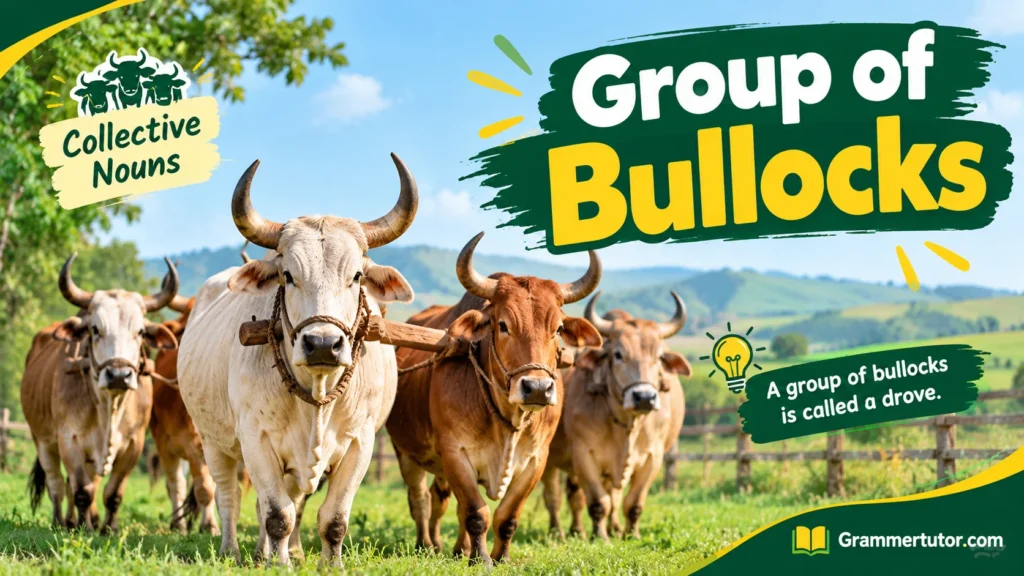
A group of bullocks is a simple and understandable expression for describing several bullocks gathered together. Unlike herd, which is an established animal-group term, group is a general word that can describe almost any collection of animals or other things.
This expression is useful when the exact number, activity, or arrangement of the bullocks is not important. It works well in everyday conversations, school assignments, and general descriptions of farm life.
Examples of “Group of Bullocks”
- A group of bullocks gathered near the feeding area.
- The farmer observed a group of bullocks in the pasture.
- A group of bullocks rested beside the farmhouse.
- The children counted a group of bullocks in the field.
- A group of bullocks walked towards the water trough.
- The farmer moved a group of bullocks into a larger enclosure.
- A group of bullocks stood quietly under the trees.
- The group of bullocks received fresh fodder in the evening.
- A group of bullocks crossed the farmyard together.
- The farmer checked the health of a group of bullocks.
Types of Bullocks and Their Characteristics
Bullocks are male cattle, usually castrated, although the precise meaning of the term varies by region. They are often associated with agricultural work because their muscular bodies and strong legs can help them pull carts, ploughs, and other equipment. Their appearance varies according to breed, age, diet, and environment.
Different types of cattle used as bullocks vary in size, coat color, strength, and adaptation to local conditions. Some are raised in warm climates and are well adapted to outdoor agricultural work, while others are suited to different environments and farming practices.
Bullocks are herbivores, meaning they primarily eat plant material. Their digestive systems allow them to obtain nutrients from fibrous foods such as grass and hay. Their behavior, physical characteristics, and working abilities make them important animals in traditional farming communities.
Examples of Bullock Characteristics
- Bullocks have strong bodies.
- Bullocks have cloven hooves.
- Bullocks primarily eat plant-based food.
- Bullocks have a four-compartment stomach.
- Bullocks can be trained for agricultural work.
- Bullocks may pull carts and ploughs.
- Bullocks can graze together in herds.
- Bullocks need clean water and suitable food.
- Different cattle breeds vary in size and appearance.
- Proper care helps support bullocks’ health and well-being.
Interesting Facts About Bullocks
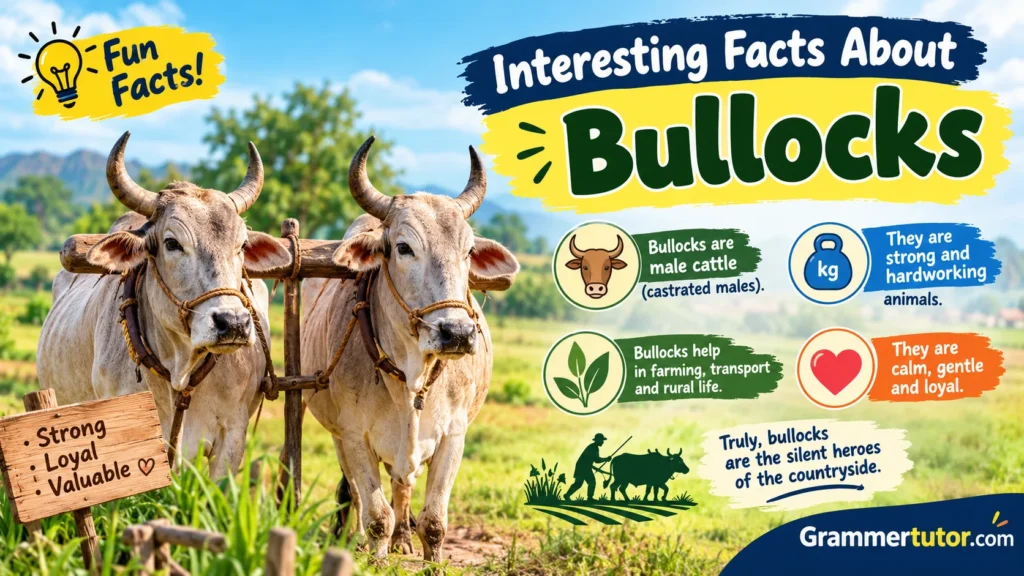
Bullocks are remarkable farm animals with physical characteristics closely connected to their diet and traditional working roles. Their lifespan varies depending on breed, nutrition, veterinary care, and working conditions. Cattle can live for around 15–20 years or sometimes longer, although individual lifespans differ considerably.
One of the most interesting physiological features of bullocks is their four-compartment stomach. The rumen, reticulum, omasum, and abomasum work together to help process plant material. Microorganisms in the rumen break down fibrous components of vegetation, allowing cattle to obtain nutrients from grasses and other foods that humans cannot digest in the same way. Their broad grinding teeth and specialized digestive system are well suited to a plant-based diet.
Bullocks primarily eat grass, hay, straw, and other suitable fodder. Depending on their nutritional needs and workload, their diet may also include legumes, crop residues, and balanced supplementary feed. Access to clean water, adequate nutrition, shade, and appropriate veterinary care is essential for maintaining their health, particularly when they perform demanding agricultural work.
Another interesting feature of bullocks is their social behaviour. Like other cattle, they can recognize familiar animals, form social relationships, and graze or rest near one another. These characteristics help explain why herd of bullocks is such a natural expression for describing animals gathered together. Their long association with ploughing, cart pulling, and transporting crops also explains the usefulness of terms such as team of bullocks and yoke of bullocks.
Bullocks therefore have an important place in both agricultural history and English vocabulary. Understanding their physical features, feeding habits, and social behaviour makes it easier to appreciate why different expressions are used to describe them in everyday language.
Conclusion
Collective noun for bullocks is commonly a herd of bullocks. Other expressions, such as team, yoke, pair, and group of bullocks, can be used depending on the situation. Learning these terms improves your English vocabulary and helps you describe bullocks, their social behaviour, and their important role in traditional farming more clearly.
FAQs
Q1. What is the collective noun for bullocks?
The most common general collective noun for bullocks is a herd of bullocks. It describes several bullocks living, grazing, or moving together.
Q2. What does “a herd of bullocks” mean?
A herd of bullocks means a group of bullocks gathered or living together, usually on a farm or in a pasture.
Q3. Can I say “a group of bullocks”?
Yes. A group of bullocks is a simple and grammatically correct expression for describing several bullocks together.
Q4. Can “team” be used for bullocks?
Yes. A team of bullocks describes bullocks working together, especially when pulling carts, ploughs, or other equipment.
Q5. What does “a yoke of bullocks” mean?
A yoke of bullocks generally refers to two bullocks harnessed together for pulling a plough or cart. A yoke is the device used to connect the animals to the equipment.
Q6. Is “pair of bullocks” a collective noun?
Pair of bullocks is a collective expression referring to two bullocks considered together. It is useful when describing two animals kept or used together.
Q7. What is the difference between a herd and a team of bullocks?
A herd describes bullocks gathered or living together, while a team emphasizes animals working together to perform a task.
Q8. Are bullocks social animals?
Yes. Bullocks, like other cattle, can recognize familiar animals and display social behaviours. They often graze and rest together, making herd an appropriate general term.
Q9. What do bullocks eat?
Bullocks mainly eat grass, hay, straw, and other plant-based fodder. They may also receive suitable supplementary feed depending on their nutritional needs and workload.
Q10. How long do bullocks live?
Bullocks’ lifespans vary according to breed, diet, health, and living conditions. Cattle can commonly live for around 15–20 years, although some live longer and others have shorter lifespans.