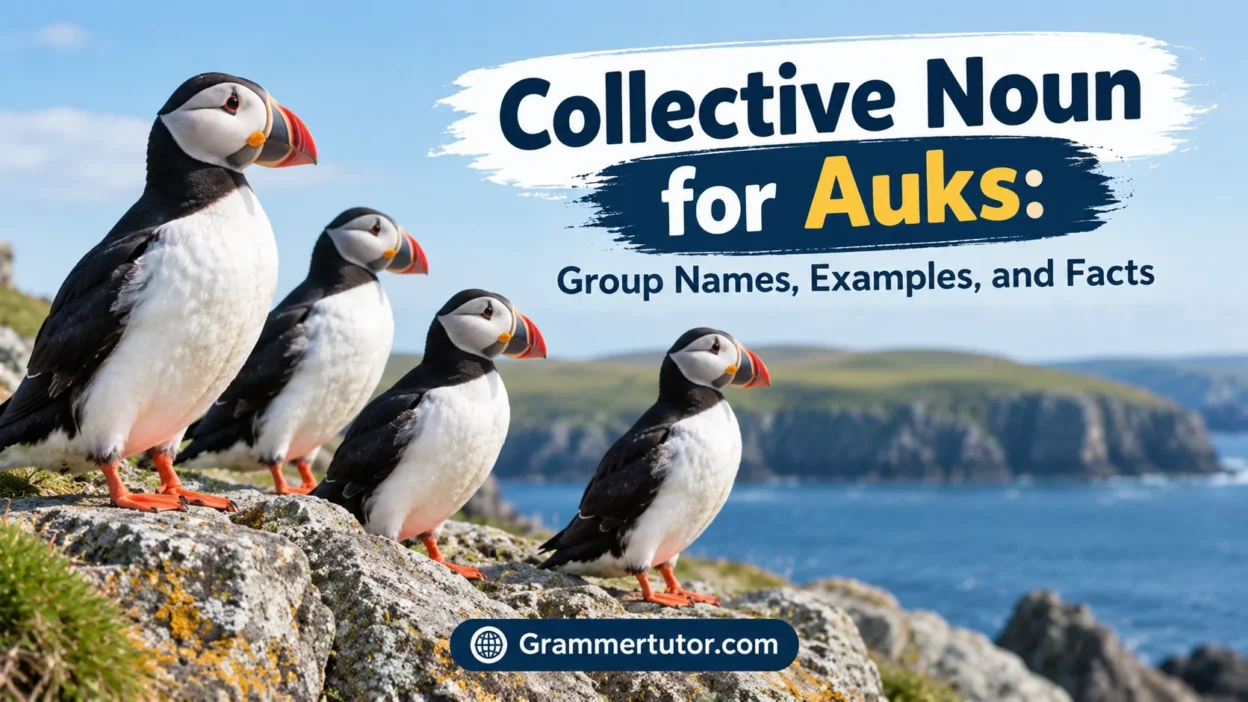
A collective noun for auks helps you describe these fascinating seabirds when they gather along rocky coastlines, swim in cold northern waters, or meet at breeding sites. A colony of auks is a useful term, especially when these birds gather to breed and nest.
You can also use a flock of auks or a group of auks, depending on their activity. A colony usually highlights a breeding group, while a flock can describe auks flying or moving together over the water. These expressions make your English vocabulary more precise and help you describe seabirds in their natural habitats. When observing auks, pay attention to what the birds are doing and where they are gathered.
These marine birds have compact bodies and remarkable swimming abilities that help them live in ocean habitats and cold-water regions. Whether you are describing nesting birds on rocky shores or swimming auks offshore, choosing the right collective noun makes your sentences clearer and helps readers understand the behavior and movement of these unusual seabirds.
Why Collective Nouns Are Used for Auks
Auks often gather in large numbers on coastal cliffs and isolated islands during the breeding season. These gatherings allow birds to nest near one another, find mates, and raise their chicks in suitable habitats. A collective noun makes it easier to describe many individual birds as one gathering.
For example, a colony is especially appropriate for auks nesting together, while a flock works well when they travel or feed in company. The general phrase group of auks is also correct when the exact activity is not important.
Understanding these expressions connects English grammar with wildlife observation and makes descriptions of seabirds clearer and more engaging.
Collective Nouns for Auks
| Collective Noun | Used For | Simple Example |
| Colony | Auks nesting together | A colony of auks occupied the cliffs. |
| Flock | Auks flying together | A flock of auks passed overhead. |
| Raft | Auks floating on the sea | A raft of auks drifted offshore. |
| Flight | Auks moving through the air | A flight of auks crossed the bay. |
| Loomery | A traditional name for a group of auks | A loomery of auks gathered near the rocks. |
These expressions are not equally common. Colony, flock, and raft are the most useful terms for ordinary descriptions of auks. Flight and loomery appear in traditional collective-noun lists.
Colony of Auks
A colony of auks describes birds gathering at a shared breeding location. Rocky islands, narrow ledges, and steep coastal cliffs can provide suitable nesting places for these seabirds. During the breeding season, many individuals may occupy the same area, creating a busy and noisy scene.
Examples of “Colony of Auks”
- A colony of auks occupied the rocky coastline.
- Researchers examined the nesting birds from a boat.
- A colony of auks returned to the island in spring.
- Several auks guarded their eggs on narrow ledges.
- The coastal colony became lively before sunrise.
- Young birds waited for their parents near the nests.
- A colony of auks filled the distant cliffs.
- Wildlife enthusiasts observed the seabirds through binoculars.
- The nesting site attracted scientists studying marine wildlife.
- A colony of auks settled on the isolated island.
Flock of Auks
A flock of auks refers to multiple birds flying or moving together. This expression is familiar in English and works well when describing seabirds travelling across the ocean or searching for suitable feeding grounds.
Examples of “Flock of Auks”
- A flock of auks swept across the horizon.
- Several seabirds flew above the chilly Atlantic.
- A flock of auks travelled toward distant islands.
- The birds disappeared behind a curtain of mist.
- Auks glided over the restless waves.
- The flock changed direction above the shoreline.
- Dark silhouettes passed beneath the cloudy sky.
- Auks flew toward a sheltered coastal inlet.
- The birds circled briefly before descending.
- A flock of auks headed out toward deeper waters.
Raft of Auks
A raft of auks describes birds floating together on the water. This term is particularly suitable when these seabirds gather on the sea’s surface between dives or while resting near their feeding grounds.
Examples of “Raft of Auks”
- A raft of auks floated beside the rocky island.
- The birds bobbed gently on the blue water.
- A raft of auks gathered beyond the harbor.
- The seabirds rested between underwater hunting trips.
- Auks floated together beneath the morning sunlight.
- The raft drifted farther away from the beach.
- Several birds dipped their heads beneath the surface.
- A raft of auks appeared beside a fishing vessel.
- The floating birds scattered when a wave arrived.
- Auks rested on the ocean while the wind weakened.
Flight of Auks
A flight of auks is a traditional expression describing these birds in the air. It is useful for writing vivid descriptions of seabirds travelling between their nesting areas and the open sea. Although understandable, flock of auks is more familiar in everyday English.
Examples of “Flight of Auks”
- A flight of auks crossed the distant headland.
- The birds rose above the crashing surf.
- A flight of auks travelled toward the northern coast.
- Seabirds passed over the fishing village.
- A flight of auks disappeared into the evening haze.
- The birds swept past the lighthouse.
- A flight of auks moved above the rugged cliffs.
- The seabirds travelled together across the bay.
- A flight of auks appeared against the pale sky.
- The birds descended toward their island habitat.
Loomery of Auks
A loomery of auks is an unusual traditional collective expression found in lists of bird group names. It is far less familiar than colony, flock, or raft, so it is best treated as an interesting vocabulary term rather than the normal choice for everyday conversation.
Examples of “Loomery of Auks”
- A loomery of auks gathered along the remote coast.
- The traditional term appeared in an old bird-name list.
- A loomery of auks occupied the rocky island.
- The naturalist recorded the unusual expression in a notebook.
- A loomery of auks rested near the nesting grounds.
- The students learned this uncommon bird-group name.
- A loomery of auks appeared in the wildlife description.
- The guide explained the historical naming tradition.
- A loomery of auks occupied the distant headland.
- The unusual term added interest to the vocabulary lesson.
Types of Auks and Their Characteristics
Auks belong to the bird family Alcidae, which includes several distinctive seabirds adapted to life in northern oceans. Familiar members include puffins, guillemots, murres, razorbills, and little auks. Although their appearances differ, many share compact bodies, relatively short wings, and strong swimming abilities.
Unlike seabirds that mainly skim over the ocean, auks use their wings to propel themselves underwater while pursuing prey. Their dense plumage provides insulation in cold marine environments, and their streamlined bodies help them move efficiently beneath the surface. Different species occupy different habitats, with some nesting on steep cliffs and others choosing rocky crevices or sheltered island slopes.
Examples of Auk Characteristics
- Puffins belong to the auk family.
- Many auks breed on northern coastal islands.
- Their wings help propel them underwater.
- Several species have dark upper plumage.
- Some auks possess brightly colored beaks during breeding season.
- Their feathers help retain body heat.
- Many species feed on small marine animals.
- Certain auks nest on narrow cliff ledges.
- Their feet help them steer while swimming.
- Breeding colonies can contain numerous nesting birds.
Interesting Facts About Auks
Auks have interesting life histories, and their longevity varies considerably by species. Some, including common guillemots, can survive for more than two decades in favorable circumstances. Their ability to live for many years is connected with their slow life histories, although survival depends on environmental conditions, food availability, predators, and human impacts. Their bodies are specially adapted for marine life: short, powerful wings provide underwater propulsion, dense feathers offer insulation, and streamlined shapes reduce resistance as they pursue prey.
Most auks feed on fish and other small marine animals, including crustaceans and squid, depending on the species and location. Adults may travel considerable distances to find food and bring prey back to their chicks. These birds also demonstrate how different environments influence group behavior. Nesting auks may form colonies on land, while birds resting offshore can gather in rafts. Such differences explain why several collective nouns can describe the same family of seabirds in different situations.
READ MORE: Collective Nouns for Butterfly Fish: Examples, and Interesting Facts
Conclusion
Understanding the collective noun for auks makes it easier to describe these fascinating seabirds in different situations. A colony of auks is commonly used for birds gathered at breeding sites, while a flock of auks and a group of auks are useful alternatives depending on the context. Learning these collective nouns can improve your English vocabulary and help you describe the behavior, habitats, and group activities of auks more clearly.
FAQs
Q1. What is the collective noun for auks?
The most recognized collective nouns include colony, flock, and raft. A colony usually describes nesting birds, a flock can describe birds flying together, and a raft refers to birds floating on the water.
Q2. Is “colony of auks” correct?
Yes. A colony of auks is an appropriate expression for seabirds nesting together at a breeding site.
Q3. What is a raft of auks?
A raft of auks describes several auks floating together on the sea. The term is especially useful when discussing birds resting on the water.
Q4. What do auks eat?
Auks mainly eat marine prey such as fish and small invertebrates. Their precise diet varies according to species, season, and food availability.
Q5. Why do auks gather in colonies?
Many auks nest close together on coastal cliffs and islands. Breeding colonies provide shared nesting areas, although the advantages and exact behavior vary between species.