The collective noun for pigs is useful when describing how these intelligent animals gather and live together, making your English sentences clearer and more natural.Pigs are social animals that gather in groups, live in groups, and communicate with one another. They often stay close to other pigs while feeding and resting. The terms herd of pigs, droves of pigs, and sounder of pigs can describe pig groups in different situations.
A herd is a general term for animals living together, a drove often refers to animals being driven, and a sounder is especially associated with wild pigs. These collective nouns for pigs help you describe pigs and understand their group behavior, social behavior, animal communication, feeding behavior, and resting behavior. Learning these group names is useful for a school assignment, understanding farm animals, and improving your English vocabulary.When learning pig terminology and animal terminology, focus on word meanings, contextual usage, and correct usage. These collective terms, including pig herd, pig drove, and pig sounder, make group descriptions more specific.
Practicing simple examples and sentence examples improves English writing, sentence clarity, and word choice. For example, “A sounder of pigs moved through the woods” demonstrates how a collective noun works in everyday English. Studying grammar, nouns, plural animals, and English grammar supports vocabulary development, language learning, and writing skills. It also strengthens language skills, helps you use common expressions, and makes your descriptive language more effective. With practice, you can use the English language to create natural English sentences and accurate descriptions of pigs and their behavior.
Why Collective Nouns Are Used for Pigs
Collective nouns give a name to a group of people, animals, or things. Instead of saying “many pigs” every time, you can use a more specific expression, such as a herd of pigs. This makes your writing more natural and helps readers picture the animals more easily.
Pigs are social animals that often live and move together. On farms, several pigs may share a pen or feeding area. In the wild, groups of pigs may travel together while searching for food or shelter. Collective nouns help describe these different situations without repeating the same words.
These expressions are also useful for students and English learners. They help build vocabulary, improve sentence construction, and make stories about animals more descriptive. For example, “A herd of pigs walked across the field” gives readers a clearer picture than “Many pigs walked across the field.”
Some collective nouns are more common than others. Herd is a widely understood general term, while drove and sounder may be used in particular contexts. The best choice depends on the type of pigs and the situation you want to describe.
Collective Nouns for Pigs

Several collective nouns can describe groups of pigs. Some are common in everyday English, while others are more specific or descriptive.
| Collective Noun | Used For | Simple Example |
| Herd | A group of pigs living or moving together | A herd of pigs rested in the shade. |
| Drove | A group of pigs being driven or moving together | A drove of pigs crossed the lane. |
| Sounder | A group of wild pigs, especially wild boars and related pigs | A sounder of wild pigs searched for food. |
| Litter | Young pigs born to one sow at the same time | A litter of piglets slept beside their mother. |
| Team | Pigs working or being managed together in a specific context | The team of pigs took part in a farm activity. |
| Group | A general term for pigs gathered together | A group of pigs gathered near the trough. |
| Passel | An informal or regional term sometimes used for a group | A passel of pigs wandered around the enclosure. |
Remember: “Herd” is a safe, familiar choice for a general group of pigs. “Litter” refers specifically to piglets born together, not to a group of adult pigs. “Sounder” is especially associated with groups of wild pigs.
Herd of Pigs
A herd of pigs is a common way to describe several pigs living, feeding, resting, or moving together. The word “herd” is used for many animals, including cattle, elephants, and pigs. It works well in everyday conversation, schoolwork, and descriptive writing.
Pigs in a herd may gather around food, rest near one another, or explore their surroundings. On a farm, the term can describe pigs sharing an enclosure or pasture. It doesn’t require a particular number of animals; the important point is that they form a group.
Examples of “Herd of Pigs”
- A herd of pigs walked slowly across the muddy field.
- The farmer watched a herd of pigs eating their breakfast.
- A herd of pigs rested beneath a large tree.
- The children saw a herd of pigs near the barn.
- A herd of pigs gathered around the feeding trough.
- The farmer moved the herd of pigs into a clean enclosure.
- A herd of pigs searched the ground for fallen apples.
- The herd of pigs made loud noises as they waited for food.
- A herd of pigs followed the farmer along the path.
- We photographed a herd of pigs during our visit to the farm.
Drove of Pigs
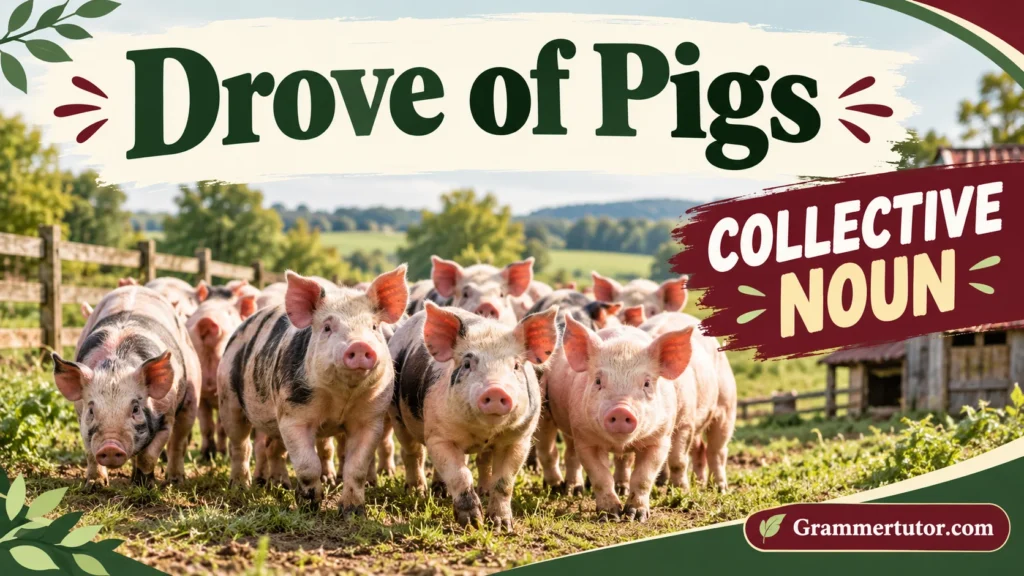
A drove of pigs is another expression used for a group of pigs. The word “drove” is connected with the idea of driving or moving animals from one place to another. It can be particularly suitable when pigs are being guided along a road, track, or farm path.
This term gives a sentence a sense of movement. While “herd” is a broad, everyday choice, “drove” can emphasize that the pigs are travelling together or being moved by a farmer or handler.
For example, “A drove of pigs moved toward the market” highlights the animals’ journey. The expression may sound less familiar to some readers than “herd of pigs,” but it is useful when the context involves movement.
Examples of “Drove of Pigs”
- A drove of pigs moved along the country road.
- The farmer guided a drove of pigs toward the pasture.
- A drove of pigs passed the old wooden fence.
- The villagers watched a drove of pigs cross the village lane.
- A drove of pigs followed the handler toward the barn.
- The drove of pigs moved slowly through the farmyard.
- A drove of pigs travelled along the dusty track.
- The farmer kept the drove of pigs away from the vegetable garden.
- A drove of pigs entered the enclosure before sunset.
- The children stood safely aside as a drove of pigs passed.
Sounder of Pigs
A sounder of pigs is a term commonly associated with wild pigs, including wild boars and feral pigs. These animals may form social groups while searching for food, raising young, or moving through their habitat.
A sounder often includes related females and their young, although group composition can vary. Adult males may spend more time alone, particularly outside the breeding season. The term is especially useful when writing about wild pigs rather than pigs kept in ordinary farm settings.
If you’re describing animals in a forest or other natural habitat, “sounder” can add precision to your sentence. However, for a general group of domestic pigs, “herd” will usually be easier for readers to understand.
Examples of “Sounder of Pigs”
- A sounder of wild pigs searched for food in the forest.
- The wildlife photographer spotted a sounder of pigs near the trees.
- A sounder of wild pigs crossed the woodland trail.
- The sounder of pigs moved quietly through the undergrowth.
- A sounder of wild pigs gathered near a muddy pool.
- The ranger noticed a sounder of pigs near the edge of the woods.
- A sounder of pigs disappeared into the thick vegetation.
- The young pigs stayed close to the adults in the sounder.
- A sounder of wild pigs searched the soil for roots and insects.
- The researchers observed a sounder of pigs from a safe distance.
Litter of Piglets
A litter of piglets refers to the young pigs born to one sow during a single birth. This expression is different from the other terms because it describes piglets born together rather than any group of pigs.
A sow may give birth to several piglets at once. After birth, the piglets depend on their mother for milk, warmth, and protection. As they grow, they begin exploring their surroundings and learning to feed independently.
The word “litter” is also used for the young of several other mammals, including puppies and kittens. When discussing pigs, it is most accurate to use the expression “a litter of piglets” when referring to siblings born together.
Examples of “Litter of Piglets”
- A litter of piglets slept beside their mother.
- The farmer checked the litter of piglets early in the morning.
- A litter of piglets followed the sow around the pen.
- The children watched a litter of piglets explore the straw.
- A healthy litter of piglets began feeding soon after birth.
- The sow kept her litter of piglets close to her.
- A litter of piglets rested in a warm corner of the barn.
- The farmer prepared a clean area for the new litter of piglets.
- A litter of piglets made soft squealing sounds.
- The veterinarian examined the litter of piglets during the farm visit.
Team of Pigs
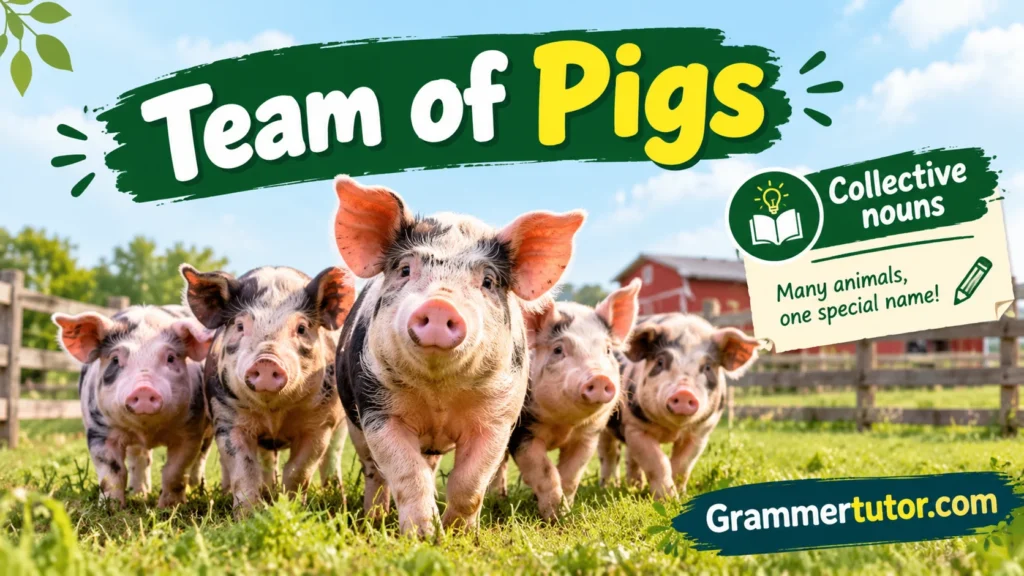
The word team can describe animals working or being managed together in a particular activity. However, it isn’t one of the most common general collective nouns for pigs. It is best used when the context clearly involves pigs acting together in an organized task or activity.
For everyday descriptions of pigs feeding, resting, or living together, “herd” is usually more natural. You may use “team” in a specific story or farm activity, but it shouldn’t be presented as the standard name for every group of pigs.
Examples of “Team of Pigs”
- The team of pigs took part in the farm demonstration.
- The farmer organized the team of pigs for a special activity.
- A team of pigs appeared in the educational show.
- The children learned how the team of pigs was cared for.
- The team of pigs was guided into the training area.
- The farmer observed the team of pigs during the activity.
- A team of pigs was featured in the farm’s annual event.
- The handler prepared the team of pigs before the demonstration.
- The team of pigs attracted attention from visitors.
- The farm staff carefully managed the team of pigs.
Group of Pigs
Group of pigs is a simple and flexible expression that works in almost any situation. Although “group” is a general collective noun rather than a pig-specific term, it is perfectly understandable and grammatically correct.
You can use it when you don’t know which specialized term fits the situation. It works for pigs on a farm, pigs in a story, or pigs seen in a natural environment. It is also useful for young students who are learning collective nouns for the first time.
For example, “A group of pigs gathered near the fence” is clear and natural. If you want to add more detail, you can replace “group” with “herd” for a more specific description of pigs living or moving together.
Examples of “Group of Pigs”
- A group of pigs gathered near the barn.
- The group of pigs ate fresh food from the trough.
- A group of pigs rested in the shade.
- We saw a group of pigs during our school trip.
- A group of pigs walked across the farmyard.
- The farmer counted the group of pigs before feeding them.
- A group of pigs explored the muddy enclosure.
- The group of pigs stayed together during the rain.
- A group of pigs followed the sound of the feeding bucket.
- The children learned about a group of pigs at the farm.
Passel of Pigs
Passel is an informal or regional word that can mean a group or a large number of people or animals. It is sometimes used descriptively for groups of pigs, but it is much less familiar than “herd.”
Because usage varies by region, “passel of pigs” is best suited to informal storytelling or colorful writing rather than formal scientific descriptions. If your goal is clear, everyday English, “herd of pigs” remains the more reliable choice.
Examples of “Passel of Pigs”
- A passel of pigs wandered around the farmyard.
- The farmer found a passel of pigs near the open gate.
- A passel of pigs gathered beside the old shed.
- The children laughed as a passel of pigs chased one another.
- A passage of pigs explored the muddy field.
- The farmer led a passel of pigs toward the feeding area.
- A passel of pigs rested beneath the trees.
- The visitors watched a passel of pigs near the fence.
- A passel of pigs scattered when they heard a loud noise.
- The story described a passel of pigs living on a small farm.
How Pigs Behave in Groups
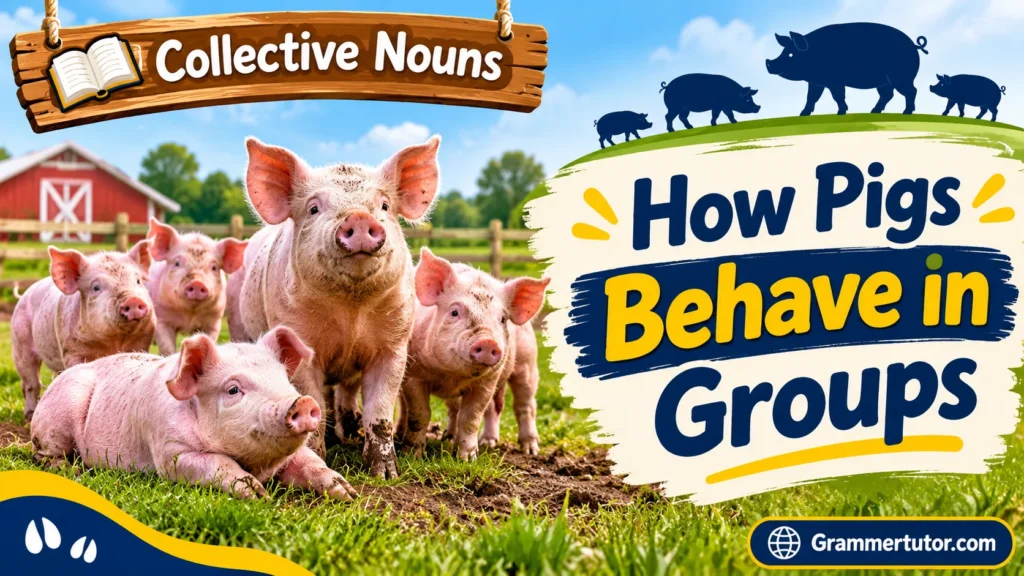
Pigs are intelligent animals with complex social behaviors. They use sounds, smells, body movements, and physical contact to communicate with other pigs. These behaviors help them find food, recognize familiar animals, and respond to their surroundings.
On farms, pigs often develop social relationships with the animals around them. They may rest together, explore their enclosure, or gather near feeding areas. When unfamiliar pigs meet, they may compete to establish their place in the social group.
Mother pigs, known as sows, also show important social and maternal behaviors. A sow prepares a nest before giving birth and cares for her piglets after they arrive. The young pigs stay close to her during their early days, making “litter of piglets” a useful expression when discussing newborns.
Wild pigs display group behavior as well. A sounder may travel through woodland, search for roots and insects, or gather near water. These groups can help young pigs remain close to adult females and may offer protection as the animals move through their habitat.
Understanding these behaviors can help you select the right collective noun. Use “herd” for a general group, “drove” when movement is important, “sounder” for a group of wild pigs, and “litter” when referring to piglets born together.
Interesting Facts About Pigs
Pigs are fascinating mammals with several traits that make them different from many other farm animals. With proper care, domestic pigs can often live for around 10 to 15 years, although their lifespan depends on breed, health, and living conditions. Their strong sense of smell helps them locate food underground, and their snouts are adapted for rooting through soil. Pigs are omnivores, which means they can eat a variety of plant-based foods and animal matter, depending on what is available and safe. They are also highly intelligent and can learn routines, recognize familiar individuals, and solve certain problems. Unlike humans, pigs have very few functional sweat glands, so they rely on other ways to cool themselves, including seeking shade and wallowing in mud. Mud can help them regulate body temperature and protect their skin from sunlight and insects. Mother pigs build nests before giving birth and care for their piglets, which begin exploring and interacting with their surroundings as they grow. These features make pigs interesting animals to study and give writers plenty of details to include when describing a herd, sounder, or litter.
READ MORE: Collective Noun for Flyingfish: A Complete Guide with Examples
Conclusion
The most common collective noun for pigs depends on the situation, but herd, drove, and sounder are useful terms to know. A herd of pigs describes a group generally, a drove of pigs can refer to pigs being driven together, and a sounder of pigs is especially associated with wild pigs. Learning these terms improves your English vocabulary, strengthens your writing skills, and helps you describe animal groups clearly and naturally.
FAQs
Q1. What is the collective noun for pigs?
Common collective nouns for pigs include herd, drove, and sounder. The best choice depends on the context.
Q2. What is a group of pigs called?
A group of pigs can be called a herd of pigs. Other terms include a drove of pigs and a sounder of pigs.
Q3. Is herd a collective noun for pigs?
Yes, herd is a commonly used collective noun for pigs and other animals that live or move together.
Q4. What does a sounder of pigs mean?
A sounder of pigs is a term especially associated with a group of wild pigs, including wild boars.
Q5. What is a drove of pigs?
A drove of pigs refers to a group of pigs being driven or moved together, often from one place to another.
Q6. Which collective noun is used for wild pigs?
Sounder is a traditional term for a group of wild pigs. The word is also used for groups of wild boars.
Q7. Do pigs live in groups?
Yes, pigs are social animals that often live in groups. They communicate with one another and may stay close while feeding or resting.
Q8. What is the difference between a herd and a sounder of pigs?
Herd is a general term for a group of animals, while sounder is more specifically associated with groups of wild pigs.
Q9. How do I use a collective noun for pigs in a sentence?
You can write, “A herd of pigs rested near the farm.” Another example is, “A sounder of wild pigs moved through the woods.”
Q10. Why should I learn collective nouns for pigs?
Learning collective nouns improves your English vocabulary, helps you choose accurate words, and makes your sentences clearer when describing animals.