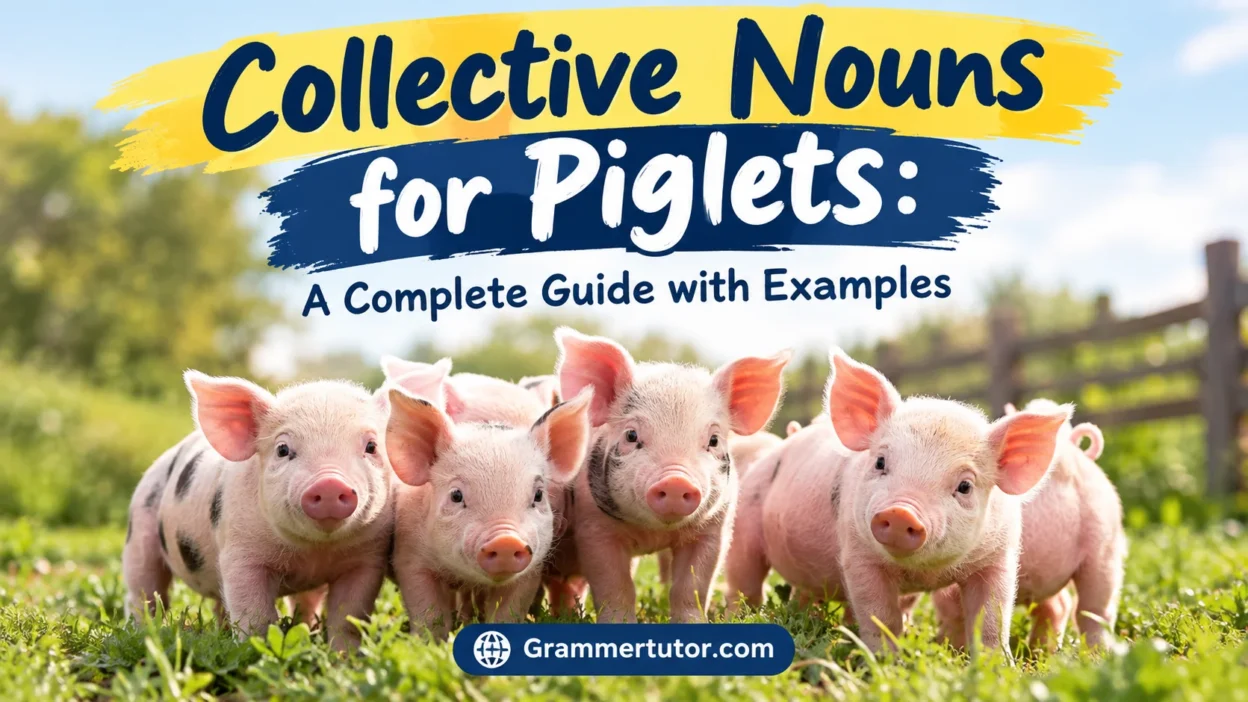
The collective noun for piglets helps you describe young pigs naturally when they appear together with their mother or other pigs.In everyday English, expressions such as litter, farrow, and herd describe a group of piglets or pigs in different situations.
A litter of piglets is closely connected with birth, while a farrow of piglets can describe young pigs born together. A herd of pigs is more general and can refer to pigs as a group rather than focusing only on young animals. Learning these descriptive terms makes your sentences more natural, interesting, and vivid.
For farm animals, these animal group names are useful when studying English vocabulary, writing, or describing animals. From my experience, connecting each term with a real farm setting makes the vocabulary easier to remember. If you are curious about animal names, learning these expressions is a useful addition to your vocabulary and helps you choose the right words when describing piglets.
Why Collective Nouns Are Used for Piglets
Piglets are naturally social and usually stay close to their mother and siblings during their early lives. They often sleep together, feed together, play with one another, and follow their mother around the farm or enclosure.
Because piglets are commonly born and raised together, some collective nouns are connected with birth and family groups. Other expressions describe pigs more generally rather than specifically focusing on young piglets.
These terms make descriptions more precise. For example, litter is particularly useful when talking about piglets born to the same mother, while farrow is connected with a sow giving birth to piglets.
Collective Nouns for Piglets
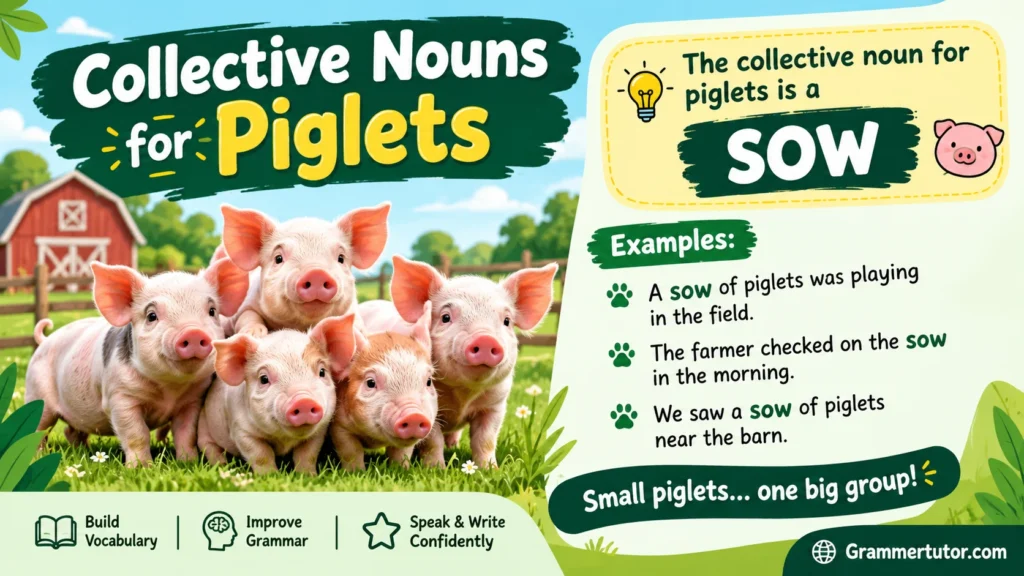
| Collective Noun | Used For | Simple Example |
| Litter | Piglets born to the same mother | A litter of piglets slept together. |
| Farrow | A group of piglets born at one time | A farrow of piglets followed the sow. |
| Brood | A group of young animals | A brood of piglets stayed near the mother. |
| Herd | A larger group of pigs | A herd of pigs moved across the farm. |
| Group | A general collection of piglets | A group of piglets played in the yard. |
Litter of Piglets
A litter is one of the most appropriate terms for a group of piglets born to the same mother. It is commonly used when discussing the young produced by one sow during a single birth.
This makes a litter of piglets especially useful when talking about newborn pigs and their siblings.
Examples of “Litter of Piglets”
- A litter of piglets slept beside their mother.
- The farmer cared for a litter of piglets.
- A litter of piglets followed the sow.
- The litter of piglets stayed warm together.
- A healthy litter of piglets was born in the barn.
- The sow watched over her litter of piglets.
- A litter of piglets played near the feeding area.
- The farmer checked the litter of piglets every morning.
- The litter of piglets gathered around their mother.
- A litter of piglets rested in the straw.
Farrow of Piglets
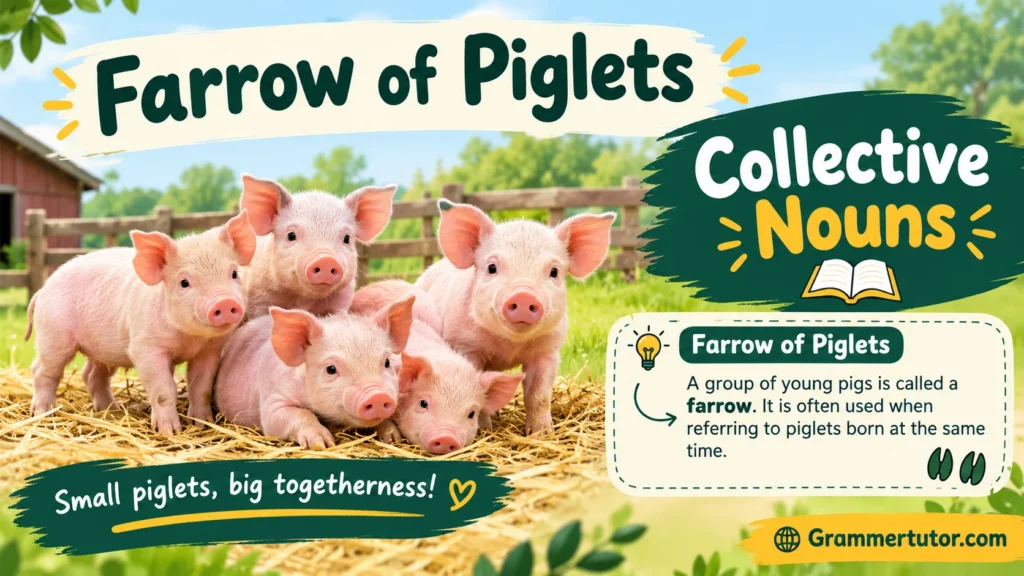
A farrow is another term associated with piglets and pig breeding. It is connected with the process of a sow giving birth and can be used to describe the piglets produced at one birth.
The expression a farrow of piglets is therefore more closely connected with reproduction than with simply describing young pigs playing together.
Examples of “Farrow of Piglets”
- A farrow of piglets was born during the night.
- The farmer carefully monitored the farrow of piglets.
- A healthy farrow of piglets followed the sow.
- The farrow of piglets stayed close to their mother.
- The farmer provided shelter for the farrow of piglets.
- A new farrow of piglets arrived in the barn.
- The farrow of piglets rested on the clean straw.
- The sow protected her farrow of piglets.
- The farmer checked the farrow every morning.
- The farrow of piglets grew stronger each week.
Brood of Piglets
A brood is a general term for a group of young animals cared for by a mother. It can be used descriptively for young piglets gathered around their mother, although litter is more specific and natural when referring to piglets born together.
The expression can be useful in literary or descriptive writing when you want to emphasize the relationship between the mother and her young.
Examples of “Brood of Piglets”
- A brood of piglets followed the sow.
- The mother watched over her brood of piglets.
- A brood of piglets rested beside the mother.
- The brood of piglets stayed close together.
- The sow guided her brood through the yard.
- A brood of piglets played in the straw.
- The farmer observed the brood of piglets.
- The brood gathered around the sow.
- A brood of piglets slept peacefully.
- The mother protected her brood from danger.
Herd of Piglets
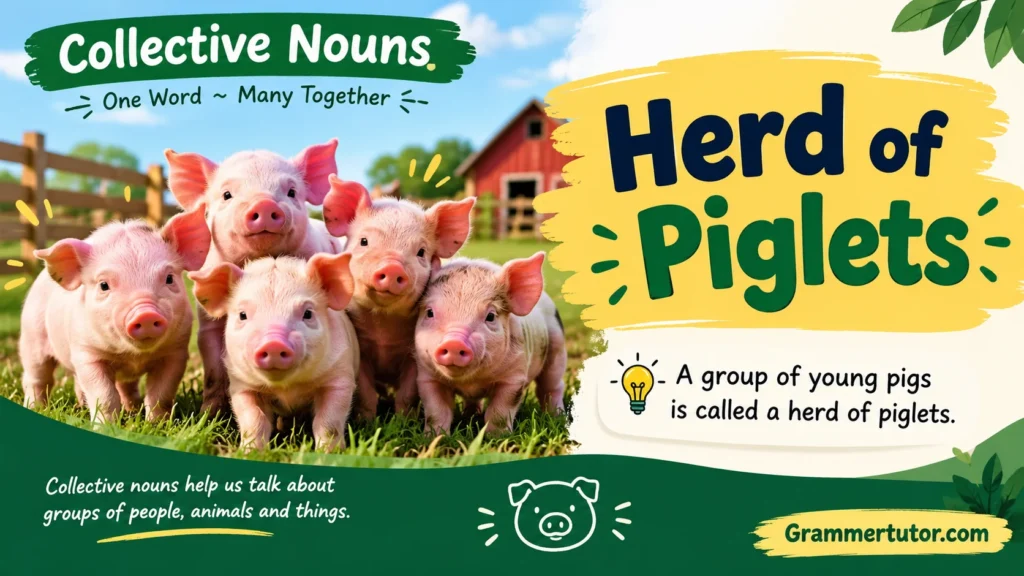
A herd is generally used for a group of pigs rather than specifically for young piglets. However, it can be appropriate when piglets are part of a larger group of pigs.
If you’re specifically describing young pigs born to the same mother, litter is usually the more precise expression.
Examples of “Herd of Pigs”
- A herd of pigs moved across the farm.
- The herd of pigs searched for food.
- A large herd of pigs gathered near the shelter.
- The farmer watched the herd of pigs.
- The herd of pigs rested in the shade.
- A herd of pigs walked through the field.
- The herd moved toward the feeding area.
- A large herd of pigs lived on the farm.
- The herd gathered near the water.
- The farmer cared for the herd every day.
Group of Piglets
A group of piglets is a simple general expression that can be used whenever several young pigs are together. It isn’t a specialized collective noun, but it is clear and completely understandable.
This expression works well when you don’t need to specify whether the piglets belong to the same litter or were born at the same time.
Examples of “Group of Piglets”
- A group of piglets played in the yard.
- We saw a group of piglets near the barn.
- The group of piglets followed the farmer.
- A group of piglets gathered around the sow.
- The group of piglets rested in the straw.
- A group of piglets searched for food.
- The farmer watched the group of piglets.
- A group of piglets ran across the enclosure.
- The group of piglets stayed close to their mother.
- A group of piglets played together in the mud.
Piglet Behavior and Social Life
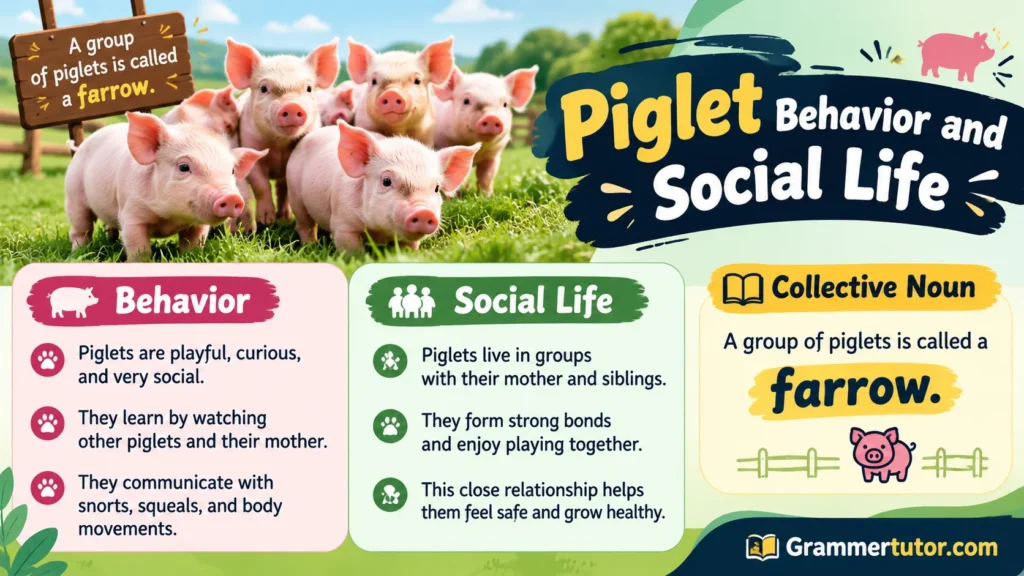
Piglets are highly active and social young animals. During their early lives, they generally remain close to their mother and siblings. They communicate using a variety of sounds, including grunts and squeals, and can respond to their mother’s calls.
Newborn piglets often compete for access to their mother’s milk. They can develop a particular nursing position, which helps them return to a consistent teat during feeding. This early competition is an important part of their development.
Piglets also spend considerable time exploring and playing. They may push, chase, nudge, root, and interact with their siblings. These activities help young pigs develop physical coordination and social skills.
Their strong sense of smell is also important. Pigs use their noses to investigate their surroundings and locate food. Rooting in soil is a natural behavior that allows pigs to search for roots, insects, and other food items.
Piglets also benefit from staying close to their mother. The sow provides food, warmth, protection, and social guidance. As the piglets grow, they become increasingly independent while continuing to interact with other pigs.
Examples of Piglet Behavior
- Piglets often stay close to their mother.
- Piglets communicate using different sounds.
- Piglets play with their siblings.
- Piglets use their noses to explore.
- Piglets naturally enjoy rooting.
- Piglets can compete for access to milk.
- A litter of piglets may sleep together.
- Piglets follow their mother around the enclosure.
- Young pigs explore their surroundings.
- Piglets develop social skills through interaction.
Interesting Facts About Piglets
Piglets are the young offspring of pigs and undergo rapid development during their early lives. Their lifespan ultimately depends on factors such as genetics, breed, nutrition, healthcare, and living conditions. Domestic pigs can live for many years when properly cared for, although the lifespan of pigs raised for agricultural production is often much shorter because of their production role.
One of the most interesting physiological features of piglets is their strong sense of smell. Their snouts are highly sensitive and are important tools for exploring the environment and locating food. Piglets also have relatively strong legs soon after birth, allowing them to move around and follow their mother. Their skin and body characteristics develop rapidly as they grow.
Piglets are omnivores, meaning pigs can consume both plant and animal foods. Depending on their environment, pigs may eat grains, roots, fruits, vegetables, insects, and other suitable foods. Domestic piglets are generally provided with nutritionally balanced feed designed to support healthy growth.
Their dietary needs change as they mature. Very young piglets depend heavily on their mother’s milk, which provides important nutrients and energy. As they grow, they gradually become accustomed to solid foods. This transition allows their digestive system to adapt to a broader diet.
Piglets are also remarkably intelligent and curious animals. They use their noses to investigate objects, search for food, and explore new surroundings. Their natural rooting behavior is one of the most recognizable characteristics of pigs.
Examples of Piglet Facts
- Piglets are young pigs.
- Piglets are social animals.
- Piglets often stay close to their mother.
- Pigs have a highly developed sense of smell.
- Piglets use their snouts to explore.
- Pigs are omnivores.
- Piglets initially depend on their mother’s milk.
- Piglets gradually begin eating solid foods.
- Young pigs enjoy exploring their surroundings.
- Piglets often play with their siblings.
READ MORE: Collective Nouns for Boars: A Complete Guide with Examples
Conclusion
Understanding the collective noun for piglets makes it easier to describe groups of young pigs clearly and naturally. Litter and farrow are closely associated with young pigs and their birth, while herd is a broader term for pigs as a group. Learning these expressions can improve your English vocabulary and make writing about farm animals more accurate and interesting.
FAQs
Q1. What is the collective noun for piglets?
The most common collective noun for piglets is litter. You can say a litter of piglets when referring to young pigs born together.
Q2. What is a group of piglets called?
A group of piglets can be called a litter of piglets. Farrow is another term associated with a group of young pigs born at the same time.
Q3. Is “litter” a collective noun for piglets?
Yes. Litter is a commonly used term for a group of piglets, especially when they are from the same birth.
Q4. Can you say “a farrow of piglets”?
Yes. Farrow can refer to a group of piglets born to the same sow, although litter is more familiar in general English.
Q5. Can “herd” be used for piglets?
Yes, a herd can describe pigs kept or moving together. However, it is more general and doesn’t specifically emphasize that they are piglets.
Q6. What is the difference between a litter and a herd of pigs?
A litter usually refers to young pigs born together, while a herd refers more generally to pigs living or moving together.
Q7. What is a baby pig called?
A baby pig is called a piglet. Piglets are young pigs, usually associated with their mother during their early stage of life.
Q8. What is the collective noun for baby pigs?
Litter is a common collective noun for baby pigs. Farrow can also be used when referring to piglets born together.
Q9. Why are collective nouns for piglets useful?
Collective nouns make animal-related writing more precise and varied. Instead of repeatedly saying “a group of piglets,” you can use terms such as litter or farrow.
Q10. Which collective noun should I use for piglets?
Use litter of piglets when you mean piglets born together. Use a herd of pigs when referring to pigs generally as a group.