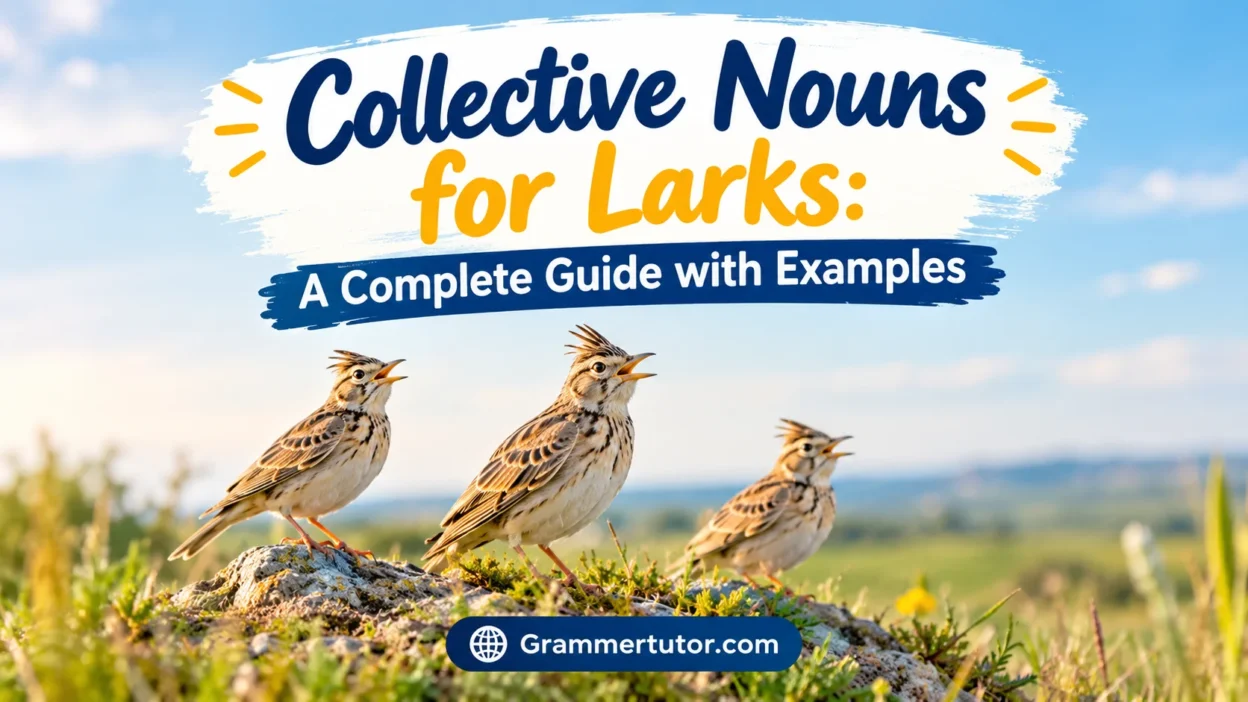
Learning Collective Nouns for Larks gives English learners simple ways to describe these lively birds when they gather together in nature. Instead of always saying a group of larks, writers can use varied expressions to make descriptions more vivid and specific. These terms are useful for anyone interested in birds, vocabulary, or natural writing.
Larks are famous for their beautiful songs and their habit of singing while flying. Their presence in open fields, grasslands, and farmland has inspired many descriptive expressions. Learning the collective nouns associated with larks can improve your English vocabulary and help you understand their fascinating bird behavior more clearly.
Different collective nouns can suit different situations. Some describe larks gathered together on the ground, while others create an image of several birds moving or singing in the sky. For readers interested in nature writing, these expressions can make descriptions more colorful and memorable.
Why Collective Nouns Are Used for Larks
Larks are small songbirds that are often associated with open landscapes. They may gather while feeding, rest together in suitable areas, or fly through the air while producing their characteristic songs. Their active movements and distinctive vocal behavior make them interesting subjects for collective nouns.
Using a collective noun also makes a sentence more precise. Instead of saying many larks were flying together, a writer can choose an expression that creates a stronger mental image of the birds. These terms are particularly useful in descriptive writing, birdwatching notes, stories, and educational material.
Collective Nouns for Larks
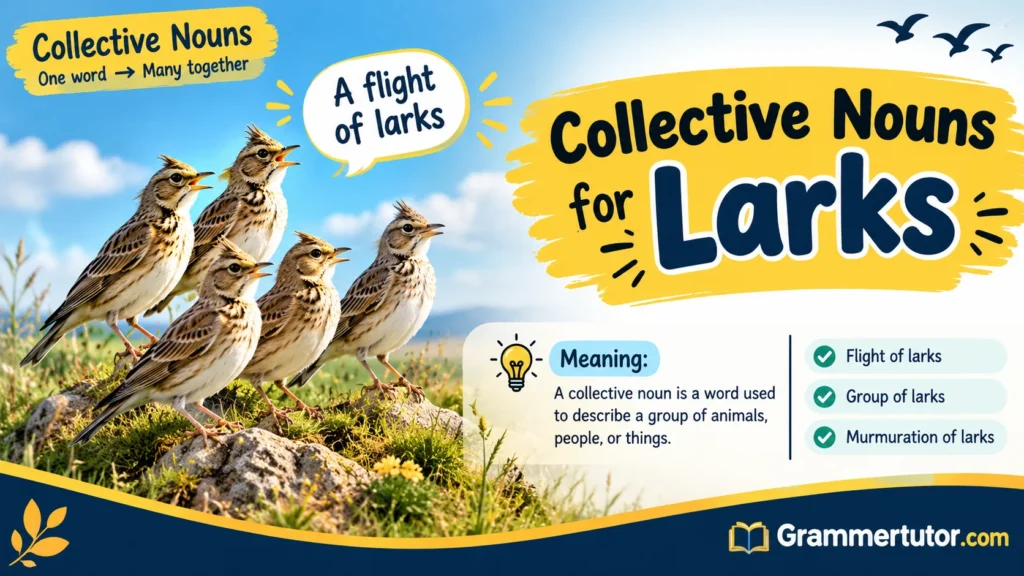
| Collective Noun | Used For | Simple Example |
| Exaltation | A group of larks, especially when singing or flying | An exaltation of larks rose above the field. |
| Bevy | A group of larks gathered together | A bevy of larks searched the grass. |
| Flock | Larks moving or flying together | A flock of larks crossed the meadow. |
| Company | A group of larks gathered together | A company of larks rested nearby. |
| Flight | Larks flying together | A flight of larks moved across the sky. |
| Group | A general collection of larks | A group of larks gathered in the field. |
| Chime | A poetic expression connected with singing larks | A chime of larks filled the morning air. |
Exaltation of Larks
Exaltation is the most distinctive traditional collective noun associated with larks. The word is particularly fitting because larks are famous for their uplifting songs, often produced while the birds fly high above open fields.
The expression an exaltation of larks creates a vivid image of several singing birds rising into the sky. It is especially effective in literary, descriptive, and nature writing.
Examples of “Exaltation of Larks”
- An exaltation of larks rose above the meadow.
- We heard an exaltation of larks at sunrise.
- An exaltation of larks filled the morning sky with song.
- The exaltation of larks flew over the open field.
- An exaltation of larks sang above the farmland.
- We watched an exaltation of larks climbing into the sky.
- The exaltation of larks created a beautiful morning sound.
- An exaltation of larks appeared above the grassland.
- The birds formed an exaltation as they rose together.
- An exaltation of larks welcomed the new day with song.
Bevy of Larks
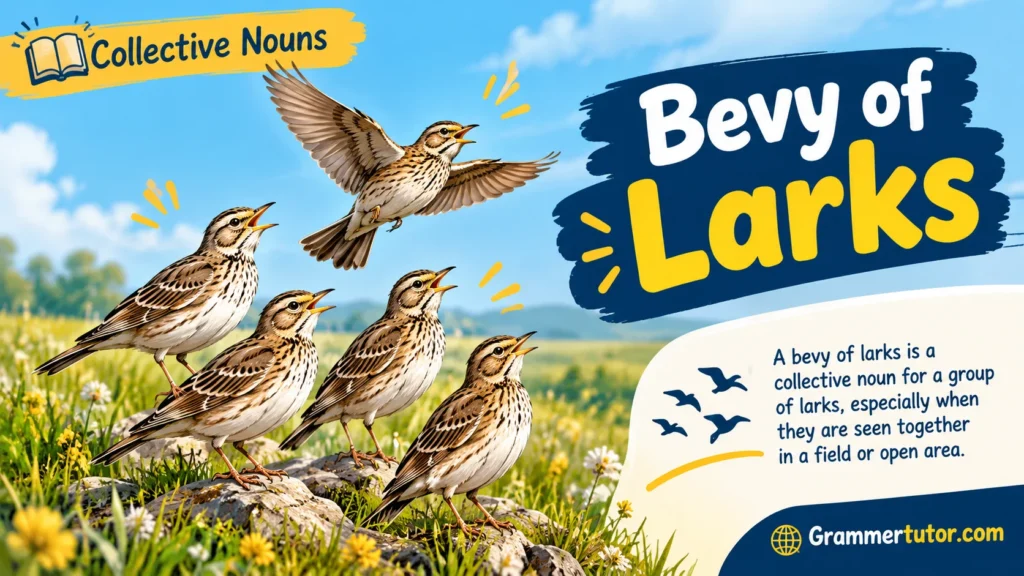
A bevy is a general collective noun that can be used for a group of birds or other creatures gathered together. When applied to larks, it can describe several birds feeding, resting, or moving together.
The term has a softer and more traditional feel, making it suitable for descriptive writing about birds in fields and countryside settings.
Examples of “Bevy of Larks”
- A bevy of larks gathered in the meadow.
- We spotted a bevy of larks near the field.
- The bevy of larks searched for food.
- A bevy of larks moved through the grass.
- The bevy of larks rested near the hedgerow.
- A bevy of larks flew across the farmland.
- The birds formed a bevy near the open field.
- A bevy of larks gathered at sunrise.
- We watched a bevy of larks from a distance.
- The bevy of larks disappeared into the tall grass.
Flock of Larks
A flock is a familiar general term for a group of birds. It can be used when larks are flying, feeding, or moving together.
Unlike the more distinctive exaltation, the word flock is straightforward and easy to understand. It works well in everyday English and general bird descriptions.
Examples of “Flock of Larks”
- A flock of larks flew over the field.
- We saw a flock of larks near the meadow.
- The flock of larks moved across the sky.
- A flock of larks gathered in the grass.
- The flock of larks searched for seeds.
- A flock of larks rose from the farmland.
- The flock of larks flew toward the hills.
- We watched a flock of larks above the field.
- A flock of larks landed near the hedgerow.
- The flock of larks disappeared into the distance.
Company of Larks
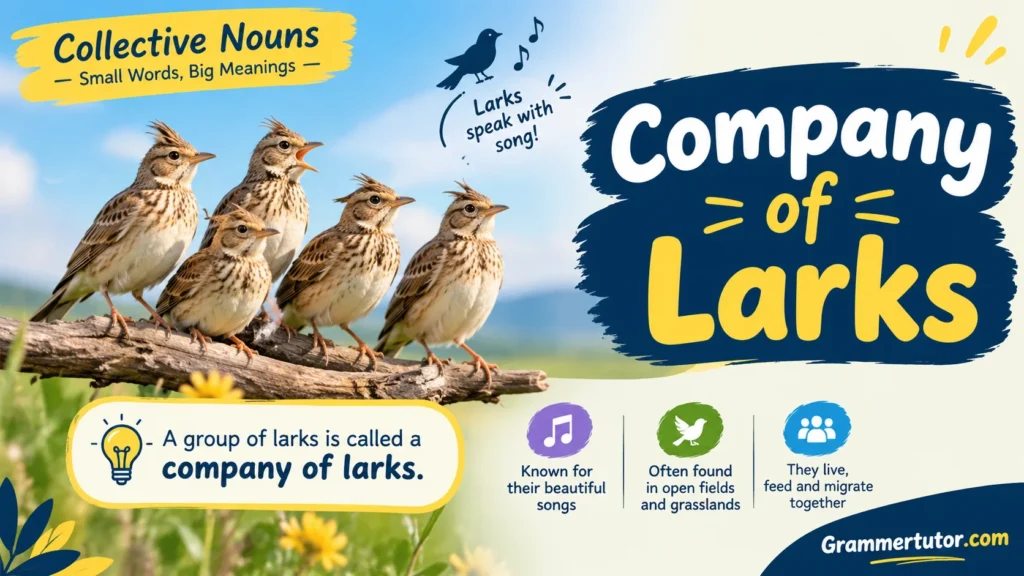
A company can be used as a general descriptive collective noun for a group of larks. It gives the idea of several birds gathered or traveling together.
This expression works particularly well in literary or descriptive writing where the writer wants to give the birds a sense of companionship.
Examples of “Company of Larks”
- A company of larks gathered near the meadow.
- We noticed a company of larks in the field.
- The company of larks searched for food.
- A company of larks flew across the valley.
- The company of larks rested in the grass.
- A company of larks rose into the morning sky.
- The birds formed a company near the hedgerow.
- A company of larks moved across the farmland.
- We watched the company of larks from afar.
- The company of larks returned to the field.
Flight of Larks
A flight of larks emphasizes movement through the air. It can be used when several larks are seen flying together or moving from one area to another.
This expression is especially useful when the focus is on the birds’ movement rather than where they are resting or feeding.
Examples of “Flight of Larks”
- A flight of larks crossed the morning sky.
- We watched a flight of larks above the meadow.
- The flight of larks moved toward the hills.
- A flight of larks rose from the field.
- The flight of larks disappeared beyond the trees.
- A flight of larks flew over the farmland.
- We saw a flight of larks at sunrise.
- The flight of larks moved gracefully through the air.
- A flight of larks passed above the grassland.
- The photographer captured a flight of larks in the sky.
Group of Larks
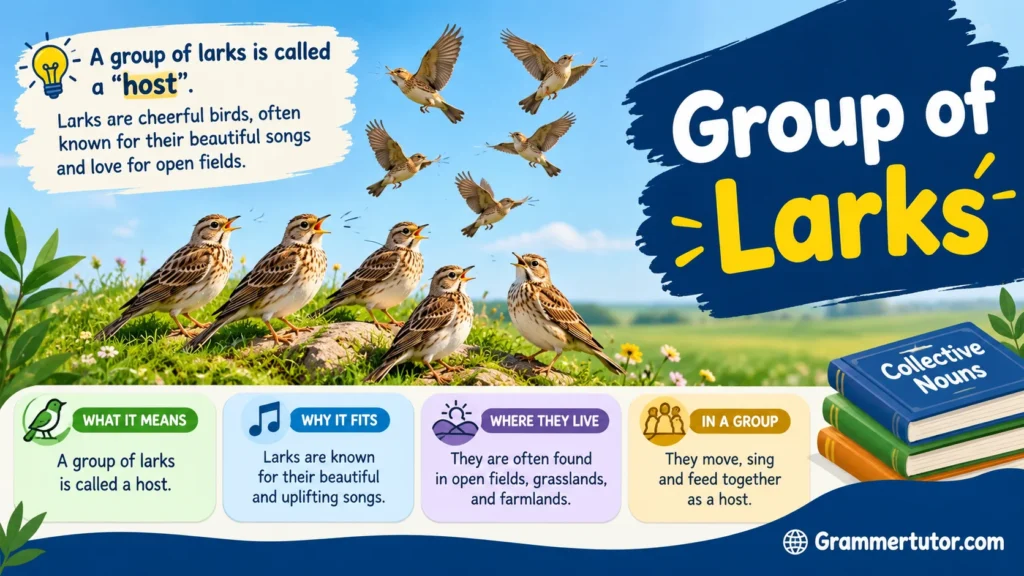
A group of larks is a simple and straightforward expression. Although it isn’t as distinctive as exaltation, it can be used whenever you want to describe several larks together without focusing on a particular behavior.
This expression is especially useful in general conversation and educational writing.
Examples of “Group of Larks”
- A group of larks gathered in the field.
- We saw a group of larks near the meadow.
- The group of larks searched for insects.
- A group of larks flew across the sky.
- The group of larks rested in the grass.
- A group of larks appeared at sunrise.
- The farmer noticed a group of larks.
- A group of larks moved across the field.
- The group of larks disappeared into the distance.
- We watched a group of larks feeding together.
Chime of Larks
A chime of larks is a poetic expression that focuses on the beautiful sounds produced by several singing larks. The word chime creates an image of multiple voices blending together like musical notes.
It can be particularly effective in creative or descriptive writing about a peaceful morning landscape.
Examples of “Chime of Larks”
- A chime of larks filled the morning air.
- We woke to a chime of larks.
- The chime of larks echoed across the meadow.
- A chime of larks sang above the fields.
- The countryside came alive with a chime of larks.
- A chime of larks welcomed the sunrise.
- We listened to the chime of larks from the garden.
- The chime of larks drifted across the farmland.
- A beautiful chime of larks filled the valley.
- The chime of larks made the morning peaceful.
Interesting Facts About Larks
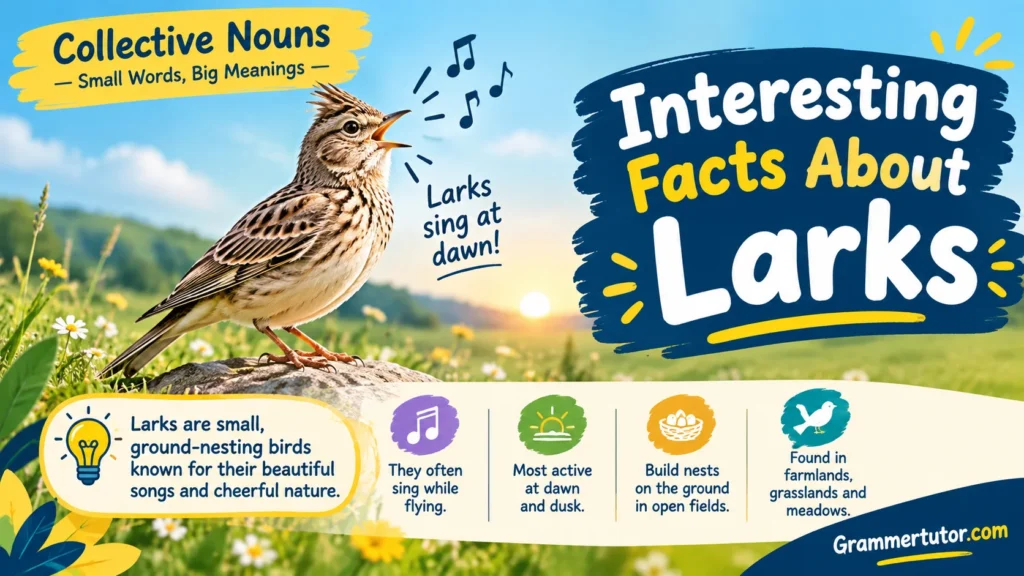
Larks are small songbirds belonging to the family Alaudidae, and they are best known for their impressive vocal abilities. Many lark species live in open habitats such as grasslands, plains, deserts, farmland, and other areas with plenty of open ground. Their lifespan varies by species and environmental conditions, with survival affected by food availability, predators, weather, habitat quality, and other factors. Some larks can live for several years in the wild, although many young birds do not survive their first year.
One of the most remarkable physiological and behavioral features of larks is their ability to sing while flying. Species such as the skylark can rise high above the ground while producing long and complex songs. Their strong flight abilities allow them to remain airborne while singing, creating the familiar impression of a tiny bird filling the sky with sound. Larks also have bodies adapted for life on the ground, with sturdy legs and feet that help them walk and forage across open landscapes.
Larks are generally omnivorous, although much of their diet consists of plant material and seeds. Depending on the species and season, they may eat seeds, grains, grasses, and other plant matter, while insects and other small invertebrates can provide important sources of protein, particularly during the breeding season. Young larks often receive animal-based foods from their parents because developing chicks need nutrient-rich food.
Larks also have interesting nesting habits. Many species build their nests directly on or close to the ground, often using grass and other vegetation to create a concealed structure. This makes camouflage particularly important because ground nests can be vulnerable to predators. Their preference for open habitats and their remarkable songs have made larks familiar and much-loved birds in many regions.
Examples of Lark Facts
- Larks are songbirds.
- Larks belong to the family Alaudidae.
- Many larks live in open habitats.
- Some larks can sing while flying.
- Larks have strong and agile flight abilities.
- Many larks eat seeds and grains.
- Larks can also eat insects and small invertebrates.
- Young larks often need protein-rich food.
- Many larks build nests on or near the ground.
- Larks are famous for their beautiful songs.
READ MORE: Collective Noun for Racehorses: A Complete Guide with Examples
Conclusion
Collective nouns for larks give us useful and colorful ways to talk about these lively birds when they appear in groups. Whether larks are resting on the ground, flying across the sky, or singing over open fields and grasslands, the right group term can make writing clearer and more interesting. Learning these expressions also adds variety to your English vocabulary and helps you describe bird behavior more naturally.
FAQs
Q1. What is a collective noun for larks?
A collective noun is a word or phrase used to describe a group of larks. The expression used can depend on the context in which the birds are being described.
Q2. Why are collective nouns used for larks?
They make it easier to describe several larks together without repeatedly saying “a group of larks.” They can also make nature writing more colorful.
Q3. Are larks usually found in groups?
Larks may be seen alone or in groups, depending on the species, season, and situation. Some gather together when feeding, migrating, or resting.
Q4. What are larks famous for?
Larks are particularly well known for their beautiful songs. Many species are also recognized for singing while flying.
Q5. Where do larks commonly live?
Larks are commonly associated with open fields, grasslands, farmland, and other open habitats where they can feed and build nests.
Q6. Do larks sing while flying?
Yes. Several lark species are known for producing songs during flight, often creating a distinctive sound over their habitat.
Q7. Can collective nouns for larks describe birds in flight?
Yes. A group term can be used when describing several birds flying together, especially when the scene involves birds moving through the sky.
Q8. How can learning lark collective nouns improve English?
Learning these terms can improve your vocabulary by introducing descriptive expressions that are useful in wildlife writing, storytelling, and everyday English.
Q9. Are all collective nouns for larks equally common?
No. Some expressions may be familiar or traditional, while others are less common. Context and regional usage can influence which term a writer chooses.
Q10. Why are larks interesting birds to describe?
Their fascinating bird behavior, lively movements, and distinctive singing make them especially interesting subjects for nature writing. Using descriptive language can make these scenes more memorable.