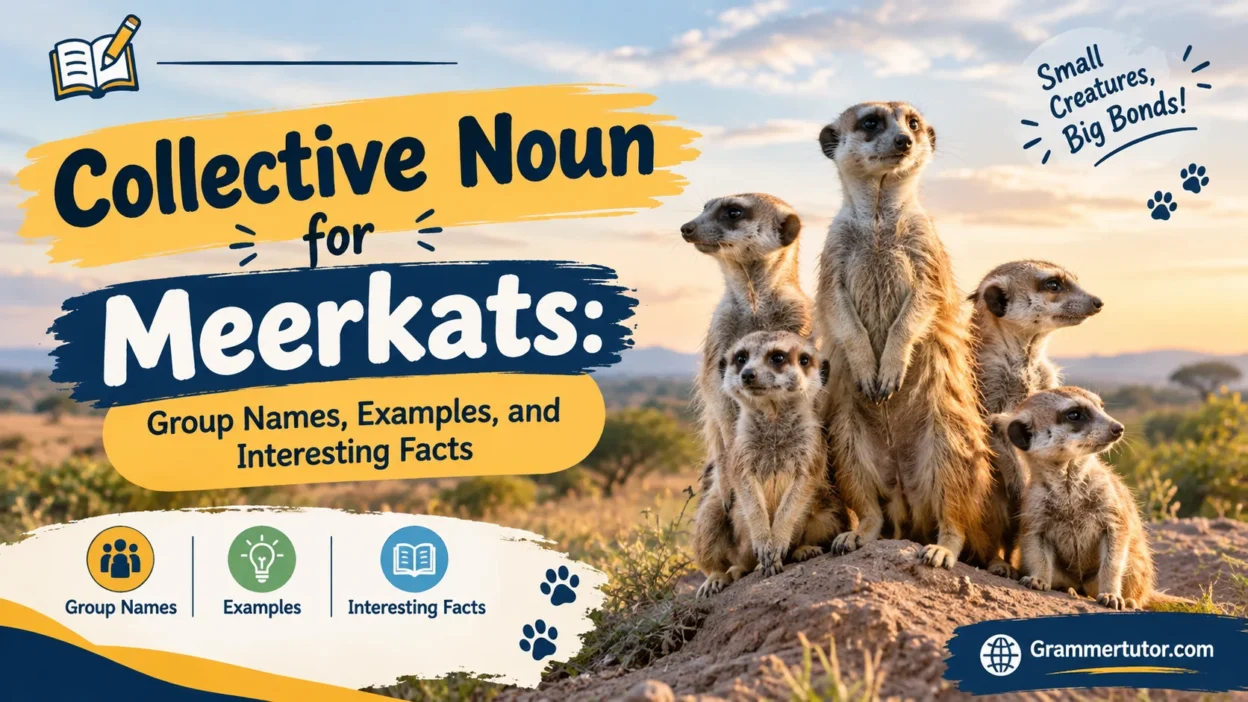
A mob of meerkats is the most commonly recognized collective noun for these small, social mammals. Meerkats are famous for standing upright and watching their surroundings while others search for food or stay near their underground burrows. When I explain this term, I find that thinking of a meerkat group as one unit makes the idea easier to understand. Their habit of working together shows why a collective noun is useful when describing how these animals live.
Other expressions include a gang of meerkats and a clan of meerkats, particularly when referring to their close social groups and social life. These terms can make descriptions of meerkat behavior more vivid and specific. The animals interact closely, and their way of living together is one of the most fascinating things about them. Discovering these group names can be a fun way of learning and improving English vocabulary.
For students, writers, and wildlife enthusiasts, understanding collective nouns is useful because it gives a more expressive term than repeatedly saying “group of meerkats.” In my experience, using the right term makes writing sound more natural and shows that you are interested in wildlife and the English language. The word reflects how the animals live together, making a simple description more engaging while improving your knowledge of English.
Why Do We Use Collective Nouns for Meerkats?
Meerkats are highly social animals that usually live in organized groups. They cooperate while searching for food, watching for predators, caring for young, and maintaining their burrows.
Because these animals spend much of their lives together, a collective noun gives us a convenient way to describe them as a single social unit. A mob of meerkats is a particularly interesting expression because it reflects the lively and active nature of these groups.
Other words, including gang and clan, can also describe groups of meerkats depending on the context. Knowing these expressions can make wildlife descriptions more engaging and help learners understand how collective nouns work in English.
Collective Nouns for Meerkats
| Collective Noun | Used For | Simple Example |
| Mob | A group of meerkats | A mob of meerkats stood near the burrow. |
| Gang | A social group of meerkats | A gang of meerkats searched for food. |
| Clan | A close social group | A clan of meerkats lived together. |
| Group | A general group | A group of meerkats crossed the sand. |
| Colony | A larger community or population | A colony of meerkats occupied the area. |
Mob of Meerkats
Mob is the best-known collective noun associated with meerkats. Meerkats live in cooperative social groups, and members often perform different tasks that help the entire group survive.
A mob may spend time searching for food, looking after young meerkats, grooming one another, and keeping watch for predators. Their cooperative lifestyle makes this collective expression especially interesting.
Examples of “Mob of Meerkats”
- A mob of meerkats gathered near the burrow.
- We watched a mob of meerkats searching for food.
- The mob of meerkats stood alert in the sunlight.
- A mob of meerkats crossed the sandy ground.
- The photographer captured a mob of meerkats together.
- A mob of meerkats disappeared into the burrow.
- The mob of meerkats looked for insects nearby.
- We saw a mob of meerkats outside their den.
- A mob of meerkats worked together to find food.
- The mob of meerkats quickly returned to the shelter.
Gang of Meerkats
Gang can be used as an informal collective expression for a group of meerkats. It fits their energetic and cooperative behavior, particularly when several animals are moving or exploring together.
Although mob is the more familiar collective noun, gang can be useful in informal descriptions and creative wildlife writing.
Examples of “Gang of Meerkats”
- A gang of meerkats searched the ground for insects.
- We spotted a gang of meerkats near the rocks.
- The gang of meerkats moved away from the burrow.
- A gang of meerkats stood together on the hill.
- The children watched a gang of meerkats at the zoo.
- A gang of meerkats explored the sandy area.
- The gang of meerkats returned to their den.
- We photographed a gang of meerkats in the morning.
- A gang of meerkats gathered around the entrance.
- The gang of meerkats stayed close to one another.
Clan of Meerkats
Clan is a useful term for emphasizing the close social relationship among meerkats. Meerkats live in cooperative communities in which individuals interact frequently and work together.
The word clan highlights the idea of a connected social group rather than simply a collection of individual animals.
Examples of “Clan of Meerkats”
- A clan of meerkats lived in the desert.
- The clan of meerkats shared the same burrow system.
- We observed a clan of meerkats near their den.
- A clan of meerkats searched for food together.
- The clan of meerkats protected the young animals.
- A clan of meerkats gathered outside the burrow.
- The researchers studied a clan of meerkats.
- A clan of meerkats moved across the sandy ground.
- The clan of meerkats remained close to its shelter.
- We watched a clan of meerkats communicate with one another.
Group of Meerkats
Group of meerkats is a straightforward general expression. It does not have the distinctive character of mob, but it is easy to understand and can be used whenever you do not need a specialized collective noun.
This expression works well in everyday writing, school assignments, and general descriptions of wildlife.
Examples of “Group of Meerkats”
- A group of meerkats stood near the burrow.
- We saw a group of meerkats in the enclosure.
- A group of meerkats searched for food.
- The group of meerkats moved across the sand.
- A group of meerkats rested beside the rocks.
- We photographed a group of meerkats at the zoo.
- The group of meerkats entered the burrow.
- A group of meerkats watched the surrounding area.
- The group of meerkats stayed together.
- A group of meerkats appeared near the entrance.
Colony of Meerkats
Colony can be used as a broader term when discussing a population or community of meerkats living in the same general area. It is less specific than mob when describing their usual social group.
A colony may include interconnected burrows and meerkats occupying a particular territory, making the term useful in broader wildlife discussions.
Examples of “Colony of Meerkats”
- A colony of meerkats lived in the dry region.
- Researchers observed a colony of meerkats.
- The colony of meerkats occupied several burrows.
- A colony of meerkats searched for food together.
- The wildlife team studied a colony of meerkats.
- A colony of meerkats lived near the rocky landscape.
- The colony of meerkats moved between different burrows.
- We learned about a colony of meerkats at the wildlife center.
- A colony of meerkats depended on cooperation for survival.
- The colony of meerkats remained active throughout the day.
Meerkat Behavior and Lifestyle
Meerkats are known for their remarkable cooperation. They live in social groups and often share responsibilities. While some members search for food, another meerkat may stand upright and act as a sentinel, watching for danger. If a predator approaches, the lookout can give an alarm call to warn the others.
Their underground burrows provide protection from extreme temperatures and predators. Meerkats may spend considerable time underground and use interconnected tunnels and chambers. They also groom one another, play together, and communicate using different sounds and body movements.
Meerkats are mainly insectivorous, although their diet can include other foods. They may eat insects, spiders, scorpions, small reptiles, eggs, and other available food. Their ability to work together and remain alert helps them survive in the challenging environments where they live.
Examples of Meerkat Behavior
- Meerkats often live in social groups.
- A sentinel watches for approaching predators.
- Meerkats communicate using different calls.
- They spend time inside underground burrows.
- Meerkats often search for food during the day.
- They can eat insects and other small animals.
- Group members may help care for the young.
- Meerkats groom one another.
- They use burrows for shelter and protection.
- Cooperation is important to meerkat survival.
Interesting Facts About Meerkats
Meerkats are fascinating mammals with adaptations suited to their often hot and dry environments. Their lifespan can vary depending on habitat, food availability, predators, disease, and other conditions. In favorable circumstances, meerkats can live for several years, while individuals under human care may sometimes survive longer.
One of their most recognizable physiological features is their ability to stand upright on their hind legs. This behavior allows them to look across their surroundings and search for potential danger. Their dark markings around the eyes can also help reduce the effects of bright sunlight, which is useful when they are active in open, sunny habitats.
Meerkats have strong front claws that help them dig through soil while searching for food and constructing or maintaining burrows. Their burrows provide valuable shelter from heat, cold, and predators. Their slim bodies and specialized digging abilities make them well suited to their underground lifestyle.
Their diet is another interesting part of their biology. Meerkats primarily eat insects and other small creatures, including spiders and scorpions. They can also consume small reptiles, eggs, and other available foods. Their food choices can change according to what is available in their environment.
Perhaps the most remarkable feature of meerkats is their cooperative social behavior. Members of a group can take on different roles, including guarding the surroundings, searching for food, and caring for the young. This cooperation helps explain why collective nouns are useful when talking about these highly social animals.
READ MORE: Collective Noun for Beavers: Group Names, Examples, and Interesting Facts
Conclusion
The collective noun for meerkats is most commonly a mob of meerkats. Other terms, such as a gang or a clan, can also describe these social animals. Knowing these collective nouns makes your English more varied and helps you describe the close, cooperative life of meerkats clearly.
FAQs
Q1. What is the collective noun for meerkats?
The most commonly recognized collective noun for meerkats is a mob of meerkats.
Q2. Can you say “a mob of meerkats”?
Yes. A mob of meerkats is a widely used term for a group of these social animals.
Q3. What are other collective nouns for meerkats?
Other terms include a gang of meerkats and a clan of meerkats.
Q4. Why are meerkats called a mob?
The term mob describes meerkats when they live and move together as a social group.
Q5. Are meerkats social animals?
Yes. Meerkats are highly social mammals that cooperate and interact closely with one another.
Q6. What do meerkats do as a group?
They often work together to search for food, watch for danger, care for young, and protect their group.
Q7. Where do meerkats live?
Meerkats commonly live in underground burrows, which provide shelter and protection.
Q8. Can “clan” be used for meerkats?
Yes. A clan of meerkats can be used to describe their close social group.
Q9. Why should I learn collective nouns for animals?
Learning collective nouns can improve vocabulary and make your English writing and descriptions more expressive.
Q10. What is the best term to use for a group of meerkats?
A mob of meerkats is the best-known and most commonly recognized collective noun.